Painter of the Bible
Gerrit van Honthorst
Gerrit van Honthorst — called Gherardo delle Notti (Gerard of the Nights) by his Italian patrons for his specialty in candlelit nocturnal scenes — was a leading Dutch painter of the seventeenth century and the principal …

Their faith
Why Gerrit van Honthorst painted Christ
Gerrit van Honthorst, a prominent Dutch painter of the seventeenth century, was deeply influenced by his Christian faith, which is evident in his remarkable body of religious work. Born in Utrecht in 1592, he trained under Abraham Bloemaert and later traveled to Italy, where he honed his craft under the patronage of Vincenzo Giustiniani, a significant figure in the Caravaggio circle. Van Honthorst's devotion to his faith is reflected in the candlelit nocturnal scenes he created, such as 'The Adoration of the Shepherds' and 'Christ before the High Priest.' These works not only showcase his technical mastery but also reveal a profound reverence for the sacred narratives of scripture, suggesting that he approached his art as a form of worship and devotion to God.
The spiritual vision that van Honthorst expressed through his paintings is characterized by the dramatic use of light and shadow, which serves to highlight the emotional depth of the biblical scenes he portrayed. In 'The Adoration of the Shepherds,' for instance, the soft glow of candlelight envelops the figures, creating an intimate atmosphere that draws viewers into the moment of Christ's birth. Similarly, 'Christ before the High Priest' captures the tension and gravity of the scene with its striking chiaroscuro. Through these masterpieces, van Honthorst invites us to reflect on the divine mysteries of faith and the transformative power of Christ's presence. His artistic legacy continues to inspire and uplift viewers today, reminding us of the beauty and significance of the sacred stories that shape our spiritual lives.
Life & work
Gerrit van Honthorst — called Gherardo delle Notti (Gerard of the Nights) by his Italian patrons for his specialty in candlelit nocturnal scenes — was a leading Dutch painter of the seventeenth century and the principal Utrecht-based exponent of the Caravaggesque manner that a small group of Utrecht painters had absorbed during their study trips to Rome in the 1610s. Born in Utrecht in 1592, trained in his native city in the workshop of Abraham Bloemaert, and traveling to Italy around 1615 (where he worked for some years in Rome under the patronage of Vincenzo Giustiniani — Caravaggio's principal Roman patron — and absorbed the Caravaggesque chiaroscuro at the source), he returned to Utrecht around 1620 and worked there for the rest of his life with intermittent court appointments in England (1628 under Charles I), Denmark (1635–1638), and the Hague (1637 onward). He died in Utrecht in 1656.
His Christian religious work is concentrated in candlelit nocturnal scenes — the Adoration of the Shepherds, the Adoration of the Christ Child, the Christ before the High Priest, the Liberation of Saint Peter — in which the dramatic single-source candlelight defines the entire pictorial composition. The Adoration of the Shepherds (Wallraf-Richartz Museum, Cologne, c. 1622), the Christ before the High Priest (London, c. 1617), the Beheading of Saint John the Baptist (Santa Maria della Scala, Rome, 1618), and the Christ Crowned with Thorns (Madrid) anchor the religious painted corpus.
His Italian-period altarpieces in particular — produced for Roman churches and aristocratic patrons during his Italian residence between roughly 1615 and 1620 — are among the supreme Northern Caravaggesque achievements and were widely admired by his Roman contemporaries. The Christ before the High Priest in London is widely held to be one of the finest Caravaggesque candlelit scenes by any Northern artist.
After his return to the Netherlands he turned increasingly toward portraiture for the Dutch and English courts, producing a long sequence of state portraits that established his reputation as the leading Northern Caravaggesque-into-court-portraiture transitional figure. His Utrecht workshop trained the next generation of Dutch painters who would absorb the Caravaggesque manner — including, briefly, the young Rembrandt's older Leiden contemporary Jan Lievens.
Notable works in detail
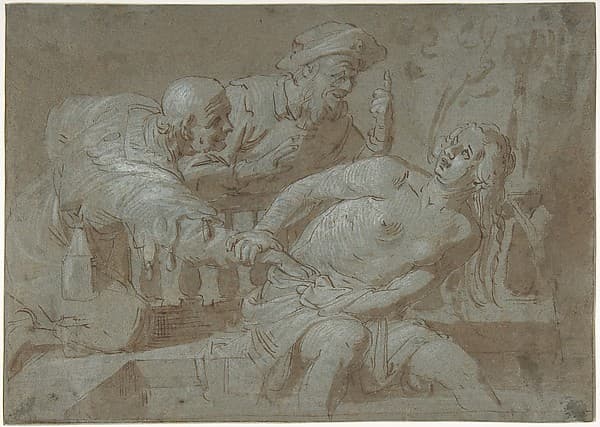
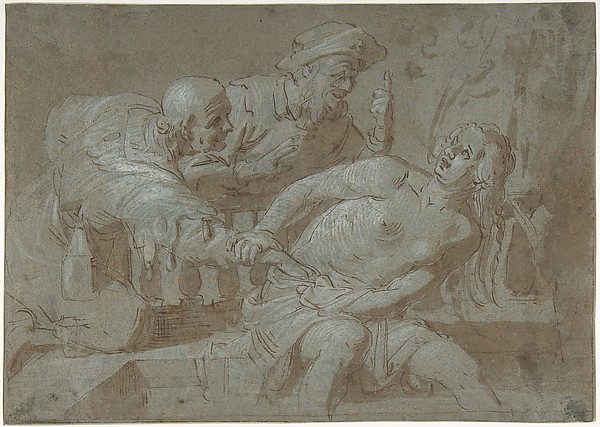
Susanna and the Elders, painted by Gerrit van Honthorst around 1620 in oil on canvas during his late Italian years in Rome and now in the Metropolitan Museum of Art in New York, illustrates the deuterocanonical narrative from Daniel 13 in which the chaste Susanna is spied upon while bathing by two elders of her community who later attempt to extort her into adultery and, when she refuses, falsely accuse her of the crime themselves. Honthorst stages the scene with characteristic Caravaggesque compositional drama: Susanna in the foreground partially undressed beside her bath, the two elders in the bushes at the lower left looking on, the dramatic single-source candlelit chiaroscuro defining the entire composition. The painting belongs to the late Italian-period Honthorst output that earned him the Italian nickname Gherardo delle Notti (Gerard of the Nights) for his specialty in candlelit nocturnal scenes.
Bible scenes Gerrit van Honthorst painted
Daniel