Painter of the Bible
Lucas Cranach the Younger
Lucas Cranach the Younger was the son and principal heir of Lucas Cranach the Elder, the great Wittenberg court painter and visual partner of the Lutheran Reformation.
.jpg%3Fwidth%3D600&w=2048&q=75)
Their faith
Why Lucas Cranach the Younger painted Christ
Lucas Cranach the Younger was deeply rooted in the Lutheran faith, a legacy of his father, Lucas Cranach the Elder, who was a pivotal figure in the Protestant Reformation. Growing up in Wittenberg, he was immersed in a culture that celebrated the teachings of Martin Luther and the principles of the Reformation. Cranach the Younger inherited not only his father's workshop but also his commitment to creating art that reflected Lutheran theology. His works often served a dual purpose: they were both artistic expressions and tools for teaching the faith. The altarpieces and devotional panels he created were imbued with a sense of reverence and devotion, reflecting his understanding of scripture and the importance of Christ's message in the lives of believers.
Cranach the Younger's faith profoundly influenced his artistic output, particularly in pieces like the Last Supper altarpiece, which beautifully encapsulates the central tenets of Lutheran belief. This work features a depiction of Luther preaching to a congregation, emphasizing the significance of the Lord's Supper within the faith community. His Crucifixion altarpieces, often showing the reformers at the foot of the cross, highlight the importance of grace and redemption in Lutheran doctrine. Through his art, Cranach the Younger not only continued his father's legacy but also contributed to the visual language of the Reformation, inviting viewers to engage with the profound mysteries of faith. His devotion continues to resonate today, reminding us of the enduring power of Christ's message through the beauty of sacred art.
Life & work
Lucas Cranach the Younger was the son and principal heir of Lucas Cranach the Elder, the great Wittenberg court painter and visual partner of the Lutheran Reformation. Born in Wittenberg in 1515 to Lucas the Elder and Barbara Brengbier, trained in his father's vast workshop from his youth, and serving as principal workshop assistant to his father from his late teens, he inherited the workshop on his father's death in 1553 and continued it almost without break until his own death in Wittenberg in 1586.
His Christian religious work is concentrated in altarpieces and devotional panels produced in the standard Wittenberg-Cranach workshop format inherited from his father. The Last Supper altarpiece in the Town Church of Wittenberg (1565 — the predella shows Luther preaching from a pulpit to a Lutheran congregation, with the supper scene above and the central panel showing the institution of the Lord's Supper), the Crucifixion altarpieces in numerous Saxon and Thuringian Lutheran churches, the Adam and Eve compositions in workshop variants of his father's earlier types, the Christ Blessing the Children compositions (a particular Lutheran devotional preference for the small intimate Gospel-narrative subject), and the great series of Lutheran electoral and theological portraits (Luther, Melanchthon, the Saxon electors, the Wittenberg University faculty) anchor the painted corpus.
His personal style is closely modeled on his father's late workshop manner — figures in slim elongated proportions, careful chromatic discipline, soft sfumato modeling, and a deliberate visual emphasis on Lutheran theological clarity — and the workshop hand of father and son is often hard to distinguish on individual surviving panels. The supreme Cranach Lutheran iconographic types — the Adam and Eve, the Crucifixion with the Lutheran reformer at the foot of the cross, the Law and Grace allegories — were created by the elder Cranach but largely propagated through the European Reformation publishing market by the younger.
He served as mayor of Wittenberg in his late years and was a wealthy and respected citizen of the city through the consolidation of Lutheran political and religious authority across Saxony in the second half of the sixteenth century. He is buried in the Wittenberg Town Church beside his father.
Notable works in detail
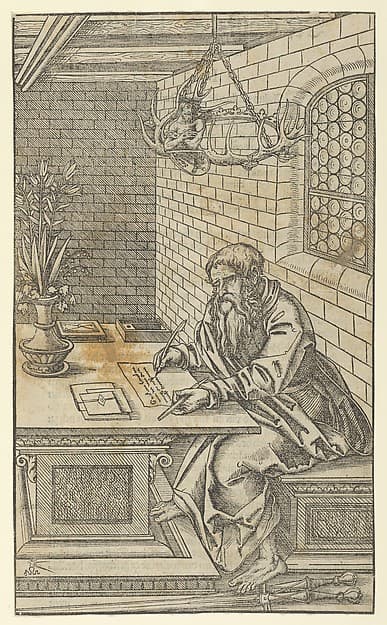
Paul, from "The Four Evangelists and Three Apostles Sitting in Rooms"
Paul, from The Four Evangelists and Three Apostles series of woodcuts produced by Lucas Cranach the Younger and the Wittenberg workshop in the early sixteenth century, depicts the apostle in the conventional iconographic posture of his apostolic teaching — standing in three-quarter view holding a small book and a sword (the iconographic attributes of his apostolic writing and his eventual martyrdom by beheading). Cranach the Younger composes the figure with the characteristic Wittenberg-Cranach workshop signature: slim elongated proportions, careful chromatic discipline (in the printed-line context, this means precise crosshatched modeling), and a deliberate visual emphasis on Lutheran theological clarity. The print belongs to the standard Lutheran devotional output of the Wittenberg-Cranach workshop and circulated through the German Reformation publishing market for several decades.
Bible scenes Lucas Cranach the Younger painted
Romans