1 Kings 8
People in this chapter
Solomon has spent seven years building the Temple. The materials are gathered, the craftsmen have labored, the stone and gold and cedar have been shaped into a house more magnificent than any on earth. And now, at last, the dedication. All Israel assembles - the elders, the heads of the tribes, the chiefs of the fathers. They have come to witness the moment when the dwelling place of God is consecrated.
Tap any highlighted phrase to jump to the commentary that unpacks it.
1 Kings 8:1-11The Ark Brought Into the Temple
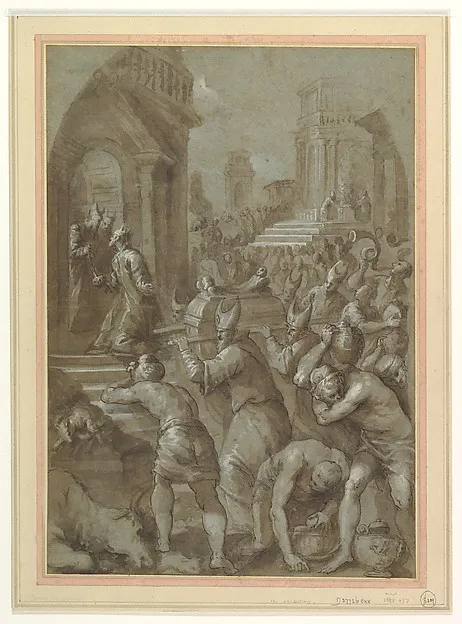
1Then Solomon assembled the elders of Israel, and all the heads of the tribes, the chief of the fathers of the children of Israel, unto king Solomon in Jerusalem, that they might bring up the ark of the covenant of the LORD out of the city of David, which is Zion. 2And all the men of Israel assembled themselves unto king Solomon at the feast in the month Ethanim, which is the seventh month. 3And all the elders of Israel came, and the priests took up the ark. 4And they brought up the ark of the LORD, and the tabernacle of the congregation, and all the holy vessels that were in the tabernacle, even those did the priests and the Levites bring up. 5And king Solomon, and all the congregation of Israel, that were assembled unto him, were with him before the ark, sacrificing sheep and oxen, that could not be told nor numbered for multitude.
All Israel gathers, unified. The elders, the heads of the tribes, the chiefs of the fathers. This is a moment of national assembly. The feast is in the seventh month, Ethanim, the month of ingathering. The entire people has come together to witness what Solomon is about to do.123
The sacrifices are beyond counting. So many sheep and oxen that the scribes cannot keep track. The sheer abundance of the offering reflects the magnitude of the moment. The whole people, through their king, offer sacrifice on a scale that overwhelms the ability to measure.
6And the priests brought in the ark of the covenant of the LORD unto his place, into the oracle of the house, to the most holy place, even under the wings of the cherubims. 7For the cherubims spread forth their two wings over the place of the ark, and the cherubims covered the ark and the staves thereof above. 8And they drew out the staves, that the ends of the staves were seen out in the holy place before the oracle, and they were not seen without: and there they are unto this day. 9There was nothing in the ark save the two tables of stone, which Moses put there at Horeb, when the LORD made a covenant with the children of Israel, when they came out of the land of Egypt.
The cherubims spread their wings over the ark - the same posture as in the tabernacle of old. These are not merely decorative. In Jewish tradition, the space between the wings of the cherubims is understood as the mercy seat, the place where God's presence dwelt in a unique and concentrated way. The ark itself contains only the two tablets of stone: the covenant. Everything else has passed away. What remains is the word of God.
10And it came to pass, when the priests were come out of the holy place, that the cloud filled the house of the LORD, 11So that the priests could not stand to minister because of the cloud: for the glory of the LORD had filled the house of the LORD.
The cloud descends. This is the same cloud that filled the tabernacle at Mount Sinai (Exodus 40:34-35), the same shekinah that hovered over the wilderness camp, the visible sign of God's presence. The priests - whose role is to serve - find they cannot stand. The glory is too great. The presence of God is so overwhelming, so manifest, that the very function of priesthood becomes impossible: what they are witnessing transcends the work they were meant to do.
1 Kings 8:12-21Solomon's Blessing and Testament
12Then spake Solomon, The LORD said that he would dwell in the thick darkness. 13I have surely built thee an house to dwell in, a settled place for thee to abide in for ever.
Solomon begins with a theology of God's transcendence. The Lord dwells in thick darkness, in a place inaccessible and beyond the ordinary. This echoes the revelation at Sinai, where God spoke from the cloud and the mountain was wrapped in smoke. God is not transparent. God is not reducible to human understanding. Yet this God of inaccessible darkness has chosen to dwell in a house - a settled place, an abode.
14And the king turned his face about, and blessed all the congregation of Israel: (and all the congregation of Israel stood;) 15And he said, Blessed be the LORD God of Israel, which spake with his mouth unto David my father, and hath with his hand fulfilled it, saying, 16Since the day that I brought forth my people Israel out of Egypt, I chose no city out of all the tribes of Israel to build an house, that my name might be therein; but I chose David to be over my people Israel.
Solomon turns from the altar to face the whole assembly of Israel and blesses them as they stand. He praises the LORD, who has fulfilled with His own hand the promise He spoke to David: since bringing Israel out of Egypt God chose no city for a house to bear His name, but chose David to lead His people.
17And it was in the heart of David my father to build an house for the name of the LORD God of Israel. 18And the LORD said unto David my father, Whereas it was in thine heart to build an house unto my name, thou didst well that it was in thine heart. 19Nevertheless thou shalt not build the house; but thy son that shall come forth out of thy loins, he shall build the house unto my name. 20And the LORD hath performed his word that he spake, and I am risen up in the room of David my father, and sit on the throne of Israel, as the LORD promised, and have built an house for the name of the LORD God of Israel.
Solomon turns to bless the people. He recounts the covenant promise: that God spoke to David, that David longed to build a house, that God said no - the work would go to his son. And now that son stands before them, and the promise is fulfilled. Every word the Lord spoke has come true. This is Solomon's moment of witness: the promise made to David is now embodied in stone and gold and cedar.
1 Kings 8:22-30The Theology of God's Transcendence
22And Solomon stood before the altar of the LORD in the presence of all the congregation of Israel, and spread forth his hands toward heaven: 23And he said, LORD God of Israel, there is no God like thee, in heaven above, or on earth beneath, who keepest covenant and mercy with thy servants that walk before thee with all their heart:
Solomon stands before the altar, hands spread toward heaven. This is the posture of intercession. He opens with a confession: there is no God like you - utterly unique, in a category of His own. This God keeps covenant. This God shows mercy to those who walk before Him with all their hearts. The prayer opens with adoration.
24Who hast kept with thy servant David my father that thou promisedst him: thou spakest also with thy mouth, and hast fulfilled it with thine hand, as it is this day. 25Therefore now, LORD God of Israel, keep with thy servant David my father that thou promisedst him, saying, There shall not fail thee a man in my sight to sit on the throne of Israel; so that thy children take heed to their way, that they walk before me as thou hast walked before me. 26And now, O God of Israel, let thy word, I pray thee, be verified, which thou spakest unto thy servant David my father.
Solomon moves from adoration to petition. He asks God to keep the covenant promises made to David - that there shall never fail a man on the throne of Israel. But he adds a condition: "so that thy children take heed to their way, that they walk before me as thou hast walked before me." The covenant is conditional. The dynasty will endure if the people obey God.
27But will God indeed dwell on the earth? behold, the heaven and heaven of heavens cannot contain thee; how much less this house that I have builded?
Here is Solomon's greatest theological insight. He has just built the most magnificent Temple on earth. But in this moment of dedication, he asks a question that relativizes all he has built: "Will God indeed dwell on the earth? Behold, the heaven and heaven of heavens cannot contain thee; how much less this house that I have builded?" The vastness of the universe cannot contain God. The highest heaven cannot hold Him. And yet - He chooses to dwell in this house, choosing to make His presence manifest here by His own will.
God chooses to be found in the house.
28Yet have thou respect unto the prayer of thy servant, and to his supplication, O LORD my God, to hearken unto the cry and to the prayer, which thy servant prayeth before thee to day: 29That thine eyes may be open toward this house night and day, even toward the place of which thou hast said, My name shall be there: that thou mayest hearken unto the prayer which thy servant shall make toward this place. 30And hearken thou to the supplication of thy servant, and of thy people Israel, when they shall pray toward this place: and hear thou in heaven thy dwelling place: and when thou hearest, forgive.
Solomon asks God to keep His eyes open toward the Temple "night and day." He asks God to hear the prayers made toward this place. And he adds the key understanding: "hear thou in heaven thy dwelling place" - God's true dwelling place is heaven. The Temple is a place where prayers are made, a place where God has said His name shall be. But God dwells in heaven. This house is where the people turn when they cry out. This is where God has chosen to be found.
1 Kings 8:31-53The Prayer of Dedication
Solomon's prayer spans the full range of human need. It covers drought and famine, defeat in battle, plague and pestilence, the exile of the people and their return. This is a prayer that anticipates every way a people might fail, every way they might be brought low, every way they might need to call upon God. Solomon prays as if he is already seeing the future - a future in which Israel will sin, will be defeated, will be taken into captivity. And his prayer asks God to hear them even then.
31If any man trespass against his neighbour, and an oath be laid upon him to cause him to swear, and the oath come before thine altar in this house: 32Then hear thou in heaven, and do, and judge thy servants, condemning the wicked, to bring his way upon his head; and justifying the righteous, to give him according to his righteousness.
33When thy people Israel be smitten down before the enemy, because they have sinned against thee, and shall turn again to thee, and confess thy name, and pray, and make supplication unto thee in this house: 34Then hear thou in heaven, and forgive the sin of thy people Israel, and bring them again unto the land which thou gavest unto their fathers.
Solomon prays for the moment when Israel will be defeated in battle - and he knows it will come. He also knows something crucial: "If they shall turn again to thee, and confess thy name, and pray...then hear thou in heaven, and forgive." Repentance opens the door to forgiveness. This prayer assumes failure and points to the way back: turning, confessing, praying.
35When heaven is shut up, and there is no rain, because they have sinned against thee; if they pray toward this place, and confess thy name, and turn from their sin, when thou afflictest them: 36Then hear thou in heaven, and forgive the sin of thy servants, and of thy people Israel, that thou teach them the good way wherein they should walk, and give rain upon thy land, which thou hast given to thy people for an inheritance.
37If there be in the land famine, if there be pestilence, blasting, mildew, locust, or if there be caterpiller; if their enemy besiege them in the land of their cities; whatsoever plague, whatsoever sickness there be; 38What prayer and supplication soever be made by any man, or by all thy people Israel, which shall know every man the plague of his own heart, and spread forth his hands toward this house: 39Then hear thou in heaven thy dwelling place, and forgive, and do, and give to every man according to his ways, whose heart thou knowest; (for thou, even thou only, knowest the hearts of all the children of men;)
Solomon names all the griefs a nation can suffer: famine, pestilence, blight, mildew, locusts, siege, every plague and sickness. And to each, he adds the same response: if they pray toward this place, confess their sin, and turn from it, then God will hear and forgive. The Temple becomes a house of mercy for every kind of human suffering. The prayers made here belong to those who "know every man the plague of his own heart" - those who have felt the weight of their own failure and cry out for forgiveness.
41Moreover concerning a stranger, that is not of thy people Israel, but cometh out of a far country for thy name’s sake; 42(For they shall hear of thy great name, and of thy strong hand, and of thy stretched out arm;) when he shall come and pray toward this house; 43Hear thou in heaven thy dwelling place, and do according to all that the stranger calleth to thee for: that all people of the earth may know thy name, to fear thee, as do thy people Israel; and that they may know that this house, which I have builded, is called by thy name.
Here is one of the most extraordinary moments in Solomon's prayer. He prays for "the stranger that is not of thy people Israel, but cometh out of a far country for thy name's sake." The Temple, he says, opens to the foreigner who has heard of God's great name and come seeking; that person shall also be heard. "That all people of the earth may know thy name, to fear thee." The Temple is a house where all nations may come and find God, a vision of universal mission embedded in the very moment of dedication.
1 Kings 8:54-66The Blessing and the Feast
54And it was so, that when Solomon had made an end of praying all this prayer and supplication unto the LORD, he arose from before the altar of the LORD, from kneeling on his knees with his hands spread up to heaven. 55And he stood, and blessed all the congregation of Israel with a loud voice, saying, 56Blessed be the LORD, that hath given rest unto his people Israel, according to all that he promised: there hath not failed one word of all his good promise, which he promised by the hand of Moses his servant.
Solomon rises from his knees and blesses the people. His blessing is a confession: "There hath not failed one word of all his good promise." Every word spoken by God through Moses has been fulfilled. The people have been brought into the land. The Temple has been built. Rest has been given. This blessing is testimony to what God has already done.
57The LORD our God be with us, as he was with our fathers: let him not leave us, nor forsake us: 58That he may incline our hearts unto him, to walk in all his ways, and to keep his commandments, and his statutes, and his judgments, which he commanded our fathers. 59And let these my words, wherewith I have made supplication before the LORD, be nigh unto the LORD our God day and night, that he maintain the cause of his servant, and the cause of his people Israel at all times, as the matter shall require: 60That all the people of the earth may know that the LORD is God, and that there is none else.
Solomon's final words draw the blessing inward, to the hearts of the people. He asks God to "incline our hearts unto him" - to turn the people's affection toward God, to make them walk in His ways. The blessing is not only that God will be with them, but that they will be inclined to want His presence, to keep His commandments, to walk in His statutes. And he prays that "all the people of the earth may know that the Lord is God, and that there is none else."
The dedication of the Temple becomes a witness to all nations.
62And the king, and all Israel with him, offered sacrifice before the LORD. 63And Solomon offered a sacrifice of peace offerings, which he offered unto the LORD, two and twenty thousand oxen, and an hundred and twenty thousand sheep. So the king and all the children of Israel dedicated the house of the LORD.
The sacrifices offered are staggering: 22,000 oxen and 120,000 sheep. The sheer scale suggests that Solomon has made the Temple's dedication a national event of unprecedented magnitude. Every person brings something. Every family has a part in the offering. The dedication is a corporate act of the whole people, a royal ceremony that draws the entire nation in.
64The same day did the king hallow the middle of the court that was before the house of the LORD: for there he offered burnt offerings, and meat offerings, and the fat of the peace offerings: because the brasen altar that was before the LORD was too little to receive the burnt offerings, and meat offerings, and the fat of the peace offerings. 65And at that time Solomon held a feast, and all Israel with him, a great congregation, from the entering in of Hamath unto the river of Egypt, before the LORD our God, seven days and seven days, even fourteen days. 66On the eighth day he sent the people away: and they blessed the king, and went unto their tents joyful and glad of heart for all the goodness that the LORD had done for David his servant, and for Israel his people.
The feast lasts fourteen days - seven days for the dedication of the altar, and seven more days. The number fourteen is significant: seven is the number of completion, of rest. Fourteen is completion doubled. The celebration is sustained, expansive, overflowing with joy. And on the eighth day, a new beginning, Solomon sends the people away. They depart "joyful and glad of heart for all the goodness that the Lord had done for David his servant, and for Israel his people." The goodness is both past and present, personal and national.
1 Kings 8 OverviewThe Temple Dedicated
The dedication of the Temple marks the apex of Israel's glory under Solomon. The ark is brought up. The cloud fills the house. Solomon, the wisest king, stands before the people and speaks a theology of both transcendence and immanence: God dwells in thick darkness, so great that the heaven of heavens cannot contain Him. Yet He chooses to dwell in the Temple. He chooses to hear the prayers of the righteous and the repentant, the native-born and the stranger.
And He asks for one thing: that the people walk before Him with all their hearts. The dedication is the threshold of another story - the story of whether Israel will keep the covenant or break it, of whether the Temple will remain a place of God's presence or become a place of hollow ritual. Solomon prays as if he already knows this story will unfold in heartbreak and exile. But he also prays with the confidence that even in exile, even in the darkest hour, God will hear the prayer of a repentant people and bring them home.
Research trail
Sources & further study
These references support the historical, linguistic, manuscript, and contextual notes in this chapter. Scripture remains the primary text; external sources are provided so readers can inspect the research directly.
- Solomon's Reign and TempleSolomon's ascension to the throne and his building of the first temple.
- Solomonic Period ArtifactsMuseum collection of objects from Solomon's era revealing 10th-century Iron Age culture.
- Archaeology of the Solomonic PeriodExcavation evidence for urban centers and building projects attributed to Solomon.