1 Samuel 11
People in this chapter
A serpent is at the gate. Nahash the Ammonite besieges Jabesh-gilead, and when the town sues for peace he names a price meant to shame the whole nation: every man's right eye, gouged out, a reproach upon all Israel (v. 2). The elders buy seven days to search the land for a deliverer. Some in Israel had already sneered at their new king, How shall this man save us? Now the question turns deadly serious.1
Tap any highlighted phrase to jump to the commentary that unpacks it.
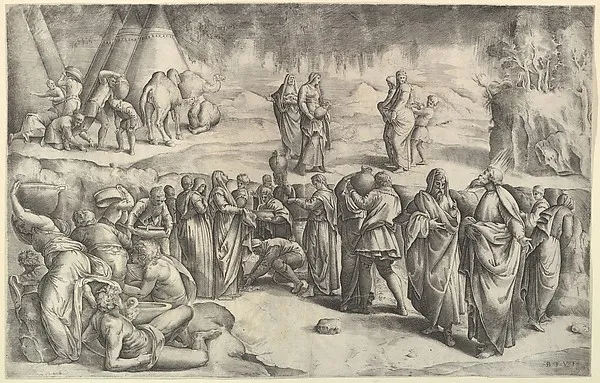
1 Samuel 11:1-3A Reproach Upon All Israel
1Then Nahash the Ammonite came up, and encamped against Jabeshgilead: and all the men of Jabesh said unto Nahash, Make a covenant with us, and we will serve thee. 2And Nahash the Ammonite answered them, On this condition will I make a covenant with you, that I may thrust out all your right eyes, and lay it for a reproach upon all Israel. 3And the elders of Jabesh said unto him, Give us seven days’ respite, that we may send messengers unto all the coasts of Israel: and then, if there be no man to save us, we will come out to thee.
Then Nahash the Ammonite came up, and encamped against Jabesh-gilead (v. 1). The Ammonites were a people east of the Jordan, old adversaries of Israel; Jabesh-gilead was an Israelite town on that eastern frontier, exposed and far from help. Cornered and outmatched, its men do the only thing they think they can: they sue for terms. Make a covenant with us, and we will serve thee. They are willing to become Nahash's servants if only he will let them live.
It is the bargain of the desperate - surrender everything for survival - and it sets up the cruelty that follows, for Nahash has no intention of letting them off so cheaply.1
He wants to lay it for a reproach upon all Israel - the mutilation as a public shaming of the entire nation, a standing taunt that this is what Israel and Israel's God amount to. The cruelty is aimed past the town, straight at the people of God. Into that taunt the chapter will send a deliverer. The reproach Nahash means to fix on Israel forever gets lifted in a single day.
1 Samuel 11:4-11The Spirit of God Came Upon Saul
4Then came the messengers to Gibeah of Saul, and told the tidings in the ears of the people: and all the people lifted up their voices, and wept. 5And, behold, Saul came after the herd out of the field; and Saul said, What aileth the people that they weep? And they told him the tidings of the men of Jabesh. 6And the Spirit of God came upon Saul when he heard those tidings, and his anger was kindled greatly.
Israel's deliverers have a habit of being found at ordinary labour when the call comes - Gideon at the winepress, David with the sheep, the fishermen at their nets. Greatness here is summoned out of an everyday field. Saul is about to become the saviour Jabesh is searching for, and the narrative is careful to show us where he was standing when it happened: in the dirt, behind the herd, doing the next plain thing in front of him.
If you are reading this in the middle of an unremarkable week, doing your own version of the next plain thing, take heart - that is exactly where God has reached for people before.
There is an anger that is simply the right response to wickedness, and the Spirit of God produces exactly that. It stirs him to act for people who cannot act for themselves. The same Spirit later poured out to set at liberty them that are bruised moves first, here, as a holy indignation that will not leave the bruised to their tormentor.
7And he took a yoke of oxen, and hewed them in pieces, and sent them throughout all the coasts of Israel by the hands of messengers, saying, Whosoever cometh not forth after Saul and after Samuel, so shall it be done unto his oxen. And the fear of the LORD fell on the people, and they came out with one consent. 8And when he numbered them in Bezek, the children of Israel were three hundred thousand, and the men of Judah thirty thousand. 9And they said unto the messengers that came, Thus shall ye say unto the men of Jabeshgilead, To morrow, by that time the sun be hot, ye shall have help. And the messengers came and shewed it to the men of Jabesh; and they were glad. 10Therefore the men of Jabesh said, To morrow we will come out unto you, and ye shall do with us all that seemeth good unto you. 11And it was so on the morrow, that Saul put the people in three companies; and they came into the midst of the host in the morning watch, and slew the Ammonites until the heat of the day: and it came to pass, that they which remained were scattered, so that two of them were not left together.
The pieces go out, and a scattered, weeping, divided people meets a single undeniable demand: rise, and follow.
The whole nation, north and south, is gathered around the deliverer. Then hope races back to the besieged town: To morrow, by that time the sun be hot, ye shall have help (v. 9). The men of Jabesh, who a week ago could find no saviour at all, hear that rescue is one day away - and they were glad. The deliverer they searched the land for is coming.
The Ammonites are struck while they sleep, and the rout runs on until the heat of the day, the survivors so scattered that two of them were not left together. The army that came to maim and shame all Israel is broken past regrouping. The reproach Nahash meant to fix on God's people forever is undone in a single morning, by a deliverer the LORD raised up and filled with His Spirit.1
1 Samuel 11:12-15To Day the LORD Hath Wrought Salvation
12And the people said unto Samuel, Who is he that said, Shall Saul reign over us? bring the men, that we may put them to death. 13And Saul said, There shall not a man be put to death this day: for to day the LORD hath wrought salvation in Israel. 14Then said Samuel to the people, Come, and let us go to Gilgal, and renew the kingdom there. 15And all the people went to Gilgal; and there they made Saul king before the LORD in Gilgal; and there they sacrificed sacrifices of peace offerings before the LORD; and there Saul and all the men of Israel rejoiced greatly.
It is a natural, almost reflexive impulse: the deliverer has been vindicated, so let his detractors be silenced for good. Notice that the demand is not even Saul's; it rises up from the crowd, addressed to Samuel, in the flush of triumph. This is the dangerous moment for any victor - the hour when power is most absolute and the temptation to use it for settling old scores is strongest. The men who mocked Saul are now entirely at his mercy.
A word from him, and they are dead. The whole tenor of the chapter, and the measure of the man in this hour, now turns on what he will say.
To renew the kingdom there anchors Saul's reign in the long story of God's dealings with Israel. This king, in this hour, belongs to the same purpose that first brought them into the land.
So the chapter that opened with a town weeping under a death-threat closes with a whole nation feasting in thanks. No one treats the rescue as Saul's achievement to admire. It is God's gift, and they celebrate it in His presence. Beneath every good thing here runs one note: this is the LORD's work, and the only fitting answer is to rejoice before Him.
Research trail
Sources & further study
These references support the historical, linguistic, manuscript, and contextual notes in this chapter. Scripture remains the primary text; external sources are provided so readers can inspect the research directly.
- 1 Samuel 11 - Translators' NotesThe NET Bible's detailed footnotes on 1 Samuel 11 - the historical setting of Nahash's siege of Jabesh-gilead, the force of the verb in verse 6 for the Spirit coming on Saul, the muster and the “morning watch” assault, and the textual notes on Saul's magnanimous refusal in verse 13.
- 1 Samuel 11 · Hebrew + classical Jewish commentaryThe Hebrew text of 1 Samuel 11 with Rashi, Radak, and other classical commentators side by side - useful for the verb tsalach (v. 6, the Spirit that “came upon” Saul, lit. rushed on him), for teshuah (v. 13, the “salvation” the LORD wrought that day), and for the cruel terms of Nahash in verse 2.
- 1 Samuel 11 ↔ Judges · Luke 4 · Luke 23Traces the threads tying 1 Samuel 11 to the rest of Scripture - the Spirit rushing on a deliverer (v. 6) read alongside the judges (Judg. 6:34; 14:6) and the One anointed with the Spirit to free the captive (Luke 4:18), and the king who spares his enemies in victory (v. 13) read beside the prayer from the cross (Luke 23:34).
Where this echoes in Scripture
A Reproach Upon All Israel
- Genesis 3:1Now the serpent was more subtil than any beast of the field which the LORD God had made.The name Nahash (v. 1) is the Hebrew word for serpent - an old enemy whose bargains deceive and enslave.
- Isaiah 59:16And he saw that there was no man, and wondered that there was no intercessor: therefore his arm brought salvation.The cry of verse 3, “if there be no man to save us” - answered when God Himself provides the deliverer.
- Judges 10:7-9the children of Ammon... oppressed and crushed the children of Israel... So that Israel was sore distressed.The Ammonites, old oppressors of Israel east of the Jordan - the same foe Nahash leads here.
- 1 Timothy 2:5For there is one God, and one mediator between God and men, the man Christ Jesus.The “man to save us” the elders sought (v. 3) named in person - the man God provided.
The Spirit of God Came Upon Saul
- Judges 6:34But the Spirit of the LORD came upon Gideon, and he blew a trumpet; and Abiezer was gathered after him.The same Spirit-rush and gathering of the people behind a deliverer as verses 6-7; cf. Samson in Judges 14:6.
- 1 Samuel 16:13and the Spirit of the LORD came upon David from that day forward.The same verb for the Spirit rushing on the king (v. 6) - here on David, “from that day forward.”
- Matthew 3:16he saw the Spirit of God descending like a dove, and lighting upon him.The Spirit on the deliverer (v. 6) come to rest in fullness on Jesus, given without measure (John 3:34).
- Luke 4:18The Spirit of the Lord is upon me... to preach deliverance to the captives... to set at liberty them that are bruised.The Spirit coming upon a deliverer (v. 6) fulfilled - the One anointed to free the oppressed.
- John 10:16other sheep I have, which are not of this fold... and there shall be one fold, and one shepherd.The scattered people gathered “with one consent” (v. 7) around the one who saves them.
- Exodus 14:24in the morning watch the LORD looked unto the host of the Egyptians... and troubled the host of the Egyptians.The “morning watch” assault of verse 11 - the dark hour before dawn when the LORD routs the enemy.
- Psalm 60:11-12Give us help from trouble: for vain is the help of man. Through God we shall do valiantly.The truth Saul will name in verse 13 - the victory belongs to the LORD.
To Day the LORD Hath Wrought Salvation
- Luke 23:34Then said Jesus, Father, forgive them; for they know not what they do.The King who, in His hour of triumph, prays mercy on His enemies - what Saul shows in shadow in verse 13.
- Luke 9:56For the Son of man is not come to destroy men's lives, but to save them.The deliverer's refusal to repay scorn with death (v. 13) - fulfilled in the One who came to save.
- John 12:47I came not to judge the world, but to save the world.Saul's pardon in the hour of triumph (v. 13) writ large - the King whose coming brings rescue.
- Joshua 5:9-10This day have I rolled away the reproach of Egypt from off you. And the children of Israel encamped in Gilgal.Gilgal (v. 14), where the reproach was first rolled away - now the place the kingdom is renewed.
- 1 Samuel 12:1-2And Samuel said unto all Israel... behold, the king walketh before you.The renewal at Gilgal (vv. 14-15) flows straight into Samuel's farewell charge in the next chapter.
- Luke 15:7joy shall be in heaven over one sinner that repenteth, more than over ninety and nine just persons.The rejoicing of verse 15 - the gladness that rightly follows a salvation worked by God.