2 Samuel 12
People in this chapter
The narrative of David's life takes a turn in chapter 12 that will echo through the rest of his reign. His sin with Bathsheba - the murder of Uriah, the taking of another man's wife - has been hidden. The kingdom moves on. But God sees, and He sends a prophet.
Tap any highlighted phrase to jump to the commentary that unpacks it.
2 Samuel 12:1-6A Story About a Stolen Lamb
1And the LORD sent Nathan unto David. And he came unto him, and said unto him, There were two men in one city; the one rich, and the other poor.
Nathan is a prophet whose name means "He gave." He is not a priest, not a member of the official religious class - he is a man to whom God has spoken, and he comes to the palace to speak. This is the second time in David's life a prophet has come to him. But this time, David is not listening for approval. He is about to hear something he does not want to hear.
2The rich man had exceeding many flocks and herds:
3But the poor man had nothing, save one little ewe lamb, which he had bought and nourished up: and it grew up together with him, and with his children; it did eat of his own meat, and drank of his own cup, and lay in his bosom, and was unto him as a daughter.
The rich man "spared" to take from his own flock. He refused the courtesy expected of hospitality - to give from his own abundance. Instead, he took from the poor man. Not because he needed it. Because he could. Because power answers to no one123.
4And there came a traveller unto the rich man, and he spared to take of his own flock and of his own herd, to dress for the wayfaring man that was come unto him; but took the poor man’s lamb, and dressed it for the man that was come to him.
David speaks as a judge - with perfect clarity about what justice demands. His is the anger of a man who sees power abused, the defenseless robbed, and he sentences the criminal to death and quadruple restitution. He is righteous here. He does not yet know he is sitting in judgment on himself.
2 Samuel 12:7-12Thou Art the Man
5And David’s anger was greatly kindled against the man; and he said to Nathan, As the LORD liveth, the man that hath done this thing shall surely die:
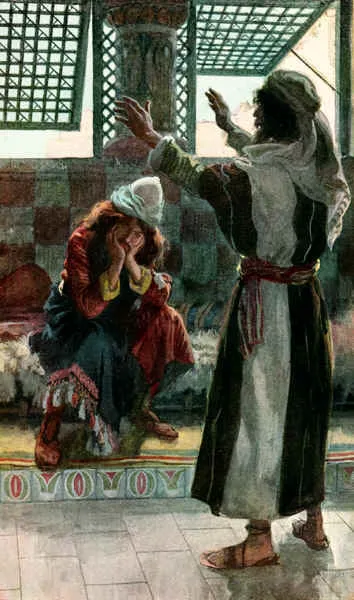
"Thou art the man." Four words. The most piercing words in Scripture. David has just pronounced death on the thief, and now Nathan turns the mirror around. The rich man is the king himself, no imagined criminal in a distant city. The lamb is Uriah's wife, taken, dressed, consumed.
6And he shall restore the lamb fourfold, because he did this thing, and because he had no pity.
God recounts what He has given David - not just the throne, but protection, the house of Saul, even Saul's wives. The Lord is saying: You did not need to take. Everything has been yours. I gave it to you. And if this was not enough, I would have given you more. The sin is born of appetite.
7And Nathan said to David, Thou art the man. Thus saith the LORD God of Israel, I anointed thee king over Israel, and I delivered thee out of the hand of Saul;
Nathan names the sin: adultery. Murder. The taking of another man's wife. Uriah was not killed in battle by accident - he was put in the forefront of the battle, abandoned to die. His blood is on David's hands. God does not describe this as a moment of passion. He calls it despising God's commandment.
8And I gave thee thy master’s house, and thy master’s wives into thy bosom, and gave thee the house of Israel and of Judah; and if that had been too little, I would moreover have given unto thee such and such things. 9Wherefore hast thou despised the commandment of the LORD, to do evil in his sight? thou hast killed Uriah the Hittite with the sword, and hast taken his wife to be thy wife, and hast slain him with the sword of the children of Ammon. 10Now therefore the sword shall never depart from thine house; because thou hast despised me, and hast taken the wife of Uriah the Hittite to be thy wife.
The consequences are named. The sword will never leave David's house. His own family will turn against him. His wives will be taken publicly. What David did in darkness will be exposed in light. This is symmetry: as David acted in secret, so God will act in the sight of the sun. As David took another man's wife, so his wives will be given to another. The consequence is forgiveness purchased at a price.
2 Samuel 12:13I Have Sinned
13And David said unto Nathan, I have sinned against the LORD. And Nathan said unto David, The LORD also hath put away thy sin; thou shalt not die.
David does not defend himself. He does not explain. He does not minimize. He simply says: "I have sinned against the Lord." The confession is total. And Nathan, in that moment, speaks God's response: the Lord has put away thy sin. You shall not die. The death sentence David pronounced on the rich man is lifted from David himself.
2 Samuel 12:14-18The Child That Was Born Unto Thee Shall Surely Die
14Howbeit, because by this deed thou hast given great occasion to the enemies of the LORD to blaspheme, the child also that is born unto thee shall surely die.
David's sin is forgiven. His life is spared. But the consequence remains. The child born to him and Bathsheba will die. This is the shape that sin took in the world. Uriah's child was taken from him. Now David's child will be taken. The symmetry shows how the world works when power and lust collide: others pay the price.
15And Nathan departed unto his house. And the LORD struck the child that Uriah’s wife bare unto David, and it was very sick. 16David therefore besought God for the child; and David fasted, and went in, and lay all night upon the earth.
David does not accept the sentence. He prays. He fasts. He lies on the earth - a posture of mourning, of supplication, of a man who has placed himself lower than the dust. For seven days, the king of Israel lies on the ground, begging God for the life of his child.
17And the elders of his house arose, and went to him, to raise him up from the earth: but he would not, neither did he eat bread with them. 18And it came to pass on the seventh day, that the child died. And the servants of David feared to tell him that the child was dead: for they said, Behold, while the child was yet alive, we spake unto him, and he would not hearken unto our voice: how will he then vex himself, if we tell him that the child is dead?
The servants are afraid to tell David. They assume that when the child dies, David's grief will be uncontainable - that a king who would not eat, who lay on the earth for seven days, will break entirely. But they do not yet know what David has learned: that God hears, that sin can be forgiven even when consequences remain, and that a man can survive the loss of what he loves most.
2 Samuel 12:19-23I Shall Go to Him
19But when David saw that his servants whispered, David perceived that the child was dead: therefore David said unto his servants, Is the child dead? And they said, He is dead. 20Then David arose from the earth, and washed, and anointed himself, and changed his apparel, and came into the house of the LORD, and worshipped: then he came to his own house; and when he required, they set bread before him, and he did eat.
David rises. He cleans himself. He anoints himself - a sign of restored dignity. He goes to the house of the Lord and worships. And he eats. This is the behavior of a man who has moved through grief and found something on the other side of it: acceptance of what cannot be changed, and a choice to continue living.
21Then said his servants unto him, What thing is this that thou hast done? thou didst fast and weep for the child, while it was alive; but when the child was dead, thou didst rise and eat bread. 22And he said, While the child was yet alive, I fasted and wept: for I said, Who can tell whether GOD will be gracious to me, that the child may live? 23But now he is dead, wherefore should I fast? can I bring him back again? I shall go to him, but he shall not return to me.
David explains himself to the confused servants. While the child lived, there was a possibility - that God might yet be gracious, that the child might live. So David fasted and wept in hope against hope. But now the child is dead. The prayer has been answered "no." And David's response is acceptance of what is.
And then David says something extraordinary: "I shall go to him, but he shall not return to me." This is one of the first hints in Scripture of resurrection, of life beyond death. David is saying: I cannot bring my child back from the dead. But one day, I will go to where he is. I will see him again. This is the language of hope, the hope of reunion beyond death.
2 Samuel 12:24-25Jedidiah - Beloved of the Lord
24And David comforted Bathsheba his wife, and went in unto her, and lay with her: and she bare a son, and he called his name Solomon: and the LORD loved him. 25And he sent by the hand of Nathan the prophet; and he called his name Jedidiah, because of the LORD.
It is striking that God Himself sends word through Nathan to name this child Jedidiah. David has just confessed his sin. The child born from that sin has died. And now a new son is born - and God names him "Beloved of the Lord." This is mercy working through the wreckage of sin. Solomon will become a king of wisdom and power, and his very existence declares that God is working alongside a repentant man.
Research trail
Sources & further study
These references support the historical, linguistic, manuscript, and contextual notes in this chapter. Scripture remains the primary text; external sources are provided so readers can inspect the research directly.
- Nathan's Parable and ConfessionThe prophet Nathan's parable that confronts David and leads to his confession of sin.
- Solomon: Son of David and BathshebaSolomon's birth as God's chosen son to succeed David as Israel's next king.
- God's Promise of a Faithful SonGod's promise that David's son will build the temple and his dynasty will be eternal.