4 Maccabees 10
People in this chapter
By chapter 10 the proof has stopped being an argument and become bodies. Two of the seven brothers are already dead. The third is led in, and the crowd does the tyrant's work for him - voices begging him to taste the meat and live. One bite and the pain stops. He will not. Same father, same mother, same teachings, same kinship: he will not betray it. Ye are not able to touch… my soul (v. 4).1
Tap any highlighted phrase to jump to the commentary that unpacks it.
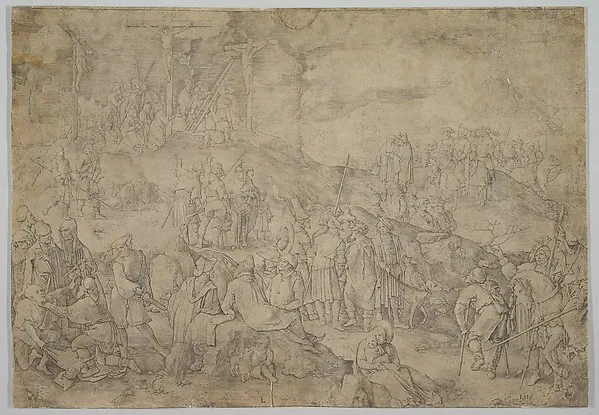
4 Maccabees 10:1-4You Are Not Able to Touch My Soul
1 2Do ye not know that the same father begot me as well as those who died, and the same mother bare me, and that I was brought up on the same teachings? 3I do not renounce the noble kinship that binds me to my brothers 4ye are not able to touch, even if ye wish it, my soul
Watch the word the author chooses for the death that has just happened: the brother who died a moment ago is already glorious (v. 1), and that memory is part of what now holds the next one upright. The third brother does not walk in alone. He walks in behind two who have shown him how it is done. Notice, too, where the pressure comes from. It is not only the tyrant's threat; it is the crowd, many repeatedly urged him to save himself by tasting the meat. This is temptation wearing the face of concern: voices begging him to take the simple way out, telling him no one would blame him, the pain would stop.
And he answers with his whole identity. The same father begot me… the same mother bare me… I was brought up on the same teachings (v. 2). He is bound to the brothers who went before him three ways over - by the father, by the mother, by the shared schooling in the law - and that threefold bond is stronger than the crowd's pleading. To betray now would be to betray not just himself but the kinship that made him who he is.1
He hands the tyrant everything the tyrant can actually take. Then he names the one thing no instrument of vengeance can reach. The verbs do the work. Apply it to my body (v. 4): he does not flinch from the rack; he points to it. Ye are not able to touch… my soul: the inner self, the will set on God, lies outside the executioner's power entirely. This is no denial that the body matters or that the pain is real; the chapter will describe the agony in unsparing detail.
It is a claim about where a person truly lives. The torturers can unmake his flesh. They cannot make him betray God, because that surrender can only ever come from within - and he will not give it. The same line runs through your own life: there is a place in you that no one else can occupy unless you open the door. The boundary the brother draws is the one the whole book has been defending - the pious mind is a fortress that can only be lost by being handed over.
4 Maccabees 10:5-11Torn on the Wheel; the Two Ends Named
5disjointed his hands and feet with their instruments 6 7scalped him with their fingernails after the Scythian fashion 8 9 10We, most abominable tyrant, suffer this for the sake of godly training and virtue 11endure unceasing torments
The author does not look away from what is done to the body, and neither may we. They disjointed his hands and feet… dismembering him by prying his limbs from their sockets, and breaking his fingers and arms and legs and elbows (vv. 5-6). The verbs pile up joint by joint - hands, feet, fingers, arms, legs, elbows - until the human frame is being taken apart piece by piece. Then comes a line that quietly carries the whole point: Since they were not able in any way to break his spirit, they abandoned the instruments and scalped him (v. 7).
The torturers have a goal: to break him, to force the surrender of his will. And they fail. They run through their instruments, find the spirit still unbroken, and are reduced to tearing at him with their fingernails “after the Scythian fashion” - a phrase the author's readers would have heard as the mark of the most savage cruelty known. The escalation is itself the confession of defeat: the more they cannot reach his soul, the more frantically they assault his body.
Verse 8 holds the most harrowing detail of all - on the wheel he saw his own flesh torn all about him, conscious to the end, watching his own undoing - and still he does not yield.
His last words are a verdict. In two short clauses (vv. 10-11) he lays out two destinies and assigns each its owner. On one side stands the brother and his kin, suffering for the sake of godly training and virtue - the Greek points to a whole life shaped and disciplined by God's law, a soul educated into faithfulness. On the other side stands the tyrant, whose present power is real but whose end the brother names without hesitation: unceasing torments. The reversal here is total and deliberate.
To every watching eye the tyrant is winning - he is whole, he is seated, the broken body on the wheel is his enemy's. But the brother insists the appearances are upside down. The one being torn apart is bound for the company of the godly; the one doing the tearing is bound for a torment that does not end. The brother is not gloating; he is testifying. With his last breath he refuses to let the tyrant's version of the story stand, and he commits both their cases to the judgment of God, who alone settles which of them has truly prevailed.
4 Maccabees 10:12-16No Fire Hot Enough to Make Me a Coward
12 13As for thee, do not give way to the same insanity as thy brothers, but obey the king and save thyself 14Ye have not a fire hot enough to make me play the coward 15the everlasting life of the pious 16Contrive tortures, tyrant, that thou mayest learn from them that I am a brother to those who have just now been tortured
The third brother dies in a manner worthy of his brothers (v. 12) - the word worthy again binding each death to the ones before it - and at once the fourth is dragged in. The tyrant's men have a script, and we hear it now: do not give way to the same insanity as thy brothers, but obey the king and save thyself (v. 13). The word translated insanity is the key to how the persecutors see the whole thing.
To them, choosing death over a mouthful of meat is, to them, madness, a derangement, a failure of basic reason. This is precisely the charge the book exists to answer. Its entire argument has been that the brothers act by the highest reason there is - the devout reason that has weighed God and the law against mere survival and chosen rightly. So when the executioners call it insanity and urge him to save thyself, they are unknowingly framing the contest in the book's own terms.
The fourth brother will now show that what looks like madness to a tyrant is in fact the clearest-eyed sanity of all: a mind that sees what truly lasts and holds to it.
The brother never claims the fire will not hurt. He claims it cannot reach the thing they are aiming at (v. 14). There is no temperature of torment that can turn his courage into cowardice, because his courage was never built on the absence of pain in the first place. Heat it as high as you like; you are still pointing it at the wrong target. Then he swears an oath, and the three things he swears by map the whole moral landscape of the chapter: by the blessed death of my brothers, and the eternal destruction of the tyrant, and the everlasting life of the pious, I will not renounce our noble brotherhood (v. 15).
He binds himself by the brothers already glorified in death, by the doom he is certain awaits the tyrant, and by the everlasting life that belongs to the faithful - three fixed points by which he steers. And he ends by inviting the worst they have: Contrive tortures, tyrant, that thou mayest learn… that I am a brother to those who have just now been tortured (v. 16). He wants the torture as the proof of his kinship.
To suffer as his brothers suffered is how he will show he belongs to them. The threat the tyrant means as a deterrent, the brother receives as an honor.
4 Maccabees 10:17-21God Heareth Also the Silent
17 18Even if thou remove mine organ of speech, God heareth also the silent 19not for that shalt thou make our reason speechless 20 21God shall visit thee speedily, for thou cuttest off a tongue that hath been melodious with divine hymns
The tyrant's rage now fixes on the very organ of the brother's defiance. The bloodthirsty and murderous and utterly abominable Antiochus gave orders to cut out his tongue (v. 17). The author stacks up the adjectives without restraint - he wants no reader in any doubt about who the monster in this scene is. And the command is shrewd as well as cruel: cut out the tongue, and you cut off the speech that has been turning every torture into testimony.
Silence him, and you win at least the appearance of the last word. But the brother turns even this into a confession of faith, and his answer is among the most piercing lines in the book: Even if thou remove mine organ of speech, God heareth also the silent (v. 18). The tyrant can take the voice, but he cannot take the hearing of God. A faith that can no longer be spoken aloud is not therefore a faith God fails to hear.
The brother's witness does not depend on his tongue; it rises to God from a place deeper than speech. To a power that thinks silence is victory, the brother says the truest things are heard by God whether or not a mouth can form them.
Then the brother does something almost unbearable to picture: he holds out his own tongue to the blade. Behold, my tongue is put forth; cut it off, for not for that shalt thou make our reason speechless (v. 19). As with the third brother who pointed to the rack, this one offers the very thing they mean to take, and in offering it strips the act of its power to intimidate. And he tells them exactly why it will not work.
They imagine that cutting out the tongue silences the man; the brother answers that reason - the pious mind that is the book's great hero - cannot be made speechless by anything done to the body. Speech can be cut out; logismos cannot. He goes further still: Gladly, for the sake of God, do we let our bodily members be mutilated (v. 20). Gladly. Because the members are given for the sake of God, their loss is not pure subtraction; it is offering.
And he closes with a warning that hands the verdict to heaven: God shall visit thee speedily, for thou cuttest off a tongue that hath been melodious with divine hymns (v. 21). The tongue Antiochus destroys is no ordinary tongue; it has sung the praises of God, and the God who heard those hymns will not overlook what is now done to it.
With almost his last words the brother defines what his tongue was truly for. It was made to sing His praises (v. 21). That is the use he claims for it even as it is taken from him - and that is why its loss will be answered: God shall visit thee speedily. There is a quiet challenge in the picture for anyone who reads it. The brother's tongue had a settled habit long before this hour; it was a praising tongue, an instrument of worship, and so it remained faithful to its purpose right to the end.
Our own words, too, are forming a habit - toward complaint or toward gratitude, toward tearing down or toward praise. The brother shows what it looks like for the habit to be so deeply set in the worship of God that not even a torturer can pry it loose. He loses the tongue; he does not lose what the tongue was for. And he commits the wrong done to it, as he has committed everything else, into the hands of the God who hears the silent and will surely visit the persecutor.
Research trail
Sources & further study
These references support the historical, linguistic, manuscript, and contextual notes in this chapter. Scripture remains the primary text; external sources are provided so readers can inspect the research directly.
- 4 Maccabees · introduction, text, and scholarshipAn overview of 4 Maccabees with links to the text and to scholarly discussion - helpful background for chapter 10's place in the larger work: a diaspora retelling of the seven brothers' martyrdom (drawn from 2 Maccabees 7) reframed as the living demonstration that devout reason masters the passions, even the passion to survive.
- IV Maccabees 10 · full textThe full text of 4 Maccabees 10 in Sefaria's library - useful for following the third brother's appeal to the shared kinship of father, mother, and teaching (vv. 2-3), the boundary he draws between body and soul (v. 4), and the fourth brother's words as his tongue is cut away (vv. 18-19), all within the book's sustained case that the pious mind cannot be conquered.
- 4 Maccabees - date, authorship, and the “pious reason” thesisA survey of 4 Maccabees - a Greek work of the first or early second century by an unknown diaspora Jewish author - covering its central thesis that pious reason rules the emotions, its expansion of the martyrdom narratives of 2 Maccabees, and the intellectual kinship some scholars note with New Testament writings such as Hebrews on faithfulness through suffering.
Where this echoes in Scripture
You Are Not Able to Touch My Soul
- John 8:39If ye were Abraham's children, ye would do the works of Abraham.The true kinship the brothers refuse to renounce (vv. 2-3) - defined not by blood alone but by the faith of Abraham.
- Galatians 3:7they which are of faith, the same are the children of Abraham.The deepest bond behind the brothers' “noble kinship” (v. 3) - the lineage of faith the tyrant cannot destroy.
- Galatians 3:9they which be of faith are blessed with faithful Abraham.The blessing that follows the true descent (vv. 2-3) - shared with Abraham by those who share his faith.
- Matthew 10:28fear not them which kill the body, but are not able to kill the soul.The very boundary of verse 4 - the body within the tormentor's reach, the soul beyond it.
- Daniel 3:16-18our God whom we serve is able to deliver us... But if not... we will not serve thy gods.The same refusal under the same kind of threat - faithfulness that will not bend whether or not deliverance comes.
- Romans 4:18Who against hope believed in hope, that he might become the father of many nations.The faith of Abraham that makes the true kinship (vv. 2-3) - trust that holds even where hope seems impossible.
Torn on the Wheel; the Two Ends Named
- Hebrews 12:1seeing we also are compassed about with so great a cloud of witnesses... let us run with patience the race that is set before us.The chain of courage in this chapter (v. 1) - each sufferer strengthened by the faithful who went before.
- Hebrews 11:35others were tortured, not accepting deliverance; that they might obtain a better resurrection.A remembrance that reaches toward these very Maccabean martyrs - torture refused for the sake of a better hope (vv. 5-11).
- Romans 8:18the sufferings of this present time are not worthy to be compared with the glory which shall be revealed in us.The brother's weighing of the two ends (vv. 10-11) - present agony set against a glory the tormentor cannot see.
- 2 Corinthians 4:16-17though our outward man perish, yet the inward man is renewed day by day.The very distinction the chapter dramatizes - the body torn (vv. 5-8), the inward self unbroken.
- 2 Maccabees 7:9the King of the world shall raise us up, who have died for his laws, unto everlasting life.The earlier telling this chapter expands - the seven brothers' hope of everlasting life beyond the tyrant's reach.
No Fire Hot Enough to Make Me a Coward
- Hebrews 11:35others were tortured, not accepting deliverance; that they might obtain a better resurrection.The refusal of “save thyself” (v. 13) for the sake of a better hope - words that reach toward these very martyrs.
- John 11:25I am the resurrection, and the life: he that believeth in me, though he were dead, yet shall he live.The hope the brother swears by - “the everlasting life of the pious” (v. 15) - named and secured in person.
- Revelation 2:10be thou faithful unto death, and I will give thee a crown of life.The exchange the fourth brother makes (vv. 14-16) - faithfulness through death for the life that does not end.
- Matthew 16:25whosoever will save his life shall lose it: and whosoever will lose his life for my sake shall find it.The “save thyself” of verse 13 turned inside out - the life clutched is lost, the life surrendered is found.
- 1 Corinthians 15:54-55Death is swallowed up in victory. O death, where is thy sting?Why no fire is hot enough (v. 14) - the final defeat of the death the tyrant wields as his last weapon.
God Heareth Also the Silent
- Romans 8:26-27the Spirit itself maketh intercession for us with groanings which cannot be uttered.The truth the brother leans on (v. 18) - God hears the witness too deep, or now too wordless, for speech.
- Isaiah 53:7he was oppressed, and he was afflicted, yet he opened not his mouth.The silence forced on the brother (vv. 17-18) taken up willingly by the suffering Servant before His accusers.
- Matthew 27:14And he answered him to never a word; insomuch that the governor marvelled greatly.The same chosen silence (v. 18) - Jesus answering His accusers with not a word, and heard by the Father all the same.
- Psalm 71:23My lips shall greatly rejoice when I sing unto thee; and my soul, which thou hast redeemed.The tongue “melodious with divine hymns” (v. 21) - the use the brother claims for his speech to the last.
- Romans 12:1present your bodies a living sacrifice, holy, acceptable unto God, which is your reasonable service.The brother's “gladly… we let our bodily members be mutilated” (v. 20) - the body offered to God as worship.
- Romans 12:19Vengeance is mine; I will repay, saith the Lord.The verdict the brother hands to heaven (v. 21) - “God shall visit thee” - leaving judgment to God alone.