4 Maccabees 2
People in this chapter
Chapter 1 of this Greek work made a bold claim: the mind trained by God's law can master any desire. Chapter 2 stops arguing and calls its witnesses, and the first is the strongest the author has. Joseph - young, enslaved, far from home - is hunted day after day by a desire the book refuses to call shameful. He feels the full pull of it. And he quenches it (vv. 2-3). Not numbness. Mastery.1
Tap any highlighted phrase to jump to the commentary that unpacks it.
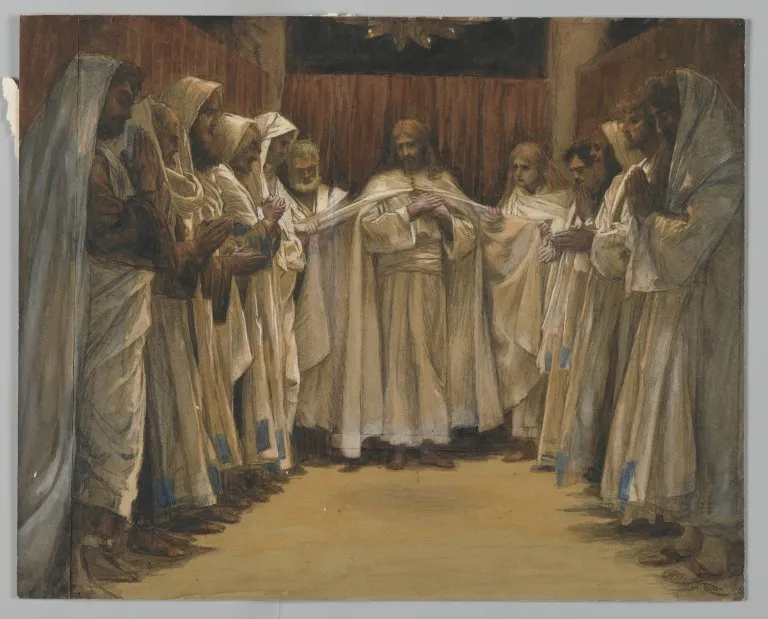
4 Maccabees 2:1-6Joseph and the Mastery of Desire
1 2he checked the carnal impulse 3a young man at the age when physical desire is strong 4Reason is proved to subdue the impulse not only of sexual desire, but of all sorts of covetings 5 6
Notice first what the author does not say. He opens with a question so casual it almost slides past - is it really so surprising that the desire to enjoy beauty can be quenched? (v. 1) - and in framing it that way, he refuses to call the desire evil or pretend a virtuous person feels nothing. The desire is natural; the pull toward beauty is part of being human. His claim is sharper and harder than mere suppression: that this real and powerful pull can be quenched by reason.
And then comes the witness everyone in his audience would know: this, certainly, is why we praise the virtuous Joseph, because by his Reason, with a mental effort, he checked the carnal impulse (v. 2). The story behind the line is Genesis 39 - Joseph enslaved in Egypt, pursued day after day by his master's wife, with everything to lose by refusing her. The author drives home that the test was genuinely hard: Joseph was a young man at the age when physical desire is strong (v. 3).
The victory belongs to a young man fully alive to the desire who, by a trained and devout mind, refuses to be ruled by it.1
From the single case the author reaches for a general law, and his proof is shrewd. He points to the tenth commandment - Thou shalt not covet thy neighbour's wife, nor anything that is thy neighbour's (v. 5) - and notices something most readers skim past. Most of the commandments forbid acts: murder, theft, false witness. But this one forbids a wanting, an inner motion of the heart before it ever becomes a deed. And here is his leap: God would not forbid coveting if coveting could not be governed.
The very existence of the command is evidence that the mind can rule the appetite - which is exactly why reason subdues not only sexual desire, but of all sorts of covetings (v. 4). The law is summoning your heart to a mastery it was made for. Desire reaches for what belongs to another. Reason, trained by the law, keeps the watch at the door before the reaching becomes injustice.2
4 Maccabees 2:7-20The Law Trains Reason - Even Over Anger
7naturally gormandizing and greedy and drunken, be taught to change his nature 8 9 10the Law ranks above affection for parents 11 12 13 14 15ambition, vanity, ostentation, pride, and backbiting 16 17Moses when he was angered against Dathan and Abiram did not give free course to his wrath, but governed his anger by his Reason 18 19‘Accursed be their anger!’ 20
Having proved his point with desire, the author marches it through the rest of the passions, and his first move is the boldest. He claims reason can change not just behaviour but ingrained nature - that even the man who is naturally gormandizing and greedy and drunken can be taught to become someone else (v. 7). And his evidence is concrete and Jewish to the core - the law's specific commands reshaping a greedy man's habits.
The miser, ordered by the law, lends money to the needy without interest, and at the seventh-year periods cancels the debt (v. 8); the tight-fisted man refrains from gleaning his stubbles or picking the last grapes from his vineyards (v. 9), leaving the edges of his harvest for the poor and the stranger. These are the actual statutes of the Torah - the sabbatical release, the gleaning laws - and the author reads them as God's training programme for the grasping heart.
The law does not merely forbid greed in the abstract; it builds in concrete, repeated acts of open-handedness until the nature itself bends. Reason, working through the law, retrains the very instinct to grasp.2
Then the argument turns to its most delicate ground: not the obviously dangerous passions, but the good ones - the natural affections for parents, spouse, children, friends. These are loves, not vices, and yet the author insists reason must govern even these. The Law ranks above affection for parents, so that a man may not for their sakes surrender his virtue (v. 10); it overrides love for a wife and governs love for children and controls the claims of friendship, so that a man will rebuke, correct, or reprove those he loves when they do evil (vv. 11-12).
The point is bracing and easily misread. Even our dearest loves can be twisted into a reason to abandon what is right - shielding a child who needs correction, excusing a friend's wrong, betraying virtue to keep a relationship comfortable. Reason ordered by God's law keeps love from collapsing into mere indulgence. And the author pushes further still: reason can master even hatred, so that a man protects an enemy's property and returns his strayed goods (vv. 13-14) - the very thing the law commands in Exodus 23.
The passions reason must rule, then, run the whole span: from hatred at one end to our deepest loves at the other.
The author saves anger for the climax, because anger is the passion that feels most justified and therefore hardest to govern. He lists the aggressive vices - ambition, vanity, ostentation, pride, and backbiting (v. 15) - and says the temperate mind repels them all, even as it does anger, for it conquers even this (v. 16). Then two witnesses. First Moses, who when he was angered against Dathan and Abiram did not give free course to his wrath, but governed his anger by his Reason (v. 17) - a man with every provocation to rage at open rebellion, who held it under restraint.
The author draws from this a careful, almost surgical principle: the temperate mind wins by modifying some passions, while crushing others absolutely (v. 18). Reason is not a blunt instrument that destroys all feeling; it discerns. Some passions it tempers and redirects; others it must put down entirely. The second witness is Jacob, who on his deathbed cursed the cruelty of Simeon and Levi for slaughtering the Shechemites: Accursed be their anger! (v. 19, quoting Genesis 49:7).
And the author's logic is exact: Jacob would not have condemned their anger had not Reason possessed the power to restrain it (v. 20). You do not blame a man for failing to do what cannot be done. The very fact that uncontrolled anger is blameworthy proves that anger can be controlled.1
4 Maccabees 2:21-23The Mind Set on a Throne
21God created man, he implanted in him his passions and inclinations 22set the mind on a throne amidst the senses to be his sacred guide in all things 23he shall reign over a kingdom that is temperate, and just, and virtuous, and brave
The chapter gathers to a close with its deepest claim, and it is a claim about creation itself. The author traces the whole arrangement back to the day God created man (v. 21). And he says two things were done at once. First, God implanted in him his passions and inclinations - the desires, drives, and feelings the chapter has spent twenty verses discussing are not a flaw to be regretted. They are God-given, part of the design, placed in the human creature by the Creator's own hand.
This is why the book never preaches the killing of all emotion: you do not uproot what God has planted. But - and this is the second thing, done at the very same time - God did not leave the passions to rule. He set the mind on a throne amidst the senses to be his sacred guide in all things (v. 22). The image is regal and exact: the mind is enthroned, the senses and passions are its realm, and its rule is meant to be a sacred one - wise governance of the feelings, fitted to their nature.
From the first day, humanity was built to be ruled from within, the mind crowned over the appetites it was given to direct.
But an enthroned mind still needs a guide, and the author names it: to the mind he gave the Law (v. 23). This is the keystone of the whole book. Reason alone is not enough - reason must be devout, instructed by God's law, or its throne becomes a seat of mere cleverness. Given the law, the mind has what it needs to govern rightly, and the result is described as nothing less than a kingdom: the one who orders himself by the law shall reign over a kingdom that is temperate, and just, and virtuous, and brave (v. 23).
The four qualities are the classic virtues - self-control, justice, prudence, courage - and the author's vision is that an ordinary person who lives by God's law becomes, in the truest sense, a king: not over others, but over the unruly territory of the self. It is a noble and genuine hope, and the New Testament does not despise it - it takes the same picture of a mind enthroned over the passions and presses it further, naming a power the chapter reaches toward but cannot name.
For the deepest mastery, the Gospel says, comes from a mind renewed by the Spirit of God, and from union with the One in whom that reign becomes real.3
Research trail
Sources & further study
These references support the historical, linguistic, manuscript, and contextual notes in this chapter. Scripture remains the primary text; external sources are provided so readers can inspect the research directly.
- 4 Maccabees · introduction, dating, and full textBackground on 4 Maccabees as a Greek work of Hellenistic Judaism - its thesis that devout reason rules the passions, its debt to the philosophy of its day, and its conviction that the passions are implanted by the Creator to be governed by reason - which frames the argument of chapter 2 (vv. 18, 21) in its own time.
- IV Maccabees 2 · text with cross-linksThe text of 4 Maccabees 2 in an English translation, verse by verse, with links into the wider Jewish library - useful for tracing the Joseph example (vv. 1-3), the appeal to the commandment against coveting (vv. 5-6), and the closing image of the mind enthroned over the senses under the law (vv. 21-23).
- 4 Maccabees · overview and receptionA survey of 4 Maccabees - authorship, date, canonical status across traditions, and its central theme of reason's sovereignty over the emotions - helpful for placing chapter 2's catalogue of mastered passions (vv. 4-20) within the book's larger philosophical argument.
Where this echoes in Scripture
Joseph and the Mastery of Desire
- Genesis 39:9-12how then can I do this great wickedness, and sin against God?... and he left his garment in her hand, and fled.The story behind verses 2-3 - Joseph refusing, then fleeing, the temptation the chapter praises him for.
- 1 Corinthians 6:18Flee fornication... but he that committeth fornication sinneth against his own body.The integrity of verse 2 named in the Gospel - flee the temptation outright.
- Hebrews 4:15tempted like as we are, yet without sin.The mastery of verse 2 carried to its fullness - the One tested in all points who never yielded.
- Exodus 20:17Thou shalt not covet thy neighbour's house... nor any thing that is thy neighbour's.The commandment the author quotes in verse 5 - the law that forbids the wanting, not only the deed.
- James 1:14-15every man is tempted, when he is drawn away of his own lust... then when lust hath conceived, it bringeth forth sin.Why the chapter targets the desire itself (vv. 4-6) - sin is conceived in the wanting before it is born in the act.
- Titus 2:11-12the grace of God... teaching us that, denying ungodliness and worldly lusts, we should live soberly, righteously, and godly.Where the strength behind verse 2 comes from in the Gospel - grace itself teaching self-denial.
The Law Trains Reason - Even Over Anger
- Leviticus 19:9-10thou shalt not wholly reap the corners of thy field... thou shalt leave them for the poor and stranger.The gleaning law behind verse 9 - the statute the author reads as God retraining the grasping heart.
- Exodus 23:4-5If thou meet thine enemy's ox... going astray, thou shalt surely bring it back to him again.The command behind verses 13-14 - reason mastering even hatred to do good to an enemy.
- Genesis 49:5-7Simeon and Levi are brethren... Cursed be their anger, for it was fierce.Jacob's words quoted in verse 19 - the blame that proves anger could have been restrained.
- Ephesians 4:26Be ye angry, and sin not: let not the sun go down upon your wrath.The governing of anger (v. 17) carried forward - feeling allowed, but not given free course.
- Romans 12:2be ye transformed by the renewing of your mind.Where the Gospel locates the mastery the chapter prizes - a mind made new by the Spirit.
- James 1:19-20let every man be swift to hear, slow to speak, slow to wrath: for the wrath of man worketh not the righteousness of God.The governing of anger (v. 17) echoed - slowness to wrath, because human rage does not produce God's righteousness.
The Mind Set on a Throne
- Romans 8:6For to be carnally minded is death; but to be spiritually minded is life and peace.The enthroned mind of verse 22 reframed - the mind's rule set rightly by the Spirit.
- Galatians 5:22-23the fruit of the Spirit is love, joy, peace... temperance: against such there is no law.The self-mastery of verse 23 named as gift - temperance as fruit grown by the Spirit.
- Romans 6:14For sin shall not have dominion over you: for ye are not under the law, but under grace.The kingdom of verse 23 secured - the deeper liberty in which the passions no longer reign.
- Revelation 3:21To him that overcometh will I grant to sit with me in my throne, even as I also overcame.The reign of verse 23 carried to its end - a throne shared with the One who first overcame.
- 2 Corinthians 10:5bringing into captivity every thought to the obedience of Christ.The mind's sacred rule (v. 22) at its fullest - thought itself governed by the Lord it serves.