Deuteronomy 34
People in this chapter
Moses climbs Nebo with his eye undimmed and his strength unspent, and from the cleft of Pisgah God shows him the whole land. Gilead to Dan. Naphtali, Ephraim, the plain of Jericho, the southern desert. Every acre God swore to Abraham, spread out in the clear desert air. Then the word comes that he has waited forty years to hear, and it closes the door: thou shalt not go over thither.1
Tap any highlighted phrase to jump to the commentary that unpacks it.
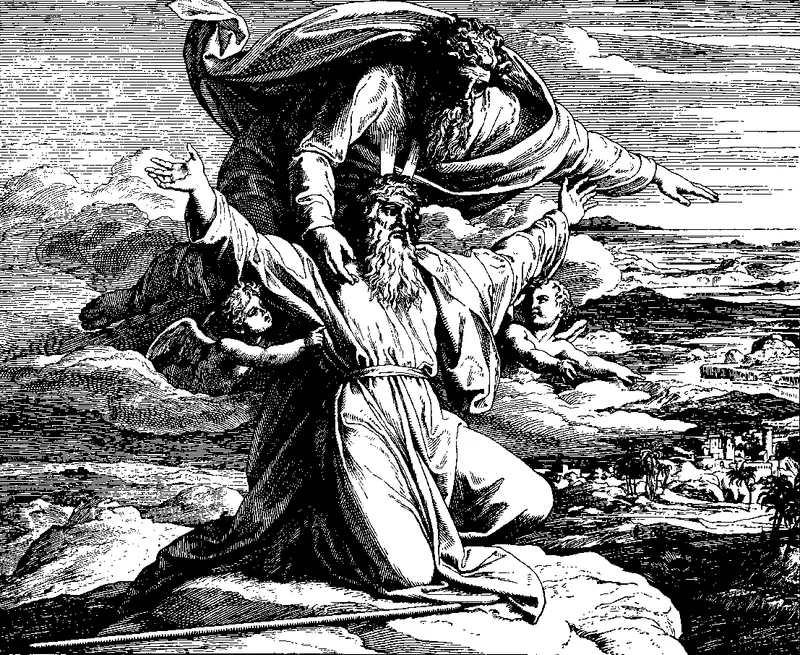
Deuteronomy 34:1-4The View from Pisgah
1And Moses went up from the plains of Moab unto the mountain of Nebo, to the top of Pisgah, that is over against Jericho. And the LORD shewed him all the land of Gilead, unto Dan, 2And all Naphtali, and the land of Ephraim, and Manasseh, and all the land of Judah, unto the utmost sea, 3And the south, and the plain of the valley of Jericho, the city of palm trees, unto Zoar. 4And the LORD said unto him, This is the land which I sware unto Abraham, unto Isaac, and unto Jacob, saying, I will give it unto thy seed: I have caused thee to see it with thine eyes, but thou shalt not go over thither.
God shows Moses everything. Not a glimpse, but the whole geography of the promise - Gilead to Dan, Naphtali, Ephraim, Manasseh, Judah, the south, the plain of Jericho, Zoar. It is a panoramic vision: here is what faithfulness was always reaching toward. And then the door closes. Moses sees it all and enters none of it.
This is the law of Moses: it shows the destination. It illuminates what wholeness looks like, what righteousness requires, what covenant demands. But the law itself cannot bring anyone across. Moses is faithful - at 120, his eye is not dim, his force is not abated. His faithfulness is perfect. And still: thou shalt not go over. The law reveals the land. Only grace can lead us in.
Deuteronomy 34:5-8The Unmarked Grave
5So Moses the servant of the LORD died there in the land of Moab, according to the word of the LORD. 6And he buried him in a valley in the land of Moab, over against Bethpeor: but no man knoweth of his sepulchre unto this day. 7And Moses was an hundred and twenty years old when he died: his eye was not dim, nor his natural force abated. 8And the children of Israel wept for Moses in the plains of Moab thirty days: so the days of weeping and mourning for Moses were ended.
Moses is called "the servant of the Lord" - the same title given only to Joshua and Jesus in Scripture. He dies in service, at the end of his work, his calling fulfilled. He has led the people through forty years of wilderness. His death comes exactly on schedule.
No sickness brings Moses down. No slow failure of the body. A later Jewish tradition pictures God taking his life with a kiss, and the phrase here invites it: he dies by the mouth of the LORD, on schedule, at a word. His eye was clear. His strength was whole. He could have gone on for years. The ending was not decay catching up with him; it was God calling time on a finished work.
No human hand digs Moses' grave. God buries him. In the ancient world, a grave - especially an unmarked grave - can suggest shame or abandonment. But here it is the opposite. No human foot disturbs his rest. No one can point to the place and say, "Here lies the law." Instead, his burial is hidden, kept by God alone. It is a kind of honor: his grave is God's private work.
Beth-peor, "the house of Peor," marks the place where Israel had fallen into idolatry (Numbers 25). Moses is buried in a valley opposite the site of Israel's worst transgression. The location is exact, even as the grave itself is invisible. God knows where His servant lies.
Kings built pyramids. Prophets got shrines. Pilgrims still walk to tombs. The man who spoke with God face to face, who led a nation out of Egypt, who carried down the Law from the fire - that man got an unmarked grave no one has ever located, then or now. There is nothing to visit. And the text seems strangely at peace with this, even relieved by it. No one knows where Moses sleeps. But the silence is not abandonment. It only means the one place his body rests is known to God alone, and that is enough.
Deuteronomy 34:8-9The Passing of the Mantle
8And the children of Israel wept for Moses in the plains of Moab thirty days: so the days of weeping and mourning for Moses were ended. 9And Joshua the son of Nun was full of the spirit of wisdom; for Moses had laid his hands upon him: and the children of Israel hearkened unto him, and did as the LORD commanded Moses.
The defining word for Joshua here is wisdom: he is full of the spirit of wisdom. Wisdom is the capacity to see what God is doing and to move in alignment with it. The next generation will need discernment more than power.
Hands on the head: blessing, transfer, commission. The whole weight of leading a nation passes from one set of shoulders to another by a touch. But the choice was never Moses' to make alone. God named the successor, and God's own Spirit already filled him before any hand was laid. What you see is two things happening at once - a man handing on what he carried, and God appointing the one He had already prepared.
Deuteronomy 34:10-12There Arose Not a Prophet Like Unto Moses
10And there arose not a prophet since in Israel like unto Moses, whom the LORD knew face to face, 11In all the signs and the wonders, which the LORD sent him to do in the land of Egypt to Pharaoh, and to all his servants, and to all his land, 12And in all that mighty hand, and in all the great terror which Moses shewed in the sight of all Israel.
This is the climax of all the Pentateuch's portrayal of Moses. He was faithful as a servant. He saw signs and wonders. He moved in the power of God's mighty hand. And the highest thing about him was that he knew God face to face. He was a friend of God. The law that bears his name came from a man who had heard God's voice directly, who had stood in the presence of the Almighty.
The closing lines reach back across forty years to Egypt - the plagues, the mighty hand at the sea, the terror that fell on a superpower when a slave nation walked free. This is how the Pentateuch wants you to remember Moses. Not as the man who handed down a rulebook. As the man God moved through to shatter an empire and rescue a people. The Law that bears his name was forged in that rescue, by a leader who had felt the power of God pass through his own hands.
Matthew 17:1-8; Luke 9:28-36The Promise Exceeded
Centuries after Deuteronomy 34, Moses appears on a mountain - in a real bodily presence, speaking with Jesus about His coming exodus to Jerusalem. He is standing in the Promised Land. He is no longer in the grave. The unmarked grave did not hold him. He was alive to God, and God raised him to stand with the One greater than himself.
Research trail
Sources & further study
These references support the historical, linguistic, manuscript, and contextual notes in this chapter. Scripture remains the primary text; external sources are provided so readers can inspect the research directly.
- Deuteronomy 34Open-access source text and rabbinic commentary on Moses' death [res:sefaria-deuteronomy-34], the view from Pisgah, and the transition to Joshua's leadership.
- Mount Nebo and the Geography of Moses' FarewellGeographical and archaeological study of Mount Nebo and the view [res:moses-death-mount-nebo-promised-land-view] across the Jordan valley, the location of Moses' death and final vision.
- Moses as Covenant Mediator and Type of ChristTraces how Moses' role as mediator of the old covenant [res:moses-typology-jesus-mediator-covenant-intertextual] prefigures Jesus as mediator of the new and better covenant in Hebrews.
Where this echoes in Scripture
The View from Pisgah
- Hebrews 4:8-9For if Jesus had given them rest, then would he not afterward have spoken of another day. There remaineth therefore a rest to the people of God.Even after Joshua settled Israel in the land, a deeper rest was still promised - one the law could not reach.
- Romans 7:7-12The law is holy, and the commandment holy, and just, and good.The law reveals what righteousness looks like, yet cannot itself carry anyone across into it.
- Galatians 3:24The law was our schoolmaster to bring us unto Christ, that we might be justified by faith.Moses on the summit, showing the land he cannot enter, is the law's whole vocation in one image.
The Unmarked Grave
- Matthew 17:1-3And, behold, there appeared unto them Moses and Elias talking with him.The man God buried in secret stands bodily on a mountain with Jesus, inside the land he had only seen.
- Luke 9:30-31There talked with him two men, which were Moses and Elias: who appeared in glory, and spake of his decease which he should accomplish at Jerusalem.Even in glory Moses is talking about an exodus - the greater deliverance Jesus would finish.
- John 12:26If any man serve me, let him follow me; and where I am, there shall also my servant be.The servant of the LORD is not left in the grave but brought to be where his Lord is.
- Jude 1:9Yet Michael the archangel, when contending with the devil he disputed about the body of Moses.Even the powers of darkness contend over this body, as if they sense it belongs entirely to God.
The Passing of the Mantle
- Acts 3:22-23A prophet shall the Lord your God raise up unto you of your brethren, like unto me; him shall ye hear in all things.Peter takes the promise of a prophet like Moses and lays it on Jesus by name.
- Hebrews 3:5-6Moses verily was faithful in all his house, as a servant... but Christ as a son over his own house.Moses was the faithful servant in the house; the One who comes after is the Son over it.
- Numbers 27:18-20Take thee Joshua the son of Nun, a man in whom is the spirit, and lay thine hand upon him.The commissioning here was God's command long before Moses' last day - the successor was chosen, not improvised.
There Arose Not a Prophet Like Unto Moses
- Deuteronomy 18:15The LORD thy God will raise up unto thee a Prophet from the midst of thee, of thy brethren, like unto me; unto him ye shall hearken.Moses himself names the one to come, and tells the people their job is to listen to him.
- Acts 3:22-23For Moses truly said unto the fathers, A prophet shall the Lord your God raise up unto you... like unto me.Peter reads the “prophet like Moses” as fulfilled in Jesus.
- Acts 7:37This is that Moses, which said unto the children of Israel, A prophet shall the Lord your God raise up unto you of your brethren, like unto me.Stephen, on trial, makes the same identification before the council.
- John 1:17-18The law was given by Moses, but grace and truth came by Jesus Christ. No man hath seen God at any time; the only begotten Son... hath declared him.Moses knew God face to face; the Son makes God known from nearer still.
The Promise Exceeded
- Matthew 17:1-3And after six days Jesus taketh Peter, James, and John... and was transfigured before them... and there appeared unto them Moses and Elias talking with him.Moses, kept from Canaan in life, stands on a mountain inside it - face to face with Jesus.
- Luke 9:30-31Who appeared in glory, and spake of his decease which he should accomplish at Jerusalem.The word for “decease” is exodus - the rescue Moses once led, now spoken of as the one Jesus will finish.
- 2 Corinthians 1:20For all the promises of God in him are yea, and in him Amen, unto the glory of God by us.Every promise, including the one Moses died still holding, finds its yes in Christ.