Exodus 10
People in this chapter
Exodus 10 is the story of two plagues that tear at the very heart of Egypt's power. The eighth plague - locusts - descends on the land like a moving wall, consuming every leaf, every plant, every hope of harvest. Pharaoh's own servants finally break, pleading with him: "Egypt is destroyed." He bends, he seems ready to let the people go. And then his conditions reveal his true grip: he will free the people, but their children must stay.
Their animals must stay. The wealth of Egypt must stay. Total obedience is the one thing Pharaoh cannot give; the one thing Moses will not accept.
Tap any highlighted phrase to jump to the commentary that unpacks it.
Exodus 10:1-2The God Who Hardens Hearts
1And the LORD said unto Moses, Go in unto Pharaoh: for I have hardened his heart, and the heart of his servants, that I might shew these my signs before him: 2And that thou mayest tell in the ears of thy son, and of thy son’s son, what things I have wrought in Egypt, and my signs which I have done among them; that ye may know how that I am the LORD.
The eighth plague is not a surprise to God. He is not scrambling, not reacting. He sends Moses in knowing what Pharaoh will do. This is a God who moves toward an end He has already seen and chosen. The plagues are signs meant to convince Israel12.
God does not hide His plan: "I have hardened his heart." This is not a secret operating behind the scenes. God announces it plainly. Pharaoh's refusal is not a surprise that caught God off guard; it is part of a larger story God is writing. A king who refuses God does not change God's timeline. He only changes his own3.
Notice: God cares that this story gets passed down. This moment will be told to grandchildren and great-grandchildren. In a world where Egypt tried to erase and control, God makes sure His people know the difference between Pharaoh's power and His own. This is how you survive a century of slavery - you tell the story. You keep the miracle alive in the mouths of your children.
Exodus 10:3-6Pharaoh Won't Listen
3And Moses and Aaron came in unto Pharaoh, and said unto him, Thus saith the LORD God of the Hebrews, How long wilt thou refuse to humble thyself before me? let my people go, that they may serve me. 4Else, if thou refuse to let my people go, behold, to morrow will I bring the locusts into thy coast: 5And they shall cover the face of the earth, that one cannot be able to see the earth: and they shall eat the residue of that which is escaped, which remaineth unto you from the hail, and shall eat every tree which groweth for you out of the field: 6And they shall fill thy houses, and the houses of all thy servants, and the houses of all the Egyptians; which neither thy fathers, nor thy fathers’ fathers have seen, since the day that they were upon the earth unto this day. And he turned himself, and went out from Pharaoh.
Moses asks: "How long will you refuse to humble yourself?" The Hebrew word for "refuse" (ma'an) carries a sense of active resistance, deliberate choice. Pharaoh is choosing his own destruction.
This is the pattern now: if you refuse, then. Refusal has a cost. And Pharaoh keeps choosing the cost because his heart has been hardened - not by God alone, but by his own refusals. Each time he says no, his ability to say yes gets smaller.
Exodus 10:7-11Servants Break, Pharaoh Bends - and Deceives
7And Pharaoh’s servants said unto him, How long shall this man be a snare unto us? let the men go, that they may serve the LORD their God: knowest thou not yet that Egypt is destroyed? 8And Moses and Aaron were brought again unto Pharaoh: and he said unto them, Go, serve the LORD your God: but who are they that shall go? 9And Moses said, We will go with our young and with our old, with our sons and with our daughters, with our flocks and with our herds will we go; for we must hold a feast unto the LORD. 10And he said unto them, Let the LORD be so with you, as I will let you go, and your little ones: look to it; for evil is before you. 11Not so: go now ye that are men, and serve the LORD; for that ye did desire. And they were driven out from Pharaoh’s presence.
The servants finally speak truth: "This man is a snare unto us." Pharaoh's refusal is not just about the Hebrews anymore. It is destroying Egypt. They are not arguing for the Hebrews' freedom; they are arguing for their own survival. And still, Pharaoh refuses to truly let go.
For a moment it looks like Pharaoh might actually yield. "Go, serve the LORD." But the next words betray him: "but who are they that shall go?" Pharaoh is not letting anyone go. He is asking a trap question.
Moses is clear: everyone. The young, the old, the sons, the daughters, the livestock. Complete deliverance or no deliverance. This is the non-negotiable word of God - no hostages left behind in Egypt.
Pharaoh offers a compromise: the men can go, but the children stay. The women stay. The animals stay. In other words, leave us leverage. Leave us a reason to bring you back. Leave us power over you. And look at his words: "evil is before you." He means the journey. He means the unknown. But what he cannot say is: I will not release my grip on what belongs to God.
Pharaoh finally tells the men to go serve the Lord. But this is not generosity. This is defeat. This is what a man does when he has no more cards to play, when his power is broken, and when even his own servants are turning against him. And yet even in this surrender, he cannot surrender. He must go back on his word the moment the plague lifts. A half-hearted concession is no concession at all.
Exodus 10:12-15Locusts Cover the Land
12And the LORD said unto Moses, Stretch out thine hand over the land of Egypt for the locusts, that they may come up upon the land of Egypt, and eat every herb of the land, even all that the hail hath left. 13And Moses stretched forth his rod over the land of Egypt, and the LORD brought an east wind upon the land all that day, and all that night; and when it was morning, the east wind brought the locusts. 14And the locusts went up over all the land of Egypt, and rested in all the coasts of Egypt: very grievous were they; before them there were no such locusts as they, neither after them shall be such. 15For they covered the face of the whole earth, so that the land was darkened; and they did eat every herb of the land, and all the fruit of the trees which the hail had left: and there remained not any green thing in the trees, or in the herbs of the field, through all the land of Egypt.
By the eighth plague, the pattern is familiar. Moses stretches out his hand. God acts. The thing Pharaoh feared happens anyway. But now the servants have broken. The land is visibly ruined. Pharaoh is running out of time to change course - and God knows it.
The east wind brings the locusts. In Egypt, the east wind is the khamsin - the desert wind that devours. God uses the land's own rhythms against Pharaoh. Nothing Pharaoh can do to the Nile, nothing he can do to the sky will stop what God has set in motion.
"Before them there were no such locusts as these, neither after them shall be such." This is the superlative. This is the worst thing anyone has ever seen. And still, Pharaoh will not break completely.
Exodus 10:16-20Repentance Without Release
16Then Pharaoh called for Moses and Aaron in haste; and he said, I have sinned against the LORD your God, and against you. 17Now therefore forgive, I pray thee, my sin only this once, and intreat the LORD your God, that he may take away from me this death only. 18And he went out from Pharaoh, and intreated the LORD. 19And the LORD turned a mighty strong west wind, which took away the locusts, and cast them into the Red sea; there remained not one locust in all the coasts of Egypt. 20But the LORD hardened Pharaoh’s heart, so that he would not let the children of Israel go.
Pharaoh confesses: "I have sinned." But his confession reaches only to his own pain - he is suffering, and he wants the plague gone. The wrong of holding God's people does not enter into it. This is remorse reaching only as far as his own suffering.
He asks Moses to intercede, to "take away from me this death only." He is focused on his own escape, his own comfort. When the plague lifts, his fear evaporates - and so does any pretense of obedience. A heart that only changes under pressure has not changed at all.
The text is explicit: "the LORD hardened Pharaoh's heart." After Pharaoh sees the locusts vanish, he decides once again not to let them go. God does not force this; God simply allows Pharaoh to be who he chooses to be. Each refusal hardens him further, until refusal becomes his nature.
Exodus 10:21-23Three Days of Darkness
21And the LORD said unto Moses, Stretch out thine hand toward heaven, that there may be darkness over the land of Egypt, even darkness which may be felt. 22And Moses stretched forth his hand toward heaven; and there was a thick darkness in all the land of Egypt three days: 23They saw not one another, neither rose any from his place for three days: but all the children of Israel had light in their dwellings.
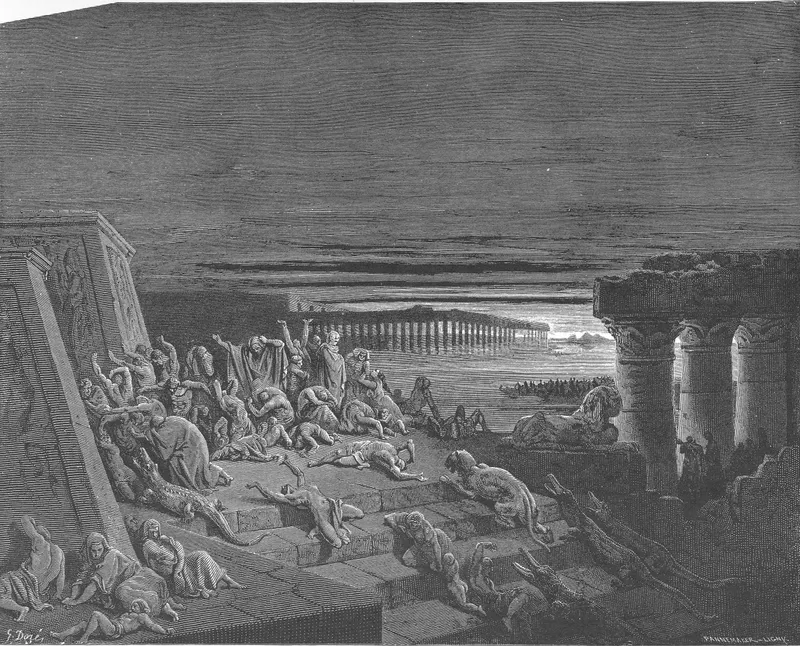
Not just darkness - "darkness which may be felt." This is tangible. This is a darkness so thick it presses against the skin, so complete it seems solid. For three days, Egypt sits in this thickness, unable to move, unable to see, unable to function. Ra is gone. The sun is gone. There is nothing.
Three days. Not two. Not four. The same number of days that will later define resurrection. Jesus rises on the third day. Here, Egypt is in darkness for three days - the land of the empty tomb before the tomb opens. While Pharaoh sits blind, God is already writing a message in the sky.
Moses stretches out his hand a final time before the darkness breaks. His hand, raised toward heaven, becomes the channel through which God withdraws light itself. No more negotiation. No more compromise. Just the pure power of a God who can unmake the world.
Exodus 10:24-26The Cattle Must Go Too
24And Pharaoh called unto Moses, and said, Go ye, serve the LORD; only let your flocks and your herds be stayed: let your little ones also go with you. 25And Moses said, Thou must give us also sacrifices and burnt offerings, that we may sacrifice unto the LORD our God. 26Our cattle also shall go with us; there shall not an hoof be left behind; for thereof must we take to serve the LORD our God; and we know not with what we must serve the LORD, until we come thither.
Pharaoh offers the same compromise again: the people can go, but the animals stay. The cattle are the wealth of Egypt. The cattle are leverage. The cattle are proof that Pharaoh still has power over the Hebrews.
Moses does not barter. He does not negotiate. He speaks the requirement: "Thou must give us also sacrifices and burnt offerings." Moses is not asking for permission to leave. He is stating what complete obedience looks like. And it includes everything.
Exodus 10:27-29I Will See Thy Face No More
27But the LORD hardened Pharaoh’s heart, and he would not let them go. 28And Pharaoh said unto him, Get thee from me, take heed to thyself, see my face no more; for in that day thou seest my face thou shalt die. 29And Moses said, Thou hast spoken well, I will see thy face again no more.
The pattern reaches its end. Nine plagues. Nine refusals. Nine moments when Pharaoh could have bent and chosen life. And now the text is final: "he would not let them go." Not "could not." Would not. This is the hardness of a will that has chosen itself over God one too many times.
"Get thee from me." Pharaoh orders Moses out. The king of Egypt, surrounded by the wreckage of nine plagues, announces that he will speak to Moses no more. But he has already spoken. And what he has said is: I choose my own darkness.
And Moses agrees. "Thou hast spoken well. I will see thy face again no more." Moses walks out of Pharaoh's presence. The negotiation is over. God will act alone now. Pharaoh has made his choice, and Moses has accepted it. What comes next is deliverance.
Research trail
Sources & further study
These references support the historical, linguistic, manuscript, and contextual notes in this chapter. Scripture remains the primary text; external sources are provided so readers can inspect the research directly.