Exodus 28
People in this chapter
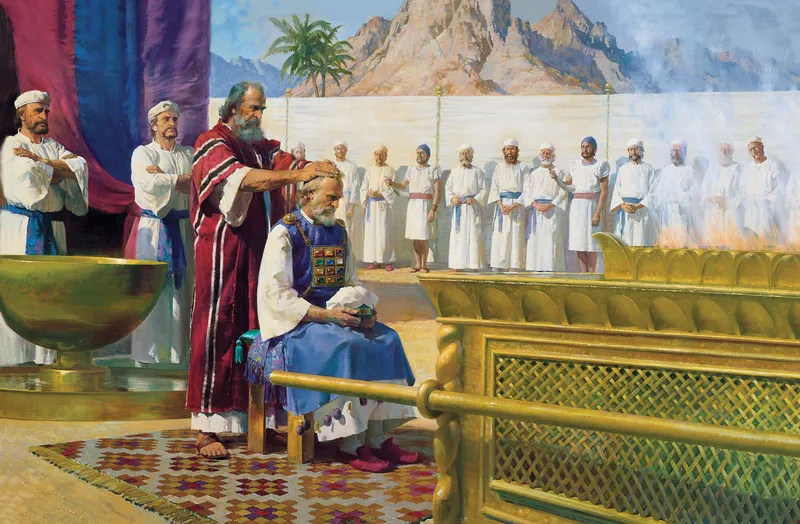
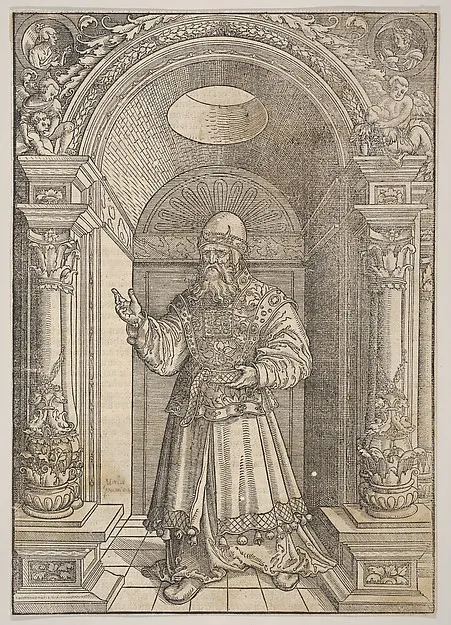
Exodus 28 takes us inside the tabernacle workshop to dress the high priest. His garments are unlike any ordinary clothes - they are instruments of priesthood itself. The ephod holds the names of Israel's twelve tribes on its shoulder stones, one name on each shoulder: the priest bears them in strength on his shoulders, always visible to the Lord. The breastplate holds twelve more stones, one for each tribe, placed directly over the heart. These are the Urim and Thummim - the lots by which Israel sought God's guidance.
A blue robe rings with bells and pomegranates, sounding his movements as he ministers before the Lord. And on his forehead, a golden plate engraved with "Holiness to the Lord," declaring that whatever is offered here is offered to the Lord alone.
Tap highlighted text to jump to notes, then scroll back to where you were.
Exodus 28:1-5Aaron Set Apart
1And take thou unto thee Aaron thy brother, and his sons with him, from among the children of Israel, that he may minister unto me in the priest’s office, even Aaron, Nadab and Abihu, Eleazar and Ithamar, Aaron’s sons.
Aaron is not chosen because of special qualification or prior training. He is simply called out from Israel and set apart for the Lord's service. The priesthood is God's gift. His sons are named: Nadab and Abihu will later die for offering strange fire before the Lord (Leviticus 10:1-2), so even priestly calling carries the weight of covenant obedience12.
2And thou shalt make holy garments for Aaron thy brother for glory and for beauty.
The priest's garments are made for glory and beauty - they display the dignity of the office and the loveliness of serving the Lord. A holy priesthood is not meant to hide; it is meant to make visible what it looks like to stand before God3.
3And thou shalt speak unto all that are wise hearted, whom I have filled with the spirit of wisdom, that they may make Aaron’s garments to consecrate him, that he may minister unto me in the priest’s office.
4And these are the garments which they shall make; a breastplate, and an ephod, and a robe, and a broidered coat, a mitre, and a girdle: and they shall make holy garments for Aaron thy brother, and his sons, that he may minister unto me in the priest’s office.
5And they shall take gold, and blue, and purple, and scarlet, and fine linen.
Gold, blue, purple, and scarlet are the colors of heaven and royalty. Fine linen speaks of purity. Every material was freely given by the people in their offering - the same materials that built the tabernacle itself. The priest's garments, like the tabernacle, are a gift from the congregation.
Exodus 28:6-12The Ephod and Shoulder Stones
6And they shall make the ephod of gold, of blue, and of purple, of scarlet, and fine twined linen, with cunning work.
7It shall have the two shoulderpieces thereof joined at the two edges thereof; and so it shall be joined together.
8And the curious girdle of the ephod, which is upon it, shall be of the same, according to the work thereof; even of gold, of blue, and purple, and scarlet, and fine twined linen.
9And thou shalt take two onyx stones, and grave on them the names of the children of Israel: 10Six of their names on one stone, and the other six names of the rest on the other stone, according to their birth.
Two onyx stones, one on each shoulder. The twelve tribes of Israel - all of them, ordered by birth - are engraved on these stones. This is not a decoration; this is the priest's most sacred work: to carry the names of God's people into the presence of God, bearing them on his shoulders in strength.
11With the work of an engraver in stone, like the engravings of a signet, shalt thou engrave the two stones with the names of the children of Israel: thou shalt make them to be set in ouches of gold. 12And thou shalt put the two stones upon the shoulders of the ephod for stones of memorial unto the children of Israel: and Aaron shall bear their names before the LORD upon his two shoulders for a memorial.
Exodus 28:15-30The Breastplate and Urim and Thummim
15And thou shalt make the breastplate of judgment with cunning work; after the work of the ephod thou shalt make it; of gold, of blue, and of purple, and of scarlet, and of fine twined linen, shalt thou make it.
16Foursquare it shall be being doubled; a span shall be the length thereof, and a span shall be the breadth thereof.
17And thou shalt set in it settings of stones, even four rows of stones: the first row shall be a sardius, a topaz, and a carbuncle: this shall be the first row. 18And the second row shall be an emerald, a sapphire, and a diamond. 19And the third row a ligure, an agate, and an amethyst. 20And the fourth row a beryl, and an onyx, and a jasper: they shall be set in gold in their inclosings.
Twelve stones, one for each tribe, arranged in four rows. These are the same twelve stones, in the same order, that will later be set in the foundation walls of the New Jerusalem (Revelation 21:14, though there called the twelve apostles). The breastplate sits directly over the priest's heart. When the priest stands before God, the tribes are held against his heart.
21And the stones shall be with the names of the children of Israel, twelve, according to their names, like the engravings of a signet; every one with his name shall they be according to the twelve tribes.
29And Aaron shall bear the names of the children of Israel in the breastplate of judgment upon his heart, when he goeth in unto the holy place, for a memorial before the LORD continually.
30And thou shalt put in the breastplate of judgment the Urim and the Thummim; and they shall be upon Aaron’s heart, when he goeth in before the LORD: and Aaron shall bear the judgment of the children of Israel upon his heart before the LORD continually.
The Urim and Thummim - "lights and perfections" - were likely sacred lots placed in a pouch in the breastplate. When Israel needed to know God's will, the priest would consult them. The exact mechanism is not explained; it remains mysterious. What matters is that God made a way for His people to ask and receive an answer. Guidance was held in the priest's hands, literally over his heart.
Exodus 28:31-35The Robe with Bells and Pomegranates
31And thou shalt make the robe of the ephod all of blue.
32And there shall be an hole in the top of it, in the midst thereof: it shall have a binding of woven work round about the hole of it, as it were the hole of an habergeon, that it be not rent.
33And beneath upon the hem of it thou shalt make pomegranates of blue, and of purple, and of scarlet, round about the hem thereof; and bells of gold between them round about:
Bells and pomegranates alternate on the hem of the blue robe. One ornament speaks of fruit, abundance, fertility - the blessing of God's fruitfulness. One speaks of sound, presence, announcement. As the priest moves through the tabernacle, his movements are heard. He does not approach God in silence; his service makes a sound.
34A golden bell and a pomegranate, a golden bell and a pomegranate, upon the hem of the robe round about. 35And it shall be upon Aaron to minister: and his sound shall be heard when he goeth in unto the holy place before the LORD, and when he cometh out, that he die not.
The bells serve a life-and-death purpose. If the priest entered the holy place unworthy or in uncleanness, he could die in God's presence (Numbers 4:15-20, 1 Samuel 6:19). The bells announced his movement; silence would mean danger. The sound of his work is the sound of his ongoing faithfulness.
Exodus 28:36-43The Holiness Plate
36And thou shalt make a plate of pure gold, and grave upon it, like the engravings of a signet, HOLINESS TO THE LORD.
A golden plate for the priest's forehead. On it, the words "Holiness to the Lord" - to the Lord, dedicated entirely to God. Every act of priestly service belongs to God alone. The plate is worn on the forehead, the place of highest visibility, the seat of thought and intention. The priest's whole mind is set toward the holiness of God.
37And thou shalt put it on a blue lace, that it may be upon the mitre; upon the forefront of the mitre it shall be.
38And it shall be upon Aaron’s forehead, that Aaron may bear the iniquity of the holy things, which the children of Israel shall hallow in all their holy gifts; and it shall be always upon his forehead, that they may be accepted before the LORD.
The plate declares "Holiness to the Lord," yet Aaron bears the iniquity of the holy things. This mystery - that the priest wears both the declaration of holiness and the burden of the people's imperfection - points to the one High Priest who alone can reconcile these two truths. The priest is both holy and sinful; the sacrifice must be both.
39And thou shalt embroider the coat of fine linen, and thou shalt make the mitre of fine linen, and thou shalt make the girdle of needlework.
40And for Aaron’s sons thou shalt make coats, and thou shalt make for them girdles, and bonnets shalt thou make for them, for glory and for beauty. 41And thou shalt put them upon Aaron thy brother, and his sons with him; and shalt anoint them, and consecrate them, and sanctify them, that they may minister unto me in the priest’s office.
42And thou shalt make them linen breeches to cover their nakedness; from the loins even unto the thighs they shall reach: 43And they shall be upon Aaron, and upon his sons, when they come in unto the tabernacle of the congregation, or when they come near unto the altar to minister in the holy place; that they bear not iniquity, and die: it shall be a statute for ever unto him and his seed after him.
Even the priest's body is covered and protected by the garments. Nothing is left exposed in God's presence. This is not shame; it is mercy. The priest is covered so that he might live in the presence of holiness. The garments do not hide the priest - they protect him.
Exodus 28: Priestly GarmentsA Priest Set Apart
From head to toe, Aaron is dressed to stand before God on behalf of Israel. The names of the tribes rest on his shoulders in strength and lie over his heart in love. The Urim and Thummim rest in his hands. Bells announce his faithful work. And on his forehead, written in gold: "Holiness to the Lord." Every detail answers a question Israel had: Does God see us? Does He know our names? Can we come before Him? The answer is yes - through a priest who carries you, bears your name, and brings you into the presence of God.
Research trail
Sources & further study
These references support the historical, linguistic, manuscript, and contextual notes in this chapter. Scripture remains the primary text; external sources are provided so readers can inspect the research directly.