Ezra 9
People in this chapter
Ezra 9 opens with crisis. The exiles have returned. The temple foundation is laid. Worship is being restored. And then, in a devastating report, the princes come to Ezra with word that the people have done the very thing they were commanded not to do: they have intermarried with the surrounding nations - Canaanites, Hittites, Perizzites, Jebusites, Amorites, Egyptians. The problem is spiritual. To marry into these peoples is to invite their gods, their practices, their ways into the heart of the returning remnant.
Tap any highlighted phrase to jump to the commentary that unpacks it.
Ezra 9:1-2The Holy Seed Mingled
1Now when these things were done, the princes came to me, saying, The people of Israel, and the priests, and the Levites, have not separated themselves from the people of the lands, doing according to their abominations, even of the Canaanites, the Hittites, the Perizzites, the Jebusites, the Ammonites, the Moabites, the Egyptians, and the Amorites. 2For they have taken of their daughters for themselves, and for their sons: so that the holy seed have mingled themselves with the people of those lands: yea, the hand of the princes and rulers hath been chief in this trespass.
The princes come to Ezra as witnesses to what has already happened. They have compromised the boundary that was meant to keep them separate. The list is long and deliberate: seven nations whose gods and practices the law explicitly forbade. To marry their daughters is to invite those gods into the home, into the family, into the heart of the remnant. 1
Separation in Scripture is about covenant. When God called Israel to separate themselves from the nations, He was saying "you belong to Me in a particular way, and that belonging requires that you not bind yourselves to practices and gods that would pull you away from covenant." The separation is unto God2.
Notably, the princes themselves have been chief in this trespass. This is not a failure of the common people alone - those who were meant to guard the boundary have crossed it first. The leadership, the ones who should have protected the people from compromise, have led them into it. This makes the crisis more acute.
Ezra 9:3-5The Rending of Garment and Soul
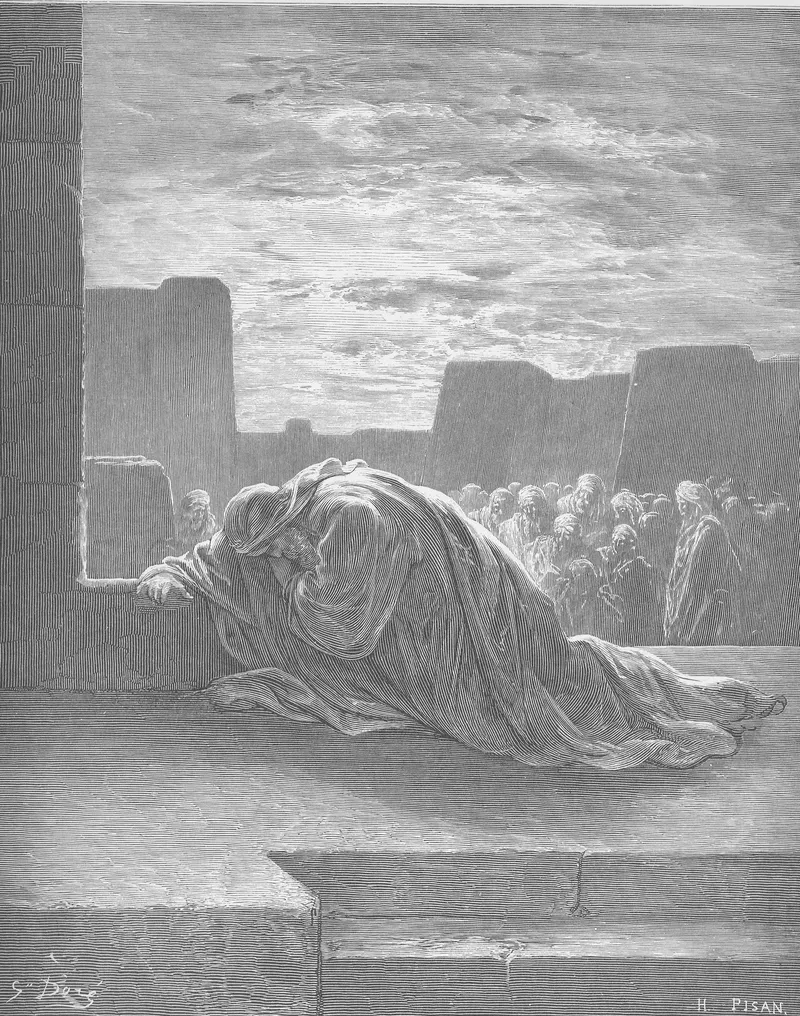
3And when I heard this thing, I rent my garment and my mantle, and plucked off the hair of my head and of my beard, and sat down astonied. 4Then were assembled unto me every one that trembled at the words of the God of Israel, because of the transgression of those that had been carried away; and I sat astonied until the evening sacrifice. 5And at the evening sacrifice I arose up from my heaviness; and having rent my garment and my mantle, I fell upon my knees, and spread out my hands unto the LORD my God,
Ezra does not respond to the news with bureaucratic efficiency. He tears his outer garments - visible, public signs of his distress. This is a spiritual wound that he embodies, that he wears on his body. His response mirrors the response of Job, of Jacob, of those who encounter catastrophic loss.
The plucking of hair from head and beard is one of the most extreme signs of distress in biblical culture. This is anguish given physical form. Ezra is devastated, identifying with their shame, pulling out his hair as if to say: the whole of me is undone by this transgression.
Ezra "sat astonied" - a silence that lasted hours, stretching until evening worship. This is a man genuinely undone, waiting in silence for the moment when, in the presence of the altar and the offering, he can finally speak to God. The structure of his response is itself a theology: first the body speaks (tearing clothes, pulling hair), then silence, then prayer at the place where heaven and earth meet.
Those who "trembled at the words of the God of Israel" gather to Ezra. These are the faithful remnant - the ones who understand that covenant with God is not negotiable. They are drawn to Ezra in solidarity with his grief, sitting with him in his silence.
Notice that Ezra tears his garments a second time - once when he hears the news, and again when he rises to pray. His physical distress is not a one-time gesture. It frames his entire response, from hearing to confession.
At the evening sacrifice - the moment when the people's worship meets God in the sanctuary - Ezra falls upon his knees. This is the position of the suppliant, the penitent, the one who has nothing to stand on except God's mercy. He does not stand to pronounce judgment. He kneels to intercede.
Spreading out the hands is the ancient posture of prayer - the whole body opened toward God, empty, asking. This is how Moses lifted his hands for Israel, how Solomon spread his hands at the dedication of the temple, how Jesus stretched His arms on the cross. Ezra adopts the posture of every intercessor.
Ezra 9:6-7Ashamed to Lift Up His Face
6And said, O my God, I am ashamed and blush to lift up my face to thee, my God: for our iniquities are increased over our head, and our trespass is grown up unto the heavens. 7Since the days of our fathers have we been in a great trespass unto this day; and for our iniquities have we, our kings, and our priests, been delivered into the hand of the kings of the lands, to the sword, to captivity, and to a spoil, and to confusion of face, as it is this day.
Ezra begins his prayer with confession: "I am ashamed and blush to lift up my face to thee." This is the language of one who can no longer meet the eyes of the one he has offended. Yet precisely in that shame, uttered before God, lies the beginning of restoration. He confesses as the representative of the people: "Our iniquities. Our trespass. We have been delivered."
Ezra acknowledges that their transgressions are not small matters - they have "increased over our head" and grown "up unto the heavens." The image is one of weight, of a burden so great it towers above them. They are crushed under the accumulation of their own sin. Yet by naming it, by refusing to minimize it, Ezra opens the possibility of its being forgiven.
Ezra traces the transgression back to the days of their fathers. This is not blame-shifting. It is acknowledging a pattern of covenant-breaking that extends across generations. They are not suddenly fallen from righteousness - they have been a trespassing people all along. Only now, at the moment of return and restoration, does the weight of this history become unbearable.
Ezra 9:8-9The Nail in the Holy Place
8And now for a little space grace hath been shewed from the LORD our God, to leave us a remnant to escape, and to give us a nail in his holy place, that our God may lighten our eyes, and give us a little reviving in our bondage. 9For we were bondmen; yet our God hath not forsaken us in our bondage, but hath extended mercy unto us in the sight of the kings of Persia, to give us a reviving, to set up the house of our God, and to repair the desolations thereof, and to give us a wall in Judah and in Jerusalem.
Even in the midst of acknowledging the weight of transgression, Ezra glimpses mercy. God has left them "a remnant to escape." Some remain. Some have been preserved. This is grace - unmerited favor falling like rain on a people who have no claim to it. The remnant is a gift in the midst of judgment.
The image of the "nail in his holy place" is one of the most beautiful and mysterious in Scripture. A nail, driven into rock, is fixed. It does not move. It does not waver. It holds. In the holy place - in the very sanctuary where the people meet God - there is a nail. What does it hold? The people themselves. The hope of restoration. The promise that even though they are unfaithful, God's steadfastness cannot be shaken. This image will echo forward in Isaiah 22:23, where the Messiah Himself is called "a nail in a sure place."
Ezra prays for "a little reviving." The return is partial. The revival is incomplete. Yet that little revival - the ability to rebuild the temple, to restore worship, to have a wall around Jerusalem - is itself a miracle. It is mercy measured in small graces, but graces nonetheless.
Though they were captives in Persia, God extended mercy in the sight of the Persian kings. The king himself commissioned the rebuilding. They remain subjects, and within that bondage God has provided the space to worship, to rebuild, to hope. Sometimes mercy arrives as the gift of a little space, a little light, within circumstances we cannot escape.
Ezra 9:10-12What Can We Say After This?
10And now, O our God, what shall we say after this? for we have forsaken thy commandments, 11Which thou hast commanded by thy servants the prophets, saying, The land, unto which ye go to possess it, is an unclean land with the filthiness of the people of the lands, with their abominations, which have filled it from one end to another with their uncleanness. 12Now therefore give not your daughters unto their sons, neither take their daughters unto your sons, nor seek their peace or their wealth for ever: that ye may be strong, and eat the good of the land, and leave it for an inheritance to your children for ever.
Ezra's rhetorical question - "What shall we say after this?" - is the cry of one who has no defense. There is no excuse. The commandment was clear. The boundary was explicit. They knew. They chose to cross it. And now Ezra stands before God with no words to offer except the recognition of his own wordlessness.
The word "forsaken" (azab) means to abandon, to turn one's back on. Ezra is not saying they sinned accidentally. He is saying they willfully abandoned the covenant. They knew the commandment. They turned away from it. And in turning away, they turned toward the gods and practices of the nations.
Ezra quotes the prohibition: the land is unclean, filled with the uncleanness of the peoples who dwell there. Intermarrying with those peoples is a spiritual danger, an invitation of uncleanness into the holy seed, into the family of God.
The promise is that separation for the Lord will bring blessing. They will "eat the good of the land, and leave it for an inheritance to your children for ever." The preservation of a holy seed is tied to their capacity to remain separate from the surrounding nations.
Ezra 9:13-15We Cannot Stand Before Thee
13And after all that is come upon us for our evil deeds, and for our great trespass, seeing that thou our God hast punished us less than our iniquities deserve, and hast given us such deliverance as this; 14Should we again break thy commandments, and join in affinity with the people of these abominations? wouldest not thou be angry with us till thou hadst consumed us, so that there should be no remnant nor escaping? 15O LORD God of Israel, thou art righteous: for we remain yet escaped, as it is this day: behold, we are before thee in our trespasses: for we cannot stand before thee because of this.
Ezra acknowledges the mercy that has already been extended - they were taken into captivity, yet were not destroyed. They were punished less than their iniquities deserved. This is the paradox of mercy: given because God is merciful, and that very mercy makes the continuation in sin unthinkable.
At the heart of Ezra's prayer stands a single word: "Thou art righteous." This is the acknowledgment that God's character is unchanging, His justice absolute. And before the face of that righteous God, Ezra and his people have nothing to claim except their transgression. Yet in that very righteous character lies hope - for a righteous God is one who keeps covenant, who acts with integrity, who does what He has promised.
They remain "a people escaped." Not many. Not all. But some. The remnant is evidence that God has not completely cut off His people. There is still a future. There is still a possibility of restoration. And yet that deliverance only heightens their responsibility: to the mercy that has been shown to them, they owe a covenant response.
Ezra says they are "before thee in our trespasses" - standing in God's presence, not hidden, not defended, but fully exposed in their transgression. This is the stance of the honest sinner: no hiding, no excuse, no attempt to justify. Simply: here we are, in our trespasses, before You.
The final confession is absolute: "We cannot stand before thee because of this." This is the recognition that guilt has a weight, that transgression separates, that there is no way to stand in the presence of holiness while clothed in unconfessed sin. Only confession, only the acknowledgment of that separation, can become the ground of reunion. Ezra does not stand. He kneels. He cannot stand. And in that kneeling lies the only path to restoration.
Research trail
Sources & further study
These references support the historical, linguistic, manuscript, and contextual notes in this chapter. Scripture remains the primary text; external sources are provided so readers can inspect the research directly.