Genesis 48
People in this chapter
Genesis 48 is a moment of divine reversal played out in the fading eyesight and steady faith of an old man on his deathbed 1. Jacob hears that Joseph has brought his two sons to be blessed. The names Manasseh and Ephraim are not accidents - they are Joseph's thanksgiving, the names he gave his sons in Egypt to remember how God had dealt with him in exile : "causing to forget" the pain, and "fruitful" in the midst of estrangement.
Now Jacob, Israel, will adopt these two boys into the covenant. But he will do something that will echo through Scripture: he will bless the younger over the older. Again.
Tap any highlighted phrase to jump to the commentary that unpacks it.
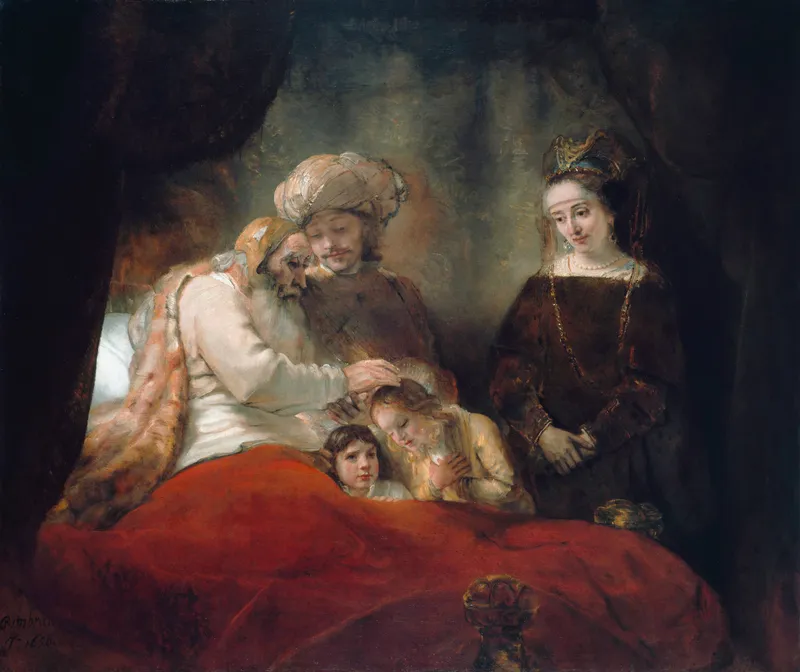
Genesis 48:1-4Joseph Brings His Sons
1And it came to pass after these things, that one told Joseph, Behold, thy father is sick: and he took with him his two sons, Manasseh and Ephraim. 2And one told Jacob, and said, Behold, thy son Joseph cometh unto thee: and Israel strengthened himself, and sat upon the bed. 3And Jacob said unto Joseph, God Almighty appeared unto me at Luz in the land of Canaan, and blessed me, 4And said unto me, Behold, I will make thee fruitful, and multiply thee, and I will make of thee a multitude of people; and will give this land to thy seed after thee for an everlasting possession.
Jacob is dying. His eyes are about to go dim. Yet the text says he strengthened himself - gathered his remaining strength, sat up in the bed. What is coming in the next verses will take everything he has left. He knows it. An old man summoning the last reserves of his life for one more blessing.
Jacob walks back through his own story. The promise God gave him at Bethel - fruitfulness, multiplication, the land as an everlasting possession - is the promise he is about to hand on. He is not inventing a blessing. He is passing down what was given to him.
Genesis 48:5-7Manasseh and Ephraim Are Mine
5And now thy two sons, Ephraim and Manasseh, which were born unto thee in the land of Egypt before I came unto thee into Egypt, are mine; as Reuben and Simeon, they shall be mine. 6And thy issue, which thou begettest after them, shall be thine, and shall be called after the name of their brethren in their inheritance. 7And as for me, when I came from Padan, Rachel died by me in the land of Canaan in the way, when yet there was but a little way to come unto Ephrath: and I buried her there in the way of Ephrath; the same is Bethlehem.
Jacob is not just blessing Joseph's sons. He is adopting them. Ephraim and Manasseh will now be counted as his own - full sons, not grandsons - as if they were Reuben and Simeon, the first two sons of Jacob. Joseph's bloodline will become Jacob's bloodline. Two tribes will come from what Joseph thought was exile.
Jacob pauses and speaks of Rachel. She died trying to give him a second son in Canaan, trying to reach Bethlehem. Now, in Egypt, Joseph has given him two sons from the Egyptian woman he married there. There is loss in this moment, but there is also grace. God has not left Joseph without sons; He has given him more than Jacob expected.
Genesis 48:8-12Israel's Dim Eyes
8And Israel beheld Joseph’s sons, and said, Who are these? 9And Joseph said unto his father, They are my sons, whom God hath given me in this place. And he said, Bring them, I pray thee, unto me, and I will bless them. 10Now the eyes of Israel were dim for age, so that he could not see. And he brought them near unto him; and he kissed them, and embraced them. 11And Israel said unto Joseph, I had not thought to see thy face: and, lo, God hath shewed me also thy seed. 12And Joseph brought them out from between his knees, and he bowed himself with his face to the earth.
The old man cannot see the boys in front of him. But his hands will not fail. His faith will not fail. In the Bible, sight goes and stays goes, but the seeing that matters - spiritual sight, the recognition of God's work - that only deepens with age.
Jacob says something tender: “I had not thought to see thy face: and, lo, God hath shewed me also thy seed.” To see Joseph alive is already more than he dared hope (he thought Joseph was dead, torn by a wild beast, these many years). But to be shown Joseph's sons, to hold them, to bless them - that is abundance beyond expectation.
Genesis 48:13-16Right Hand on the Younger
13And Joseph took them both, Ephraim in his right hand toward Israel’s left hand, and Manasseh in his left hand toward Israel’s right hand, and brought them near unto him. 14And Israel stretched out his right hand, and laid it upon Ephraim’s head, who was the younger, and his left hand upon Manasseh’s head, guiding his hands wittingly; for Manasseh was the firstborn. 15And he blessed Joseph, and said, God, before whom my fathers Abraham and Isaac did walk, the God which fed me all my life long unto this day, 16The Angel which redeemed me from all evil, bless the lads; and let my name be named on them, and the name of my fathers Abraham and Isaac; and let them grow into a multitude in the midst of the earth.
Joseph positions his sons deliberately. The older, Manasseh, is on Jacob's right. The younger, Ephraim, is on Jacob's left. But Jacob - guided by something deeper than habit - crosses his hands. His right hand, the hand of the primary blessing, goes to the younger. Joseph sees it and objects. But Jacob refuses to correct the crossing. He is doing this on purpose.
The younger blessed over the older. Again. For the fifth time in Genesis, the pattern repeats: Abel over Cain, Isaac over Ishmael, Jacob over Esau, and now Ephraim over Manasseh. In the last days, Jesus will say, “The last shall be first.” He will make that promise in the ears of a world that ranks by age, by strength, by who got there first. God's kingdom runs on the logic of grace.
Jacob blesses Joseph, not the boys - but it is Joseph's listening ear that the words are meant to land on. "The God which fed me all my life long." Jacob is ancient now. He is counting the provisions. Every meal, every narrow escape, every time God did not let him die. All of it adds up. A life fed.
Genesis 48:17-20Hold Still Your Hand
17And when Joseph saw that his father laid his right hand upon the head of Ephraim, it displeased him: and he held up his father’s hand, to remove it from Ephraim’s head unto Manasseh’s head. 18And Joseph said unto his father, Not so, my father: for this is the firstborn; put thy right hand upon his head. 19And his father refused, and said, I know it, my son, I know it: he also shall become a people, and he also shall be great: but truly his younger brother shall be greater than he, and his seed shall become a multitude of nations. 20And he blessed them that day, saying, In thee shall Israel bless, saying, God make thee as Ephraim and as Manasseh: and he set Ephraim before Manasseh.
Joseph protests. It is natural to protest. The firstborn deserves the right hand. This is how the world works. But Jacob refuses to move his hand. I know it, my son, I know it. An old man, half-blind, letting his son see that the crossing is intentional. Deliberate. Rooted in something deeper than ceremony.
Jacob speaks a promise over both boys - both will be great, both will become peoples. But one is greater. Ephraim, the younger, will have a larger seed. Will multiply into more nations. The name Ephraim will become so large that it will sometimes name all of northern Israel. (The prophet Jeremiah will later call Israel "Ephraim" as a mark of intimacy and hope.) What Jacob sees in the Spirit, he names.
Jacob establishes a blessing formula that will outlive both boys. From this day on, when parents in Israel bless their children, they will say: "God make thee as Ephraim and as Manasseh." A formula set down once will be repeated for generations. The blessing becomes the language of the people.
Genesis 48:21-22I Die, but God Shall Be With You
21And Israel said unto Joseph, Behold, I die: but God shall be with you, and bring you again unto the land of your fathers. 22Moreover I have given to thee one portion above thy brethren, which I took out of the hand of the Amorite with my sword and with my bow.
Jacob is direct. He is dying. But the next breath belongs to the promise: God shall be with you. When the father dies, the Father continues. The covenant moves on.
Jacob gives Joseph a name-portion, a birthright - the double inheritance that belonged to the firstborn. Joseph, though the younger (Reuben was technically the eldest), gets the portion meant for the firstborn. It is a final crossing of hands. A final reversal - the same pattern carried through, now to its completion.
Jacob speaks of taking the land "with my sword and with my bow" - but the victory he means is the inner kind: prayer, faith, wrestling with God. The poet borrows the language of warfare to name the real conquest: the strength to believe when everything says disbelieve, to hold on when everything says let go.
Research trail
Sources & further study
These references support the historical, linguistic, manuscript, and contextual notes in this chapter. Scripture remains the primary text; external sources are provided so readers can inspect the research directly.