Joshua 8
People in this chapter
Joshua 8 follows immediately after the humiliation of chapter 7, when Israel was routed at Ai because of Achan's hidden sin. Now, with Achan removed and the nation cleansed, God speaks again to Joshua in words he has heard before: "Fear not, neither be thou dismayed." The command that opened the conquest must be renewed after every stumble. This chapter shows two back-to-back commands: conquer Ai through strategy, then stop and worship. Not one or the other - both.
Tap any highlighted phrase to jump to the commentary that unpacks it.
Joshua 8:1"Fear Not, Neither Be Dismayed"
1And the LORD said unto Joshua, Fear not, neither be thou dismayed: take all the people of war with thee, and arise, go up to Ai: see, I have given into thy hand the king of Ai, and his people, and his city, and his land:
These words open Joshua's calling in Joshua 1:9. Now, after the shame of Achan, after Israel's first defeat, after the people have wept in dust, God speaks them again. The tone is tender and resolute: "I am still here; fear remains a choice you must refuse." Courage is the renewed choice to obey despite fear, again and again.
1And the LORD said unto Joshua, Fear not, neither be thou dismayed: take all the people of war with thee, and arise, go up to Ai: see, I have given into thy hand the king of Ai, and his people, and his city, and his land:
God says, "Take all the people of war with thee" - every able-bodied warrior, the full commitment of Israel's strength. The people are not divided or withheld. Conquest demands the whole people.
For Jericho, the strategy was God's - march and blow trumpets. For Ai, Joshua receives a military blueprint: divide the force, draw them out, spring the trap from behind. God gives not just the victory but the method. Here Israel fights as warriors, using intellect and strategy, under God's guarantee.
Joshua 8:2-13The Ambush: Strategy and Concealment
2And thou shalt do to Ai and her king as thou didst unto Jericho and her king: only the spoil thereof, and the cattle thereof, shall ye take for a prey unto yourselves: lay thee an ambush for the city behind it. 3So Joshua arose, and all the people of war, to go up against Ai: and Joshua chose out thirty thousand mighty men of valour, and sent them away by night.
Thirty thousand men - a massive reserve force - are selected and deployed in the dark. This is deliberate and calculated. Joshua does not hide the fact of the ambush from his troops; what is hidden is the ambush itself from Ai. The whole strategy depends on a portion of Israel concealing themselves so completely that the men of Ai will not suspect them.
4And he commanded them, saying, Behold, ye shall lie in wait against the city, even behind the city: go not very far from the city, but be ye all ready: 5And I, and all the people that are with me, will approach unto the city: and it shall come to pass, when they come out against us, as at the first, that we will flee before them,
The waiting force is positioned behind the city, not far from it - close enough to respond when the signal is given. Distance is the enemy of coordination; Joshua keeps the trap tight. They wait while the city rouses and marches out, their eyes on the fleeing army before them, blind to what is behind.
6(For they will come out after us) till we have drawn them from the city; for they will say, They flee before us, as at the first: therefore we will flee before them. 7Then ye shall rise up from the ambush, and seize upon the city: for the LORD your God will deliver it into your hand.
Joshua and his men will flee - but it is a feigned flight. They are not really retreating; they are drawing. The men of Ai will read it as panic, as a repeat of the route at chapter 7. Joshua knows what their eyes will see and what their pride will believe. He is using their own triumph against them.
8And it shall be, when ye have taken the city, that ye shall set the city on fire: according to the commandment of the LORD shall ye do. See, I have commanded you. 9Joshua therefore sent them forth: and they went to lie in ambush, and abode between Bethel and Ai, on the west side of Ai: but Joshua lodged that night among the people.
The text repeats the command to draw them out and the reason - Ai's confidence born from yesterday's victory. They defeated Israel once; they believe they will do it again. Joshua trusts in their pride to pull them away from the city's protection.
10And Joshua rose up early in the morning, and numbered the people, and went up, he and the elders of Israel, before the people to Ai. 11And all the people, even the people of war that were with him, went up, and drew nigh, and came before the city, and pitched on the north side of Ai: now there was a valley between them and Ai. 12And he took about five thousand men, and set them to lie in ambush between Bethel and Ai, on the west side of the city. 13And when they had set the people, even all the host that was on the north of the city, and their liers in wait on the west of the city, Joshua went that night into the midst of the valley.
The fire is the signal. When smoke rises from Ai, the waiting force will know the main army has engaged the city's defenders and drawn them out. The fire turns the trap from invisible to undeniable - the moment when the men of Ai turn and realize the city burns behind them, and no retreat is possible.
Joshua 8:14-29The Trap Sprung: Smoke, Flight, and the King on the Tree
14And it came to pass, when the king of Ai saw it, that they hasted and rose up early, and the men of the city went out against Israel to battle, he and all his people, at a time appointed, before the plain; but he wist not that there were liers in ambush against him behind the city. 15And Joshua and all Israel made as if they were beaten before them, and fled by the way of the wilderness. 16And all the people that were in Ai were called together to pursue after them: and they pursued after Joshua, and were drawn away from the city.
The king of Ai hastens because he sees Joshua's army and knows yesterday's victory. Speed and confidence are the traps. He marches out with all his people - the city is left defended only by those too young, too old, or too sick to fight. This is what Joshua counted on.
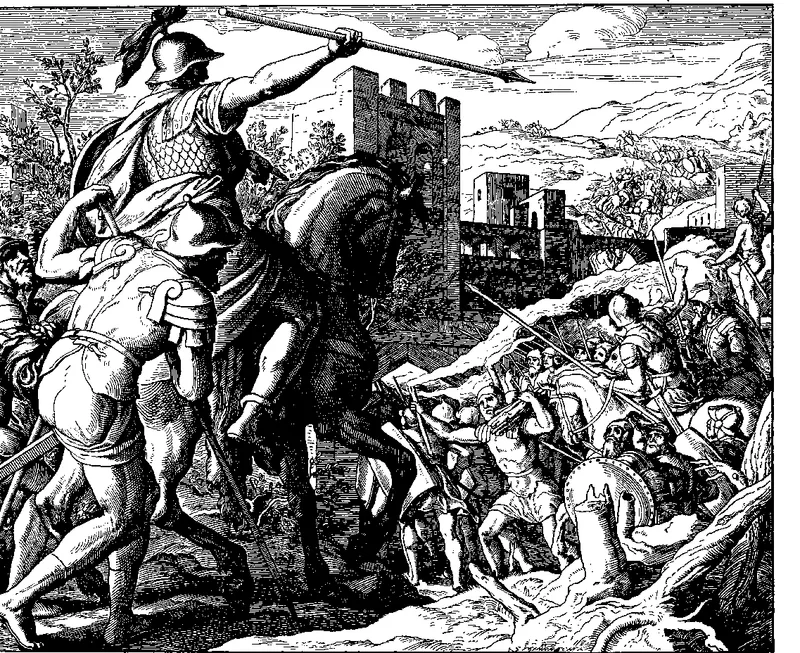
17And there was not a man left in Ai or Bethel, that went not out after Israel: and they left the city open, and pursued after Israel. 18And the LORD said unto Joshua, Stretch out the spear that is in thy hand toward Ai; for I will give it into thine hand. And Joshua stretched out the spear that he had in his hand toward the city.
The city is now utterly exposed - left open - because every man capable of fighting is pursuing Joshua's feigned retreat. The trap is ready to close. Joshua waits for the moment when the ambush force must move.
19And the ambush arose quickly out of their place, and they ran as soon as he had stretched out his hand: and they entered into the city, and took it, and hasted and set the city on fire. 20And when the men of Ai looked behind them, they saw, and, behold, the smoke of the city ascended up to heaven, and they had no power to flee this way or that way: and the people that fled to the wilderness turned back upon the pursuers.
The outstretched spear is the signal. Joshua's gesture carries the army - just as in Exodus 17, when Moses held up his staff and Israel prevailed in battle. The leader's hand, raised in obedience to God's word, becomes the moment when the people move. This is the visible sign of a unified command under God's word.
21And when Joshua and all Israel saw that the ambush had taken the city, and that the smoke of the city ascended, then they turned again, and slew the men of Ai. 22And the other issued out of the city against them; so they were in the midst of Israel, some on this side, and some on that side: and they smote them, so that they let none of them remain or escape. 23And the king of Ai they took alive, and brought him to Joshua.
The city is taken, the people destroyed. But the king is taken alive. The text is leading to a moment of formal judgment. The king of Ai will face a choice about where his body will rest, and that choice will echo through Scripture.
24And it came to pass, when Israel had made an end of slaying all the inhabitants of Ai in the field, in the wilderness wherein they chased them, and when they were all fallen on the edge of the sword, until they were consumed, that all the Israelites returned unto Ai, and smote it with the edge of the sword. 25And so it was, that all that fell that day, both of men and women, were twelve thousand, even all the men of Ai. 26For Joshua drew not his hand back, wherewith he stretched out the spear, until he had utterly destroyed all the inhabitants of Ai. 27Only the cattle and the spoil of that city Israel took for a prey unto themselves, according unto the word of the LORD which he commanded Joshua. 28And Joshua burnt Ai, and made it an heap for ever, even a desolation unto this day. 29And the king of Ai he hanged on a tree until eventide: and as soon as the sun was down, Joshua commanded that they should take his carcase down from the tree, and cast it at the entering of the gate of the city, and raise thereon a great heap of stones, that remaineth unto this day.
Joshua 8:30-32The Altar on Mount Ebal: Worship After War
30Then Joshua built an altar unto the LORD God of Israel in mount Ebal, 31As Moses the servant of the LORD commanded the children of Israel, as it is written in the book of the law of Moses, an altar of whole stones, over which no man hath lift up any iron: and they offered thereon burnt offerings unto the LORD, and sacrificed peace offerings.
Mount Ebal. The mountain of curse, the mountain of judgment. After destroying the city of Ai and slaying twelve thousand people, Joshua does not press forward to the next conquest. He stops. He builds an altar on the very mountain where curses will be proclaimed. He chooses the place of judgment as the place of worship. This is a theological statement: we do not worship only in triumph; we worship in the shadow of the law's teeth.
32And he wrote there upon the stones a copy of the law of Moses, which he wrote in the presence of the children of Israel.
Whole stones, unhewn, no iron tool lifted. This is the same requirement Moses gave in Deuteronomy 27. The altar is not made by human skill or craft. It is made from what God provides, unworked, unwrought. The point is deliberate: the law does not come because humans made something clever; it comes because God gave it whole.
Joshua writes the law on the stones - engraved, plastered, public. Every Israelite can read it. Every child can see it. The law is written where all can see and know.
Joshua 8:33-35The Law Read Aloud: Blessing and Curse Before All Israel
33And all Israel, and their elders, and officers, and their judges, stood on this side the ark and on that side before the priests the Levites, which bare the ark of the covenant of the LORD, as well the stranger, as he that was born among them; half of them over against mount Gerizim, and half of them over against mount Ebal; as Moses the servant of the LORD had commanded before, that they should bless the people of Israel.
The people divide, standing on both mountains. The Levites stand between them, reading the law, proclaiming blessings and curses. The entire nation hears both words - the promise of blessing for obedience, the warning of curse for betrayal. No one gets to hear only the blessing; no one is allowed to forget the curse. The law is read in its wholeness.
34And afterward he read all the words of the law, the blessings and cursings, according to all that is written in the book of the law. 35There was not a word of all that Moses commanded, which Joshua read not before all the congregation of Israel, with the women, and the little ones, and the strangers that were conversant among them.
The strangers - the non-Israelites living among them - hear the law too. They are not excluded from the covenant reading. They stand among the people and hear every word. The law's voice reaches the whole community, bloodline and stranger alike. This is the same vision Deuteronomy 27 held: the stranger is as one born among them.
Research trail
Sources & further study
These references support the historical, linguistic, manuscript, and contextual notes in this chapter. Scripture remains the primary text; external sources are provided so readers can inspect the research directly.
- Mount Ebal Excavations and AltarArchaeological evidence from Mount Ebal including remains of early Iron Age structures and altar sites.
- Covenant Renewal and the Law Read AloudTextual parallels between Joshua 8 and Deuteronomy 27, showing the covenant renewal ceremony with blessings and curses.
- Mount Ebal and Mount Gerizim in ScriptureSBL study of the two covenant mountains and their role in Israel's covenant renewal and blessing.