Judges 16
People in this chapter
Samson has defeated Philistines with the jawbone of a donkey, carried away the gates of Gaza, and left a trail of burned crops and burnt temple1s behind him. But chapter 16 shows what every reader has sensed since chapter 13: a man with superhuman strength and deeply subhuman judgment. He goes in unto a harlot in Gaza, telling himself he is invincible. He falls in love with Delilah and tells himself he can hold back the truth.
He tells the truth to Delilah and tells himself God will wake him as before. Each time, he is catastrophically, publicly wrong.
Tap any highlighted phrase to jump to the commentary that unpacks it.
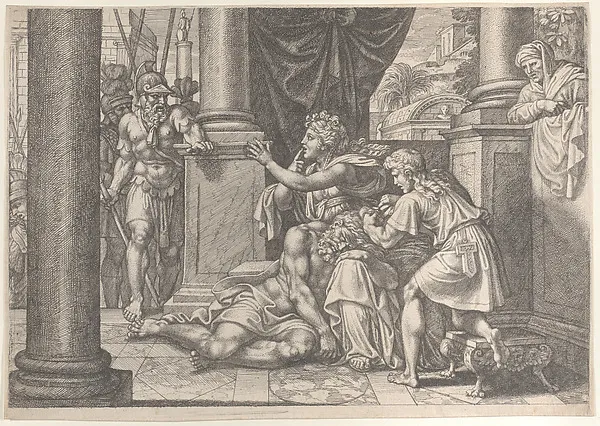
Judges 16:1-3Gaza and the Gates Carried Away
1Then went Samson to Gaza, and saw there an harlot, and went in unto her.
The chapter opens with Samson in enemy territory, in a place he should never be. A harlot in Gaza - enemy territory. No prelude, no rationalization, no resistance. The narrative moves fast, as if Samson himself moved through this decision without pausing. We will see that pattern repeat with Delilah.
2And it was told the Gazites, saying, Samson is come hither. And they compassed him in, and laid wait for him all night in the gate of the city, and were quiet all the night, saying, In the morning, when it is day, we shall kill him.
The Gazites trap him inside the walled city. The gate is shut. It is night. For anyone else, it would be the end of the story. But Samson is not anyone else - and part of the chapter's sadness is that he has learned to rely on that fact, to forget that his strength is not his own.
3And Samson lay till midnight, and arose at midnight, and took the doors of the gate of the city, and the two posts, and went away with them, bar and all, and put them upon his shoulders, and carried them up to the top of an hill that is before Hebron.
Samson simply removes the gates and carries them away. The feat is breathtaking and terrible. He walks out of the trap as if it were a joke, leaving a city with broken walls. But notice the trajectory: he uses his strength to walk away from sin and continue. This is the beginning of the end.
Judges 16:4-5Delilah's Bargain
4And it came to pass afterward, that he loved a woman in the valley of Sorek, whose name was Delilah.
Samson “loved” Delilah. The word suggests real attachment, not mere lust. This is what makes the chapter bite: he made himself vulnerable to someone who would sell him. Gaza never required that.
5And the lords of the Philistines came up unto her, and said unto her, Entice him, and see wherein his great strength lieth, and by what means we may prevail against him, that we may bind him to afflict him: and we will give thee every one of us eleven hundred pieces of silver.
The lords come to Delilah with a price: 1,100 pieces of silver. They know what Samson cannot see: that the one he loves is negotiable. That his strength is worthless against the hidden economy of betrayal. They do not ask her to kill him. They ask her to trap him. And she agrees.
Judges 16:6-14The Three Deceptions
6And Delilah said to Samson, Tell me, I pray thee, wherein thy great strength lieth, and wherewith thou mightest be bound to afflict thee.
Notice the language: “wherewith thou mightest be bound to afflict thee.” Delilah speaks as though the question is purely theoretical - to harm you, yes, but if you tell me. It is the language of intimacy wrapped around a knife. She has learned to ask about his destruction using the tone of pillow talk.
7And Samson said unto her, If they bind me with seven green withs that were never dried, then shall I be weak, and be as another man. 8Then the lords of the Philistines brought up to her seven green withs which had not been dried, and she bound him with them. 9Now there were men lying in wait, abiding with her in the chamber. And she said unto him, The Philistines be upon thee, Samson. And he brake the withs, as a thread of tow is broken when it toucheth the fire. So his strength was not known.
Samson's first lie is confident: “green withs.” He is testing. He tells her a lie, hoping to stumble her, to prove she loves him - and she does not even hesitate. She simply does it, and when he breaks the withs, Samson knows he has been tested. But does he leave? No. He stays.
10And Delilah said unto Samson, Behold, thou hast mocked me, and told me lies: now tell me, I pray thee, wherewith thou mightest be bound. 11And he said unto her, If they bind me fast with new ropes that never were occupied, then shall I be weak, and be as another man. 12Delilah therefore took new ropes, and bound him therewith, and said unto him, The Philistines be upon thee, Samson. And there were liers in wait abiding in the chamber. And he brake them from off his arms like a thread.
Second lie. Same pattern. She accuses him - “thou hast mocked me” - using the language of hurt to pull another confession. And Samson, moved by her accusation, tells another lie. He is performing fidelity to the test itself.
13And Delilah said unto Samson, Hitherto thou hast mocked me, and told me lies: tell me wherewith thou mightest be bound. And he said unto her, If thou weavest the seven locks of my head with the web. 14And she fastened it with the pin, and said unto him, The Philistines be upon thee, Samson. And he awaked out of his sleep, and went away with the pin of the beam, and with the web.
Third lie. Now Samson goes even further - he suggests she weave his hair into the loom itself. He is almost playing with her, almost enjoying the test. And when he breaks free again, he walks away “with the pin of the beam and the web” - literally dragging the evidence of her setup with him. He cannot ignore it anymore. But he still does not leave.
Judges 16:15-17The Secret Revealed
15And she said unto him, How canst thou say, I love thee, when thine heart is not with me? thou hast mocked me these three times, and hast not told me wherein thy great strength lieth.
This is the cruelest moment in the chapter. Delilah uses the language of relationship to demand destruction. “If you loved me, you would tell me the truth.” She has learned exactly how to wound him. She appeals to something deeper than suspicion - she appeals to love itself, and makes truth-telling to her feel like the proof of love.
16And it came to pass, when she pressed him daily with her words, and urged him, so that his soul was vexed unto death;
The relentless pressure. “Daily.” “Urged him.” His soul was “vexed unto death” - worn down, made sick. She has weaponized time itself. This is how erosion happens: the same knife at the same spot, day after day.
17That he told her all his heart, and said unto her, There hath not come a razor upon mine head; for I have been a Nazarite unto God from my mother’s womb: if I be shaven, then my strength will go from me, and I shall become weak, and be like any other man.
The real truth at last: his vow. His consecration. The unbroken covenant he has had with God since before his birth. He does not say the strength comes from the hair - he says if the hair is shaven, the strength will go. The strength is conditional on the vow. The moment he tells her this, everything is over. He has named the thing that made him holy, and named it to an enemy.
Judges 16:18-20“He Wist Not the Lord Was Departed”
18And when Delilah saw that he had told her all his heart, she sent and called for the lords of the Philistines, saying, Come up this once, for he hath shewed me all his heart. Then the lords of the Philistines came up unto her, and brought money in their hand.
She calls them. She collects. She has what she was promised. The transaction is complete. Samson is asset stripping his own soul for someone who has already calculated his price.
19And she made him sleep upon her knees; and she called for a man, and she caused him to shave off the seven locks of his head; and she began to afflict him, and his strength went from him.
He sleeps on her knees - a picture of utter trust, utter vulnerability. And while he sleeps, she orders his head shaved. The loss is physical and real. His strength goes.
20And she said, The Philistines be upon thee, Samson. And he awoke out of his sleep, and said, I will go out as at other times before, and shake myself. And he wist not that the LORD was departed from him.
Perhaps the most chilling sentence in the Old Testament. “He wist not that the Lord was departed from him.” Samson woke without his strength. And he does not know why. He does not know that the vow is broken. He does not know that God is gone. He thought he could shake himself as before. He could not. And the worst part: he did not realize what had happened. The strength of self-confidence outlasted the substance of God's empowering. We can lose God's presence and not realize it.
Judges 16:21-27Captured, Blinded, Grinding
21But the Philistines took him, and put out his eyes, and brought him down to Gaza, and bound him with fetters of brass; and he did grind in the prison house.
The man who saw a harlot and went in unto her loses his eyes. The irony is not subtle. And he is brought back to Gaza - the place he escaped at the beginning by carrying away the gates. Now he comes back in fetters. The full circle.
He grinds in the prison house. The day-to-day, repetitive, humiliating work of a prisoner. This is where the chapter sits for a moment: in the rubble of a life.
22Howbeit the hair of his head began to grow again after he was shaven.
A single sentence. No fanfare. The hair grows. God does not entirely withdraw His mercy. The vow can be renewed. The condition for strength can be re-established. In the prison, in the dark, grinding grain, Samson's hair is growing. This is mercy in its quietest form: not rescue, just restoration of possibility.
23Then the lords of the Philistines gathered them together for to offer a great sacrifice unto Dagon their god, and to rejoice: for they said, Our god hath delivered Samson our enemy into our hand. 24And when the people saw him, they praised their god: for they said, Our god hath delivered into our hands our enemy, and the destroyer of our country, which slew many of us. 25And it came to pass, when their hearts were merry, that they said, Call for Samson, that he may make us sport. And they called for Samson out of the prison house; and he made them sport: and they set him between the pillars.
The Philistines gather to celebrate. They have captured Samson. They have taken away his strength, his eyes, his freedom. And now they want him to perform. To “make them sport.” This is the depth: not only is he captured, he is exhibited. Made into entertainment for the people he fought. The blind man grinding grain is now made to dance.
Judges 16:28-31“Let Me Die with the Philistines”
26And Samson said unto the lad that held him by the hand, Suffer me that I may feel the pillars whereupon the house standeth, that I may lean upon them.
He asks to feel the pillars. To a blind man, touch is the only remaining sense. He is asking permission to know the shape of the thing that holds the house.
27Now the house was full of men and women; and all the lords of the Philistines were there; and there were upon the roof about three thousand men and women, that beheld while Samson made sport.
Three thousand. Gathered. Celebrating. Watching him. This is the full weight of the moment: the blindness, the chains, the laughter, the stone pillars, and the knowledge that his life has become a joke to everyone he has ever fought.
28And Samson called unto the LORD, and said, O Lord God, remember me, I pray thee, and strengthen me, I pray thee, only this once, O God, that I may be at once avenged of the Philistines for my two eyes.
“Remember me.” This is the prayer of a broken man. Not “Make me strong” or “Save my life.” Just “Remember me.” And then: “Strengthen me, only this once.” He knows he is asking for something he has no right to. He knows he squandered the strength once. And he prays for it anyway.
29And Samson took hold of the two middle pillars upon which the house stood, and on which it was borne up, of the one with his right hand, and of the other with his left. 30And Samson said, Let me die with the Philistines. And he bowed himself with all his might; and the house fell upon the lords, and upon all the people that were therein. So the dead which he slew at his death were more than they which he slew in his life. 31Then his brethren and all the house of his father came down, and took him, and brought him up, and buried him between Zorah and Eshtaol in the buryingplace of Manoah his father. And he judged Israel twenty years.
“Let me die with the Philistines.” A grim conclusion: pulling the temple down on himself and them together. The prayer for one more use of his strength is answered, though not in the way anyone watching that day would have expected.
32Then his brethren and all the house of his father came down, and took him, and brought him up, and buried him between Zorah and Eshtaol in the buryingplace of Manoah his father. And he judged Israel twenty years.
His brothers come for him. They bury him. The life that became a spectacle is given the dignity of a grave. And a simple epitaph: “He judged Israel twenty years” - two decades of leading a people who needed leading. The last word on Samson is his rule.
Research trail
Sources & further study
These references support the historical, linguistic, manuscript, and contextual notes in this chapter. Scripture remains the primary text; external sources are provided so readers can inspect the research directly.