Judges 18
People in this chapter
Judges 18 is a tragic story of ambition without dependence on God. The tribe of Dan seeks an inheritance they were given by God but never took possession of. They hire a Levite priest, consult idols, and steal what belongs to another family. By the end, a whole tribe has institutionalized the very idolatry that was destroying Israel.
Tap any highlighted phrase to jump to the commentary that unpacks it.
Judges 18:1-2The Unclaimed Inheritance
1In those days there was no king in Israel: and in those days the tribe of the Danites sought them an inheritance to dwell in; for unto that day all their inheritance had not fallen unto them among the tribes of Israel. 2And the children of Dan sent of their family five men from their coasts, men of valour, from Zorah, and from Eshtaol, to spy out the land, and to search it; and they said unto them, Go, search the land: who when they came to mount Ephraim, to the house of Micah, they lodged there.
The refrain "no king in Israel" appears repeatedly in Judges. The people have not let the one true King rule them. They are unshepherded, and unshepherded people make the wrong choices.
God gave each tribe their inheritance at the conquest (Joshua 19:40-48). The Danites received fertile land near Judah. But they never fully possessed it - they were driven back by the Amorites, who were stronger. They decide to find their own way, setting aside the cry of faith that could have moved God to deliver them.
Judges 18:3-6A Hireling Priest
3When they were by the house of Micah, they knew the voice of the young man the Levite: and they turned in thither, and said unto him, Who brought thee hither? and what makest thou in this place? and what hast thou here? 4And he said unto them, Thus and thus dealeth Micah with me, and hath hired me, and I am his priest.
The spies recognize the Levite by his voice and accent. He has been living in Micah's1 house, serving as a private priest. What should have been a sacred office - mediating between God and His people - has become a career transaction. Micah paid him to be his priest, and the Levite accepted.
5And they said unto him, Ask counsel, we pray thee, of God, that we may know whether our way which we go shall be prosperous. 6And the priest said unto them, Go in peace: before the LORD is your way wherein ye go.
The Levite gives them a positive word: "The Lord favors your way." But he is a priest-for-hire, a man whose livelihood depends on pleasing his employer. Does he consult God, or does he simply tell them what they want to hear? Judges leaves the question hanging. A priest without independence from his patron cannot speak God's word faithfully.
The irony deepens: the Danites ask for a word from God - they know there is a priest, they know there is a ritual. But they do not know God Himself. They want a blessing on their own plan, a divine stamp of approval on a path they have already chosen.
Judges 18:7-10Careless and Defenseless
7Then the five men departed, and came to Laish, and saw the people that were therein, how they dwelt careless, after the manner of the Zidonians, quiet and secure; and there was no magistrate in the land, that might put them to shame in any thing; and they were far from the Zidonians, and had no business with any man.
Laish means "lion," a name of power and strength. Yet the people inside it are completely defenseless, without a shepherd or magistrate to lead them. A city's name and its actual strength have come apart.
The Hebrew word betach means to live in false confidence, without awareness of danger. The Laishites are at peace - but it is the peace of those who don't know they are vulnerable. This is the peace of the unshepherded.
Again: no magistrate. No one to lead, to protect, to judge. The Danites will not give them a shepherd; they will take their city and their god.
8And they came unto their brethren to Zorah and Eshtaol: and their brethren said unto them, What say ye? 9And they said, Arise, that we may go up against them: for we have seen the land, and, behold, it is very good: and are ye still? be not slothful to go, and to enter to possess the land. 10When ye go, ye shall come unto a people secure, and to a large land: for God hath given it into your hands; a place where there is no want of any thing that is in the earth.
Notice what the spies don't say. They don't say, "God has told us to attack Laish." They don't say, "God will fight for us." They say the land is good and the people are weak. That is enough for them to justify war.
The spies invoke God once - "God hath given it into your hands" - as if possession of vulnerable people is automatic, as if God's will is evident just because conquest is easy. Ease of conquest has never been a reliable sign of God's will.
Judges 18:14-20The Levite's Ambition
14Then answered the five men that went to spy out the country of Laish, and said unto their brethren, Do ye know that there is in these houses an ephod, and teraphim, and a graven image, and a molten image? now therefore consider what ye have to do. 15And they turned thitherward, and came to the house of the young man the Levite, even unto the house of Micah, and saluted him.
The spies have spotted Micah's1 collection of idols. An ephod (priestly garment), teraphim (household idols), a graven image (wooden), and a molten image (metal) - all forbidden, all signs of syncretism. The five men see an opportunity to strengthen their own religious practice with better religious objects.
16And the six hundred men appointed with their weapons of war, which were of the children of Dan, stood by the entering of the gate. 17And the five men that went to spy out the land went up, and came in thither, and took the graven image, and the ephod, and the teraphim, and the molten image: and the priest stood in the entering of the gate with the six hundred men that were appointed with weapons of war.
Six hundred armed men. An overwhelming force. They are taking what they want. Notice where the priest is standing: at the gate with the militia. He is waiting to see which way the power flows.
18And these went into Micah’s house, and fetched the carved image, the ephod, and the teraphim, and the molten image. Then said the priest unto them, What do ye? 19And they said unto him, Hold thy peace, lay thine hand upon thy mouth, and go with us, and be to us a father and a priest: is it better for thee to be a priest unto the house of one man, or that thou be a priest unto a tribe and a family in Israel?
Micah asks the obvious question: "What are you doing?" The Danites answer with a bribe dressed as a promotion. "Be quiet. Come with us. Stop being a priest to one man's household idol and become a priest to an entire tribe's idol." It is a career upgrade. The Levite will have more power, more respect, more security.
20And the priest’s heart was glad, and he took the ephod, and the teraphim, and the graven image, and went in the midst of the people.
The Levite's heart is glad. Not conflicted. Not wrestling with conscience. Glad. He picks up the stolen idols and walks away from his old employer into a bigger, better position. What begins as one family's private syncretism becomes, through one man's ambition, a tribal institution.
Judges 18:21-26The Powerless Response
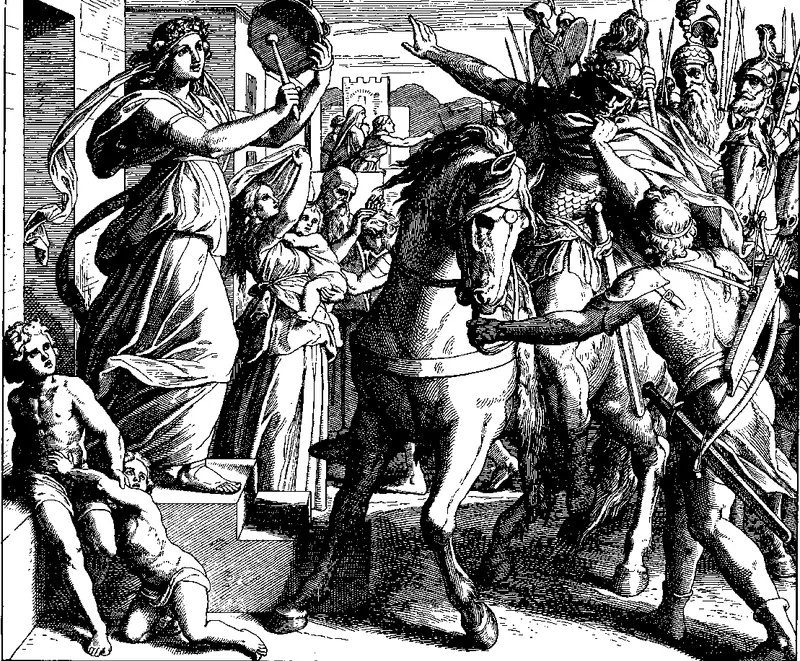
21So they turned and departed, and put the little ones and the cattle and the carriage before them. 22And when they were a good way from the house of Micah, the men that were in the houses near to Micah’s house were gathered together, and overtook the children of Dan. 23And they cried unto the children of Dan. And they turned their faces, and said unto Micah, What aileth thee, that thou comest with such a company? 24And he said, Ye have taken away my gods which I made, and the priest, and ye are gone away: and what have I more? and what is this that ye say unto me, What aileth thee?
Micah pursues them, but he is alone with a handful of neighbors. He asks one question: "What have I more?" His gods are gone. His priest is gone. His entire religious world has been dismantled and carried away.
25And the children of Dan said unto him, Let not thy voice be heard among us, lest angry fellows run upon thee, and thou lose thy life, with the lives of thy household. 26And the children of Dan went their way: and when Micah saw that they were too strong for him, he turned and went back unto his house.
The Danites threaten him with death. Micah has no choice but to turn back. Six hundred soldiers will always win against one man and his neighbors. Micah goes home empty. That is what the pursuit of idolatry costs you: everything you thought made you secure becomes the thing that leaves you defenseless.
Judges 18:27-31Idolatry Becomes Tribal Heritage
27And they took the things which Micah had made, and the priest which he had, and came unto Laish, unto a people that were at quiet and secure: and they smote them with the edge of the sword, and burnt the city with fire. 28And there was no deliverer, because it was far from Zidon, and they had no business with any man; and it was in the valley that lieth by Bethrehob. And they built a city, and dwelt therein. 29And they called the name of the city Dan, after the name of Dan their father, who was born unto Israel: howbeit the name of the city was Laish at the first.
The Danites conquer Laish. A defenseless people - careless, without magistrate, without shepherd - are slaughtered. This is the cost of rejecting God as your leader. You do not find an innocent replacement; you become the danger to others.
They rename Laish to Dan. The city no longer bears the name "Lion"; it bears the name "Judge." But the tribe called Judge has become executioners. A name changes, but the people's hearts remain untouched by God.
30And the children of Dan set up the graven image: and Jonathan, the son of Gershom, the son of Manasseh, he and his sons were priests to the tribe of Dan until the day of the captivity of the land. 31And they set them up Micah’s graven image, which he made, all the time that the house of God was in Shiloh.
A haunting detail: Jonathan is the son - or grandson - of Gershom, a name meaning "a sojourner there." Moses named his son this way, saying, "I have been a stranger in a strange land" (Exodus 18:3). Yet here, generations later, Gershom's descendant has settled into idolatry as if it were home. The greatest leaders' descendants can fall.
The final, chilling note: "all the time that the house of God was in Shiloh." While the true tabernacle - God's true dwelling place - stood in Shiloh, Dan was setting up an idol and calling it their god. Syncretism: a false god, close at hand, chosen over the true God whose house stood at Shiloh. One man's homemade religion became a tribe's inheritance. This is how spiritual drift works.
Judges 18:21-26Micah Confronts Them; Dan Threatens Him
21So they turned and departed, and put the little ones and the cattle and the carriage before them. 22And when they were a good way from the house of Micah, the men that were in the houses near to Micah’s house were gathered together, and overtook the children of Dan. 23And they cried unto the children of Dan. And they turned their faces, and said unto Micah, What aileth thee, that thou comest with such a company?
Micah has gathered neighbors and come after them. He is not wealthy or powerful - he is just a man who made a shrine and hired a priest, and now both have been taken. His neighbors came with him, perhaps from obligation, perhaps from fear. None of it will matter.
24And he said, Ye have taken away my gods which I made, and the priest, and ye are gone away: and what have I more? and what is this that ye say unto me, What aileth thee?
Micah's1 lament is clear: he has lost everything he worshiped, and the priest he trusted. His question "what have I more?" suggests a man who has poured his life into a false shrine. He is wrong to have made them; but he is right to feel the wound.
25And the children of Dan said unto him, Let not thy voice be heard among us, lest angry fellows run upon thee, and thou lose thy life, with the lives of thy household. 26And the children of Dan went their way: and when Micah saw that they were too strong for him, he turned and went back unto his house.
Dan threatens Micah and his household with death if he speaks again. The tone shifts from deception to outright intimidation. Might is invoked to silence the weak. Micah sees he is outmatched - 600 warriors against a small band of neighbors - and turns back. There is no rescue, no divine intervention. He simply goes home, defeated.
The command to silence echoes through Scripture: "Let not thy voice be heard among us." Power always wants the weak to be quiet. Here it works. Micah is silenced by fear.
Judges 18:27-31Dan Conquers Laish and Establishes False Worship
27And they took the things which Micah had made, and the priest which he had, and came unto Laish, unto a people that were at quiet and secure: and they smote them with the edge of the sword, and burnt the city with fire.
The description of Laish repeats from verse 7. Their peace and security, which seemed like an invitation to conquest, provided no defense. The city had built no walls, kept no militia, relied on distance from great powers. They were exactly what they seemed: vulnerable.
Dan smites them with the sword. The priest says "go in peace" while the swords fall. This is what the blessing actually covered. The tragedy is not that Laish fought back - they could not. The tragedy is that they were destroyed by a tribe that dressed conquest as calling.
28And there was no deliverer, because it was far from Zidon, and they had no business with any man; and it was in the valley that lieth by Bethrehob. And they built a city, and dwelt therein. 29And they called the name of the city Dan, after the name of Dan their father, who was born unto Israel: howbeit the name of the city was Laish at the first.
The city is renamed Dan, as if to claim it completely. It becomes the northern shrine of Israel, marking the phrase "from Dan to Beersheba" as the boundaries of the land. But Dan is built on Laish's graves, in a valley far from Sidon, isolated and alone.
30And the children of Dan set up the graven image: and Jonathan, the son of Gershom, the son of Manasseh, he and his sons were priests to the tribe of Dan until the day of the captivity of the land. 31And they set them up Micah’s graven image, which he made, all the time that the house of God was in Shiloh.
The "captivity of the land" refers to the Assyrian conquest of the Northern Kingdom in 722 BC, roughly 200 years later. Dan's false priesthood lasted for ten generations - centuries in which the tribe worshiped in defiance of Shiloh and the covenant. The text marks this idolatry as persistent, long-rooted, and finally punished by exile.
Research trail
Sources & further study
These references support the historical, linguistic, manuscript, and contextual notes in this chapter. Scripture remains the primary text; external sources are provided so readers can inspect the research directly.