Leviticus 16
People in this chapter
Leviticus 16 is the book's centerpiece - the one day each year when the high priest enters the Holy of Holies, the place where God's presence dwells on the mercy seat. It is a day when the whole nation must afflict their souls. It is the day the gap between the holy God and a sinful people is bridged by blood, by confession, by the death of an innocent. The chapter begins immediately after the death of Nadab and Abihu, two of Aaron's own sons, who entered God's presence carelessly and were consumed by holy fire.
The message is stark: holiness is not a metaphor. It is a boundary. It costs.
Tap any highlighted phrase to jump to the commentary that unpacks it.
Leviticus 16:1-4God Speaks After the Cost
1And the LORD spake unto Moses after the death of the two sons of Aaron, when they offered before the LORD, and died; 2And the LORD said unto Moses, Speak unto Aaron thy brother, that he come not at all times into the holy place within the vail before the mercy seat, which is upon the ark; that he die not: for I will appear in the cloud upon the mercy seat. 3Thus shall Aaron come into the holy place: with a young bullock for a sin offering, and a ram for a burnt offering. 4He shall put on the holy linen coat, and he shall have the linen breeches upon his flesh, and shall be girded with a linen girdle, and with the linen mitre shall he be attired: these are holy garments; therefore shall he wash his flesh in water, and so put them on.
Nadab and Abihu entered God's presence carelessly - they offered strange fire, fire not prescribed by God. Fire went out from His presence and consumed them. They died. The opening word of this chapter is death. Only after the people have seen what holiness costs do we learn how to approach it. Holiness is a boundary. It burns.
The mercy seat is the place where God sits enthroned above the ark. It is the holiest point in all of Israel - the one place where the high priest stands once a year, alone, before the presence of God. The veil separates it from the rest of the tabernacle. No one enters there except once each year, and only the high priest, and only after prescribed preparation, and only with blood. This is the place Christ enters according to Hebrews 9:11-12: "Christ being come an high priest of good things to come... by his own blood... entered in once into the holy place."
Leviticus 16:5-10The Two Goats
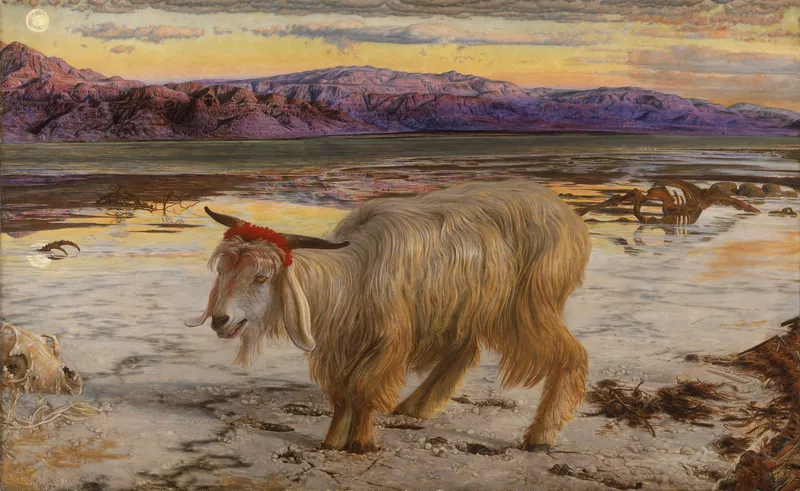
5And he shall take of the congregation of the children of Israel two kids of the goats for a sin offering, and one ram for a burnt offering. 6And Aaron shall offer his bullock of the sin offering, which is for himself, and make an atonement for himself, and for his house. 7And he shall take the two goats, and present them before the LORD at the door of the tabernacle of the congregation. 8And Aaron shall cast lots upon the two goats; one lot for the LORD, and the other lot for the scapegoat. 9And Aaron shall bring the goat upon which the LORD’s lot fell, and offer him for a sin offering. 10But the goat, on which the lot fell to be the scapegoat, shall be presented alive before the LORD, to make an atonement with him, and to let him go for a scapegoat into the wilderness.
The decision is made by lot, not by human choice. Both goats are identical. Both are blameless. But one is appointed for death, and one for exile. One remains in the camp with the LORD's people; the other is driven into the wasteland. The lot removes human preference and makes clear that the difference is appointed, not earned. The casting of lots will appear again in the Gospels when soldiers cast lots for Jesus' garments at the cross.
Leviticus 16:11-14The High Priest Enters
11And Aaron shall bring the bullock of the sin offering, which is for himself, and shall make an atonement for himself, and for his house, and shall kill the bullock of the sin offering which is for himself: 12And he shall take a censer full of burning coals of fire from off the altar before the LORD, and his hands full of sweet incense beaten small, and bring it within the vail: 13And he shall put the incense upon the fire before the LORD, that the cloud of the incense may cover the mercy seat that is upon the testimony, that he die not: 14And he shall take of the blood of the bullock, and sprinkle it with his finger upon the mercy seat eastward; and before the mercy seat shall he sprinkle of the blood with his finger seven times.
The coal comes from the altar where the sacrifices have been burned. The incense rises in a cloud. The cloud is protection - it hides the high priest from the direct gaze of the presence of God. Without the veil of smoke, he would see directly what even Isaiah could barely endure seeing. The incense creates a mercy between the human and the holy. The Psalms sing of incense as prayer: "Let my prayer be set forth before thee as incense" (Psalm 141:2). Here, incense is intercession - it speaks for the priest even as he stands silent.
Seven times the blood is sprinkled. Seven is the number of completion, of fullness, of perfection in Hebrew. The blood covers completely - every trace of sin in the people's record is answered. The repetition is thorough. God's mercy is full.
Leviticus 16:15-19The Goat for the LORD
15Then shall he kill the goat of the sin offering, that is for the people, and bring his blood within the vail, and do with that blood as he did with the blood of the bullock, and sprinkle it upon the mercy seat, and before the mercy seat: 16And he shall make an atonement for the holy place, because of the uncleanness of the children of Israel, and because of their transgressions in all their sins: and so shall he do for the tabernacle of the congregation, that remaineth among them in the midst of their uncleanness. 17And there shall be no man in the tabernacle of the congregation when he goeth in to make an atonement in the holy place, until he come out, and have made an atonement for himself, and for his household, and for all the congregation of Israel. 18And he shall go out unto the altar that is before the LORD, and make an atonement for it; and shall take of the blood of the bullock, and of the blood of the goat, and put it upon the horns of the altar round about. 19And he shall sprinkle of the blood upon it with his finger seven times, and cleanse it, and hallow it from the uncleanness of the children of Israel.
The blood is applied to the mercy seat, the altar, the horns of the altar - all the places of God's presence in the tabernacle. Why? Because the people's sin pollutes even the sacred spaces. A holy God cannot dwell in the midst of uncleanness. The tabernacle itself becomes unclean when the people sin. So the blood must cleanse the people and the place where God meets them. This is radical: sin is a cosmic stain that reaches into the very structure of reality. Only blood removes it.
When the high priest enters the Holy of Holies, no one else is in the tabernacle. He is utterly alone. The whole nation is outside, waiting, afflicting their souls, hoping. One man stands between heaven and earth. One man bears the sin of all. This image of solitary intercession will echo through the New Testament: "He is the mediator of the new testament... that by means of death... they which are called might receive the promise of eternal inheritance" (Heb. 9:15).
Leviticus 16:20-22The Scapegoat Sent Away
20And when he hath made an end of reconciling the holy place, and the tabernacle of the congregation, and the altar, he shall bring the live goat: 21And Aaron shall lay both his hands upon the head of the live goat, and confess over him all the iniquities of the children of Israel, and all their transgressions in all their sins, putting them upon the head of the goat, and shall send him away by the hand of a fit man into the wilderness: 22And the goat shall bear upon him all their iniquities unto a land not inhabited: and he shall let go the goat in the wilderness.
Aaron lays both hands on the goat's head. Not one hand. Both. It is a gesture of complete transfer, of the full weight of sin passing from the nation to the innocent animal. And over this gesture, he confesses. He names the sins out loud. He does not hide them. He does not minimize them. He confesses all their iniquities, all their transgressions, all their sins. The goat hears the confession. The people hear the confession. God hears the confession. And then the goat is sent away.
The goat is sent to a land not inhabited - the wilderness, the place of no return, the place of separation. This is harsh and real. The goat is driven away from camp, from people, from the place of God's dwelling. Its breathing life continues, unlike the first goat's, yet it is ended in the sense that matters most: separated from the community, exiled with the sins it carries.
Leviticus 16:23-28The Purification After
23And Aaron shall come into the tabernacle of the congregation, and shall put off the linen garments, which he put on when he went into the holy place, and shall leave them there: 24And he shall wash his flesh with water in the holy place, and put on his garments, and come forth, and offer his burnt offering, and the burnt offering of the people, and make an atonement for himself, and for the people. 25And the fat of the sin offering shall he burn upon the altar. 26And he that let go the goat for the scapegoat shall wash his clothes, and bathe his flesh in water, and afterward come into the camp. 27And the bullock for the sin offering, and the goat for the sin offering, whose blood was brought in to make atonement in the holy place, shall one carry forth without the camp; and they shall burn in the fire their skins, and their flesh, and their dung. 28And he that burneth them shall wash his clothes, and bathe his flesh in water, and afterward he shall come into the camp.
The high priest removes the linen garments - the holy clothes he wore in the presence of God - and leaves them there in the tabernacle. They are not taken back to the camp. They stay in the holy place. Then he bathes. He puts on ordinary clothes. He emerges into the light of day as an ordinary man. The moment of mediation is over. The burden is set down. He has done what no other person could do, and now he steps back into the community.
Everyone involved in the sacrifice - the priest, the man who sent the scapegoat, the man who burned the animals - must wash. They must bathe in water. They have touched the machinery of sin, the animals that bore it, and must be purified before re-entering the camp. This insists that sin is real, its weight is real, its separation is real, and even those who help remove it must be cleansed.
Leviticus 16:29-34The People Afflict Their Souls
29And this shall be a statute for ever unto you: that in the seventh month, on the tenth day of the month, ye shall afflict your souls, and do no work at all, whether it be one of your own country, or a stranger that sojourneth among you: 30For on that day shall the priest make an atonement for you, to cleanse you, that ye may be clean from all your sins before the LORD. 31It shall be a sabbath of rest unto you, and ye shall afflict your souls, by a statute for ever. 32And the priest, whom he shall anoint, and whom he shall consecrate to minister in the priest’s office in his father’s stead, shall make the atonement, and shall put on the linen clothes, even the holy garments: 33And he shall make an atonement for the holy sanctuary, and he shall make an atonement for the tabernacle of the congregation, and for the altar, and he shall make an atonement for the priests, and for all the people of the congregation. 34And this shall be an everlasting statute unto you, to make an atonement for the children of Israel for all their sins once a year. And he did as the LORD commanded Moses.
This is a statute for ever. Once a year, every year, on the tenth day of the seventh month, the whole nation stops. All work ceases. No one eats. Everyone afflicts their soul. It becomes the rhythm of Israel's year. The holiest day. The day that says: We remember what we are. We remember what we deserve. We remember that we live only because of blood, because of atonement, because someone stands between us and the consuming fire.
The promise of Yom Kippur is staggering: "Ye shall be clean from all your sins before the LORD." Not some sins. Not the minor ones. All. Every trace. Before the LORD. Not hidden from God's knowledge, but openly, fully, completely clean. There is no asterisk, no condition, no unfinished business. The atonement is total.
Research trail
Sources & further study
These references support the historical, linguistic, manuscript, and contextual notes in this chapter. Scripture remains the primary text; external sources are provided so readers can inspect the research directly.
- Leviticus 16 - Yom KippurExtensive rabbinic commentary on the Day of Atonement, the two goats, and the high priest's entry into the Holy of Holies[res:sefaria-leviticus-16].
- Leviticus 16 ↔ Hebrews 9-10Side-by-side comparison showing how Hebrews reads Christ's atonement through the lens of Leviticus 16[res:intertextual-hebrews-9-leviticus-16].