Nehemiah 2
People in this chapter
Nehemiah stands in the palace of Artaxerxes the king of Persia, bearing wine as he has done before. But on this day, his heart is burdened. The city of his fathers lies waste. The walls are broken. The gates are consumed with fire. And it shows on his face. The king sees his sadness and asks: "Why is thy countenance sad, seeing thou art not sick? this is nothing else but sorrow of heart."
Tap any highlighted phrase to jump to the commentary that unpacks it.
Nehemiah 2:1-5The King Sees the Sadness - An Instant Prayer
1And it came to pass in the month Nisan, in the twentieth year of Artaxerxes the king, that wine was before him: and I took up the wine, and gave it unto the king. Now I had not been beforetime sad in his presence. 2Wherefore the king said unto me, Why is thy countenance sad, seeing thou art not sick? this is nothing else but sorrow of heart. Then I was very sore afraid, 3And said unto the king, Let the king live for ever: why should not my countenance be sad, when the city, the place of my fathers’ sepulchres, lieth waste, and the gates thereof are consumed with fire? 4Then the king said unto me, For what dost thou make request? So I prayed to the God of heaven. 5And I said unto the king, If it please the king, and if thy servant have found favour in thy sight, that thou wouldest send me unto Judah, unto the city of my fathers’ sepulchres, that I may build it.
Nehemiah has been a trusted servant in the king's household - "the king's cupbearer" is his title, a position of intimacy and responsibility. But on this day, his heart is too heavy to hide. The king notices what Nehemiah perhaps hoped to conceal. And in that moment of exposure, Nehemiah must decide: speak, or remain silent. He chooses to speak the truth. "The city, the place of my fathers' sepulchres, lieth waste." His sorrow is not personal indulgence - it is devotion to something larger than himself. 1
Nehemiah is terrified. The king has noticed his sadness. In a court where the monarch's favor means everything, showing sorrow in the king's presence is dangerous. A sad servant might mean illness, disloyalty, or hidden grievance. The king could as easily strike Nehemiah as question him. Fear is the natural response. Yet Nehemiah speaks anyway2.
4Then the king said unto me, For what dost thou make request? So I prayed to the God of heaven.
This is one of the most remarkable moments in Scripture. The king asks Nehemiah what he wants, and before Nehemiah speaks his answer, he prays. "So I prayed to the God of heaven." No time to withdraw. No moment to prepare. Just a heart turning to God in the presence of the king himself. The Psalms later capture this kind of prayer: "In the day when I cried thou answeredst me, and strengthenedst me with strength in my soul" (Psalm 138:3).
Prayer in the instant of decision. Prayer while the king waits. Prayer as the foundation of every word that follows.
Nehemiah 2:6-10The King Grants the Request - The Good Hand of God
6And the king said unto me, (the queen also sitting by him,) For how long shall thy journey be? and when wilt thou return? So it pleased the king to send me; and I set him a time. 7Moreover I said unto the king, If it please the king, let letters be given me to the governors beyond the river, that they may convey me over till I come into Judah; 8And a letter unto Asaph the keeper of the king’s forest, that he may give me timber to make beams for the gates of the palace which appertained to the house, and for the wall of the city, and for the house that I shall enter into. And the king granted me, according to the good hand of my God upon me.
The queen sits by the king. We are not told her name or her role in the decision, but her presence is noted. Some have speculated she was Esther's great-granddaughter, and that Jewish queens held particular sway in Persian courts. Whatever the case, the text marks her presence. Nehemiah's request is heard not only by the king, but by the woman whose judgment the king clearly values. And the king does more than grant permission - he asks when Nehemiah will return, confirming that Nehemiah is not abandoning his service, merely embarking on a mission.
Nehemiah asks not only for permission, but for letters - official papers that will authorize him as he travels through the provinces beyond the river Euphrates. These letters are his credentials. They tell every governor: this man comes on the king's business. Without them, he would be a wanderer. With them, he is an emissary.
Nehemiah asks for timber from Asaph, the keeper of the king's forest. The palace, the house of God, the walls of the city - all will need beams. But here is the key: Nehemiah asks for a letter to Asaph, the keeper of the forest. He is asking the king to use his authority to grant Nehemiah access to what he needs. It is the difference between asking for aid and asking for authorization. Nehemiah is teaching himself and us the art of resourcefulness - finding who can give you access to what you need.
8And a letter unto Asaph the keeper of the king’s forest, that he may give me timber to make beams for the gates of the palace which appertained to the house, and for the wall of the city, and for the house that I shall enter into. And the king granted me, according to the good hand of my God upon me.
Here is the theological heartbeat of Nehemiah's story. "According to the good hand of my God upon me." Everything that happened - the king's openness, the queen's presence, the willingness to grant not just permission but resources - all of it flows from the hand of God. Nehemiah attributes the credit to the good hand of God. This is the posture of a servant who prays first, speaks second, and credits God always.
Nehemiah 2:10The Opposition Grieves - The Work Threatens Them
10When Sanballat the Horonite, and Tobiah the servant, the Ammonite, heard of it, it grieved them exceedingly that there was come a man to seek the welfare of the children of Israel.
These two men are named here for the first time, but they will appear again and again in Nehemiah's story as persistent adversaries. Sanballat is a Horonite - from Horon, in Samaria. Tobiah is called "the servant, the Ammonite" - perhaps a provincial official. They are not Israelites. They live in the land and have influence. They likely profit from Jerusalem's disarray. A strong Jerusalem, with rebuilt walls, is a threat to their power. The text tells us their real grievance: "it grieved them exceedingly that there was come a man to seek the welfare of the children of Israel."
Their grief at someone seeking the welfare of Israel itself cuts deeper than any concern about walls. The work is a threat not to bricks and mortar, but to the very wellbeing of God's people.
The text says they were grieved "exceedingly" - in Hebrew, the words suggest a deep anger, a real pain at the news. Why would they be wounded by Nehemiah's arrival? Because they understand, even if the people of Jerusalem do not yet, that the rebuilding of the walls is the first step toward independence, toward strength, toward a people no longer under their influence. Opposition is often terrified. The work threatens the status quo.
Nehemiah 2:11-16The Night Survey - Careful Vision, Prayerful Planning
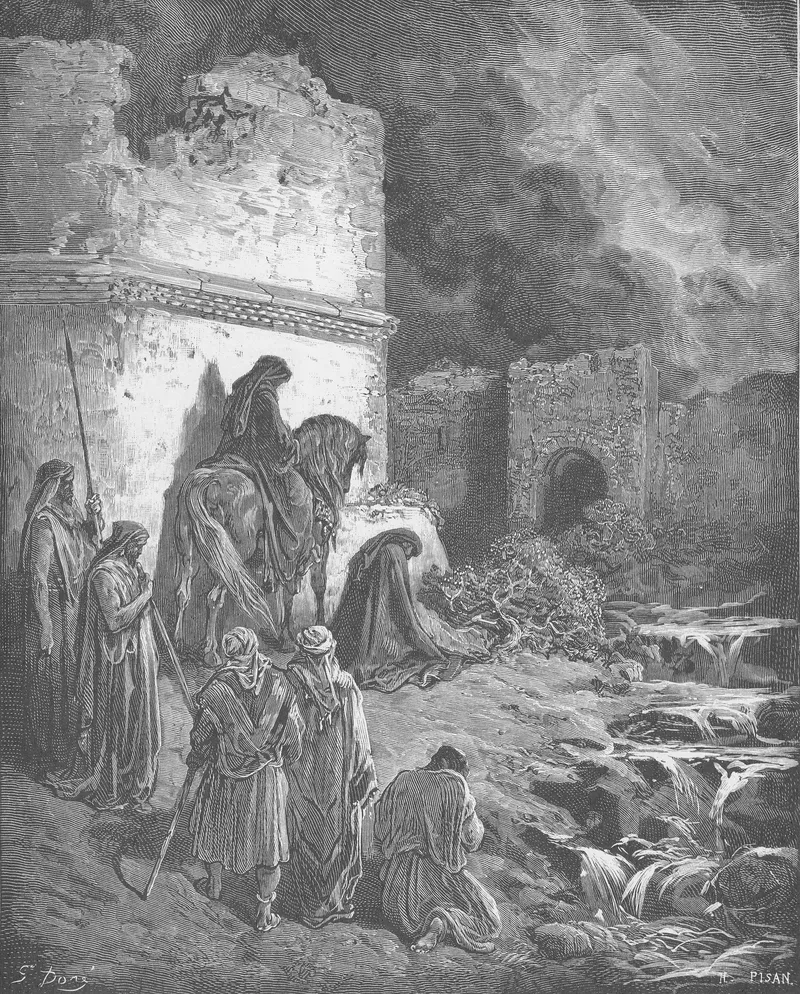
11So I came to Jerusalem, and was there three days. 12And I arose in the night, I and some few men with me; neither told I any man what my God had put in my heart to do at Jerusalem: neither was there any beast with me, save the beast that I rode upon. 13And I went out by night by the gate of the valley, even before the dragon well, and to the dung port, and viewed the walls of Jerusalem, which were broken down, and the gates thereof were consumed with fire. 14Then I went on to the gate of the fountain, and to the king’s pool: but there was no place for the beast that was under me to pass. 15Then went I up in the night by the brook, and viewed the wall, and turned back, and entered by the gate of the valley, and so returned. 16And the rulers knew not whither I went, or what I did; neither had I as yet told it to the Jews, nor to the priests, nor to the nobles, nor to the rulers, nor to the rest that did the work.
Nehemiah arrives in Jerusalem and waits. He does not immediately call the people together. He does not begin repairs. He waits three days. This is characteristic of his method: prayer, waiting, observation. Only after he has understood the scope of what must be done does he move. Three days in the city, and then he rises in the night.
Nehemiah arises in the night to survey the walls. Why at night? Secrecy, surely - he does not want the opposition (Sanballat, Tobiah) to know what he is planning. But also because the night survey is a solitary communion with God and with the work. There are no crowds. There are no opinions. There is only Nehemiah, a few trusted men, a beast, and the broken walls. He walks the entire perimeter - north side (dragon well, dung port), east side (fountain gate, king's pool), south side (valley gate). He sees the devastation with his own eyes. This is a vision he builds himself.
Nehemiah says: "neither told I any man what my God had put in my heart to do at Jerusalem." The vision remains between Nehemiah and God. He holds it carefully. This is the wisdom of a leader - to see what must be done, to carry it in silence until the moment is right, and then to speak it with the force of someone who has already seen the solution clearly.
At the king's pool, the breach is so severe that "there was no place for the beast that was under me to pass." The destruction is absolute. Even a donkey cannot navigate the rubble and broken stones. This is the reality Nehemiah walks through. He sees a ruined city. The work before him is immense. But he has also now walked it. He knows its scope. He can envision its reconstruction.
Nehemiah 2:17-18The Rallying Cry - Come and Build
17Then said I unto them, Ye see the distress that we are in, how Jerusalem lieth waste, and the gates thereof are burned with fire: come, and let us build up the wall of Jerusalem, that we be no more a reproach. 18Then I told them of the hand of my God which was good upon me; as also the king’s words that he had spoken unto me. And they said, Let us rise up and build. So they strengthened their hands for this good work.
Nehemiah names what the people already see: "Ye see the distress that we are in." He is not telling them something new. He is articulating what they feel. The city lies waste. The gates are burned. They are living in shame. Nehemiah is speaking their reality. And from that shared reality, he issues the call: "Come, and let us build up the wall of Jerusalem, that we be no more a reproach."
Now Nehemiah tells the people what he has been carrying in silence: the hand of God is good upon him. The king has sent him with letters and authority. Nehemiah tells them that authority, provision, and divine favor have already come. He has walked the walls. He has the king's permission. He has the letters. God's hand is already working. Now the people can believe.
The people respond immediately: "Let us rise up and build." There is no debate. There is no question. What had seemed impossible - too large, too expensive, too opposed by enemies - becomes possible the moment someone speaks it with authority and announces that God is already moving. Nehemiah has shown them three things: the problem (the distress), the solution (come and build), and the divine approval (the good hand of God upon him). The people respond by strengthening their hands "for this good work." The work is not Nehemiah's burden anymore. It is theirs.
Nehemiah 2:19-20The Opposition Declares Itself - But We Are Already Building
19But when Sanballat the Horonite, and Tobiah the servant, the Ammonite, and Geshem the Arabian, heard it, they laughed us to scorn, and despised us, and said, What is this thing that ye do? will ye rebel against the king? 20Then answered I them, and said unto them, The God of heaven, he will prosper us; therefore we his servants will arise and build: but ye have no portion, nor right, nor memorial, in Jerusalem.
Now the opposition moves into the open. Sanballat, Tobiah, and a third adversary - Geshem the Arabian - hear that the people have committed themselves to building. Their response is scorn. They laugh. They despise. They mock. This is the enemy's first weapon: ridicule. Make the work seem foolish. Make the builder seem ambitious and overreaching. Accuse him of rebellion: "will ye rebel against the king?" This is a clever accusation. If Nehemiah is acting without the king's permission, then he is indeed rebelling.
But we know the truth: he has the king's letters. The accusation is a lie designed to sow doubt.
Nehemiah's answer is perfect. "The God of heaven, he will prosper us; therefore we his servants will arise and build." He simply names the true power: God will prosper the work, and those who are building are "his servants" - servants of the God of heaven. Nehemiah has positioned the conflict as a work of God that humans are privileged to join.
Nehemiah then speaks a word of clarity: "ye have no portion, nor right, nor memorial, in Jerusalem." Sanballat, Tobiah, and Geshem have no claim on Jerusalem because Jerusalem is not theirs. It belongs to the covenant people, to those who worship the God of Abraham, Isaac, and Jacob. The opposition has no standing because they do not belong to the people whose work is being done. The walls are being built to protect and to define - to mark out a people who belong to each other and to God.
Research trail
Sources & further study
These references support the historical, linguistic, manuscript, and contextual notes in this chapter. Scripture remains the primary text; external sources are provided so readers can inspect the research directly.