Nehemiah 4
People in this chapter
The work of rebuilding the walls of Jerusalem has begun. The rubble is being cleared, the stones are being set, and the people of Jerusalem are learning again the rhythm of labor and covenant. But not everyone is pleased. From outside the walls, the enemies of Israel grow angry. Sanballat and Tobiah, the leaders who mocked the returning exiles as "feeble Jews," now see their mockery turn to something darker: conspiracy.
Tap any highlighted phrase to jump to the commentary that unpacks it.
Nehemiah 4:1-3Feeble Jews and Burned Stones
1But it came to pass, that when Sanballat heard that we builded the wall, he was wroth, and took great indignation, and mocked the Jews. 2And he spake before his brethren and the army of Samaria, and said, What do these feeble Jews? will they fortify themselves? will they sacrifice? will they make an end in a day? will they revive the stones out of the heaps of the rubbish which are burned? 3Now Tobiah the Ammonite was by him, and he said, Even that which they build, if a fox go up, he shall even break down their stone wall.
The moment Sanballat hears that the work is an actual reconstruction, his indignation turns violent. This is what opposition does when it discovers the opposition will not be intimidated or discouraged. The greater the work, the greater the resistance. 1
Mockery is Sanballat's weapon. He does not attack the work itself; he attacks the workers. The people are feeble, the project is impossible, the task will never be accomplished. Mockery demoralizes. It creates an atmosphere where the people doubt themselves before they doubt God23.
Sanballat calls them "feeble Jews." He is denying their capacity. He is saying: you are not strong enough. You do not have what it takes. This is the taunt aimed at every person who has ever tried to build something sacred despite opposition. The enemy will always say you are too weak.
He mocks their ability to fortify themselves. Can they truly protect themselves? Will they sacrifice to secure God's favor? Will they finish in a day? The mockery is calculated to create doubt about both their strength and their God's willingness to help them.
The stones are burned - remnants of the destruction, fire-blackened, seemingly worthless. Sanballat's mockery is essentially: you are trying to rebuild with rubble. Your foundation is ash. Your project is built on the grave of what died. And Tobiah adds: a fox could tear down what you build. The work is so fragile that even a small animal could destroy it.
Nehemiah 4:4-6Prayer: Turn Their Reproach Upon Their Own Head
4Hear, O our God; for we are despised: and turn their reproach upon their own head, and give them for a prey in the land of captivity: 5And cover not their iniquity, and let not their sin be blotted out from before thee: for they have provoked thee to anger before the builders. 6So built we the wall; and all the wall was joined together unto the half thereof: for the people had a mind to work.
Nehemiah does not respond to mockery with more mockery or with shame. He brings it to God. "We are despised" - he acknowledges the weight of the mockery, the real sting of being seen as worthless. He brings his people's pain before God.
Nehemiah's prayer is direct: turn their reproach upon their own head. This is a prayer that asks God to execute justice, to ensure that those who have mocked His work face the consequence of their mockery. He is asking God to be God, to protect His own, and to let no mocking go unanswered.
And yet - look at verse 6. "The people had a mind to work." Prayer is not a substitute for action. The people hear Nehemiah's prayer, and immediately they return to the wall. The mockery has not broken their resolve. The prayer has not made them passive. Instead, they work with renewed purpose. The wall is joined together unto the half. The work continues.
Nehemiah 4:7-12Conspiring Enemies; A People's Doubt
7But it came to pass, that when Sanballat, and Tobiah, and the Arabians, and the Ammonites, and the Ashdodites, heard that the walls of Jerusalem were made up, and that the breaches began to be stopped, then they were very wroth, 8And conspired all of them together to come and to fight against Jerusalem, and to hinder it. 9Nevertheless we made our prayer unto our God, and set a watch against them day and night, because of them. 10And Judah said, The strength of the bearers of burdens is decayed, and there is much rubbish; so that we are not able to build the wall. 11And our adversaries said, They shall not know, neither see, till we come in the midst among them, and slay them, and cause the work to cease. 12And it came to pass, that when the Jews which dwelt by them came, they said unto us ten times, From all places whence ye shall return unto us they will be upon you.
The mockery has not worked. The people are still building. So Sanballat and his allies - the Arabians, Ammonites, Ashdodites - join together in anger. When mockery fails, conspiracy begins. The opposition hardens into a covenant of destruction.
Their goal is to hinder the work. They want to stop the building, to break the resolve, to convince the people that the task is impossible. This is the nature of spiritual opposition: it wants to prevent the work from ever being completed.
Nehemiah's response is remarkable: "We made our prayer unto our God, and set a watch." They pray to God to protect them and also station guards day and night - faith and vigilance working together. A God who tells His people to "watch and pray" (Matthew 26:41) is a God who calls us to both trust and attention.
Now the threat is internalized. The people themselves begin to lose confidence. "The strength of the bearers of burdens is decayed." The work is hard. The enemy is many. The people are tired. Rumor and fear do more damage than an actual attack. A whispered doubt can break an army that swords could not.
The enemies plan a surprise attack. "They shall not know, neither see, till we come in the midst among them." This is a strategy of terror. The people must always be looking over their shoulders, always afraid that death is about to arrive from an unseen direction.
Those living near the enemies come to the Jews with a dire message: "From all places whence ye shall return unto us they will be upon you." They deliver this message ten times. This is psychological warfare. The enemy is everywhere. There is no safe place. The threat comes from your neighbors, from those who surround you.
Nehemiah 4:13-14Remember the Lord: The Call to Stand
13Therefore set I in the lower places behind the wall, and on the higher places, I even set the people after their families with their swords, their spears, and their bows. 14And I looked, and rose up, and said unto the nobles, and to the rulers, and to the rest of the people, Be not ye afraid of them: remember the LORD, which is great and terrible, and fight for your brethren, your sons, and your daughters, your wives, and your houses.
Nehemiah does not dismiss the threat. He acknowledges it by positioning his people strategically - lower places, higher places, families together, armed. His first word to them is: Be not afraid. This is the leadership the people need - one who has planned carefully and now calls the people to courage.
Nehemiah's call to courage is rooted in memory. "Remember the Lord, which is great and terrible." He is great - infinite in power and wisdom. He is terrible in the sense of being worthy of awe and reverence, powerful enough to scatter enemies, to hold the future, to ensure that His people are never abandoned. The antidote to fear is the memory that there is a God greater than any enemy.
Nehemiah does not call them to fight for national pride or for conquest. He calls them to fight for their brethren, their sons and daughters, their wives, their houses. This is a fight for what matters most - for family, for the people you love, for home. This transforms the battle from an abstract conflict into something personal, something holy.
Nehemiah 4:15-20The Trumpet That Gathers; Building With One Hand and a Weapon in the Other
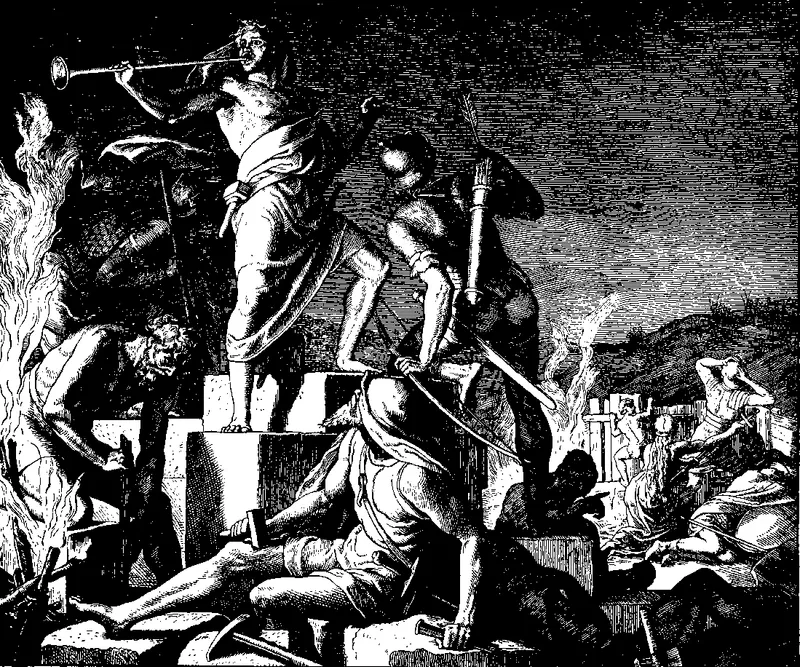
15And it came to pass, when our enemies heard that it was known unto us, and God had brought their counsel to nought, that we returned all of us to the wall, every one unto his work. 16And it came to pass from that time forth, that the half of my servants wrought in the work, and the other half of them held both the spears, the shields, and the bows, and the habergeons; and the rulers were behind all the house of Judah. 17They which builded on the wall, and they that bare burdens, with those that laded, every one with one of his hands wrought in the work, and with the other hand held a weapon. 18For the builders, every one had his sword girded by his side, and so builded. And he that sounded the trumpet was by me. 19And I said unto the nobles, and to the rulers, and to the rest of the people, The work is great and large, and we are separated upon the wall, one far from another. 20In what place therefore ye hear the sound of the trumpet, resort ye thither unto us: our God shall fight for us.
The conspiracy is discovered. God has brought the enemy's counsel to nought - their plans are exposed. And now Nehemiah implements his strategy: half the people build, half stand guard. This is a picture of a people at war and at work simultaneously. Neither one nor the other, but both.
This is one of the most powerful images in Scripture: the builders with one hand on their work and one hand on their weapon. One hand lays the stone. One hand holds the sword. This is wisdom - the courage to work while remaining vigilant. This is what it looks like to trust God and to use good sense at the same time.
Nehemiah reminds the people: "The work is great and large." It matters. It is worth defending. It is worth the double burden of building and watching. When we understand the magnitude of what we are doing, we are willing to sacrifice more to protect it.
Nehemiah stations a trumpeter by him. The trumpet is the instrument of gathering. When danger comes from any direction, the trumpet sounds, and the builders drop their tools and gather to the place of the trumpet. The trumpet calls them out of their isolation and into community, out of their fear and into unity. It is a simple system, but it is genius. The scattered people are unified by a single sound.
And then Nehemiah makes the promise that anchors everything: "Our God shall fight for us." This is said by a man who has armed his people, posted his guards, stationed his trumpeter, and is now about to build through the night. He has done everything prudence demands. And now he declares the one thing that no strategy can accomplish: that God Himself will fight for them. Their vigilance and God's fight work together. Neither one makes the other unnecessary.
Nehemiah 4:21-23No Rest, No Change of Clothes: The Long Vigilance
21So we laboured in the work: and half of them held the spears from the rising of the morning till the stars appeared. 22Likewise at the same time said I unto the people, Let every one with his servant lodge within Jerusalem, that in the night they may be a guard to us, and labour on the day.
Nehemiah ensures that every man stays within Jerusalem. They do not return to their homes each night. Instead, they maintain a constant guard. By day, they labor on the wall. By night, they guard it. There is no moment when the work is not being protected.
The detail is striking: none of them put off their clothes except to wash them. They remain in a constant state of readiness. This is the cost of building in the face of opposition - perpetual watchfulness, no rest, no moment when they can fully let down their guard. This is the reality of spiritual vigilance: it is not a posture you can simply turn on and off. It becomes the rhythm of your life.
Research trail
Sources & further study
These references support the historical, linguistic, manuscript, and contextual notes in this chapter. Scripture remains the primary text; external sources are provided so readers can inspect the research directly.
- City of David ExcavationsIAA ongoing dig revealing Iron Age and Persian period Jerusalem structures.
- Wadi Daliyeh Papyri and TobiahEpigraphic and papyrological evidence for Tobiah, Sanballat, and Samaria.
- Nehemiah 4 - Hebrew + classical Jewish commentaryThe Hebrew text of Nehemiah 4 alongside Rashi, Ibn Ezra, and other classical commentators.