Numbers 27
People in this chapter
Numbers 27 opens with five women - Mahlah, Noah, Hoglah, Milcah, and Tirzah, the daughters of Zelophehad - standing before the assembly at the tabernacle door. Their father died in the wilderness. He had no sons. Under the law as stated, there is nowhere for their inheritance to go. They approach Moses, Eleazar, the princes, and the entire assembly. They do not argue. They ask: if our father had no sons, let our father's name not be taken away from his family. Give us a possession among our father's brethren. The silence from the text is significant. They speak. The assembly listens.
Tap any highlighted phrase to jump to the commentary that unpacks it.
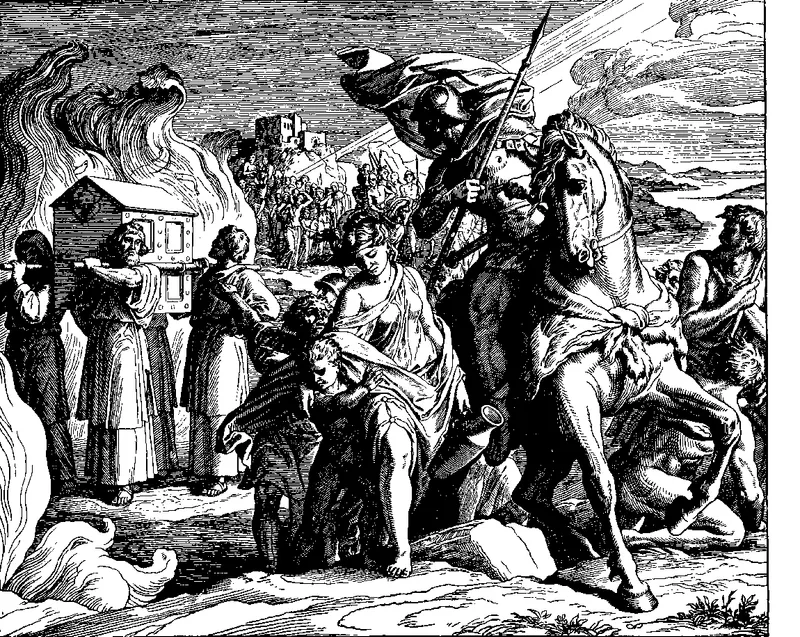
Numbers 27:1-5Five Women Who Speak
1Then came the daughters of Zelophehad, the son of Hepher, the son of Gilead, the son of Machir, the son of Manasseh, of the families of Manasseh the son of Joseph: and these are the names of his daughters; Mahlah, Noah, and Hoglah, and Milcah, and Tirzah. 2And they stood before Moses, and before Eleazar the priest, and before the princes and all the congregation, by the door of the tabernacle of the congregation, saying, 3Our father died in the wilderness, and he was not in the company of them that gathered themselves together against the LORD in the company of Korah; but died in his own sin, and had no sons. 4Why should the name of our father be done away from among his family, because he hath no son? Give unto us therefore a possession among the brethren of our father. 5And Moses brought their cause before the LORD.
The five daughters are named individually: Mahlah, Noah, Hoglah, Milcah, Tirzah. In a genealogy, names are usually how a family is remembered. These women secure their names and their father's name in the record of Israel. They are not erased.
They stand before the congregation face-to-face with Moses, the high priest, the princes, and the assembly itself. Their visibility is part of their testimony. They are not hidden away.
The daughters specify: their father died "in his own sin," not in Korah's rebellion. This matters. They are not defending a rebel. Their father was faithful to the covenant, and his daughters deserve to inherit. They are asking for justice.
The core of their request is a name. "Why should the name of our father be done away from among his family?" To let the inheritance go to another tribe is to erase him. His name disappears. They are asking that his line survive in the land.
Numbers 27:6-11A Statute and a Judgment
6And the LORD spake unto Moses, saying, 7The daughters of Zelophehad speak right: thou shalt surely give them a possession of an inheritance among their father’s brethren; and thou shalt cause the inheritance of their father to pass unto them. 8And thou shalt speak unto the children of Israel, saying, If a man die, and have no son, then ye shall cause his inheritance to pass unto his daughter. 9And if he have no daughter, then ye shall give his inheritance unto his brethren. 10And if he have no brethren, then ye shall give his inheritance unto his father’s brethren. 11And if his father have no brethren, then ye shall give his inheritance unto his kinsman that is next to him of his family, and he shall possess it: and it shall be unto the children of Israel a statute of judgment, as the LORD commanded Moses.
God does not say "they are wrong" or "the law stands as is." He says they speak right. The word is "speak" - dabar - the same word used for how God Himself speaks. Their words have the force of truth. God does not defend the old judgment; He makes a new one.
What becomes law here is not arbitrary. It is a hierarchy: sons first; if no sons, daughters; if no daughters, brothers; if no brothers, uncles; if no uncles, nearest kinsman. The inheritance system stays intact. But it now has room for daughters. The law was written for a world that assumed sons. It did not account for women who had no brothers. The new statute accounts for them.
Numbers 27:12-14Moses Ascends Mount Abarim
12And the LORD said unto Moses, Get thee up into this mount Abarim, and see the land which I have given unto the children of Israel. 13And when thou hast seen it, thou also shalt be gathered unto thy people, as Aaron thy brother was gathered. 14For ye rebelled against my commandment in the desert of Zin, in the strife of the congregation, to sanctify me at the water before their eyes: that is the water of Meribah in Kadesh in the wilderness of Zin.
Mount Abarim is the ridge east of Jordan, overlooking Canaan. Moses will see the land but not enter it. He will die on a mountain, as God promised. The irony is sharp: the man who led the people to the edge of their inheritance will not cross into it.
At Meribah (Numbers 20:1-13), God told Moses to speak to the rock, and water would come forth. Instead, Moses struck the rock twice and said, "Shall we bring you water out of this rock?" He took the credit. God said, "Because ye believed me not, to sanctify me in the eyes of the children of Israel, therefore ye shall not bring this congregation into the land which I have given them." Moses' sin was usurpation. He stepped into the place of the Lord.
Numbers 27:15-17A Shepherd for the Flock
15And Moses spake unto the LORD, saying, 16Let the LORD, the God of the spirits of all flesh, set a man over the congregation, 17Which may go out before them, and which may go in before them, and which may lead them out, and which may bring them in; that the congregation of the LORD be not as sheep which have no shepherd.
Moses is about to die, and the burden that moves him is the people's welfare. His prayer is entirely for them: "appoint a man over the congregation." His request is that the people have a shepherd.
"Go out before them, and go in before them" - the ancient formula for leadership. A shepherd leads from the front. He goes out first in battle, goes in first through the gate. He knows the way because he has walked it.
Numbers 27:18-21Joshua: A Man in Whom Is the Spirit
18And the LORD said unto Moses, Take thee Joshua the son of Nun, a man in whom is the spirit, and lay thine hand upon him; 19And set him before Eleazar the priest, and before all the congregation; and give him a charge in their sight. 20And thou shalt put some of thine honour upon him, that all the congregation of the children of Israel may be obedient. 21And he shall stand before Eleazar the priest, who shall ask counsel for him after the judgment of Urim before the LORD: at his word shall they go out, and at his word they shall come in, both he, and all the children of Israel with him, even all the congregation.
Joshua is chosen because the Spirit is in him. The Holy Spirit, the ruach - the animating force of God - already dwells in Joshua. God recognizes what He has already placed in the man.
Moses puts his honor on Joshua. The Hebrew word hod means splendor, glory, honor. Moses does not keep it for himself. He transfers it to the next man. This is the pattern of biblical leadership: you pass on what was given to you.
Joshua will not rule alone. He will stand before Eleazar, the high priest, who will ask counsel for him through the Urim - the priestly means of discerning God's will. The built-in reminder is that even the leader needs priests, needs counsel, needs to seek God's word through others. No leader stands alone.
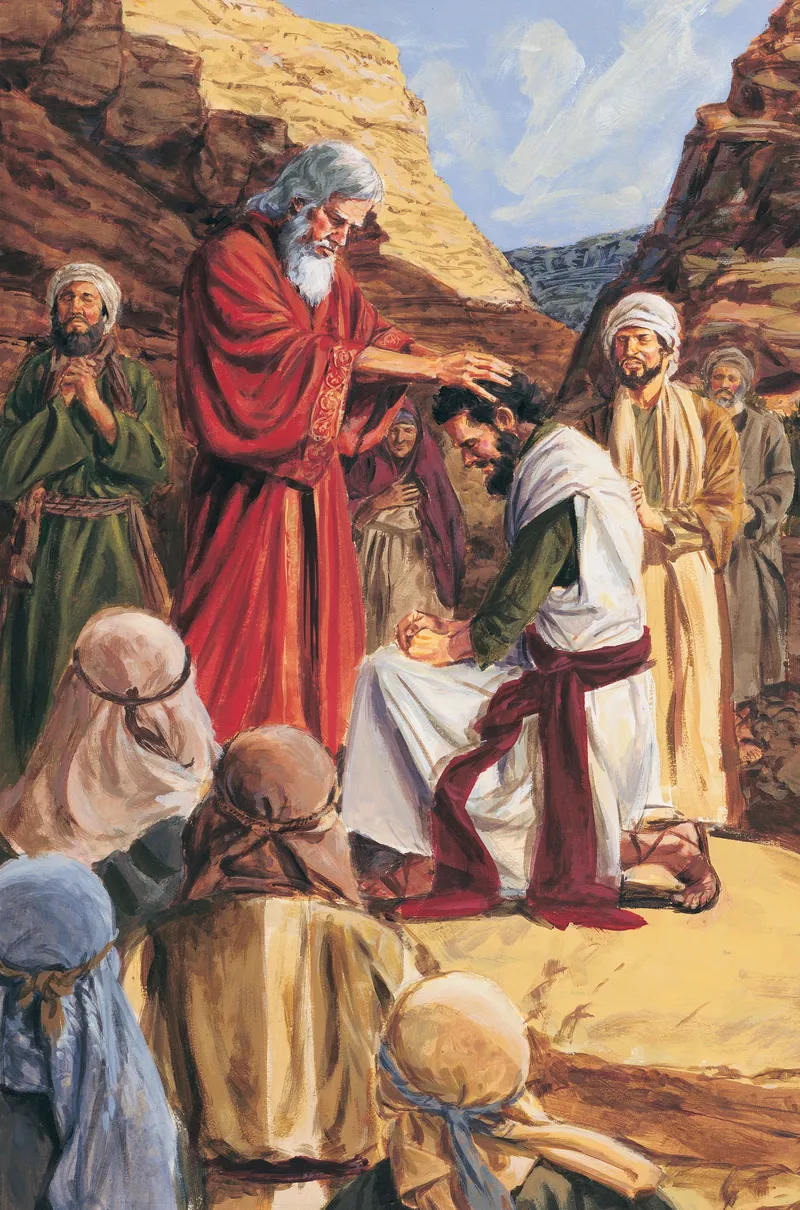
Numbers 27:22-23Laying On of Hands
22And Moses did as the LORD commanded him: and he took Joshua, and set him before Eleazar the priest, and before all the congregation: 23And he laid his hands upon him, and gave him a charge, as the LORD commanded by the hand of Moses.
Moses lays his hands on Joshua. This physical act becomes the pattern for apostolic ordination in the New Testament. In Acts 6:6, the apostles lay hands on the deacons. In 1 Timothy 4:14, Paul speaks of the laying on of hands at Timothy's ordination. The same gesture - hands on the person, the community witnessing, the Spirit's work recognized and confirmed - connects Moses and Joshua to the early church and to pastoral succession even now.
Research trail
Sources & further study
These references support the historical, linguistic, manuscript, and contextual notes in this chapter. Scripture remains the primary text; external sources are provided so readers can inspect the research directly.
- Numbers 27Case of Zelophehad's daughters and the statute permitting female inheritance, plus Joshua's appointment as successor.
- Zelophehad's Daughters (Hebrew Inheritance)Legal precedent for female inheritance in biblical Israel and the daughters' role in establishing equality under the law.
- Joshua's Commissioning ↔ Deuteronomy 34Joshua's appointment by Moses as the bridge to the promised land, foreshadowing Jesus as the true Joshua.