Philemon 1
People in this chapter
Onesimus was Philemon's slave. He ran away - perhaps stole money - and ended up in Rome. There, he encountered Paul and became a believer. But Paul does not help him hide. He sends him back to face his master, armed only with a letter that asks Philemon to receive him as a brother. The letter carries one quiet, revolutionary claim: that the gospel has changed everything.
Tap any highlighted phrase to jump to the commentary that unpacks it.
Philemon 1-3To Philemon, Our Dearly Beloved
1Paul, a prisoner of Jesus Christ, and Timothy our brother, unto Philemon our dearly beloved, and fellowlabourer,
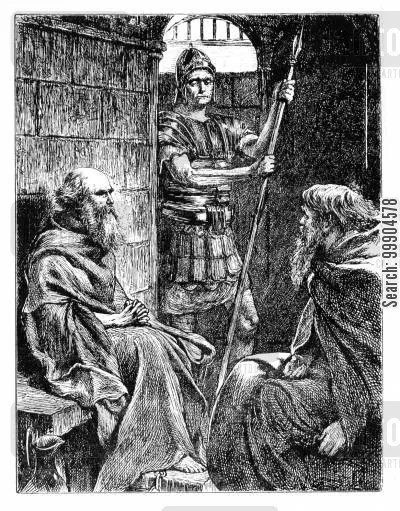
Paul does not hide his condition. He is imprisoned, bound to Christ as a slave to a master of incomparable worth. He writes from a Roman cell. Yet his opening word is a claim rather than a complaint: prisoner of Jesus Christ. His chains belong to a power higher than Rome. This is Paul's authority: apostolic suffering.
2And to our beloved Apphia, and Archippus our fellowsoldier, and to the church in thy house:
Philemon's home is a gathering place for believers - a living room sanctuary. Churches in this era gathered in homes. This letter will be read aloud to that assembly. Philemon cannot refuse Paul's plea in private; his decision will be public, witnessed by his own household and the church that worships in it. He will be tested before his people.
Philemon 4-7I Hear of Thy Love
4I thank my God, making mention of thee always in my prayers, 5Hearing of thy love and faith, which thou hast toward the Lord Jesus, and toward all saints;
Paul begins by praying. By naming what he has heard of Philemon. By locating Philemon in his own prayer life. This is the relational ground from which all that follows will flow. You cannot ask someone to do the impossible unless you first remind them of their own goodness.
6That the communication of thy faith may become effectual by the acknowledging of every good thing which is in you in Christ Jesus.
Paul prays that Philemon's faith will become effectual - working, active, alive. How? By Philemon acknowledging every good thing in himself "in Christ Jesus." This is not false humility. Paul is saying: Know who you are in Christ. You are loved. You are redeemed. You are capable of radical love. Let that knowledge become the ground of what you do next.
7For we have great joy and consolation in thy love, because the bowels of the saints are refreshed by thee, brother.
Philemon 8-12For Love's Sake I Beseech Thee
8Wherefore, though I might be much bold in Christ to enjoin thee that which is convenient, 9Yet for love’s sake I rather beseech thee, being such an one as Paul the aged, and now also a prisoner of Jesus Christ.
Paul has authority. He is an apostle. He could command Philemon to do what he is about to ask. He sets that power aside and chooses the power of love. This is a crucially important moment in the letter: Paul demonstrates that love must be voluntary to be real, and the gospel is the kind of thing that can only be freely chosen.
What is "convenient"? What is fitting and right. Paul knows that receiving Onesimus as a brother is the right thing - the gospel thing - to do. But he will not force it. He will not say, "You must do this." Instead he will appeal to Philemon's own love, his own faith, his own best self. The gospel trusts people to choose good.
10I beseech thee for my son Onesimus, whom I have begotten in my bonds:
Onesimus means "useful" in Greek. The irony is crushing: Paul now calls him his beloved son, the child of his imprisonment and faith. In the eyes of the law, Onesimus is property, theft, worthless. In the eyes of Paul - in the eyes of Christ - he is a son, beloved, reborn. Names matter. Identity matters. The gospel gives Onesimus a new name.
11Which in time past was to thee unprofitable, but now profitable to thee and to me: 12Whom I have sent again: thou therefore receive him, that is, mine own bowels:
Onesimus ran away. In doing so, he betrayed his function as a slave - became "unprofitable," achreios, useless. But there is a deeper pun: before meeting Christ, Onesimus was a slave, bound to a life of servitude with no way out. His unprofitability was spiritual, not just economic.
Paul does not ask Philemon to free Onesimus - at least not with that word. He asks him to receive him. To take him back not as property reclaimed but as a person restored. The legal status may remain; the relational reality has been unmade and remade.
Paul says to receive Onesimus is to receive "mine own bowels" - the deepest, most tender part of himself. This is an astonishing claim. Paul has so identified with Onesimus' redemption, so claimed him as his own beloved, that to receive Onesimus is to receive Paul's own heart.

Philemon 13-16Not Now as a Servant, But a Brother Beloved
13Whom I would have retained with me, that in thy stead he might have ministered unto me in the bonds of the gospel: 14But without thy mind would I do nothing; that thy benefit should not be as it were of necessity, but willingly.
Paul could have kept Onesimus. Onesimus could serve him in prison, minister to him. But Paul does not keep him. He sends him back. Why? Because the gospel does not permit shortcuts. True reconciliation requires facing the one you have wronged. True brotherhood requires consent, not capture.
Paul will not keep Onesimus "without thy mind" - without your knowledge, without your permission, without your will being honored. He respects Philemon's autonomy even as he is about to ask him to surrender the economic benefit of slaveholding. The gospel asks, it does not steal.
15For perhaps he therefore departed for a season, that thou shouldest receive him for ever; 16Not now as a servant, but above a servant, a brother beloved, specially to me, but how much more unto thee, both in the flesh, and in the Lord?
Paul does not say Onesimus' running was good. He says: perhaps God allowed it. Perhaps this crisis was the occasion for something greater. This is faith: the ability to see God's hand even in human failure and sin, redirecting it toward redemption. God is not caught off guard. He uses even our stumbles for His purposes.
Not for a season, but forever. Onesimus is not being loaned back. He is being received for ever - into a new relationship that transcends the old one of slavery. This permanence is the reversal: where slavery was supposed to be permanent, the gospel offers a new permanence - the permanence of brotherhood.
"Above a servant" - literally, "more than a servant." A servant performs duties. A brother shares life. A servant obeys from fear or law. A brother obeys from love. The social category has been transcended. Not erased, perhaps, but transcended by something greater.
Philemon 17-19If He Oweth Thee, Put That on Mine Account
17If thou count me therefore a partner, receive him as myself.
Paul calls Philemon his "partner" - koinonos, one who shares in something. If Philemon counts Paul as a partner in the gospel, then they share a common loyalty, a common King. That loyalty transcends any property claim. You cannot be partners with Paul and treat his beloved son as mere property.
18If he hath wronged thee, or oweth thee ought, put that on mine account; 19I Paul have written it with mine own hand, I will repay it: albeit I do not say to thee how thou owest unto me even thine own self besides.
Onesimus may have stolen from Philemon. The debt may be real. Paul does not deny it. He simply says: charge it to me. Let me pay what he owes. This is the language of substitution, the very language of the gospel itself.
Paul offers to make himself liable for Onesimus' debt. This is the very heart of the gospel: Christ taking our debt upon Himself, our sin placed on His account, our rightlessness paid for by His righteousness. Paul enacts the gospel with his own signature.
Paul writes this promise in his own hand. It is personal, binding, irreversible. The signature makes it a legal document, a bond. This is not a suggestion; it is a guarantee. Paul stakes his own standing, his own name, his own reputation on Onesimus' redemption.
Philemon 20-22Refresh My Bowels in the Lord
20Yea, brother, let me have joy of thee in the Lord: refresh my bowels in the Lord.
Paul does not ask for obedience. He asks for joy. For the joy of seeing the gospel work in Philemon's choice, in his transformation of heart. This is what the gospel produces: not compliance but joy, not fear but gladness.
21Having confidence in thy obedience I wrote unto thee, knowing that thou wilt also do more than I say.
Paul has not asked for Onesimus' freedom. He has asked for him to be received as a brother. But Paul trusts Philemon will go further. Love, once unleashed, goes further than what was asked. When the heart is changed, obedience becomes generosity. The minimum becomes the starting point.
22But withal prepare me also a lodging: for I trust that through your prayers I shall be given unto you.
Paul ends the personal appeal with a tender gesture: prepare a room for me. He is saying, I will come to visit you. I will see with my own eyes that Onesimus has been received as a brother. I will drink the cup of your love. The letter is a seed; Paul's visit will be the harvest. And through their prayers, Paul trusts he will be released from prison. Their faith will move mountains - or at least move Roman magistrates.
Philemon 23-25Grace Be With You All
23There salute thee Epaphras, my fellowprisoner in Christ Jesus; 24Marcus, Aristarchus, Demas, Lucas, my fellowlabourers. 25The grace of our Lord Jesus Christ be with your spirit. Amen.
Paul names his companions. They are all with him in prison or labor. These are not great names in church history - we know almost nothing of Epaphras outside of Paul's letters. But they are known to God. They are loved by Paul. They are, like Onesimus, names written in the Lamb's Book of Life. This letter ends not with power but with community. Not with Paul alone, but Paul surrounded by those who share his burden.