Painter of the Bible
Alessandro Allori
Alessandro Allori was a leading Florentine painter of the second half of the sixteenth century and the principal continuer of the late-Mannerist Florentine tradition that descended from his guardian and master Bronzino (…

Their faith
Why Alessandro Allori painted Christ
Alessandro Allori, a prominent Florentine painter of the late sixteenth century, was deeply rooted in his Christian faith, which profoundly influenced his artistic journey. Raised in the workshop of Bronzino, a master of the Mannerist style, Allori was not only trained in the technical aspects of painting but also immersed in the spiritual and devotional practices of his time. His work primarily served the needs of the Counter-Reformation, a movement that sought to revitalize the Catholic Church's influence. Allori’s commitment to his faith is evident in his creation of altarpieces and devotional panels for various Florentine churches, where he dedicated his talent to glorifying God and inspiring the faithful. He spent decades serving the Medici grand-ducal court, where his art became a vehicle for expressing his devotion and the religious fervor of the era.
Allori's faith is beautifully reflected in his significant works, such as the Saint Fiacre altarpiece and the Last Judgment fresco for Santa Maria Novella. These pieces not only showcase his mastery of the Mannerist style but also reveal his spiritual vision, emphasizing themes of redemption and divine grace. His preference for intimate Marian subjects demonstrates a deep reverence for the Virgin Mary, inviting viewers into a closer relationship with the divine. Through his art, Allori sought to elevate the viewer's spirit, encouraging contemplation and devotion. Even centuries later, his works continue to inspire and uplift those who encounter them, reminding us of the enduring power of faith and the beauty of sacred art.
Life & work
Alessandro Allori was a leading Florentine painter of the second half of the sixteenth century and the principal continuer of the late-Mannerist Florentine tradition that descended from his guardian and master Bronzino (Agnolo di Cosimo, called Il Bronzino — the Florentine Mannerist court painter who raised Allori from age five after the death of his father). Born in Florence in 1535 to the painter Cristofano Allori (no relation to the Bronzino-Allori chronological line, despite the surname coincidence — Alessandro took the name Allori from his guardian Bronzino's affectionate adoption), trained in Bronzino's Florentine workshop from his early childhood, and active in Florence for his entire career, he served the Medici grand-ducal court for more than four decades and died in Florence in 1607.
His Christian religious work is concentrated in altarpieces, fresco cycles, and small devotional panels for the Florentine Counter-Reformation churches and the Medici grand-ducal commissions. The fresco cycle in the Studiolo of Francesco I in the Palazzo Vecchio in Florence (1570s, painted as part of the Vasari-directed decorative program for the Medici grand-ducal cabinet of curiosities), the Saint Fiacre altarpiece (Pitti, 1596), the Madonna and Saints altarpieces for the Florentine parish churches, the great Last Judgment fresco for Santa Maria Novella, and the late Counter-Reformation altarpieces for the Medici-patronized monastic houses fill the painted corpus.
His personal style — late-Mannerist figural elongation derived from his teacher Bronzino, careful Florentine compositional discipline, jewel-bright chromatic palette, and a particular preference for the small intimate Marian devotional subject — gave him the principal position in the second half of the sixteenth-century Florentine pictorial tradition. He was a personal friend of Vasari (whose Lives of the Most Excellent Painters had appeared in its first edition in 1550 and would appear in expanded form in 1568), and his career runs in close parallel with Vasari's during the long Medici grand-ducal years.
His son Cristofano Allori (1577–1621) became a major late-Mannerist Florentine painter in his own right; the Allori workshop continued under Cristofano's direction through the early seventeenth century. Alessandro was buried in the Florentine church of Santi Annunziata, where he had spent four decades producing devotional altarpieces.
Notable works in detail
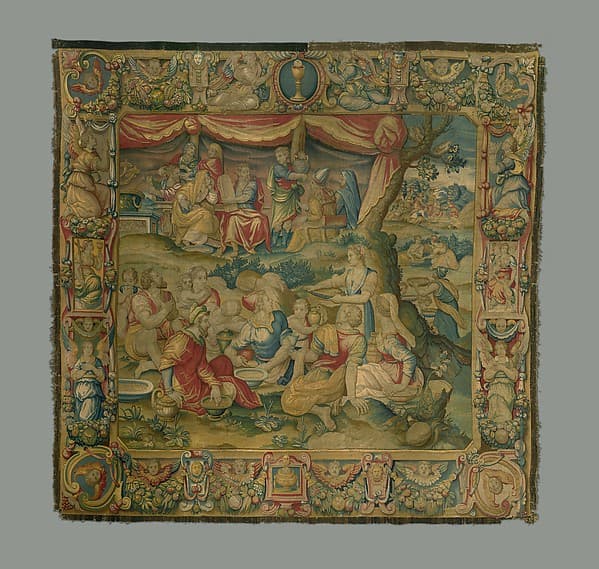
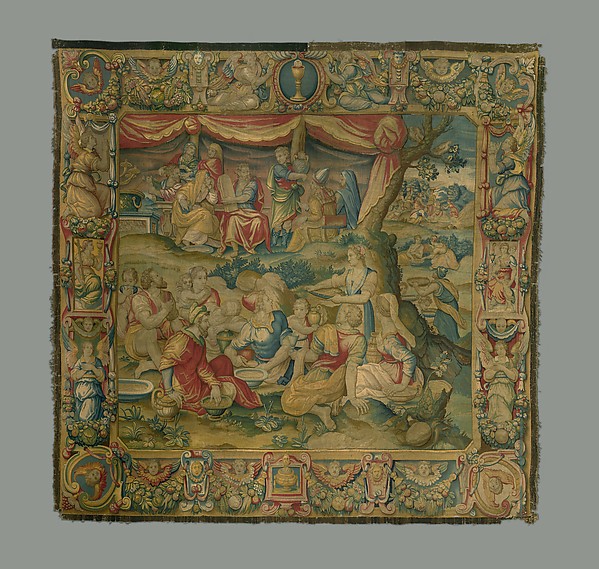
The Gathering of Manna, painted by Alessandro Allori around 1595 in oil on canvas and now in the Metropolitan Museum of Art in New York, illustrates the moment from Exodus 16 in which the Israelites gather the manna sent down from heaven during their wilderness wandering. Allori stages the scene with characteristic late-Mannerist Florentine compositional density: a crowd of Israelites in the foreground in dense varied postures of gathering — kneeling, standing, bending — with their pots, baskets, and cloths spread across the ground, the small white grains of manna scattered everywhere; Moses on a small rocky outcrop in the deeper background gesturing toward the descending miraculous food; the Egyptian-Sinai wilderness landscape opening behind. The chromatic palette of saturated crimson, ochre, and pale silver-blue is characteristic of Allori's mature Florentine workshop manner under Medici grand-ducal patronage.
Bible scenes Alessandro Allori painted
Numbers