Numbers 11
People in this chapter
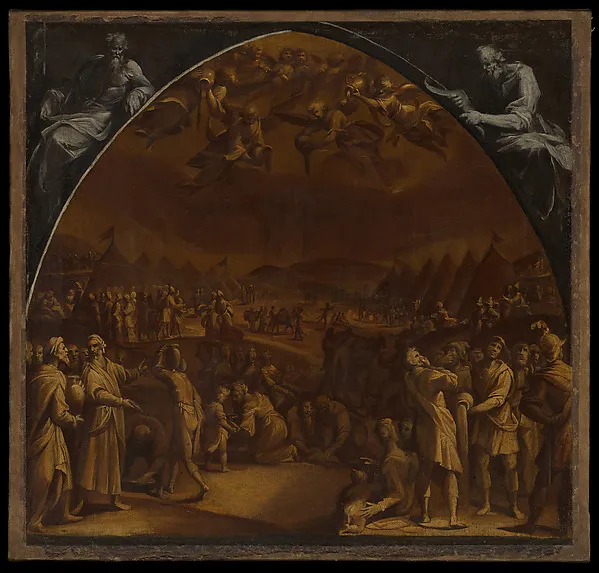
Numbers 11 shows Israel in the wilderness at a breaking point. The journey from Egypt to Canaan, which should have taken two weeks, has already stretched into months. The people are tired, hungry, and restless. What begins as a quiet complaint at the edge of camp ignites into mutiny.
Tap any highlighted phrase to jump to the commentary that unpacks it.
Numbers 11:1-3Fire at the Edge of Camp
1And when the people complained, it displeased the LORD: and the LORD heard it; and his anger was kindled; and the fire of the LORD burnt among them, and consumed them that were in the uttermost parts of the camp. 2And the people cried unto Moses; and when Moses prayed unto the LORD, the fire was quenched. 3And he called the name of the place Taberah: because the fire of the LORD burnt among them.
When God's people murmur, His anger is kindled - a Father responding to ingratitude and faithlessness. The people have seen miracles and yet forgotten the Deliverer. The fire that consumes the edges of the camp is a judgment, yes, but also a mercy - a call to repentance before the murmuring spreads further.
The word for "complained" here is a murmuring - a restless, discontent breath that spreads from person to person. In the wilderness, murmuring is a kind of faithlessness. The people have seen the pillar of fire, the plagues on Egypt, the Red Sea open before them. Yet at the first hardship, they forget.
Taberah means "burning" in Hebrew. The place is named for what happened there. Israel will carry the memory of this place - and the burning - all the way to Canaan. Names in Scripture are never accidental; they are permanent reminders of who God is.
Numbers 11:4-9The Mixed Multitude Craves Egypt
4And the mixt multitude that was among them fell a lusting: and the children of Israel also wept again, and said, Who shall give us flesh to eat? 5We remember the fish, which we did eat in Egypt freely; the cucumbers, and the melons, and the leeks, and the onions, and the garlick: 6But now our soul is dried away: there is nothing at all, beside this manna, before our eyes. 7And the manna was as coriander seed, and the colour thereof as the colour of bdellium. 8And the people went about, and gathered it, and ground it in mills, or beat it in a mortar, and baked it in pans, and made cakes of it: and the taste of it was as the taste of fresh oil. 9And when the dew fell upon the camp in the night, the manna fell upon it.
Lusting is a demand that says "I deserve this, and I deserve it now." It is the appetite in rebellion against submission. The people do not ask God for bread; they tear it from His hand through complaint.
The "mixed multitude" (aspsuf) is the word for riffraff, foreigners, those who left Egypt but never fully belonged to Israel's covenant. They ignite the murmuring. But Israel joins in. This is the danger of complaint: it spreads fastest among those who were never fully committed to the promise in the first place.
The catalog of Egyptian foods is vivid and specific. Fish, cucumbers, melons, leeks, onions, garlic - all the foods of the Nile and its cultivated fields. The people have romanticized Egypt. They remember the abundance of the food market and have forgotten the whip, the taskmaster, the crushing servitude. Memory in Scripture is dangerous when it is selective.
Cucumbers are a cool, abundant crop of the Nile Valley - easy to grow, easy to eat. They represent comfort, accessibility, the life of a slave who could at least eat well. No one who had truly tasted freedom would trade it for cucumbers.
Melons - sweet, substantial, the fruit of summer. The people are not asking for survival; they are asking for the good life they imagined themselves living in Egypt. They have forgotten that they were slaves.
Leeks, onions, garlic - the staple flavorings of poor people's food. These are not luxuries; they are the foods of subsistence. Yet to Israel in the wilderness, surviving on manna, they seem infinitely precious. The nostalgia of the enslaved is a powerful and dangerous thing.
The specificity here matters. This is not abstract hunger; this is hunger for a particular taste, a particular memory. Spiritual dissatisfaction often disguises itself as appetite.
Garlic. The humblest of the Egyptian foods mentioned. And yet it becomes, in the wilderness, the symbol of everything left behind. We desire what we have lost far more than what we have.
The manna is compared to coriander seed - small, round, pale. It is enough. God provides. But it is not what they crave. The wilderness teaches a hard lesson: provision is not the same as preference, and need is not the same as desire.
Bdellium is a pale, translucent resin. The manna catches the morning light, becomes visible as dew falls. It is a visible, daily, undeniable miracle. Yet it does not satisfy the wanting of the heart.
Numbers 11:10-15The Burden Falls on Moses
10Then Moses heard the people weep throughout their families, every man in the door of his tent: and the anger of the LORD was kindled greatly; Moses also was displeased. 11And Moses said unto the LORD, Wherefore hast thou afflicted thy servant? and wherefore have I not found favour in thy sight, that thou layest the burden of all this people upon me? 12Have I conceived all this people? have I begotten them, that thou shouldest say unto me, Carry them in thy bosom, as a nursing father beareth the sucking child, unto the land which thou swarest unto their fathers? 13Whence should I have flesh to give unto all this people? for they weep unto me, saying, Give us flesh, that we may eat. 14I am not able to bear all this people alone, because it is too heavy for me. 15And if thou deal thus with me, kill me, I pray thee, out of hand, if I have found favour in thy sight; and let me not see my wretchedness.
Moses is at the end of his strength. He is not angry at the people (though he has every right to be); he is bewildered by God. "Why have you afflicted your servant?" he asks. He is carrying a weight he was never designed to carry alone. No human leader can bear the spiritual hunger of an entire people by themselves.
Moses parries with the same word the people used: "flesh." He is saying, in effect, where am I supposed to get meat for all this people 1? He is being literal and sarcastic at once. The people are asking the impossible. And he is the one being crushed by it.
The repetition of "flesh" shows the weight of it - the people weeping, demanding, demanding again. This is not a small request. The whole camp is crying out in hunger. Moses has become the lightning rod for all of Israel's discontent.
Numbers 11:16-30The Spirit Falls on Seventy Elders
16And the LORD said unto Moses, Gather unto me seventy men of the elders of Israel, whom thou knowest to be the elders of the people, and officers over them; and bring them unto the tabernacle of the congregation, that they may stand there with thee. 17And I will come down and talk with thee there: and I will take of the spirit which is upon thee, and will put it upon them; and they shall bear the burden of the people with thee, that thou bear it not thyself alone. 18And say thou unto the people, Sanctify yourselves against to morrow, and ye shall eat flesh: for ye have wept in the ears of the LORD, saying, Who shall give us flesh to eat? for it was well with us in Egypt: therefore the LORD will give you flesh, and ye shall eat.
The LORD tells Moses to gather seventy elders at the tent, where He will take of the Spirit resting on Moses and place it on them to help him carry the people. He also tells the people to sanctify themselves, for the next day He will give them meat to eat, a whole month of it.
19Ye shall not eat one day, nor two days, nor five days, neither ten days, nor twenty days; 20But even a whole month, until it come out at your nostrils, and it be loathsome unto you: because that ye have despised the LORD which is among you, and have wept before him, saying, Why came we forth out of Egypt? 21And Moses said, The people, among whom I am, are six hundred thousand footmen; and thou hast said, I will give them flesh, that they may eat a whole month. 22Shall the flocks and the herds be slain for them, to suffice them? or shall all the fish of the sea be gathered together for them, to suffice them?
The promise has been made: you shall eat flesh a whole month. Moses doubts the logistics - how can so much meat be provided? God does not answer the question directly. He asks instead: Is My hand shortened? Can I not do what I have said? The test is not about provision; it is about faith in God's sufficiency. Now comes the answer: it will be done. Watch.
23And the LORD said unto Moses, Is the LORD’s hand waxed short? thou shalt see now whether my word shall come to pass unto thee or not. 24And Moses went out, and told the people the words of the LORD, and gathered the seventy men of the elders of the people, and set them round about the tabernacle. 25And the LORD came down in a cloud, and spake unto him, and took of the spirit that was upon him, and gave it unto the seventy elders: and it came to pass, that, when the spirit rested upon them, they prophesied, and did not cease. 26But there remained two of the men in the camp, the name of the one was Eldad, and the name of the other Medad: and the spirit rested upon them; and they were of them that were written, but went not out unto the tabernacle: and they prophesied in the camp.
The LORD assures Moses that His hand is not shortened, then rests His Spirit on the seventy gathered around the tent, and they prophesy. Two of the men, Eldad and Medad, had remained in the camp, yet the Spirit came upon them there as well, and they prophesied among the people.
27And there ran a young man, and told Moses, and said, Eldad and Medad do prophesy in the camp. 28And Joshua the son of Nun, the servant of Moses, one of his young men, answered and said, My lord Moses, forbid them. 29And Moses said unto him, Enviest thou for my sake? would God that all the LORD’s people were prophets, and that the LORD would put his spirit upon them! 30And Moses gat him into the camp, he and the elders of Israel.
Seventy elders. This is not arbitrary. Seventy becomes the template for shared leadership in Scripture - echoed later in the Sanhedrin and, most famously, in Jesus' sending of seventy disciples (Luke 10:1). The work of the kingdom is never meant to rest on one person.
When the Spirit rests on the seventy, they prophesy. Prophecy here is not primarily predicting the future; it is speaking forth the word of the Lord, blessing and directing the people. The Spirit makes speakers of plain elders.
Eldad and Medad are two men who were registered but did not show up at the tabernacle. And yet the Spirit rests on them anyway. They prophesy in the camp itself, among the people. This is shocking. The Spirit is not bound by protocol; it is not confined to the official place. It moves where it will.
These two names - Eldad and Medad - appear nowhere else in Scripture. And yet they are preserved here because of what happened to them: an outpouring of the Spirit that no one expected, in a place no one authorized, on people who were not even present when the formal commissioning occurred.
The fact that they prophesy is reported as a breach of protocol 2. But look at Moses' response. He does not see a problem. He sees instead the fulfillment of a hope.
Numbers 11:31-35The Graves of Craving
31And there went forth a wind from the LORD, and brought quails from the sea, and let them fall by the camp, as it were a day’s journey on this side, and as it were a day’s journey on the other side, round about the camp, and as it were two cubits high upon the face of the earth. 32And the people stood up all that day, and all that night, and all the next day, and they gathered the quails: he that gathered least gathered ten homers: and they spread them all abroad for themselves round about the camp. 33And while the flesh was yet between their teeth, ere it was chewed, the wrath of the LORD was kindled against the people, and the LORD smote the people with a very great plague. 34And he called the name of that place Kibrothhattaavah: because there they buried the people that lusted. 35And the people journeyed from Kibrothhattaavah unto Hazeroth; and abode at Hazeroth.
A wind from the Lord blows quail in from the sea. They fall thick on the ground - lying about two cubits deep around the camp. The provision is immediate and overwhelming. God is answering their demand. He is giving them what they wanted. This is a terrible mercy.
The people gather quail for two days straight - night and day. Each person gathers at least ten homers (a homer is a large measure, roughly 90 pounds). The abundance is staggering. They have what they asked for. And then, while they are still chewing, the plague comes.
The "flesh" they demanded comes. But it does not satisfy; it kills. The same word that described their hunger now describes the very thing that will cause their death. Desire and death become indistinguishable.
Research trail
Sources & further study
These references support the historical, linguistic, manuscript, and contextual notes in this chapter. Scripture remains the primary text; external sources are provided so readers can inspect the research directly.
- Numbers 11 - Craving and Complaint in the WildernessTalmudic and rabbinic commentary on Israel's complaint against the manna, Moses' burden of leadership, the distribution of the Spirit, and the graves of craving as judgment for appetite untethered from gratitude.
- The Distribution of the Spirit - Eldad and MedadOverview of the Spirit's outpouring on the seventy elders and the unexpected prophecy of Eldad and Medad, showing God's Spirit moves beyond formal protocols and designated places.
- Kibroth-hattaavah - The Graves of CravingRabbinic commentary on the place name as warning, the nature of appetite versus hunger for righteousness, and the judgment that follows when desire becomes the measure of faith.