Numbers 10
People in this chapter
Numbers 10 opens with two silver trumpets - made not for war or celebration, but for summoning the congregation and signaling when to march. These trumpets shape the whole chapter. They call Israel to assembly. They announce the beginning of the journey that will take forty years to complete.
Tap any highlighted phrase to jump to the commentary that unpacks it.
Numbers 10:1-4The Two Silver Trumpets
1And the LORD spake unto Moses, saying, 2Make thee two trumpets of silver; of a whole piece shalt thou make them: that thou mayest use them for the calling of the assembly, and for the journeying of the camps.
3And when they shall blow with them, all the assembly shall assemble themselves to thee at the door of the tabernacle of the congregation. 4And if they blow but with one trumpet, then the princes, which are heads of the thousands of Israel, shall gather themselves unto thee.
The trumpet has a language 1. Two blasts: the whole congregation gathers. One blast: the leaders assemble. Later in the chapter, a different kind of blast signals the camps to march. The same instrument carries different meanings depending on how it is sounded. The people learn to listen and obey.
Numbers 10:5-10The Blasts and Their Meanings
5When ye blow an alarm, then the camps that lie on the east parts shall go forward. 6When ye blow an alarm the second time, then the camps that lie on the south side shall take their journey: they shall blow an alarm for their journeys.
The Hebrew word is truah - an alarm, a blast that signals movement. The first alarm: the eastern camp moves. The second alarm: the southern camp moves. The camps march in order, tribe by tribe, family by family. There is precision here. God does not move His people in chaos; there is a sequence, a leadership, a formation.
7But when the congregation is to be gathered together, ye shall blow, but ye shall not sound an alarm. 8And the sons of Aaron, the priests, shall blow with the trumpets; and they shall be to you for an ordinance for ever throughout your generations.
Only the priests blow the trumpets. The sound belongs to the priesthood, to those who stand before God on behalf of the people. When Israel hears the trumpet, they are hearing the voice of their mediators - and through them, the voice of God Himself. Authority and function are inseparable.
9And if ye go to war in your land against the enemy that oppresseth you, then ye shall blow an alarm with the trumpets; and ye shall be remembered before the LORD your God, and ye shall be saved from your enemies. 10Also in the day of your gladness, and in your solemn days, and in the beginnings of your months, ye shall blow with the trumpets over your burnt offerings, and over the sacrifices of your peace offerings; that they may be to you for a memorial before your God: I am the LORD your God.
The trumpets sound in war, in celebration, in solemn feasts, at the beginning of months - they are woven through the whole life of the community. Every trumpet blast is a memorial before God. The sound itself is remembrance. When Israel hears the trumpet, they remember: God is here. God is leading. God will fight for us. God receives our worship. The trumpet is both summons and prayer.
Numbers 10:11-28The Order of March
11And it came to pass on the twentieth day of the second month, in the second year, that the cloud was taken up from off the tabernacle of the testimony. 12And the children of Israel took their journeys out of the wilderness of Sinai; and the cloud rested in the wilderness of Paran.
Israel has been at Sinai for eleven months. The cloud that led them out of Egypt stayed over the tabernacle while the law was given, the priesthood ordained, the people numbered. Now the cloud lifts. The pilgrimage resumes. Sinai was not home; it was a place of preparation. The promise is still ahead.
13And they first took their journey according to the commandment of the LORD by the hand of Moses. 14In the first place went the standard of the camp of the children of Judah according to their armies: and over his host was Nahshon the son of Amminadab.
Judah leads. The order of march was established in Numbers 2: Judah at the front, Reuben and Simeon on the south, Ephraim on the west, Dan on the north. Each tribe has its place. Organization and structure make order possible. God does not move a mob; He leads a people arranged, cohesive, each family knowing their position.
15And over the host of the tribe of the children of Issachar was Nethaneel the son of Zuar. 16And over the host of the tribe of the children of Zebulun was Eliab the son of Helon. 17And the tabernacle was taken down; and the sons of Gershon and the sons of Merari set forward, bearing the tabernacle.
After Judah marches, the tabernacle is carried - not the whole structure at once, but divided among the Levites. The holy place goes in the middle of the procession, protected, honored, central to the whole movement. Everything in Israel's march revolves around the presence of God.
18And the standard of the camp of Reuben set forward according to their armies: and over his host was Elizur the son of Shedeur. 19And over the host of the tribe of the children of Simeon was Shelumiel the son of Zurishaddai. 20And over the host of the tribe of the children of Gad was Eliasaph the son of Deuel. 21And the Kohathites set forward, bearing the sanctuary: and the other did set up the tabernacle against they came.
The Kohathites carry the most sacred vessels - the ark, the lampstand, the table of showbread, the altar. Because these are so holy, they cannot be carried until they are covered and prepared. The care shown to the holy things is meticulous. What is closest to God's presence requires the most protection.
22And the standard of the camp of the children of Ephraim set forward according to their armies: and over his host was Elishama the son of Ammihud. 23And over the host of the tribe of the children of Manasseh was Gamaliel the son of Pedahzur. 24And over the host of the tribe of the children of Benjamin was Abidan the son of Gideoni. 25And the standard of the camp of the children of Dan set forward, which was the rereward of all the camps throughout their hosts: and over his host was Ahiezer the son of Ammishaddai.
Dan marches last - the rearguard. They protect the vulnerable, the stragglers, the ones who cannot keep pace. Even in the order of march, there is care for the weak. The pattern of Scripture is always: the strong serve the weak, the leaders protect those without protection.
26And over the host of the tribe of the children of Asher was Pagiel the son of Ocran. 27And over the host of the tribe of the children of Naphtali was Ahira the son of Enan. 28Thus were the journeyings of the children of Israel according to their armies, when they set forward.
Numbers 10:29-34Hobab the Guide
29And Moses said unto Hobab, the son of Raguel the Midianite, Moses’ father in law, We are journeying unto the place of which the LORD said, I will give it you: come thou with us, and we will do thee good: for the LORD hath spoken good concerning Israel.
Hobab is a Midianite - Moses' father-in-law's relative. He knows the wilderness; he has lived in it. Moses asks him to come along as a guide. This is a remarkable moment. Moses, who has seen God face to face, who carries the law written on stone, asks a man of the wilderness to show the way. God works through preparation and knowledge. He uses the gifts of others.
30And he said unto him, I will not go; but I will depart to mine own land, and to my kindred. 31And he said, Leave us not, I pray thee; forasmuch as thou knowest how we are to encamp in the wilderness, and thou mayest be to us instead of eyes.
"Thou mayest be to us instead of eyes." This is the deepest form of trust. Moses is saying: you know what we cannot see. You know where water is. You know where the land is passable. You know dangers we do not. In the wilderness, the one who sees is more essential than the one who leads. Knowledge and guidance are gifts that the mighty need.
32And it shall be, if thou go with us, yea, it shall be, that what goodness the LORD shall do unto us, the same will we do unto thee. 33And they departed from the mount of the LORD three days’ journey: and the ark of the covenant of the LORD went before them in the three days’ journey, to search out a resting place for them. 34And the cloud of the LORD was upon them by day, when they went out of the camp.
The ark goes before them. The ark searches out a resting place. Even as they march with a guide who knows the wilderness, they follow God's presence. The eye that matters most is God's eye, watching the way, choosing where they rest.
Numbers 10:35-36The Great Prayers
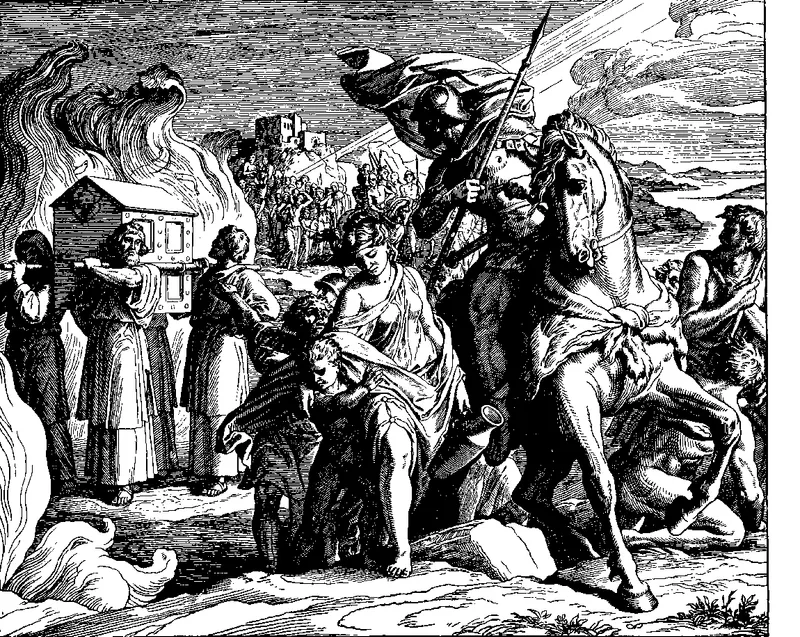
35And it came to pass, when the ark set forward, that Moses said, Rise up, LORD, and let thine enemies be scattered; and let them that hate thee flee before thee.
When the ark moves, Moses prays . It is a prayer spoken in the very moment the people begin to move forward. The prayer is an invocation: Rise up, scatter enemies, make a way. It is both confidence and plea. God, you have said you will do this. Now do it.
36And when it rested, he said, Return, O LORD, unto the many thousands of Israel.
And when they stop, Moses prays again 2: Return. Return to the many thousands of Israel. It is a prayer for rest, for God's presence to settle where the people settle. Not "return" as in coming back from a distance, but "return to your place" - settle here with us. Be at home where we are at home. The prayer bookends the journey: rise up to lead, return to dwell. The whole rhythm of faith is in these two prayers.
Research trail
Sources & further study
These references support the historical, linguistic, manuscript, and contextual notes in this chapter. Scripture remains the primary text; external sources are provided so readers can inspect the research directly.
- Numbers 10 - Silver Trumpets and the Great DepartureRabbinic and Talmudic commentary on the significance of the silver trumpets, their different blasts, the order of march, and the timing of Israel's first departure from Sinai.
- The Prayers of Movement - Rise Up and ReturnTalmudic discussion of Moses' prayers at the movement and rest of the ark, their role in binding the people to God's guidance, and their intertextual connection to spiritual pilgrimage and warfare.