Painter of the Bible
Alessandro Casolani
Alessandro Casolani — sometimes called Casolani della Torre after his birthplace at Casole d'Elsa near Siena — was a leading Sienese late-Mannerist painter of the second half of the sixteenth century.

Their faith
Why Alessandro Casolani painted Christ
Alessandro Casolani was deeply rooted in the Catholic faith, which profoundly influenced his artistic journey. Born in the small town of Casole d'Elsa, he trained under Cristoforo Roncalli in Siena, where he developed a devotion to creating sacred art. His works primarily served the needs of the Counter-Reformation, reflecting the Catholic Church's emphasis on piety and devotion during a time of spiritual renewal. Casolani's commitment to his faith is evident in his meticulous attention to detail and his choice of subjects, often focusing on the Virgin Mary and scenes from Christ's life. His altarpieces and frescoes were crafted for various churches and confraternities, showcasing his dedication to serving the Church through his artistic talents.
Casolani's faith shaped his artistic vision, leading him to create works that resonate with deep spiritual significance. His altarpiece, "The Adoration of the Shepherds," exemplifies this, capturing the humble reverence of the shepherds as they witness the birth of Christ. Similarly, his numerous depictions of the Holy Family reflect a profound understanding of familial love and divine grace. Through his vibrant color palette and elongated figures, Casolani invites viewers into a sacred space where they can encounter the divine. His art continues to inspire and uplift, allowing modern audiences to connect with the eternal truths of the Christian faith, reminding us of the beauty and depth of devotion that can be found in sacred art.
Life & work
Alessandro Casolani — sometimes called Casolani della Torre after his birthplace at Casole d'Elsa near Siena — was a leading Sienese late-Mannerist painter of the second half of the sixteenth century. Born in Casole d'Elsa in 1552, trained in Siena in the workshop of Cristoforo Roncalli (Pomarancio) before establishing his independent career in the city, and active in Siena, Rome, and the smaller Tuscan and central Italian hill towns for his entire career, he died in Siena in 1607.
His Christian religious work is concentrated in altarpieces and fresco cycles for the Sienese Counter-Reformation Catholic churches and confraternities and (during his Roman sojourns under Pope Clement VIII in the 1590s) for the Roman ecclesiastical commissions of the late-Mannerist papal-court generation. The Adoration of the Shepherds altarpiece in the Sienese church of Santa Maria della Scala, the Holy Family altarpieces in workshop variants for Tuscan parish churches, the Crucifixion altarpieces in the Sienese hospital church and the Sienese cathedral, and the small devotional Madonnas and Pietà compositions in the standard late-Sienese-Mannerist format fill the painted corpus.
His personal style — late-Mannerist figural elongation, jewel-bright Sienese chromatic palette, careful narrative composition, and a particular preference for the small intimate Marian devotional subject — places him in the broader Sienese late-Cinquecento tradition alongside Francesco Vanni and Ventura Salimbeni (the two Salimbeni half-brothers who, with Casolani, constituted the leading Sienese late-Mannerist generation). The three painters worked in close stylistic dialogue across the Sienese pictorial scene through the 1580s, 1590s, and early 1600s.
He worked principally for the Sienese ecclesiastical patrons and confraternities rather than for the Medici grand-ducal court (Siena was not formally annexed to the Medici Tuscan grand duchy until 1559, just before Casolani's birth, and the Sienese pictorial culture maintained considerable regional independence from Florentine grand-ducal patronage well into the seventeenth century). His son Ilario Casolani continued the workshop briefly after his death; the major Sienese late-Mannerist tradition was carried forward by Ventura Salimbeni and Francesco Vanni more than by the Casolani family workshop.
Notable works in detail
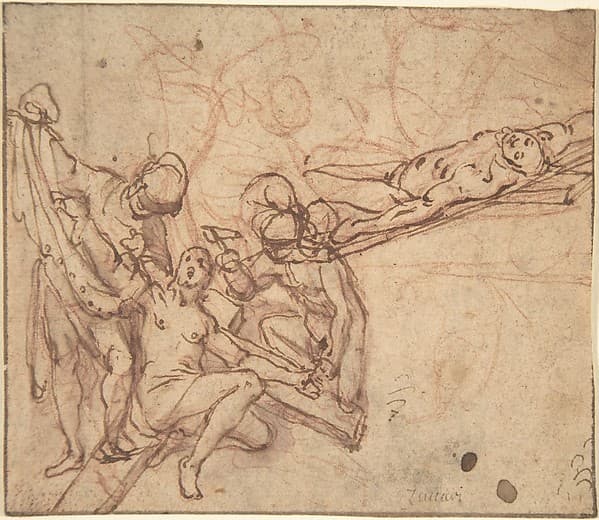
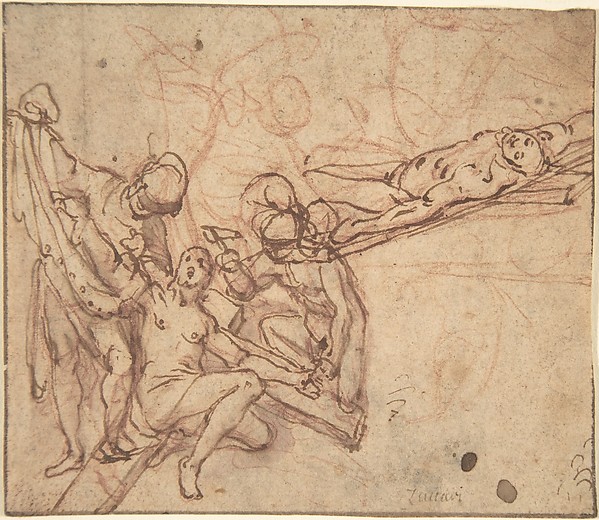
Studies for a Crucifixion, drawn by Alessandro Casolani around 1590 (the dating is somewhat early — Casolani would have been in his late thirties) in red chalk on paper and now in the Metropolitan Museum of Art in New York, is a sheet of preparatory studies for one of his many painted Crucifixion altarpiece compositions. The drawing shows multiple poses of the figure of Christ on the cross — torso, arms, legs in different foreshortenings — drawn rapidly with the soft red chalk that the late-Cinquecento Tuscan workshop tradition had refined to a high pitch. Such study sheets were the standard preparatory currency for late-Mannerist Sienese altarpiece practice and demonstrate the careful figural-study working method that Casolani and his Sienese contemporaries Salimbeni and Vanni shared in the Sienese late-Mannerist tradition.
Bible scenes Alessandro Casolani painted
Matthew