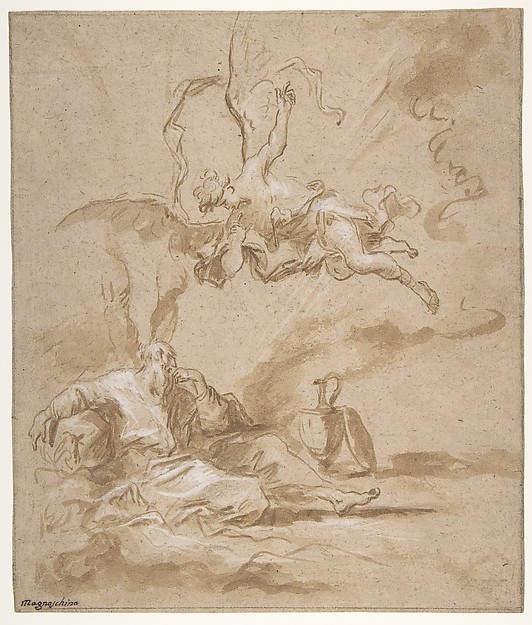
Painter of the Bible
Alessandro Magnasco
Alessandro Magnasco — called Il Lissandrino (Little Alexander) by his Genoese contemporaries — was a Genoese-born painter who spent most of his career in Milan and was one of the most distinctive late-Baroque-into-Rococo…
.jpg%3Fwidth%3D600&w=2048&q=75)
Their faith
Why Alessandro Magnasco painted Christ
Alessandro Magnasco, known as Il Lissandrino, was deeply influenced by his Christian faith, which is evident in his choice of subjects and the emotional depth of his work. Orphaned at a young age, he was apprenticed to the painter Filippo Abbiati, where he honed his skills and developed a unique style that reflected the Counter-Reformation's emphasis on spirituality and asceticism. Magnasco's paintings often depict monks, hermits, and ecstatic mystics, showcasing a profound reverence for the contemplative life. His works resonate with the dramatic landscapes of his native Genoa, infused with a sense of divine presence that invites viewers to reflect on their own spiritual journeys. His friendship with the art collector Niccolò Gabburri and his patronage under the Medici further illustrate his connection to the church and the artistic community that supported his faith-driven endeavors.
Magnasco's spiritual vision is particularly evident in works like "The Friars at Prayer" and "The Trappist Refectory," where he captures the essence of devotion and the beauty of solitude in nature. These paintings reveal his ability to blend the wild landscapes of the Italian countryside with the inner lives of his subjects, creating a dialogue between the earthly and the divine. The flickering figures and dramatic skies evoke a sense of urgency and passion, inviting viewers to contemplate the sacred moments of prayer and reflection. Magnasco's legacy as a painter of the divine continues to inspire, reminding us of the power of faith and the beauty found in the pursuit of a deeper relationship with God through art.
Life & work
Alessandro Magnasco — called Il Lissandrino (Little Alexander) by his Genoese contemporaries — was a Genoese-born painter who spent most of his career in Milan and was one of the most distinctive late-Baroque-into-Rococo Italian painters of the early eighteenth century. Born in Genoa in 1667 to the painter Stefano Magnasco (who died in 1672 leaving the young Alessandro orphaned), apprenticed to the Milanese painter Filippo Abbiati after his father's death, and active in Milan, Florence, and Genoa for his entire career, he died in Genoa in 1749.
His Christian religious work is concentrated in small-format paintings of monks, hermits, friars, and ecstatic mystics in dramatic mountain landscapes — a particular Magnasco specialty that combined the Salvator Rosa wild-landscape tradition with a peculiarly Genoese-Lombard taste for the dramatic asceticism of the Counter-Reformation monastic religious imagination. The Friars at Prayer and the Quaker Meeting (Detroit Institute of Arts), the Bandits in a Wood (numerous workshop variants), the Trappist Refectory (Pitti, c. 1700), the Synagogue (Cleveland, c. 1725), the Capuchin Convent compositions, and dozens of small monastic-and-eremitic narrative panels fill the painted corpus.
His personal style is unmistakable: small flickering figures painted with broad rapid brushwork in a deeply restricted chromatic palette of grey, ochre, brown, and accents of crimson, set against vast dramatic landscapes of mountain peaks, ruined arches, blasted trees, and roiling stormy skies. The technique — closer to a quick painted sketch than to a finished early-eighteenth-century altarpiece — was unusually loose for its period and anticipated by a century the Romantic interest in the dramatic-asceticism subject and the painterly handling of pigment.
He was a personal friend of the Florentine art collector and great Magnasco patron Niccolò Gabburri (whose collection contained over thirty Magnasco paintings) and worked under Medici grand-ducal patronage during his Florentine years. The eighteenth-century neoclassical reaction pushed his late-Baroque manner out of fashion almost immediately after his death; the modern rediscovery of Magnasco as a major figure dates from the early twentieth century, when his combination of dramatic asceticism and loose painterly technique attracted comparison with the Romantics and the modernists.
Notable works in detail
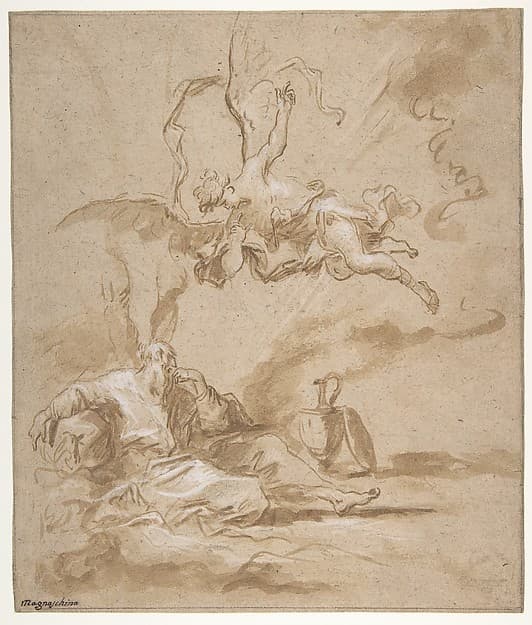
Elijah Visited by an Angel in the Wilderness (1 Kings 19:4-8)
Elijah Visited by an Angel in the Wilderness (1 Kings 19), painted by Alessandro Magnasco around 1687 in oil on canvas and now in the Metropolitan Museum of Art in New York, depicts the moment from 1 Kings 19 in which the prophet Elijah, fleeing from Queen Jezebel's persecution and weary unto death in the desert, is visited by an angel who feeds him bread and water for his forty-day journey to Mount Horeb. Magnasco stages the scene with characteristic dramatic-asceticism Romantic intensity: the small figure of Elijah collapsed under a juniper tree at the lower right, the angel descending from the upper left in a luminous burst of light bearing the bread and water, the wild rocky desert landscape stretching away to a turbulent horizon. The chromatic palette of grey, ochre, brown, and crimson against the dramatic stormy sky is the unmistakable Magnasco signature, and the painting is among his principal Old Testament treatments in any American collection.
Bible scenes Alessandro Magnasco painted
1 Kings