1 Kings 17
People in this chapter
A drought is declared, and the man who declares it has no army and no name anyone knows. Ahab has married a Sidonian princess and filled Israel with Baal, the storm-god who supposedly hands out rain. Into that court walks Elijah the Tishbite, and his first words shut the sky: there shall not be dew nor rain these years, but according to my word (v. 1). Then the LORD hides him. A brook feeds him. Ravens carry his bread. And the brook runs dry.1
Tap any highlighted phrase to jump to the commentary that unpacks it.

1 Kings 17:1-5There Shall Not Be Dew Nor Rain
1And Elijah the Tishbite, who was of the inhabitants of Gilead, said unto Ahab, As the LORD God of Israel liveth, before whom I stand, there shall not be dew nor rain these years, but according to my word. 2And the word of the LORD came unto him, saying, 3Get thee hence, and turn thee eastward, and hide thyself by the brook Cherith, that is before Jordan. 4And it shall be, that thou shalt drink of the brook; and I have commanded the ravens to feed thee there. 5So he went and did according unto the word of the LORD: for he went and dwelt by the brook Cherith, that is before Jordan.
No introduction, no genealogy beyond his town, no record of a call - Elijah is simply there, and the first thing out of his mouth shuts the sky. Aim the challenge where it stings: Baal was worshipped precisely as the lord of storm and rain and fertility, the god who supposedly turned the seasons. To announce a multi-year drought in Israel is to call Baal's bluff on his own home turf. And Elijah does it in the name of the LORD God of Israel, tying the very weather to the word in his mouth.
Listen to where he locates his authority - before whom I stand. It is not his own. He speaks as a servant attending a king, carrying a word that is not his to soften. What he delivers is a sentence, and the sky will keep it - the rain itself proving more obedient to the LORD than Israel has been.1
The very next breath after that towering pronouncement is an order to disappear. The man who just stared down a king is sent to a ravine east of the Jordan to hide beside a small brook that still runs. It reads like an anticlimax, until you see what it truly is: obedience, and the hiding itself a shelter - out of Ahab's reach, fed, kept. The text refuses to let you miss the point: So he went and did according unto the word of the LORD (v. 5).
No argument, no delay. The same prophet who hurls the LORD's word at a king turns around and does the LORD's word himself. There is no daylight between his preaching and his obeying. He speaks the word in the court and keeps it in the wilderness, and both are the same bowed-down submission to the God before whom he stands.
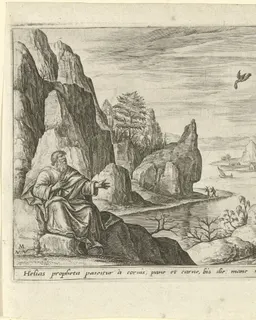
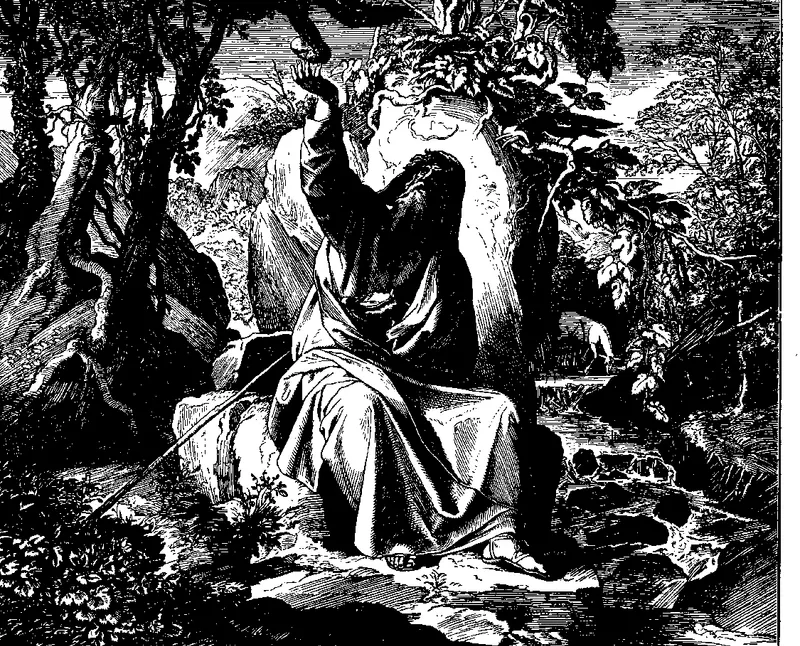
How Elijah is fed at Cherith is one of the quiet wonders of Scripture: I have commanded the ravens to feed thee there (v. 4), and so it happens - the ravens brought him bread and flesh in the morning, and bread and flesh in the evening (v. 6). Twice a day, without fail, the food arrives, as regular as sunrise and sunset, morning and evening, like the manna that fell each day in the wilderness.
And the messengers are pointed. In the law given to Israel the raven is named among the unclean birds, a scavenger not to be eaten. Yet the LORD presses these very creatures into the service of His prophet, commanding birds the way a king commands an army. The God who shut the sky can feed one man by any means He chooses, including the means least likely and least “suitable.” The lesson runs underneath the whole chapter: provision belongs to the LORD, who may use any channel He pleases - a raven, a starving widow, a dry brook that still runs for a season.
It is the LORD who feeds.
1 Kings 17:6-7The Brook Dried Up
6And the ravens brought him bread and flesh in the morning, and bread and flesh in the evening; and he drank of the brook. 7And it came to pass after a while, that the brook dried up, because there had been no rain in the land.
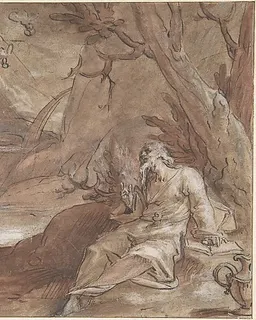
Then comes a line that lands harder than its few words suggest: And it came to pass after a while, that the brook dried up, because there had been no rain in the land (v. 7). Elijah is not exempt from the drought he announced. The very judgment he pronounced now reaches his own refuge; the water that kept him alive runs out. Anyone reading quickly might take this as the LORD's care running dry - but the chapter means something stranger.
The brook fails because the LORD is moving him on, to a provision Elijah could not yet imagine, in a place he would never have chosen. The drying brook is the LORD's summons to the next step of faith. There is a hard mercy in it: the prophet cannot settle, cannot make a permanent home of yesterday's supply. He is kept dependent, kept moving, kept learning that the LORD is the source and the brook only the channel.
Every believer eventually stands at a Cherith that has gone dry - a help that worked until it didn't, a season that has plainly ended. The question the dry brook asks is whether our trust was ever in the brook, or in the One who commanded it to flow.
1 Kings 17:8-10I Have Commanded a Widow to Sustain Thee
8And the word of the LORD came unto him, saying, 9Arise, get thee to Zarephath, which belongeth to Zidon, and dwell there: behold, I have commanded a widow woman there to sustain thee. 10So he arose and went to Zarephath. And when he came to the gate of the city, behold, the widow woman was there gathering of sticks: and he called to her, and said, Fetch me, I pray thee, a little water in a vessel, that I may drink.
Every detail of the next assignment cuts against expectation. Zarephath sits in Sidon - outside Israel, in the very homeland of Jezebel, the beating heart of Baal country. And the one appointed to feed the LORD's prophet is no king and no wealthy patron but a widow, in that world among the most defenseless and poor of all. The LORD reaches clean past the borders of His chosen nation, past every palace and power, to a destitute foreign woman, and makes her the channel of His care.
Catch the wording: He has commanded this widow to sustain Elijah, the same verb used of the ravens (v. 4). She has no idea yet - but heaven has already enlisted her. When Elijah reaches the gate he finds her gathering of sticks, scraping fuel for one last fire. The prophet who shut the sky has been sent to lean on a woman who has nothing, in a land that worships the wrong god, and the LORD calls it provision.
1 Kings 17:11-12That We May Eat It, and Die
11And as she was going to fetch it, he called to her, and said, Bring me, I pray thee, a morsel of bread in thine hand. 12And she said, As the LORD thy God liveth, I have not a cake, but an handful of meal in a barrel, and a little oil in a cruse: and, behold, I am gathering two sticks, that I may go in and dress it for me and my son, that we may eat it, and die.
Elijah's requests escalate at exactly the worst moment. First a little water - reasonable. Then, as she goes, Bring me, I pray thee, a morsel of bread (v. 11) - and that breaks her open. Her answer is the speech of someone who has reached the end: As the LORD thy God liveth, I have not a cake, but an handful of meal in a barrel, and a little oil in a cruse: and, behold, I am gathering two sticks, that I may go in and dress it for me and my son, that we may eat it, and die (v. 12).
There is no self-pity in it, only the flat clarity of despair. She is gathering two sticks - barely a fire - to bake one final meal, after which she expects to starve with her son. And notice how she swears: As the LORD thy God liveth. She names Elijah's God honestly, and her honesty is the doorway. It is precisely here, when everything has been stripped to a handful of meal and a film of oil, that the word of the LORD comes to her.
The LORD often meets people at the bottom, where everything has been stripped away and there is nothing left to trust but Him.
1 Kings 17:13-14The Barrel of Meal Shall Not Waste
13And Elijah said unto her, Fear not; go and do as thou hast said: but make me thereof a little cake first, and bring it unto me, and after make for thee and for thy son. 14For thus saith the LORD God of Israel, The barrel of meal shall not waste, neither shall the cruse of oil fail, until the day that the LORD sendeth rain upon the earth.
Into that despair Elijah speaks the two words the LORD is always speaking to the frightened: Fear not (v. 13). But what he asks next sounds, on its face, almost cruel: make me thereof a little cake first, and bring it unto me, and after make for thee and for thy son. Give the stranger the first portion of your last meal. It is an outrageous request - unless the promise attached to it is true: The barrel of meal shall not waste, neither shall the cruse of oil fail, until the day that the LORD sendeth rain upon the earth (v. 14).
Everything hangs on whether she will believe that word against the evidence of her own nearly-empty containers. To make Elijah's cake first is to stake her son's life and her own on the bare word of the LORD - to act as though the promise were more real than the famine. This is the very shape of faith: obeying the word of God at the point where it costs everything and the outcome is not yet visible.
She must choose between the arithmetic of her barrel and the promise of the LORD, and she cannot keep both. The cake comes first, or it does not come at all.
1 Kings 17:15-16According to the Word of the LORD
15And she went and did according to the saying of Elijah: and she, and he, and her house, did eat many days. 16And the barrel of meal wasted not, neither did the cruse of oil fail, according to the word of the LORD, which he spake by Elijah.
And she believes it. She went and did according to the saying of Elijah (v. 15) - and the miracle is a daily, quiet, unfailing supply: she, and he, and her house, did eat many days. And the barrel of meal wasted not, neither did the cruse of oil fail, according to the word of the LORD (vv. 15-16). The wonder of it is its sheer ordinariness. There is no flash, no voice from heaven each morning; there is simply a barrel that should have been empty and never is, an oil jar that should have run dry and does not.
Day after day after day, the meal is there. This is how the LORD often sustains His people through a long trial: by making the little they have last as long as they need it, the meal multiplied inside the famine even as the famine continues. And the text is careful to say why: according to the word of the LORD, which he spake by Elijah. The unfailing meal is the standing proof, renewed every single day, that the word in the prophet's mouth is true - the same point the raising of her son will seal beyond doubt.
1 Kings 17:17-18Art Thou Come to Slay My Son?
17And it came to pass after these things, that the son of the woman, the mistress of the house, fell sick; and his sickness was so sore, that there was no breath left in him. 18And she said unto Elijah, What have I to do with thee, O thou man of God? art thou come unto me to call my sin to remembrance, and to slay my son?
The chapter has shown the LORD conquering hunger; now it turns to the last enemy. After these things… the son of the woman, the mistress of the house, fell sick; and his sickness was so sore, that there was no breath left in him (v. 17). The phrasing is deliberate and final - a sickness that goes all the way to no breath left. The boy dies. And the cruelty of the timing is hard to miss: this is the very household the LORD has just been sustaining by daily miracle, the woman who staked everything on the prophet's word and saw it proved true day after day.
She kept faith over the meal and the oil - and now her only son lies dead. Provision was the easier lesson. This is the deeper one. It is one thing to trust the LORD for bread; it is another to face Him across the body of a child. The chapter refuses to pretend that faith exempts a person from grief. The same home where the barrel never emptied is the home where death walks in.
And it is precisely here, at the grave's edge, that the LORD will reveal something even greater than daily bread.
The widow's grief breaks over Elijah in a cry of anguish: What have I to do with thee, O thou man of God? art thou come unto me to call my sin to remembrance, and to slay my son? (v. 18). It is the raw speech of a mother in unbearable pain, and it should not be smoothed over. She reaches for the oldest and most natural reading of suffering - that her son's death must be punishment, that the prophet's holy presence has somehow exposed her sin and brought judgment on her house.
Her words are tangled, half accusation and half confession, the cry of someone trying to make sense of a loss that makes no sense. Faith does not always speak in calm and ordered sentences; sometimes it staggers, and questions God, and even half-blames the messenger. What is striking is what she does not do: she does not throw Elijah out. She brings her anguish straight to the man of God - and in the next verse she hands him her dead son.
Even her accusation is a kind of clinging. She turns toward the LORD's prophet in her darkest moment.
1 Kings 17:19-21Let This Child’s Soul Come Into Him Again
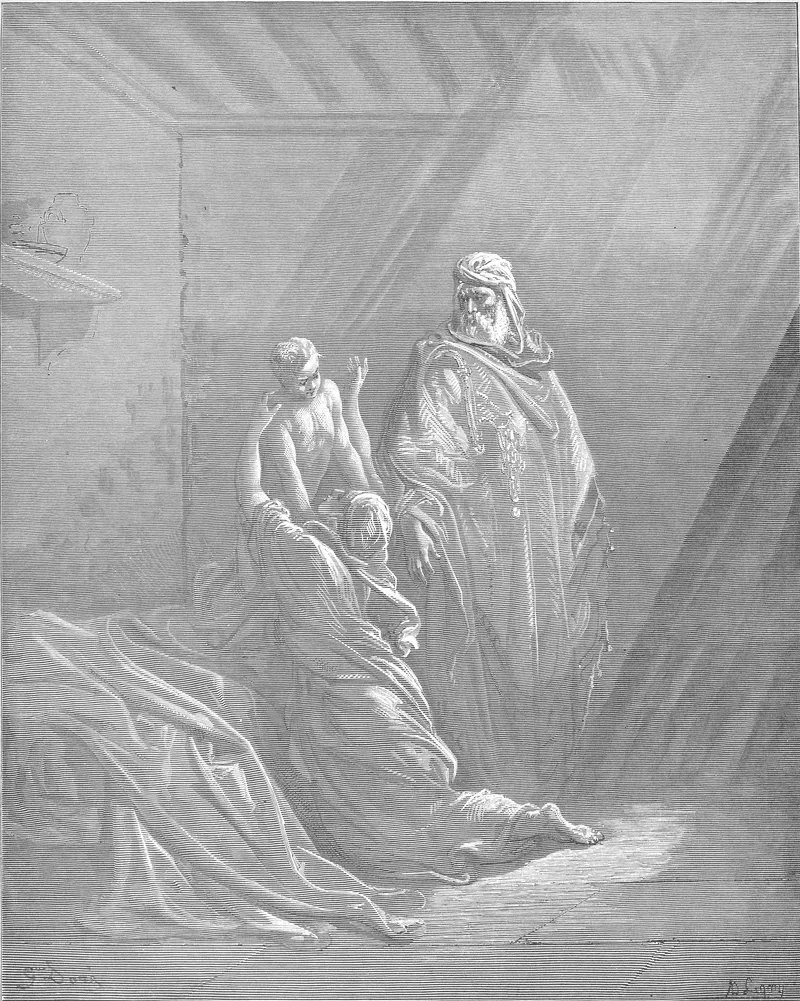
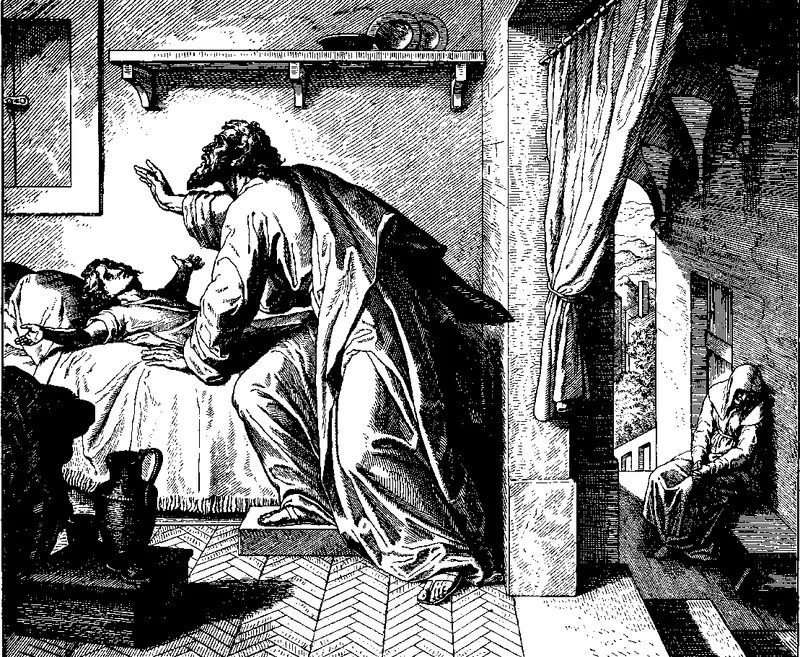
19And he said unto her, Give me thy son. And he took him out of her bosom, and carried him up into a loft, where he abode, and laid him upon his own bed. 20And he cried unto the LORD, and said, O LORD my God, hast thou also brought evil upon the widow with whom I sojourn, by slaying her son? 21And he stretched himself upon the child three times, and cried unto the LORD, and said, O LORD my God, I pray thee, let this child’s soul come into him again.
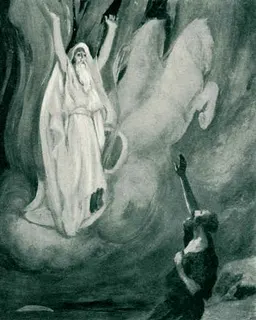
Elijah's response is tender and direct: Give me thy son (v. 19). He takes the boy from her arms, carries him up to the loft where he himself has been lodging, and lays him on his own bed. Then the prophet who shut the sky and multiplied the meal does the only thing he can do before death - he prays, and his prayer is startlingly honest: O LORD my God, hast thou also brought evil upon the widow with whom I sojourn, by slaying her son? (v. 20).
Elijah does not approach the LORD with formulas or pretend to understand. He wrestles. He lays the widow's grief before God as his own and asks the hard question plainly. Then he stretched himself upon the child three times (v. 21) - an act of total identification, the living prophet pressing himself onto the dead boy, mouth to mouth, limb to limb, as if to pour his own life into the lifeless body. But the words make clear he claims no power of his own: O LORD my God, I pray thee, let this child's soul come into him again. Elijah pleads for life from the One who is its source.
Everything depends on the LORD, and the prophet's whole posture - stretched out, crying, begging - is the posture of utter dependence on the only One who can give breath back to the dead.
1 Kings 17:22-24See, Thy Son Liveth
22And the LORD heard the voice of Elijah; and the soul of the child came into him again, and he revived. 23And Elijah took the child, and brought him down out of the chamber into the house, and delivered him unto his mother: and Elijah said, See, thy son liveth. 24And the woman said to Elijah, Now by this I know that thou art a man of God, and that the word of the LORD in thy mouth is truth.
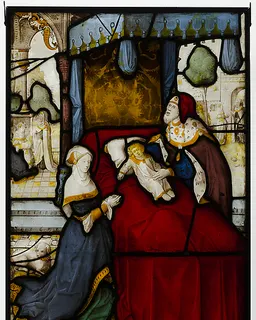
And the LORD answers. This is among the first resurrections recorded anywhere in Scripture, and the language is careful - the soul of the child came into him again. What death had carried off, the living God hands back; the life that had left returns at His word. Then comes one of the tenderest scenes in all the prophets. Elijah carries the boy down the stairs and gives him back: See, thy son liveth. Three words that undo everything the death had said.
The mother who minutes ago cried out in accusation now holds her living son, received from the prophet's own hands. And her answer is the line the whole chapter has been climbing toward: the word of the LORD in thy mouth is truth (v. 24). She had heard that word. She had watched it feed her for months. Now she knows it, sealed past all doubt, because she is holding the proof and he is breathing.
The meal proved the word reliable. The raising proves it beyond argument.
Research trail
Sources & further study
These references support the historical, linguistic, manuscript, and contextual notes in this chapter. Scripture remains the primary text; external sources are provided so readers can inspect the research directly.
- 1 Kings 17 - Translators' NotesThe NET Bible's detailed footnotes on 1 Kings 17 - the force of Elijah's oath and the phrase according to my word in verse 1, the geography of Cherith and Zarephath, the wording of the promise in verse 14, and the difficult cry of the widow and of Elijah in verses 18 and 20.
- 1 Kings 17 · Hebrew + classical Jewish commentaryThe Hebrew text of 1 Kings 17 with Rashi, Radak, and other classical commentators alongside - useful for the verbs of verses 14 and 16, kalah (the meal that is not “used up”) and chaser (the oil that does not “run short”), and for emet in verse 24, the “truth” of the word the widow finally confesses.
- 1 Kings 17 ↔ Luke 4 · Luke 7 · John 11 · Matthew 6Traces the threads tying 1 Kings 17 to the rest of Scripture - the widow of Sidon whom Jesus names at Nazareth (Luke 4:25-26), the raising of the widow's son read beside the widow of Nain (Luke 7:11-15) and the One who is the resurrection, and the life (John 11:25), and the unfailing meal and oil set beside your heavenly Father knoweth that ye have need (Matt. 6:31-33).
Where this echoes in Scripture
The Brook Dried Up
- James 5:17-18Elias was a man subject to like passions as we are, and he prayed earnestly that it might not rain: and it rained not on the earth by the space of three years and six months.The drought of verse 1 named as the fruit of Elijah's prayer - and held up as a pattern of how the prayer of a righteous man avails.
- Matthew 6:31-33your heavenly Father knoweth that ye have need of all these things. But seek ye first the kingdom of God... and all these things shall be added unto you.The provision of verses 4-6 named in person - the Father who feeds His own in famine.
- Matthew 6:11Give us this day our daily bread.The morning-and-evening supply of verse 6 - one day's bread at a time, from the Father's hand.
- Philippians 4:19But my God shall supply all your need according to his riches in glory by Christ Jesus.The God of the ravens and the dry brook (vv. 6-7) - a supply that does not run short.
- Exodus 16:12At even ye shall eat flesh, and in the morning ye shall be filled with bread; and ye shall know that I am the LORD your God.The same daily, morning-and-evening provision as verse 6 - flesh and bread given by the LORD's command.
- Psalm 37:25I have been young, and now am old; yet have I not seen the righteous forsaken, nor his seed begging bread.The truth lived out by the brook and the ravens - the LORD does not abandon His own to starve.
- 1 Kings 18:1the word of the LORD came to Elijah in the third year, saying, Go, shew thyself unto Ahab; and I will send rain upon the earth.The drought of verse 1 lifted at last - the rain returning exactly when the word of the LORD appoints.
According to the Word of the LORD
- Luke 4:25-26unto none of them was Elias sent, save unto Sarepta, a city of Sidon, unto a woman that was a widow.The Lord Himself names this widow (vv. 9-16) as the sign that God's mercy reaches beyond Israel.
- John 10:16And other sheep I have, which are not of this fold: them also I must bring, and they shall hear my voice.The Gentile widow of verse 9 as a first sign of the “other sheep” the Shepherd means to gather.
- Matthew 8:11many shall come from the east and west, and shall sit down with Abraham, and Isaac, and Jacob, in the kingdom of heaven.The mercy that fed an outsider in verses 9-16 widened into a kingdom filled from every nation.
- Luke 2:31-32Which thou hast prepared before the face of all people; a light to lighten the Gentiles.The salvation that reached a Sidonian widow (v. 9) named at the start as light for the nations.
- John 3:16For God so loved the world, that he gave his only begotten Son.The border-crossing mercy of verses 9-16 in its fullest reach - the love that takes in the world.
- John 6:35I am the bread of life: he that cometh to me shall never hunger; and he that believeth on me shall never thirst.The barrel that never empties (v. 16) pointing to the bread that finally satisfies.
- 2 Kings 4:1-7Go, sell the oil, and pay thy debt... So she went... and she poured out... And the oil stayed.Another widow, another cruse of oil multiplied - the same God provided through a prophet (vv. 14-16).
See, Thy Son Liveth
- Luke 7:11-15Young man, I say unto thee, Arise. And he that was dead sat up, and began to speak. And he delivered him to his mother.The widow of Nain's son raised - the same scene as verses 22-23, even to “delivered him to his mother,” now done by the Lord's own word.
- John 11:25I am the resurrection, and the life: he that believeth in me, though he were dead, yet shall he live.The life Elijah pleaded for (v. 21) named in person - the One who is Himself the resurrection.
- Hebrews 11:35Women received their dead raised to life again.The faith of this chapter (vv. 22-23) gathered into the great roll of those who trusted God - a mother given back her dead.
- John 5:28-29all that are in the graves shall hear his voice, and shall come forth.The raising of one boy (v. 22) opening toward the day the dead everywhere will hear His voice.
- Psalm 119:160Thy word is true from the beginning: and every one of thy righteous judgments endureth for ever.The widow's confession in verse 24 - the word of the LORD proved firm and true.
- John 14:6I am the way, the truth, and the life.The word the widow called truth (v. 24) embodied in person - truth and life in one.
- John 1:14And the Word was made flesh, and dwelt among us, ... full of grace and truth.The reliable word of verse 24 made flesh - the Word in whom every promise of God holds.