John 6
People in this chapter
A great multitude is following Jesus, drawn by the signs He has done on the sick. He goes up into a mountain with His disciples, and the Passover is near. Seeing the crowd, He turns to Philip with a question He already knows the answer to: Whence shall we buy bread, that these may eat? (v. 5). It is a test. Philip does the math and despairs - two hundred pennyworth would not give each one a little.
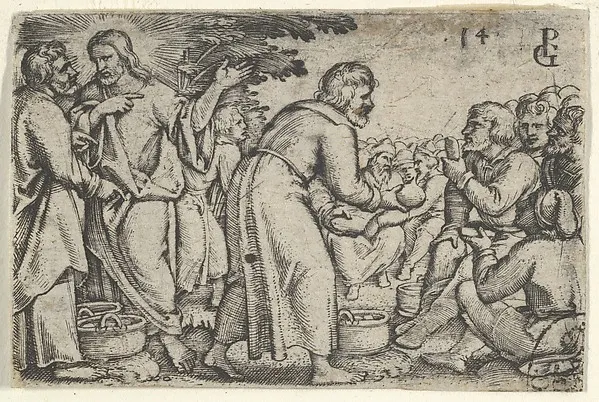
Andrew finds a boy with five barley loaves, and two small fishes, and asks the obvious thing: but what are they among so many? (v. 9). Jesus has the people sit, gives thanks, and distributes - as much as they would. When all are filled He says, Gather up the fragments that remain, that nothing be lost, and twelve baskets are taken up over and above (vv. 12-13). The crowd, certain now that this is that prophet, moves to seize Him and crown Him; and He withdraws alone into the mountain.1
Tap any highlighted phrase to jump to the commentary that unpacks it.
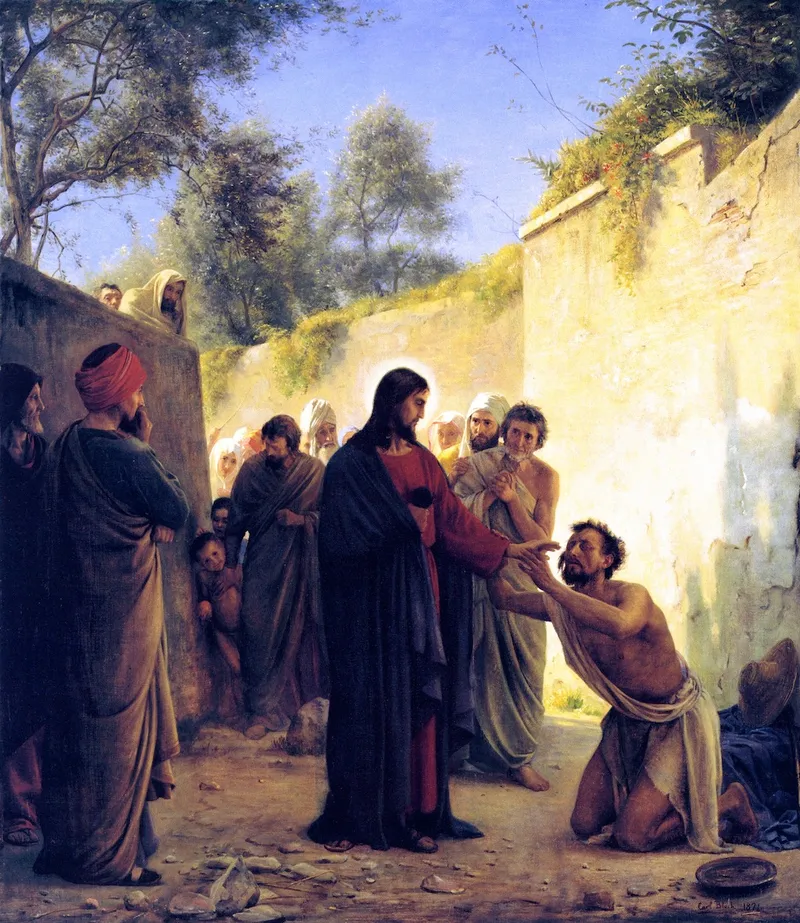
John 6:1-15Five Barley Loaves and Two Small Fishes
1After these things Jesus went over the sea of Galilee, which is the sea of Tiberias. 2And a great multitude followed him, because they saw his miracles which he did on them that were diseased. 3And Jesus went up into a mountain, and there he sat with his disciples. 4And the passover, a feast of the Jews, was nigh. 5When Jesus then lifted up his eyes, and saw a great company come unto him, he saith unto Philip, Whence shall we buy bread, that these may eat? 6And this he said to prove him: for he himself knew what he would do. 7Philip answered him, Two hundred pennyworth of bread is not sufficient for them, that every one of them may take a little. 8One of his disciples, Andrew, Simon Peter’s brother, saith unto him, 9There is a lad here, which hath five barley loaves, and two small fishes: but what are they among so many?
John alone records the question Jesus puts to Philip, and tells us in the same breath what it was for: Whence shall we buy bread, that these may eat? And this he said to prove him: for he himself knew what he would do (vv. 5-6). The test is not whether Philip can solve the problem - Jesus already has His answer ready - but whether Philip will reckon with who is asking. Philip's reply is honest and entirely earthbound: Two hundred pennyworth of bread is not sufficient for them, that every one of them may take a little (v. 7).
Two hundred denarii was the better part of a year's wages for a laborer, and even that, he calculates, would give each one only a scrap. He is not wrong about the arithmetic; he is wrong about the limits. He measures the need against the purse instead of against the Lord. It is the test set before everyone who has ever faced a gap between the resources in hand and the need in front of them - and it is the note the whole chapter will sound: the supply is in who stands among us, not in what the purse can reach.1
Andrew finds the only food on hand and names it with the same despair Philip felt: There is a lad here, which hath five barley loaves, and two small fishes: but what are they among so many? (v. 9). Every detail is deliberately small. The loaves are barley - the coarse bread of the poor, cheaper than wheat, the food of those who could afford no better. The fishes are small. The whole supply is a boy's lunch, the slightest thing in the crowd.
And Andrew's question - what are they among so many? - is exactly right as arithmetic and exactly wrong as faith. Five thousand men, John will say, besides women and children. The math is hopeless. But it is precisely the hopelessness of the sum that makes the sign legible: when the loaves are gone round and the baskets come back full, no one will be able to credit the bread. The lesson is quietly pointed - what is laughably small in our hands is not small in His.
Jesus does not require much to begin; He requires only that the little be brought to Him.
10And Jesus said, Make the men sit down. Now there was much grass in the place. So the men sat down, in number about five thousand. 11And Jesus took the loaves; and when he had given thanks, he distributed to the disciples, and the disciples to them that were set down; and likewise of the fishes as much as they would. 12When they were filled, he said unto his disciples, Gather up the fragments that remain, that nothing be lost. 13Therefore they gathered them together, and filled twelve baskets with the fragments of the five barley loaves, which remained over and above unto them that had eaten. 14Then those men, when they had seen the miracle that Jesus did, said, This is of a truth that prophet that should come into the world. 15When Jesus therefore perceived that they would come and take him by force, to make him a king, he departed again into a mountain himself alone.
Before a single loaf is broken, Jesus stops and gives thanks: And Jesus took the loaves; and when he had given thanks, he distributed (v. 11). The order matters. He blesses God over the meager supply before it has become enough, thanking the Father while the five loaves are still five. The thanksgiving is not relief after the miracle; it is faith ahead of it. And then the distribution: likewise of the fishes as much as they would. There is no rationing, no careful portion measured out to make the supply stretch.
Each receives as much as they would - until full. This is the signature of God's provision throughout Scripture: not the bare minimum to survive, but enough and to spare. The hands that gave thanks over almost nothing now give without stint to thousands, and the giving does not run dry.
The sign does not end when everyone is fed; it ends with a command about leftovers: Gather up the fragments that remain, that nothing be lost. Therefore they gathered them together, and filled twelve baskets with the fragments… which remained over and above (vv. 12-13). Two things stand out. First, the abundance is measured precisely: twelve baskets, one for each disciple who doubted the supply, far more left over than the whole supply they started with.
The miracle is not bare sufficiency but overflow - want turned to surplus. Second, even the overflow is treated as precious: that nothing be lost. The God who can multiply loaves out of almost nothing is not careless with what He has made; the same care that fed the crowd now stoops to gather the scraps. There is a quiet correction here of how we tend to think about generosity and waste. Plenty does not make Him wasteful.
The Lord who gives lavishly also says, let nothing be lost - a phrase John will not let us forget, for Jesus will soon say the same of the people the Father has given Him: that of all which he hath given me I should lose nothing (v. 39).
John 6:16-21It Is I; Be Not Afraid
16And when even was now come, his disciples went down unto the sea, 17And entered into a ship, and went over the sea toward Capernaum. And it was now dark, and Jesus was not come to them. 18And the sea arose by reason of a great wind that blew. 19So when they had rowed about five and twenty or thirty furlongs, they see Jesus walking on the sea, and drawing nigh unto the ship: and they were afraid. 20But he saith unto them, It is I; be not afraid. 21Then they willingly received him into the ship: and immediately the ship was at the land whither they went.
The scene darkens deliberately. Even was now come; the disciples go down to the sea and set out; it was now dark, and Jesus was not come to them; and the sea arose by reason of a great wind (vv. 16-18). John piles up the elements of dread - nightfall, distance, the absence of Jesus, the rising storm - before any rescue appears. They have rowed three or four miles into the teeth of it, straining at the oars and getting nowhere, when they see Jesus walking on the sea, and drawing nigh unto the ship: and they were afraid (v. 19).
It is worth pausing on what they see. Not a man wading the shallows, but a figure walking upon the open water in a gale - treading the very thing that is trying to drown them. In the Old Testament it is God alone who does this: He treadeth upon the waves of the sea (Job 9:8), His way is in the sea, and thy path in the great waters (Ps. 77:19). The sea is the realm of chaos no human masters; the One walking on it is master of it.
Small wonder their first response is not relief but terror - the help that comes is itself awesome.
John 6:22-40I Am the Bread of Life
22The day following, when the people which stood on the other side of the sea saw that there was none other boat there, save that one whereinto his disciples were entered, and that Jesus went not with his disciples into the boat, but that his disciples were gone away alone; 23(Howbeit there came other boats from Tiberias nigh unto the place where they did eat bread, after that the Lord had given thanks:) 24When the people therefore saw that Jesus was not there, neither his disciples, they also took shipping, and came to Capernaum, seeking for Jesus. 25And when they had found him on the other side of the sea, they said unto him, Rabbi, when camest thou hither? 26Jesus answered them and said, Verily, verily, I say unto you, Ye seek me, not because ye saw the miracles, but because ye did eat of the loaves, and were filled. 27Labour not for the meat which perisheth, but for that meat which endureth unto everlasting life, which the Son of man shall give unto you: for him hath God the Father sealed. 28Then said they unto him, What shall we do, that we might work the works of God? 29Jesus answered and said unto them, This is the work of God, that ye believe on him whom he hath sent.
The crowd has chased Jesus around the lake, and He meets their eager question with an uncomfortable diagnosis: Ye seek me, not because ye saw the miracles, but because ye did eat of the loaves, and were filled (v. 26). They followed the bread, not the sign in the bread. So He redirects their whole appetite: Labour not for the meat which perisheth, but for that meat which endureth unto everlasting life, which the Son of man shall give unto you (v. 27).
He is not forbidding daily work or scorning daily bread; He is naming a fatal misorder of desire. There is food that fills the stomach and is gone by morning, and there is food that endureth unto everlasting life - and the tragedy is to spend a whole life laboring only for the first. Notice the hinge in the verse: the perishing meat we labor for; the enduring meat the Son of man shall give. One is earned; the other is a gift.
The crowd has come to the right Person with the wrong hunger, and Jesus, instead of sending them away, works to enlarge the hunger until it is large enough for what He actually came to give.
The crowd hears the word labour and seizes on it, ready to roll up their sleeves: What shall we do, that we might work the works of God? (v. 28). They assume there is a task list, some program of works that will earn the enduring bread. Jesus' answer collapses the whole list into one thing - and it is not a doing in the way they mean: This is the work of God, that ye believe on him whom he hath sent (v. 29).
The one work God asks is to believe on the One He sent. This is the quiet center of the chapter and the interpretive key to everything hard that follows. When Jesus speaks, a few verses on, of eating His flesh, He has already told us what that eating is: it is coming to Him and believing on Him. The bread is received not by laboring but by trusting; the enduring meat is taken in by faith.
The crowd wants a set of works to perform; Jesus points them to a Person to receive. Everything in the discourse - the coming, the believing, the eating - is held together by this single answer.1
30They said therefore unto him, What sign shewest thou then, that we may see, and believe thee? what dost thou work? 31Our fathers did eat manna in the desert; as it is written, He gave them bread from heaven to eat. 32Then Jesus said unto them, Verily, verily, I say unto you, Moses gave you not that bread from heaven; but my Father giveth you the true bread from heaven. 33For the bread of God is he which cometh down from heaven, and giveth life unto the world. 34Then said they unto him, Lord, evermore give us this bread. 35And Jesus said unto them, I am the bread of life: he that cometh to me shall never hunger; and he that believeth on me shall never thirst. 36But I said unto you, That ye also have seen me, and believe not. 37All that the Father giveth me shall come to me; and him that cometh to me I will in no wise cast out.
The crowd reaches for their best precedent: Our fathers did eat manna in the desert; as it is written, He gave them bread from heaven to eat (v. 31). The implication is a challenge - Moses gave bread from heaven; what will you give? Jesus corrects two things at once. First, the giver: Moses gave you not that bread from heaven; but my Father giveth you the true bread from heaven (v. 32). It was never Moses who fed them; it was the Father, and the Father is feeding still, in the present tense - giveth. Second, the bread itself: the bread of God is he which cometh down from heaven, and giveth life unto the world (v. 33).
The true bread is a who - a Person who cometh down, not a thing that fell. The crowd, still thinking of loaves, answers exactly as the woman at the well answered the offer of living water: Lord, evermore give us this bread (v. 34) - yes, give us a steady supply of it. They are asking for a commodity. He is about to tell them the bread is Himself.2
Then the claim itself, the first of the great I am sayings of this Gospel: I am the bread of life: he that cometh to me shall never hunger; and he that believeth on me shall never thirst (v. 35). The two halves of the verse interpret each other. To come to Him is to believe on Him; to feed on the bread is to trust the Person - and the result is a hunger and thirst finally and forever met.
Then He widens the door as far as it will go. First the assurance that this is no fragile, self-generated effort: All that the Father giveth me shall come to me (v. 37a) - behind every coming is the Father's drawing. And then the promise that has steadied the fearful for two thousand years: him that cometh to me I will in no wise cast out (v. 37b). The double negative in the Greek is emphatic - never, by no means, on no account will I cast out the one who comes.
Not the unworthy one, not the late one, not the one who comes trembling and half-believing and ashamed. Whoever comes, He keeps. The bread of life sets no condition on the coming except the coming itself.
38For I came down from heaven, not to do mine own will, but the will of him that sent me. 39And this is the Father’s will which hath sent me, that of all which he hath given me I should lose nothing, but should raise it up again at the last day. 40And this is the will of him that sent me, that every one which seeth the Son, and believeth on him, may have everlasting life: and I will raise him up at the last day.
Jesus grounds the whole promise in the will of the Father who sent Him: I came down from heaven, not to do mine own will, but the will of him that sent me (v. 38). And He states that will twice over, so that we cannot miss it. First, as keeping: that of all which he hath given me I should lose nothing (v. 39) - the same word He used over the fragments, that nothing be lost. The people the Father gives are gathered up and kept as carefully as the leftover bread; none is dropped, none is wasted.
Second, as raising: that every one which seeth the Son, and believeth on him, may have everlasting life: and I will raise him up at the last day (v. 40). Here the bread and the resurrection are welded together. To feed on Christ by coming and believing is to receive a life that death cannot finally hold - I will raise him up at the last day. This refrain will sound four times in this chapter (vv. 39, 40, 44, 54), each time tying the feeding to the same hope.
The bread of life is the pledge of a body raised on the last day. What you take in by faith now, He will not let the grave keep.
John 6:41-59The Bread That I Will Give Is My Flesh
41The Jews then murmured at him, because he said, I am the bread which came down from heaven. 42And they said, Is not this Jesus, the son of Joseph, whose father and mother we know? how is it then that he saith, I came down from heaven? 43Jesus therefore answered and said unto them, Murmur not among yourselves. 44No man can come to me, except the Father which hath sent me draw him: and I will raise him up at the last day. 45It is written in the prophets, And they shall be all taught of God. Every man therefore that hath heard, and hath learned of the Father, cometh unto me. 46Not that any man hath seen the Father, save he which is of God, he hath seen the Father. 47Verily, verily, I say unto you, He that believeth on me hath everlasting life. 48I am that bread of life. 49Your fathers did eat manna in the wilderness, and are dead. 50This is the bread which cometh down from heaven, that a man may eat thereof, and not die.
The mood turns. The Jews then murmured at him, because he said, I am the bread which came down from heaven (v. 41). The word murmured is loaded; it is the very thing Israel did against the LORD in the wilderness over the manna (Ex. 16:2). The new generation, offered the true bread, grumbles like the old. Their objection is the scandal of His ordinariness: Is not this Jesus, the son of Joseph, whose father and mother we know? how is it then that he saith, I came down from heaven? (v. 42).
They know His address, His family, His trade - and so they cannot see past the familiar face to the One who came down. Jesus does not argue His pedigree; He explains why they cannot see it: No man can come to me, except the Father which hath sent me draw him (v. 44). Coming to Christ is, at its root, a work of the Father drawing - and yet, lest anyone think the door is therefore narrow or arbitrary, He immediately quotes the prophets: And they shall be all taught of God. Every man therefore that hath heard, and hath learned of the Father, cometh unto me (vv. 44-45).
The Father's drawing and teaching, and the person's hearing and coming, are set side by side, not against each other. The one who listens to the Father is brought to the Son.2
Before the discourse reaches its hardest words, Jesus states the heart of the matter as plainly as it can be put: Verily, verily, I say unto you, He that believeth on me hath everlasting life (v. 47). Mark the tense - hath, present, owned now, the moment one believes. And mark again the verb: believeth. This is the third time the discourse has anchored everything to faith - he that cometh… he that believeth… the work of God, that ye believe - and Jesus sets it down here, immediately before He begins to speak of eating His flesh, almost as a lamp to read the rest by.
Then He returns to the manna, now with an edge: I am that bread of life. Your fathers did eat manna in the wilderness, and are dead (vv. 48-49). The wilderness bread was real bread and it kept them alive for a time - and then they died, every one. This is the bread which cometh down from heaven, that a man may eat thereof, and not die (v. 50). The contrast is the whole point: that bread postponed death; this bread defeats it.
To eat of Christ is to receive the life over which death has no claim.
51I am the living bread which came down from heaven: if any man eat of this bread, he shall live for ever: and the bread that I will give is my flesh, which I will give for the life of the world. 52The Jews therefore strove among themselves, saying, How can this man give us his flesh to eat? 53Then Jesus said unto them, Verily, verily, I say unto you, Except ye eat the flesh of the Son of man, and drink his blood, ye have no life in you. 54Whoso eateth my flesh, and drinketh my blood, hath eternal life; and I will raise him up at the last day. 55For my flesh is meat indeed, and my blood is drink indeed. 56He that eateth my flesh, and drinketh my blood, dwelleth in me, and I in him. 57As the living Father hath sent me, and I live by the Father: so he that eateth me, even he shall live by me. 58This is that bread which came down from heaven: not as your fathers did eat manna, and are dead: he that eateth of this bread shall live for ever. 59These things said he in the synagogue, as he taught in Capernaum.
Now Jesus presses the claim to its sharpest point. I am the living bread which came down from heaven: if any man eat of this bread, he shall live for ever: and the bread that I will give is my flesh, which I will give for the life of the world (v. 51). The bread, He says at last, is His own flesh, given for the life of the world - words that point unmistakably toward His death, the self-giving in which His life becomes the world's life.
The crowd recoils: How can this man give us his flesh to eat? (v. 52). And here is the striking thing - instead of softening the image to calm them, Jesus intensifies it: Except ye eat the flesh of the Son of man, and drink his blood, ye have no life in you. Whoso eateth my flesh, and drinketh my blood, hath eternal life… For my flesh is meat indeed, and my blood is drink indeed (vv. 53-55).
The language is meant to scandalize, and it does. But the discourse has already told us how this eating is done. He has said it three times: he that cometh to me… he that believeth on me… He that believeth on me hath everlasting life (vv. 35, 40, 47). To eat His flesh and drink His blood is to take Christ wholly into oneself by faith - to live on Him as the body lives on bread, in a union so real and so total it can only be spoken in the language of eating and drinking.
The result is the union He names: He that eateth my flesh, and drinketh my blood, dwelleth in me, and I in him (v. 56) - not a transaction at arm's length but mutual indwelling, Christ in the believer and the believer in Christ.1
Jesus traces the new life back to its source and shows it flowing along a chain: As the living Father hath sent me, and I live by the Father: so he that eateth me, even he shall live by me (v. 57). The Son lives by the Father - His whole life drawn from and dependent on the Father who sent Him - and the one who feeds on the Son lives, in just that way, by Him.
Life passes from the Father, through the Son, to the believer; to eat Christ is to be plugged into the very life of God. Then He gathers the whole discourse into a final contrast with the manna: This is that bread which came down from heaven: not as your fathers did eat manna, and are dead: he that eateth of this bread shall live for ever (v. 58). The fathers ate and died; this bread is different in kind, not degree.
It does not delay the end; it carries a life that runs straight through death and out the other side - the live for ever that the four-times-repeated I will raise him up at the last day has been promising all along. These things said he in the synagogue, as he taught in Capernaum (v. 59): not a private mystery whispered to insiders, but a public claim laid down in the open, for anyone to take or refuse.
John 6:60-71To Whom Shall We Go?
60Many therefore of his disciples, when they had heard this, said, This is an hard saying; who can hear it? 61When Jesus knew in himself that his disciples murmured at it, he said unto them, Doth this offend you? 62What and if ye shall see the Son of man ascend up where he was before? 63It is the spirit that quickeneth; the flesh profiteth nothing: the words that I speak unto you, they are spirit, and they are life. 64But there are some of you that believe not. For Jesus knew from the beginning who they were that believed not, and who should betray him. 65And he said, Therefore said I unto you, that no man can come unto me, except it were given unto him of my Father.
The reaction is not from the hostile crowd now but from His own followers: Many therefore of his disciples, when they had heard this, said, This is an hard saying; who can hear it? (v. 60). A hard saying - not hard to understand so much as hard to accept, hard to stomach. The demand to live wholly on Him, to take Him in as one's only life, offends them. Jesus knows it and meets the offense with a question that lifts their eyes higher, not lower: Doth this offend you? What and if ye shall see the Son of man ascend up where he was before? (vv. 61-62).
If the thought of eating His flesh staggers them, what will they make of the cross and the ascension - the Son of man returning to where He was before? He is hinting that the offense will only deepen before it resolves, and that the resolution lies in seeing who He is and where He is going. The hard saying is the truth, and the truth will cost them something to receive.
Then comes the sentence that unlocks the whole discourse, Jesus' own key handed to His hearers: It is the spirit that quickeneth; the flesh profiteth nothing: the words that I speak unto you, they are spirit, and they are life (v. 63). He is telling them - and us - how to hear everything He has just said about eating His flesh. The flesh profiteth nothing: a crude, fleshly, literalizing imagination, the kind that pictured cannibalism and recoiled, gains nothing.
It is the spirit that quickeneth - the Spirit that makes alive. And His words, He says, are spirit, and they are life; they are to be received on the level of the Spirit, by faith, where they give life. This is the decisive interpretive word of the chapter, spoken by the Teacher Himself: the feeding on His flesh and blood is real, but it is received spiritually, by faith in the One who speaks - not by a fleshly chewing that “profiteth nothing.” The same Jesus who would not soften the hard saying now shows the way into it.
And He adds, soberly, that not all will take it: there are some of you that believe not (v. 64). The dividing line, again, is faith.1
66From that time many of his disciples went back, and walked no more with him. 67Then said Jesus unto the twelve, Will ye also go away? 68Then Simon Peter answered him, Lord, to whom shall we go? thou hast the words of eternal life. 69And we believe and are sure that thou art that Christ, the Son of the living God. 70Jesus answered them, Have not I chosen you twelve, and one of you is a devil? 71He spake of Judas Iscariot the son of Simon: for he it was that should betray him, being one of the twelve.
The hard saying does its sifting work: From that time many of his disciples went back, and walked no more with him (v. 66). These are not enemies but disciples - people who had followed, listened, perhaps followed a long while - and now they turn around and go home. It is one of the most sobering verses in the Gospels. Jesus does not run after them. He does not call out a softer version of the saying to win them back.
He lets them go, and turns instead to the Twelve with a question that is almost an offer of the same exit: Will ye also go away? (v. 67). The crowds came for bread and left when the bread became a cross; the question now falls on the inner circle. There is no coercion in following Jesus. The door that lets the many out is open to the Twelve as well. Everything hangs on how they answer - and how, in our turn, we do.
Peter answers for them all, and his words are the high point the whole chapter has been climbing toward: Lord, to whom shall we go? thou hast the words of eternal life. And we believe and are sure that thou art that Christ, the Son of the living God (vv. 68-69). Notice what Peter does not say. He does not claim the hard saying is now easy, or that he has solved it. His confession rests on knowing Whom he is with, and on the weight of that one question: where else would he go?
To whom shall we go? is the honest question of someone who has looked at every other door and found them all leading nowhere. Thou hast the words of eternal life - the very words Jesus just called spirit and life (v. 63), now confessed back to Him. And then the heart of it: thou art that Christ, the Son of the living God. Peter has heard the same hard saying that drove the others away, and it has driven him deeper in.
That is faith's shape when it is tested: the conviction that this Person, difficulty and all, is the only one who has what the soul cannot live without. Jesus' reply is bracing - one of you is a devil (v. 70), spoken of Judas - a reminder that even nearness to Christ is no guarantee of faith. The Twelve heard the same words; eleven fed, and one only followed.
Research trail
Sources & further study
These references support the historical, linguistic, manuscript, and contextual notes in this chapter. Scripture remains the primary text; external sources are provided so readers can inspect the research directly.
- John 6 - Translators' NotesThe NET Bible's detailed footnotes on John 6 - the size of the crowd and the barley loaves of the poor (vv. 9-10), the wording of the sea-crossing and “it is I” (v. 20), the structure of the bread-of-life discourse, and the much-discussed verses on eating His flesh and drinking His blood (vv. 53-58).
- John 6 ↔ Exodus 16 · Psalm 78 · Isaiah 54Traces the threads tying John 6 to the rest of Scripture - the manna of Exodus 16 and Psalm 78:24 (“he gave them bread from heaven,” quoted in v. 31) read against the true bread that came down from heaven, and Isaiah 54:13 (“all thy children shall be taught of the LORD”) behind verse 45.
- John 6 · Greek interlinear + lexiconThe Greek text of John 6 word by word with parsing and lexicon links - useful for the repeated ego eimi (“I am,” vv. 20, 35, 48, 51), for artos (“bread,” the keyword of the discourse), and for the two verbs for eating in verses 53-58 (phago and the more vivid trogo).
Where this echoes in Scripture
Five Barley Loaves and Two Small Fishes
- Psalm 23:1-2The LORD is my shepherd; I shall not want. He maketh me to lie down in green pastures.The Shepherd who feeds His people in green pastures - the picture behind the crowd seated on the grass and fed (vv. 10-11).
- Psalm 78:24-25And had rained down manna upon them to eat, and had given them of the corn of heaven. Man did eat angels' food.The bread from heaven the fathers ate - the memory the discourse will turn on (v. 31), now answered by One greater than the manna.
- Deuteronomy 18:15The LORD thy God will raise up unto thee a Prophet from the midst of thee... unto him ye shall hearken.The Prophet like Moses the crowd recognizes in verse 14 - though they want a bread-king, not the Prophet's word.
- 2 Kings 4:42-44Give unto the people, that they may eat... They shall eat, and shall leave thereof... and they did eat, and left thereof.Elisha feeds a hundred from twenty loaves with bread to spare - the sign John 6 enlarges, loaves multiplied with fragments over and above.
- Matthew 14:19-20he blessed, and brake, and gave the loaves to his disciples... and they took up of the fragments that remained twelve baskets full.The same feeding told in the first Gospel - the blessing, the breaking, the twelve baskets of verses 11-13.
It Is I; Be Not Afraid
- Job 9:8Which alone spreadeth out the heavens, and treadeth upon the waves of the sea.God alone walks upon the sea - the act the disciples witness in verse 19, done by Jesus.
- Psalm 77:19Thy way is in the sea, and thy path in the great waters, and thy footsteps are not known.The LORD's path through the deep - the same mastery of the sea Jesus shows walking to the ship.
- Exodus 3:14And God said unto Moses, I AM THAT I AM... Thus shalt thou say unto the children of Israel, I AM hath sent me unto you.The divine name folded into the “It is I” (ego eimi) of verse 20.
- Isaiah 43:1-2Fear not... When thou passest through the waters, I will be with thee... for I am the LORD thy God.The LORD's “fear not” in the deep waters - the very comfort Jesus speaks in verse 20.
- Psalm 107:28-30he bringeth them out of their distresses. He maketh the storm a calm... so he bringeth them unto their desired haven.The Lord bringing storm-tossed sailors to their haven - mirrored as the ship is immediately at the land (v. 21).
I Am the Bread of Life
- Exodus 16:14-15there lay a small round thing... And Moses said unto them, This is the bread which the LORD hath given you to eat.The manna the fathers ate (v. 31) - the bread from heaven Jesus says was only a shadow of the true bread.
- Isaiah 55:1-2every one that thirsteth, come ye to the waters... wherefore do ye spend money for that which is not bread?The call away from perishing food to the bread that satisfies - the very redirection of verse 27.
- John 4:13-14whosoever drinketh of the water that I shall give him shall never thirst.The same promise in the same Gospel - living water that ends thirst, as the bread of life ends hunger (v. 35).
- Matthew 5:6Blessed are they which do hunger and thirst after righteousness: for they shall be filled.The hunger Jesus came to satisfy (v. 35) - the appetite for God that He alone fills.
- John 10:28-29I give unto them eternal life; and they shall never perish, neither shall any man pluck them out of my hand.The keeping promised in verses 37-39 - that of all the Father gives, He will lose nothing.
The Bread That I Will Give Is My Flesh
- Exodus 16:2-4the whole congregation... murmured against Moses and Aaron... Behold, I will rain bread from heaven for you.The murmuring of Israel over the manna - repeated by the crowd in verse 41, offered the true bread.
- Isaiah 54:13And all thy children shall be taught of the LORD; and great shall be the peace of thy children.The prophets' promise Jesus quotes in verse 45 - all taught of God, and so drawn to the Son.
- John 15:4-5Abide in me, and I in you... He that abideth in me, and I in him, the same bringeth forth much fruit.The mutual indwelling of verse 56 - dwelling in Him and He in us, the life of the branch in the vine.
- Galatians 2:20I live; yet not I, but Christ liveth in me: and the life which I now live in the flesh I live by the faith of the Son of God.Christ living in the believer - the “he shall live by me” of verse 57, life received by faith.
- 1 Corinthians 10:16-17The cup of blessing which we bless, is it not the communion of the blood of Christ?... we are all partakers of that one bread.The apostle on partaking of the one bread - the communion with Christ's body and blood foreshadowed in verses 53-56.
To Whom Shall We Go?
- John 1:1-4In the beginning was the Word... In him was life; and the life was the light of men.The Word in whom was life - whose words Jesus now calls spirit and life (v. 63).
- Matthew 16:16Thou art the Christ, the Son of the living God.Peter's confession in the other Gospels - the same conviction he voices here in verses 68-69.
- Deuteronomy 8:3man doth not live by bread only, but by every word that proceedeth out of the mouth of the LORD doth man live.Life by God's word, not bread alone - the truth behind “the words... they are spirit, and they are life” (v. 63).
- 2 Corinthians 3:6the letter killeth, but the spirit giveth life.The Spirit that gives life over the flesh that profits nothing - the key Jesus hands His hearers in verse 63.
- Acts 4:12Neither is there salvation in any other: for there is none other name under heaven given among men, whereby we must be saved.Peter's “to whom shall we go?” (v. 68) made a doctrine - no other name, no other door.