Exodus 16
People in this chapter
After crossing the Red Sea, Israel stands in the wilderness of Sin. There is no bread, no crops, no visible source of food. And like people in every age, they panic. "Would God had let us die in Egypt," they tell Moses, "where we sat by the fleshpots and ate bread to the full." Three days they have been thirsty. Now they are hungry. They have seen a pillar of cloud and a pillar of fire. They have seen the sea split and the armies of Egypt drowned. But the moment their stomachs speak, they forget it all.
Tap any highlighted phrase to jump to the commentary that unpacks it.
Exodus 16:1-3Hunger and Forgetfulness
1And they took their journey from Elim, and all the congregation of the children of Israel came unto the wilderness of Sin, which is between Elim and Sinai, on the fifteenth day of the second month after their departing out of the land of Egypt.
The wilderness of Sin is not a metaphor for sinfulness - it is a place (near modern Sinai). But the name carries weight. This is where Israel will learn what they really want, what they trust, and who their God truly is12.
2And the whole congregation of the children of Israel murmured against Moses and Aaron in the wilderness: 3And the children of Israel said unto them, Would to God we had died by the hand of the LORD in the land of Egypt, when we sat by the flesh pots, and when we did eat bread to the full; for ye have brought us forth into this wilderness, to kill this whole assembly with hunger.
Three days ago - just three days - they watched the Red Sea close on their enemies. They sang about God's strength and His right hand. But hunger is a short memory. The body's need drowns out the soul's witness. They do not ask God; they accuse Moses. And in accusing him, they are really accusing God: You brought us out here to die3.
Exodus 16:4-12God's Answer: Trust and Test
4Then said the LORD unto Moses, Behold, I will rain bread from heaven for you; and the people shall go out and gather a certain rate every day, that I may prove them, whether they will walk in my law, or no.
God's first word about His provision is about its shape: a certain rate, every day. Not a year's supply on Monday. Not feast followed by famine. The rhythm itself is the teaching. Daily need meets daily grace. That is the lesson God is about to write in wilderness dust.
5And it shall come to pass, that on the sixth day they shall prepare that which they bring in; and it shall be twice as much as they gather daily.
Before the Sabbath law arrives at Sinai, God builds it into His provision. The sixth day brings twice the manna. God knows the seventh day is holy, and His people will need to rest in it.
6And Moses and Aaron said unto all the children of Israel, At even, then ye shall know that the LORD hath brought you out from the land of Egypt: 7And in the morning, then ye shall see the glory of the LORD; for that he heareth your murmurings against the LORD: and what are we, that ye murmur against us? 8And Moses said, This shall be, when the LORD shall give you in the evening flesh to eat, and in the morning bread to the full; for that the LORD heareth your murmurings which ye murmur against him: and what are we? your murmurings are not against us, but against the LORD.
God hears their murmuring - the same word they used in verse 2, lun, to grumble, to complain as a congregation. He does not punish it. He answers it. Quail in the evening, bread in the morning. A physical answer to a spiritual complaint. The body will be fed so the soul can learn.
9And Moses spake unto Aaron, Say unto all the congregation of the children of Israel, Come near before the LORD: for he hath heard your murmurings. 10And it came to pass, as Aaron spake unto the whole congregation of the children of Israel, that they looked toward the wilderness, and, behold, the glory of the LORD appeared in the cloud.
God hears their murmuring - the same word they used in verse 2, lun, to grumble, to complain as a congregation. He does not punish it. He answers it. Quail in the evening, bread in the morning. A physical answer to a spiritual complaint. The body will be fed so the soul can learn.
The glory of the Lord appears in the cloud - the same cloud that has been leading them through the desert. God's presence is visible. His answer to complaint is not a lecture, but His own appearance, reminding Israel that they are not abandoned, that He is with them.
11And the LORD spake unto Moses, saying, 12I have heard the murmurings of the children of Israel: speak unto them, saying, At even ye shall eat flesh, and in the morning ye shall be filled with bread; and ye shall know that I am the LORD your God.
Exodus 16:13-18The Gathering: Enough for Each
13And it came to pass, that at even the quails came up, and covered the camp: and in the morning the dew lay round about the host. 14And when the dew that lay was gone up, behold, upon the face of the wilderness there lay a small round thing, as small as the hoar frost on the ground.
Quail migrate through the Sinai peninsula each year. But the way they arrive - covering the whole camp at once, enough for two million hungry people - is miracle dressed as nature. God works often this way: the event is real, the provision is real, but the timing and scale reveal His hand.
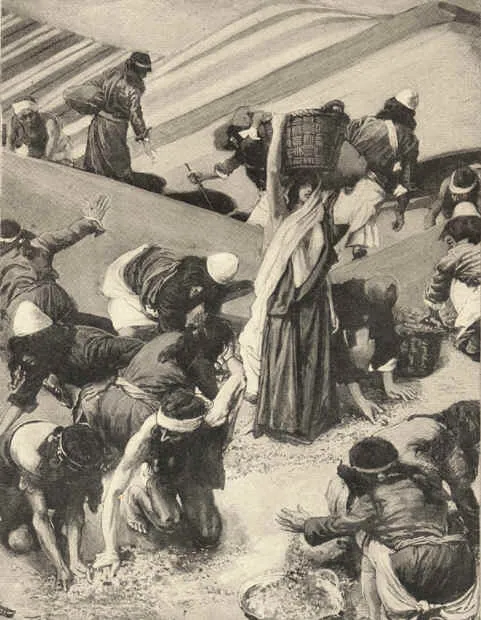
The manna appears in the morning with the dew. It is small, round, white - like frost. Israel has to learn to recognize God's gift. It does not announce itself. You have to look for it. You have to gather it. You have to trust what you are picking up off the ground.
15And when the children of Israel saw it, they said one to another, It is manna: for they wist not what it was. And Moses said unto them, This is the bread which the LORD hath given you to eat.
16This is the thing which the LORD hath commanded, Gather of it every man according to his eating, an omer for every man, according to the number of your persons; take ye every man for them which are in his tents.
The instruction is simple: gather enough for your household. Not more. Not less. The text will repeat this principle twice more, building it into Israel's memory. God's provision matches God's precision.
17And the children of Israel did so, and gathered, some more, some less. 18And when they did mete it with an omer, he that gathered much had nothing over, and he that gathered little had no lack; they gathered every man according to his eating.
Some gathered more, some less. But when they measured it out, every family had exactly what they needed. This is the miracle of the manna - not just that it appears, but that it is distributed with perfect equity. The person who was greedy ends up with the same omer as the person who was cautious.
Verse 18 is the miracle within the miracle. Greed gains nothing. Scarcity gains nothing. The omer is perfect. Paul will quote this logic in 2 Corinthians 8:15 when he is writing about generosity: "He that had gathered much had nothing over; and he that had gathered little had no lack." God's provision is calibrated to what you need.
Exodus 16:19-27Keeping and Gathering: Learning Through Disobedience
19And Moses said, Let no man leave of it till the morning. 20Notwithstanding they hearkened not unto Moses; but some of them left of it until the morning, and it bred worms, and stank: and Moses was wroth with them.
Israel has seen God work. They have eaten the bread. They have gathered their omer. And then - immediately - some of them disobey. They try to keep it. The stomach trusts God for today. But the anxious heart is already thinking about tomorrow.
The manna decays. Literally rots. It breeds worms. It stinks. The lesson is written in corruption: you cannot hoard grace. You cannot save up your prayer from yesterday and skip today's. You cannot bank your trust and withdraw it later. Each day stands alone. Each day demands fresh faith.
21And they gathered it every morning, every man according to his eating: and when the sun waxed hot, it melted.
As if to make the point twice: if you do not gather in the morning, if you wait for a more convenient time, the manna melts in the heat. Provision requires promptness. Grace waits, but not indefinitely. The window closes. The moment passes.
22And it came to pass, that on the sixth day they gathered twice as much bread, two omers for one man: and all the rulers of the congregation came and told Moses. 23And he said unto them, This is that which the LORD hath said, To morrow is the rest of the holy sabbath unto the LORD: bake that which ye will bake to day, and seethe that ye will seethe; and that which remaineth over lay up for you to be kept until the morning.
On the sixth day, the double portion is provision for rest. God has built Sabbath into the food system. You cannot work on the seventh day and gather manna, because there is none. The only way to rest is to have prepared on the sixth. Sabbath is written into the logistics of grace.
The Sabbath arrives here, at Sinai, before Moses even descends the mountain with the law. It is simply the shape of how God provides. Six days, then one day of rest. The rhythm is the revelation.
24And they laid it up till the morning, as Moses bade: and it did not stink, neither was there any worm therein. 25And Moses said, Eat that to day; for to day is a sabbath unto the LORD: to day ye shall not find it in the field.
When you keep manna for the Sabbath, it does not rot. When you try to hoard past the sixth day, it decays. God's provision honors the rhythm He has set up. Obedience to the Sabbath - even before it was commanded, even when you do not yet understand it - is met with grace.
26Six days ye shall gather it; but on the seventh day, which is the sabbath, in it there shall be none. 27And it came to pass, that there went out some of the people on the seventh day for to gather, and they found none.
Israel does not learn from rotting manna. Some of them go out on the Sabbath to gather anyway. And there is nothing there. God has made the Sabbath real. The Sabbath exists whether you believe in it or not. The rhythm stands. The work of gathering is not available on the seventh day because the seventh day is not a day for work.
Exodus 16:28-30How Long Will You Refuse?
28And the LORD said unto Moses, How long refuse ye to keep my commandments and my laws?
God's frustration is specific: Israel is not refusing major commandments here. They are refusing the rhythm He has set up through manna itself. Gathering on the Sabbath is not a written law yet - it is the shape of how provision works. But Israel keeps bumping against it and then doing it anyway. The question is tender and severe at once: How long will you refuse? How long will you not receive what I am trying to teach you?
29See, for that the LORD hath given you the sabbath, therefore he giveth you on the sixth day the bread of two days; abide ye every man in his place, let no man go out of his place on the seventh day. 30So the people rested on the seventh day.
The Sabbath is a day to stay, to be present, to be still. The only way to rest is to stop the project of providing for yourself and trust that someone else is holding the world together. On the seventh day, Israel is called to that kind of stillness.
Exodus 16:31-36The Bread Remembered
31And the house of Israel called the name thereof Manna: and it was like coriander seed, white; and the taste of it was like wafers made with honey.
Manna tastes like wafers made with honey - small, white, sweet. Not hearty bread like the fleshpots of Egypt. But enough. And the very sweetness is part of the teaching: God's provision tastes like grace. It is not given grudgingly. It comes with kindness in it.
32And Moses said, This is the thing which the LORD commandeth, Fill an omer of it to be kept for your generations; that they may see the bread wherewith I have fed you in the wilderness, when I brought you forth from the land of Egypt. 33And Moses said unto Aaron, Take a pot, and put an omer full of manna therein, and lay it up before the LORD, to be kept for your generations.
A jar of manna is to be kept in the tabernacle as a memorial, to be seen. A sign that says: God fed us. Here is proof. Future generations will open the tabernacle and see that white bread sitting there, and they will know the story is true. The bread will age in that pot but never fully spoil - it will become harder, but it will not rot. Even the preservation of it is a sign.
34As the LORD commanded Moses, so Aaron laid it up before the Testimony, to be kept. 35And the children of Israel did eat manna forty years, until they came to a land inhabited; they did eat manna, until they came unto the borders of the land of Canaan. 36Now an omer is the tenth part of an ephah.
Forty years. The entire wilderness generation eats manna. Not occasionally. Every single day. For four decades, Israel does not make bread. They do not plant. They do not harvest. Every single morning, manna appears. The provision never runs out. The rhythm never breaks. By the time they reach Canaan, a whole generation has lived their whole lives on daily bread.
Research trail
Sources & further study
These references support the historical, linguistic, manuscript, and contextual notes in this chapter. Scripture remains the primary text; external sources are provided so readers can inspect the research directly.