Exodus 17
People in this chapter
Exodus 17 shows Israel learning two hard lessons at the edge of the wilderness. First, that survival depends on God willing to provide in places where nothing grows. Second, that even when God has called you and promised to fight for you, the victory still requires somebody to stand and hold up the work while others fight. These are the lessons of a people learning to depend on God and on each other.
Tap any highlighted phrase to jump to the commentary that unpacks it.
Exodus 17:1The Journey to Rephidim
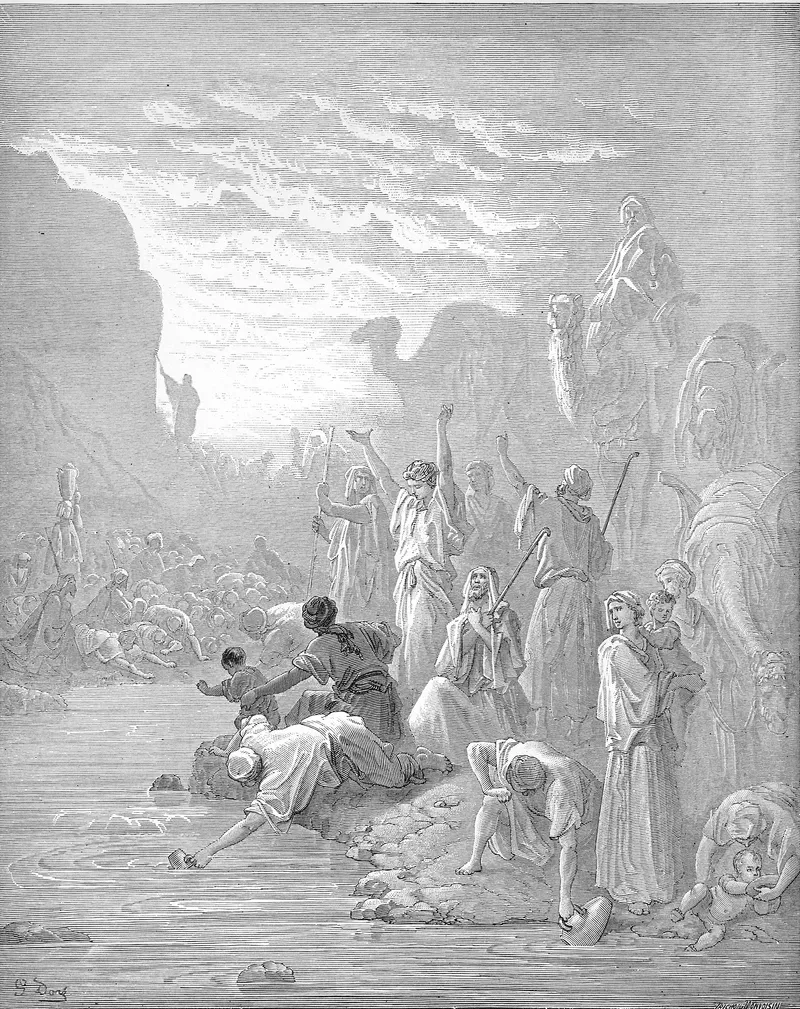
1And all the congregation of the children of Israel journeyed from the wilderness of Sin, after their journeys, according to the commandment of the LORD, and pitched in Rephidim: and there was no water for the people to drink.
Rephidim is a place with no water - a stopping place between the wilderness of Sin and Mount Sinai, where Israel will soon receive the Law. The pattern of this wilderness journey is becoming clear: Israel moves from one place to another on God's command, and at each stop discovers a new need it cannot solve. Thirst comes and water appears. Hunger comes and bread falls. Enemies come and God fights. The wilderness is a school where Israel learns that dependence on God is the only currency that purchases survival12.
Exodus 17:2-7The Rock That Flows
2Wherefore the people did chide with Moses, and said, Give us water that we may drink. And Moses said unto them, Why chide ye with me? wherefore do ye tempt the LORD? 3And the people thirsted there for water; and the people murmured against Moses, and said, Wherefore is this that thou hast brought us up out of Egypt, to kill us and our children and our cattle with thirst?
Israel does not ask God. They attack Moses. The pattern of murmuring in exodus is always the same: the moment a need arrives, the people forget who God is and blame the leader. Fear makes accusers of us. When we are thirsty or hungry or threatened, the instinct runs toward blame rather than prayer. The irony - which the text does not hide - is that Moses is the one who will intercede with God for them. Their words of accusation are being spoken to the very person who stands between them and judgment3.
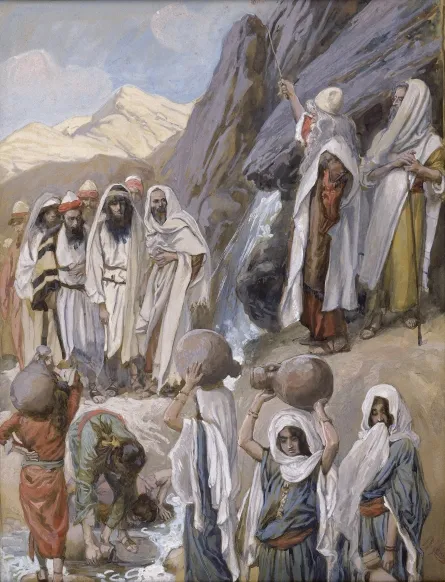
4And Moses cried unto the LORD, saying, What shall I do unto this people? they be almost ready to stone me. 5And the LORD said unto Moses, Go on before the people, and take with thee of the elders of Israel; and thy rod, wherewith thou smotest the river, take in thine hand, and go. 6Behold, I will stand before thee there upon the rock in Horeb; and thou shalt smite the rock, and there shall come water out of it, that the people may drink. And Moses did so in the sight of the elders of Israel. 7And he called the name of the place Massah, and Meribah, because of the chiding of the children of Israel, and because they tempted the LORD, saying, Is the LORD among us, or not?
The people are ready to execute their leader. This is the depth of their fear. Moses, for his part, does not defend himself or retaliate. He takes their threat to God. The leader who is most faithful to God is often the one most attacked by those he leads. His faithfulness exposes their faithlessness, and they turn it against him. Their rage at Moses is really a rage at their own lack of faith - and at the God they claim not to know.
Moses' rod is the same rod that turned the Nile to blood. It is an instrument of judgment. God tells him to take it to Horeb, to the rock, and strike. The water that flows is a mercy: the same rod that could destroy instead brings life. This sets up one of the deepest types in all of exodus: the rock will later become, for Paul and the Church, an image of Christ - the place where the rod of God's judgment falls, and from where life flows for all who drink.
The question Israel asks is the hinge of the chapter: "Is the LORD among us, or not?" This is the only question that matters in the wilderness. The question is "Is God here?" and "Does He know?" The entire exodus is teaching Israel the answer. And the answer is given in the flowing water. God stands on the rock; His presence is actual, and from it flows the water that keeps them alive.
Exodus 17:8-10The Battle Begins
8Then came Amalek, and fought with Israel in Rephidim. 9And Moses said unto Joshua, Choose us out men, and go out, fight with Amalek: to morrow I will stand on the top of the hill with the rod of God in mine hand. 10So Joshua did as Moses had said to him, and fought with Amalek: and Moses, Aaron, and Hur went up to the top of the hill.
Amalek is Israel's first military adversary. Later in Deuteronomy, Israel is commanded to remember what Amalek did and to blot out his memory from under heaven. Amalek is the enemy that attacks the weak at the rear of the column. In later typology, Amalek becomes a picture of the flesh - the enemy that comes at us precisely when we are weak, tired, and learning to depend on God. The placement is not accidental: Amalek comes right after Israel learns to drink from the rock, right after Israel has learned that God provides.
Now comes the test of whether they will fight.
Joshua appears here for the first time as a named individual. He will lead Israel into the promised land after Moses' death. But here he is first introduced as a warrior chosen by Moses to fight Amalek. His name means "the LORD is salvation." The pattern of exodus is setting itself up for what will come: Joshua will eventually lead the fight that takes the land, but the victory will never be his alone. It will always depend on Moses standing with his hands upheld in prayer.
Hur appears in the text without introduction. He is not Moses' son; he is not a judge or a priest. He is simply present and will do what is needed. Later Jewish tradition identifies him as the husband of Miriam or a chief of the tribe of Judah. But the text itself gives him almost no biography. What it does give him is a role: he will hold up Moses' arms when Moses is too tired to hold them up himself. This is the introduction of Hur because this is the only thing that matters about him. He is there.
Exodus 17:11-13The Victory in the Lifted Hands
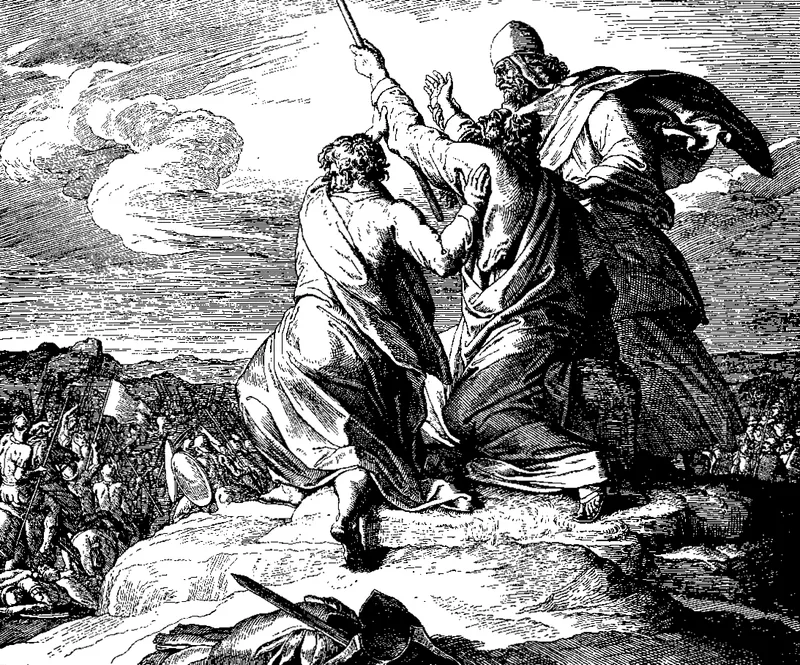
11And it came to pass, when Moses held up his hand, that Israel prevailed: and when he let down his hand, Amalek prevailed. 12But Moses’ hands were heavy; and they took a stone, and put it under him, and he sat thereon; and Aaron and Hur stayed up his hands, the one on the one side, and the other on the other side; and his hands were steady until the going down of the sun. 13And Joshua discomfited Amalek and his people with the edge of the sword.
The causality is direct and strange. Moses holds his hand up, and Israel wins. The text is saying literally that when Moses' hands are up, Israel prevails. The victory is achieved because Moses stands on the hill with his hands held up, a picture of faithful intercession. This is a type of the cross. All victories of God come through faithful intercession. The battle is won on the hill, even as it is fought on the ground.
When Moses lets his hands down, Amalek prevails. The connection is mechanical and immediate. There is no lag, no time for Israel to recover. The moment the hands drop, the advantage reverses. This is telling you that Israel's victory is dependent moment by moment on Moses' faithfulness to hold his hands up. There is no victory that sustains itself by momentum. There is no prayer that works once and carries forward. The battle requires moment-by-moment faithfulness. The hands must be up.
Moses grows weary. His hands become heavy. This is the human part - the part the text does not hide. Moses is not superhuman. He is tired. The intercession that brings victory is painful. It costs him. And as his weariness grows, he cannot do it alone. This is the turn where the chapter teaches its deepest lesson: you cannot hold up the work by yourself.
Aaron and Hur place a stone for Moses to sit on. They support him. They hold up his hands on either side. The victory that is achieved - the defeat of Amalek, the preservation of Israel - is achieved by Moses upheld by his community. The Church has seen in this image a foreshadowing of the cross: Christ with His arms outstretched, achieving a victory that no single arm could win alone. But it is also a picture of any work of God: the leader who faithfully holds up the work, the community that holds up the leader, and the victory that comes from both together.
Exodus 17:14-16Jehovah-Nissi - The Lord is My Banner
14And the LORD said unto Moses, Write this for a memorial in a book, and rehearse it in the ears of Joshua: for I will utterly put out the remembrance of Amalek from under heaven. 15And Moses built an altar, and called the name of it Jehovahnissi: 16For he said, Because the LORD hath sworn that the LORD will have war with Amalek from generation to generation.
God commands the victory to be written down and rehearsed to Joshua. This is not just a narrative record; it is instruction for the future. Joshua will need to remember that Amalek is an enemy the LORD wages perpetual war against. And from this moment forward, Israel is instructed to remember and blot out the memory of Amalek. In later scripture, this will echo in the command to annihilate the Amalekites. But here, in the first statement, it is simply a memorial: remember what God did here, and remember that the LORD is set against this enemy.
Moses builds an altar. This is the first time in exodus that anyone has built an altar to commemorate God's act. The altar is not a place of sacrifice (that will come later with the tabernacle); it is a monument. It is a way of saying: God did something here. God showed Himself here. The stone that held up Moses becomes part of the landscape of memory. Every time Israel passes this place again, they will see the altar and remember the day when God held up their victory.
The final verse is somewhat obscure in translation, but the meaning is clear: the hand upon the throne of the LORD. God has sworn an oath with His hand upon His throne. This is the strongest possible oath. It is God putting His own authority, His own kingship, behind this word: the LORD will wage war with Amalek forever. The hand is upon the throne. The promise is absolute. No enemy that comes against God's people will stand.
The enemy may come again and again - Amalek is described as an enemy "from generation to generation" - but the outcome is never in doubt. The LORD will prevail.
Research trail
Sources & further study
These references support the historical, linguistic, manuscript, and contextual notes in this chapter. Scripture remains the primary text; external sources are provided so readers can inspect the research directly.