2 Kings 4
People in this chapter
The book of 2 Kings shows us Elisha stepping into Elijah's mantle. Where Elijah was a prophet of judgment and fire, Elisha is a prophet of mercy and presence. He lives among the people, eating at their tables, sleeping in their chambers. And through these four miracles, we see God's character written in action: a God who notices the widow in her need, who restores what is dead, who heals the poisoned pot, who feeds the hungry with abundance.
Tap any highlighted phrase to jump to the commentary that unpacks it.
2 Kings 4:1-7The Widow's Oil
1Now there cried a certain woman of the wives of the sons of the prophets unto Elisha, saying, Thy servant my husband is dead; and thou knowest that thy servant did fear the LORD: and the creditor is come to take unto him my two sons to be bondmen. 2And Elisha said unto her, What shall I do for thee? tell me, what hast thou in the house? And she said, Thine handmaid hath not any thing in the house, save a pot of oil. 3Then he said, Go, borrow thee vessels abroad of all thy neighbours, even empty vessels; borrow not a few.
A widow's desperation meets the prophet's question: “what hast thou in the house?” A single pot of oil and a houseful of empty borrowed vessels become the very place where God works.
1234And when thou art come in, thou shalt shut the door upon thee and upon thy sons, and shalt pour out into all those vessels, and thou shalt set aside that which is full. 5So she went from him, and shut the door upon her and upon her sons, who brought the vessels to her; and she poured out. 6And it came to pass, when the vessels were full, that she said unto her son, Bring me yet a vessel. And he said unto her, There is not a vessel more. And the oil stayed. 7Then she came and told the man of God. And he said, Go, sell the oil, and pay thy debt, and live thou and thy children of the rest.
A widow cries out to Elisha. Her husband, a man who feared the Lord, is dead. And now the creditor has come to take her two sons as bondmen - as slaves. The law in ancient Israel allowed a debtor to sell his children into servitude, but the widow is in an impossible position. She has no resources, no protection, no way to prevent her sons from being taken into slavery. She is vulnerable and nearly helpless.
Elisha's first question is "What hast thou in the house?" He is inviting the widow into her own miracle, asking her to name what she has. She responds: "I have a pot of oil." Not much. A single pot. But it is something. And that is where the miracle begins.
Elisha tells her to borrow empty vessels from all her neighbors - many of them. The neighbors must have wondered what she was doing. But she obeys. She shuts the door. She begins to pour from the single pot of oil. And the oil flows. It fills one vessel, then another, then another. It does not stop until every empty vessel is full. The miracle is the multiplication - the way a small thing, poured out faithfully, becomes enough.
2 Kings 4:8-17The Shunammite: A Chamber for the Prophet
8And it fell on a day, that Elisha passed to Shunem, where was a great woman; and she constrained him to eat bread. And so it was, that as oft as he passed by, he turned in thither to eat bread. 9And she said unto her husband, Behold now, I perceive that this is an holy man of God, which passeth by us continually. 10Let us make a little chamber, I pray thee, on the wall; and let us set for him there a bed, and a table, and a stool, and a candlestick: and it shall be, when he cometh to us, that he shall turn in thither. 11And it fell on a day, that he came thither, and he turned into the chamber, and lay there. 12And he said to Gehazi his servant, Call this Shunammite. And when he had called her, she stood before him.
The Shunnamite recognizes the man of God; she builds him a room - provision meets prophecy, and the prophet finds rest.
13And he said unto him, Say now unto her, Behold, thou hast been careful for us with all this care; what is to be done for thee? wouldest thou be spoken for to the king, or to the captain of the host? And she answered, I dwell among mine own people. 14And he said, What then is to be done for her? And Gehazi answered, Verily she hath no child, and her husband is old. 15And he said, Call her. And when he had called her, she stood in the door. 16And he said, About this season, according to the time of life, thou shalt embrace a son. And she said, Nay, my lord, thou man of God, do not lie unto thine handmaid. 17And the woman conceived, and bare a son at that season that Elisha had said unto her, according to the time of life.
A great woman of Shunem encounters Elisha and invites him to eat at her home. She notices something about him - "I perceive that this is an holy man of God." She does not ask for signs. She does not demand proof. She sees him and recognizes the holy in him. And from that recognition flows hospitality. She builds a chamber for him - a small room on the wall of her house, furnished with a bed, a table, a stool, a candlestick. She creates a sanctuary for a stranger, because she has discerned that he is a man of God.
The chamber "on the wall" may seem like a strange architectural detail, but it is significant. She does not give him the best room in the family home. She creates a separate space - a prophet's chamber, a place set apart. It is an act of honor: this man deserves a sanctuary. And she furnishes it with everything necessary - bed for rest, table for food, candlestick for light. The chamber is complete.
When Elisha realizes her care, he asks his servant Gehazi, "What is to be done for her?" She has given him rest and food; now he wants to give something back. He offers to speak to the king, to use his influence for her benefit. But she refuses. "I dwell among mine own people," she says. She has everything she needs within her own community. Or so she thinks.
Gehazi observes what the Shunammite woman did not voice: "She hath no child, and her husband is old." In a culture where a woman's worth and security are often bound to her children, this is her hidden grief. She has a home, hospitality, care - but no son. And as her husband ages, her future becomes uncertain. Elisha sees this need and speaks the word that will change everything.
When Elisha tells her, "About this season, according to the time of life, thou shalt embrace a son," she resists: "Nay, my lord, thou man of God, do not lie unto thine handmaid." She is protecting herself. Do not give me false hope, she seems to say. Do not promise me a child if it cannot come to pass. But Elisha speaks truly. She conceives and bears a son at the appointed time. What she could not provide for herself, what seemed impossible, becomes fact. Her hospitality to a prophet opens a door to her own future.
2 Kings 4:18-20A Sudden, Fatal Cry
18And when the child was grown, it fell on a day, that he went out to his father to the reapers. 19And he said unto his father, My head, my head. And he said to a lad, Carry him to his mother. 20And when he had taken him, and brought him to his mother, he sat on her knees till noon, and then died.
The promise made at birth comes crashing down. The child, grown and strong, cries out in the field - a sudden, fatal pain. His father sends him home, and he dies in his mother's lap. No warning. No time to pray. The miracle child, given by grace, is taken by death. And the Shunammite sits alone with his body.
2 Kings 4:21-23It Shall Be Well
21And she went up, and laid him on the bed of the man of God, and shut the door upon him, and went out. 22And she called unto her husband, and said, Send me, I pray thee, one of the young men, and one of the asses, that I may run to the man of God, and come again. 23And he said, Wherefore wilt thou go to him to day? it is neither new moon, nor sabbath. And she said, It shall be well.
The Shunammite carries her dead son upstairs and lays him on the bed of the man of God, then shuts the door and leaves. She calls to her husband for a servant and a donkey so she can hurry to Elisha, and when he asks why she goes on a day that is neither new moon nor sabbath, she answers only, 'It shall be well.'
2 Kings 4:24-27Her Soul Is Vexed
24Then she saddled an ass, and said to her servant, Drive, and go forward; slack not thy riding for me, except I bid thee. 25So she went and came unto the man of God to mount Carmel. And it came to pass, when the man of God saw her afar off, that he said to Gehazi his servant, Behold, yonder is that Shunammite: 26Run now, I pray thee, to meet her, and say unto her, Is it well with thee? is it well with thy husband? is it well with the child? And she answered, It is well. 27And when she came to the man of God to the hill, she caught him by the feet: but Gehazi came near to thrust her away. And the man of God said, Let her alone; for her soul is vexed within her: and the LORD hath hid it from me, and hath not told me.
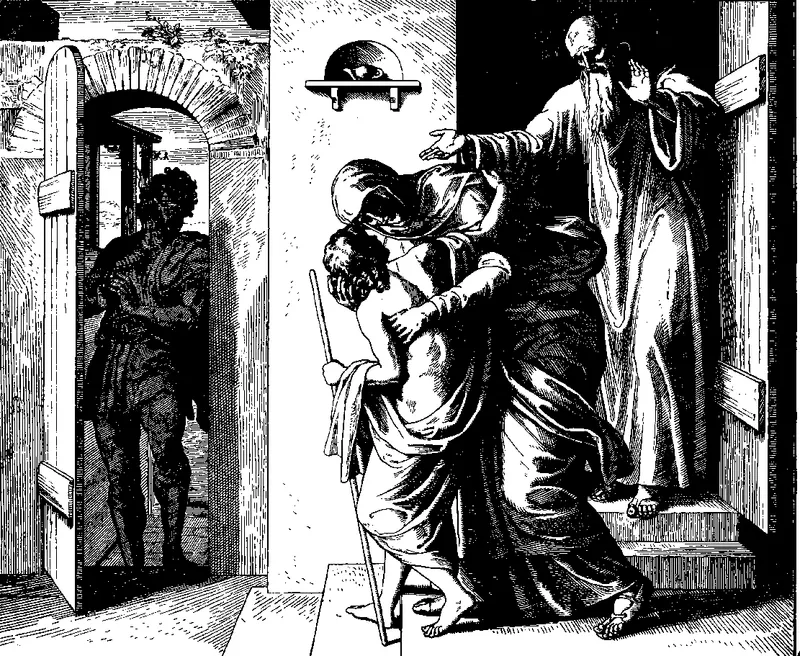
Desperation has no protocol. She does not grieve at home. She does not send word ahead. She takes the dead boy, lays him on Elisha's bed - the very chamber where the promise was given - and rides toward the prophet with fierce silence. When Gehazi asks her questions, she answers, "It is well." Not because it is well. But because she will not speak her grief to a servant. She will speak it only to the man of God. And when she reaches him, she does not kneel. She catches him by the feet and holds on.
2 Kings 4:28-31The Staff That Could Not Wake Him
28Then she said, Did I desire a son of my lord? did I not say, Do not deceive me? 29Then he said to Gehazi, Gird up thy loins, and take my staff in thine hand, and go thy way: if thou meet any man, salute him not; and if any salute thee, answer him not again: and lay my staff upon the face of the child. 30And the mother of the child said, As the LORD liveth, and as thy soul liveth, I will not leave thee. And he arose, and followed her. 31And Gehazi passed on before them, and laid the staff upon the face of the child; but there was neither voice, nor hearing. Wherefore he went again to meet him, and told him, saying, The child is not awaked.
The staff is sent first. The prophet's instrument of authority. But it does not wake the child. No voice. No hearing. The middle-man method fails. A staff laid on a dead child's face is not enough. Elisha must come himself. The Shunammite refuses to be left behind. "As the Lord liveth, and as thy soul liveth, I will not leave thee." She will not let him go. She will hold him to his promise until her son draws breath.
2 Kings 4:32-34Stretched Upon the Child
32And when Elisha was come into the house, behold, the child was dead, and laid upon his bed. 33He went in therefore, and shut the door upon them twain, and prayed unto the LORD. 34And he went up, and lay upon the child, and put his mouth upon his mouth, and his eyes upon his eyes, and his hands upon his hands: and he stretched himself upon the child; and the flesh of the child waxed warm.
2 Kings 4:35-37Seven Sneezes and Open Eyes
35Then he returned, and walked in the house to and fro; and went up, and stretched himself upon him: and the child sneezed seven times, and the child opened his eyes. 36And he called Gehazi, and said, Call this Shunammite. So he called her. And when she was come in unto him, he said, Take up thy son. 37Then she went in, and fell at his feet, and bowed herself to the ground, and took up her son, and went out.
When the staff alone does not wake the child, Elisha goes to the house himself. He shuts the door. He prays. And then he lies upon the child - his mouth on the child's mouth, his eyes on the child's eyes, his hands on the child's hands. He stretches himself upon the dead body. The flesh of the child grows warm. Elisha returns, walks in the house, goes up and stretches himself again. Seven times the child sneezed. The child opened his eyes.
This is the second raising of the dead in Scripture. Elijah had raised the widow's son (1 Kings 17:21-22). Now Elisha performs the same miracle again as confirmation that the power to undo death rests in the hands of God's servants. The child who was promised is raised. The word of the Lord is vindicated. What seemed lost is restored.
2 Kings 4:38-41Healing the Deadly Pottage
38And Elisha came again to Gilgal: and there was a dearth in the land; and the sons of the prophets were sitting before him: and he said unto his servant, Set on the great pot, and seethe pottage for the sons of the prophets. 39And one went out into the field to gather herbs, and found a wild vine, and gathered thereof wild gourds his lap full, and came and shred them into the pot of pottage: for they knew them not. 40So they poured out for the men to eat. And it came to pass, as they were eating of the pottage, that they cried out, and said, O thou man of God, there is death in the pot. And they could not eat thereof. 41But he said, Then bring meal. And he cast it into the pot; and he said, Pour out for the people, that they may eat. And there was no harm in the pot.
There is a famine in the land. The sons of the prophets are gathered with Elisha at Gilgal, and he tells his servant to make pottage - a stew - for them to eat. Food is scarce, but they will share what they have. One of the prophets goes into the field to gather herbs to add to the pot. He finds a wild vine and fills his lap with wild gourds, thinking they are edible. He shreds them into the pottage.
As the men begin to eat, they cry out: "O thou man of God, there is death in the pot!" What was meant to sustain them has become poison. They cannot eat. What appears to be fellowship around a shared meal has become a threat to their lives. The circle of the prophets is broken by hidden danger.
Elisha does not throw the pot away. He does not condemn the prophet who gathered the gourds. Instead, he asks for meal - flour - and casts it into the poisoned pottage. And then he says, "Pour out now for the people, that they may eat. And there was no harm in the pot." The poison is neutralized. Death is swallowed up in the taste and nourishment of bread. The fellowship is restored.
Meal is grain ground fine. It is the staff of life, the foundation of all provision. When Elisha casts meal into the deadly pot, he is enacting a spiritual principle: that the foundation of life - bread, the primary sustenance - has power to heal what would otherwise kill us. The prophets eat in fellowship, safe, nourished.
2 Kings 4:42-44Twenty Loaves Feed One Hundred
42And there came a man from Baalshalisha, and brought the man of God bread of the firstfruits, twenty loaves of barley, and full ears of corn in the husk thereof. And he said, Give unto the people, that they may eat. 43And his servitor said, What, should I set this before an hundred men? He said again, Give the people, that they may eat: for thus saith the LORD, They shall eat, and shall leave thereof. 44So he set it before them, and they did eat, and left thereof, according to the word of the LORD.
A man from Baalshalisha brings Elisha bread of the firstfruits - twenty loaves of barley and fresh corn in the husk. These are gifts of thanksgiving, acknowledgment that the first and best of the harvest belong to the Lord and to His servants. The man gives these to Elisha and says simply, "Give unto the people, that they may eat." He is giving to the prophet's entire community.
Elisha's servant looks at the twenty loaves and looks out at the hundred hungry people. The math does not work. "What, should I set this before an hundred men?" he asks. How can so little feed so many? His question is reasonable. It is the question we would all ask when asked to do the impossible.
But Elisha responds: "Give the people, that they may eat: for thus saith the Lord, They shall eat, and shall leave thereof." They will eat, and they will leave food behind. The provision will exceed the need. And it does. The people eat, and there is food left over. The word of the Lord creates abundance.
The pattern in these four miracles is the same: a small thing is offered or discovered, emptiness is filled, what was lacking becomes abundant, and what was dead or poisoned becomes life-giving. The widow's single pot of oil, the Shunammite's chamber, the prophet's search for food, the man of Baalshalisha's twenty loaves - each is received and transformed by Elisha's faith and God's power. Nothing is too small for God to use. No need is too large for God to meet.
Research trail
Sources & further study
These references support the historical, linguistic, manuscript, and contextual notes in this chapter. Scripture remains the primary text; external sources are provided so readers can inspect the research directly.
- Elisha the ProphetElisha's ministry of miraculous healing and prophecy succeeding Elijah.
- Elisha: Miracles and MinistryElisha's role as prophet in Israel's northern kingdom during the period of decline.
- Archaeology of Northern KingdomExcavation evidence for cities and settlements in the northern kingdom of Israel.