Exodus 3
People in this chapter
Exodus 3 is one of the three most quoted theophanies in all of scripture. God appears in a fire that does not consume, speaks the divine name for the first time, and sends a bewildered shepherd to tell the empire of Egypt that the Lord has arrived. Every time the Old Testament circles back to this chapter - and it does so often - it is because something crucial about who God is lives in these twenty-two verses.
Tap any highlighted phrase to jump to the commentary that unpacks it.
Exodus 3:1-3The Bush That Burned
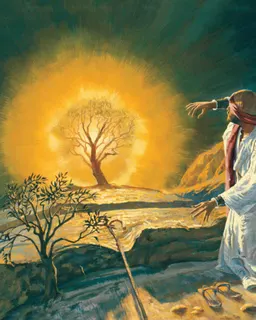
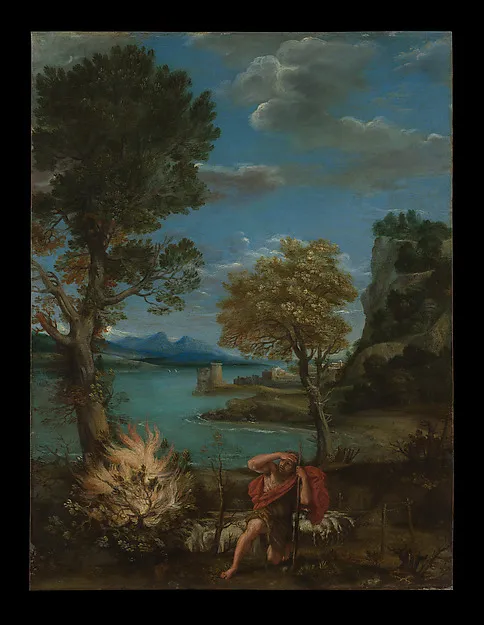
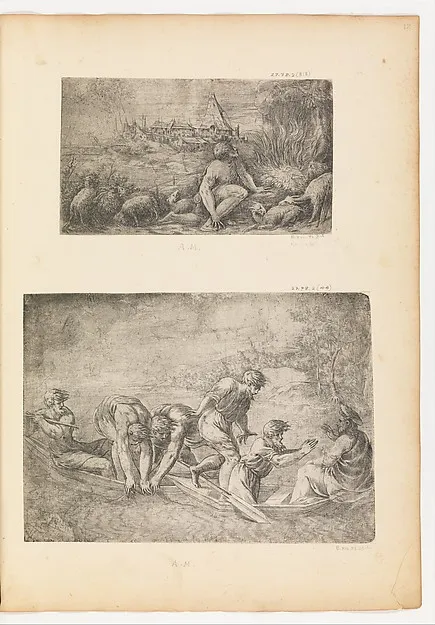
1Now Moses kept the flock of Jethro his father in law, the priest of Midian: and he led the flock to the backside of the desert, and came to the mountain of God, even to Horeb. 2And the angel of the LORD appeared unto him in a flame of fire out of the midst of a bush: and he looked, and, behold, the bush burned with fire, and the bush was not consumed. 3And Moses said, I will now turn aside, and see this great sight, why the bush is not burnt.
Horeb is the mountain of God - the same peak where Israel will later gather at the foot to receive the Law, and where Elijah will later come when he flees the kingdom in despair. It is not that Moses set out knowing he would meet God. He was keeping sheep. He came to this place out of habit, following the pasture. The divine appointment catches him at work1.
The miraculous detail is almost thrown away. The fire does not consume. For centuries, the Church has read this as a foreshadowing: Gregory of Nyssa saw in it the image of Mary bearing the divine and remaining unharmed. Others saw in it the cross itself - the place where God's holiness, like fire, dwells in human flesh without destroying it. The Hebrew mind had no word for the miraculous that separated it from the meaning: a bush that burns without burning is not a magic trick, it is a sign of a presence no human category can contain or consume .
Exodus 3:4-6Moses, Moses
4And when the LORD saw that he turned aside to see, God called unto him out of the midst of the bush, and said, Moses, Moses. And he said, Here am I. 5And he said, Draw not nigh hither: put off thy shoes from off thy feet, for the place whereon thou standest is holy ground. 6Moreover he said, I am the God of thy father, the God of Abraham, the God of Isaac, and the God of Jacob. And Moses hid his face; for he was afraid to look upon God.
God says the name twice. Moses, Moses. The doubling is not emphatic; it is intimate. Jesus uses the same language in Luke 22:31, calling Peter by his name twice. So does God to Abraham in Genesis 22:11. The doubled name is how the God of the Bible calls the people He is about to ask everything of. It is how He gets their attention before He unmakes them and remakes them for a purpose they cannot yet see.
The first command is don't come closer. The presence of God is not safe to approach carelessly. The text is anchored in physicality: it is not metaphorical. Moses is to keep distance, to remove his shoes, to stand barefoot on earth that has become holy ground. The modern reader tends to spiritualize this away - make it about the heart, about attitude, about metaphorical closeness. But Exodus doesn't let you. It is about feet and shoes and the actual ground.
Put off thy shoes. The command appears only three other times in scripture - to Joshua at the conquest (Josh. 5:15), to Paul in a vision (Acts 9), and in the vision of Isaiah in the temple. Every time, the person is standing on ground made holy because God is on it. We are not taught that earth is holy by nature. We are taught that earth becomes holy when God makes His presence known. The shoes come off as an acknowledgment: something is different here. This ground has been made holy.
Moses is afraid to look upon God. The text does not soften this. There is no romantic moment here, no warm encounter. There is fear, absolute and immediate, at the nearness of holiness. The God who called his name twice now gives him a reason to be afraid. The holiness is real. The distance is real. The command not to come closer is a boundary that matters.
Exodus 3:7-10I Have Seen, I Have Heard
7And the LORD said, I have surely seen the affliction of my people which are in Egypt, and have heard their cry by reason of their taskmasters; for I know their sorrows; 8And I am come down to deliver them out of the hand of the Egyptians, and to bring them up out of that land unto a good land and a large, unto a land flowing with milk and honey; unto the place of the Canaanites, and the Hittites, and the Amorites, and the Perizzites, and the Hivites, and the Jebusites. 9Now therefore, behold, the cry of the children of Israel is come unto me: and I have also seen the oppression wherewith the Egyptians oppress them. 10Come now therefore, and I will send thee unto Pharaoh, that thou mayest bring forth my people the children of Israel out of Egypt.
The structure of these verses will become the structure of the Incarnation. I have seen, I have heard, I have come down. God does not work from a distance. He does not manage Egypt from heaven. He comes down. God's first response to affliction is presence and rescue. The nation will later sing, “I know that the LORD will maintain the cause of the afflicted, and the right of the poor” (Psalm 140:12).
But here He is telling Moses where the conviction comes from: He Himself has seen, He Himself has heard. The knowledge is not theoretical. It is intimate.
Exodus 3:11-12Who Am I?
11And Moses said unto God, Who am I, that I should go unto Pharaoh, and that I should bring forth the children of Israel out of Egypt? 12And he said, Certainly I will be with thee; and this shall be a token unto thee, that I have sent thee: When thou hast brought forth the people out of Egypt, ye shall serve God upon this mountain.
Moses' first response is not faith. It is a question. Who am I? This is the question of someone who knows his own history: he killed a man and fled in shame. He has been out of the world for forty years. He is nobody. God does not answer the question directly - does not say, “You are chosen” or “You are qualified.” He says something far more reassuring: “I will be with thee.&rdquo> The credential for the mission is not the person being sent. It is the presence of the God who sends.
Exodus 3:13-15The Name
13And Moses said unto God, Behold, when I come unto the children of Israel, and shall say unto them, The God of your fathers hath sent me unto you; and they shall say to me, What is his name? what shall I say unto them? 14And God said unto Moses, I AM THAT I AM: and he said, Thus shalt thou say unto the children of Israel, I AM hath sent me unto you. 15And God said moreover unto Moses, Thus shalt thou say unto the children of Israel, The LORD God of your fathers, the God of Abraham, the God of Isaac, and the God of Jacob, hath sent me unto you: this is my name for ever, and this is my memorial unto all generations.
Moses is asking the right question. To know someone's name is to know who they are. In the ancient world, a name carried the full weight of character, authority, and nature. When Israel asks God's name, they are asking, who is this God, really? They are not asking for a sound. They are asking for the truth of His being.
What is God saying by refusing to be named? He is saying: I am not a borrowed deity, not a god you have been worshiping in Egypt under another name, not a god you have negotiated with before. I am not reducible to the category you think you understand. I am not manageable. I am not the kind of being whose essence you can capture and keep in a box. The only name I give you is a refusal, and the refusal is a gift - it means you will never get to the end of who I am, never run out of ways I can show up, never face a moment where I cannot meet it because I have already been categorized 2.
Exodus 3:16-22The Covenant Kept
16Go, and gather the elders of Israel together, and say unto them, The LORD God of your fathers, the God of Abraham, of Isaac, and of Jacob, appeared unto me, saying, I have surely visited you, and seen that which is done to you in Egypt: 17And I have said, I will bring you up out of the affliction of Egypt unto the land of the Canaanites, and the Hittites, and the Amorites, and the Perizzites, and the Hivites, and the Jebusites, unto a land flowing with milk and honey. 18And they shall hearken to thy voice: and thou shalt come, thou and the elders of Israel, unto the king of Egypt, and ye shall say unto him, The LORD God of the Hebrews hath met with us: and now let us go, we beseech thee, three days’ journey into the wilderness, that we may sacrifice to the LORD our God.
God tells Moses to gather the elders of Israel and report that the Lord has appeared to him, has seen what is done to them in Egypt, and will bring them up out of their affliction to a land flowing with milk and honey. The elders will heed his voice, and together they are to go to the king of Egypt and ask leave to journey three days into the wilderness to sacrifice to the Lord.
19And I am sure that the king of Egypt will not let you go, no, not by a mighty hand. 20And I will stretch out my hand, and smite Egypt with all my wonders which I will do in the midst thereof: and after that he will let you go. 21And I will give this people favour in the sight of the Egyptians: and it shall come to pass, that, when ye go, ye shall not go empty: 22But every woman shall borrow of her neighbour, and of her that sojourneth in her house, jewels of silver, and jewels of gold, and raiment: and ye shall put them upon your sons, and upon your daughters; and ye shall spoil the Egyptians.
God tells Moses to go first to the elders, the keepers of the covenant memory. These are the old ones who still remember the promise made to Abraham. The chain of faithfulness runs through them. Moses is sent to carry forward something very old.
The request is modest. Three days' journey into the wilderness, that we may sacrifice to the LORD our God. But Pharaoh will hear in it the echo of a secret: they are not coming back. God knows Pharaoh will refuse. God is giving the people permission, in advance, to ask for something they will actually get. The negotiation is scripted. The ending is known before the beginning. And yet it must be walked through, moment by moment.
The text is extraordinarily direct: I am sure that the king of Egypt will not let you go, no, not by a mighty hand. God is telling Moses in advance exactly what will happen. Pharaoh will say no. And God will have to break in with power. This is not a story about human persuasion or cunning. It is a story about the moment when the kingdom of this world meets the kingdom of God and the kingdom of God wins, because it is real.
Research trail
Sources & further study
These references support the historical, linguistic, manuscript, and contextual notes in this chapter. Scripture remains the primary text; external sources are provided so readers can inspect the research directly.