Exodus 4
People in this chapter
Exodus 4 is God's answer to Moses's doubt. Three signs - a staff that becomes a serpent, a hand that becomes leprous and is healed, water that becomes blood - are given to authenticate Moses's mission to Pharaoh. Yet Moses still resists. "I am not eloquent," he says in Hebrew - literally, "heavy of mouth and heavy of tongue." God's response is swift and surprising: He sends Aaron, and Aaron becomes a sign of something that shapes the whole account - that God speaks through human weakness, making it the very instrument of His word.
Tap any highlighted phrase to jump to the commentary that unpacks it.
Exodus 4:1-9Three Signs Authenticated
1And Moses answered and said, But, behold, they will not believe me, nor hearken unto my voice: for they will say, The LORD hath not appeared unto thee.
Moses moves from excuses about himself to a reasonable concern: the people will not recognize the Lord's word through him. Pharaoh will demand proof. The concern is not cowardice - it is a practical objection. How does the voiceless prove the voice of God? The Lord's answer is to give him visible signs, miracles that will become the very plagues he will later invoke against Egypt1.
2And the LORD said unto him, What is that in thine hand? And he said, A rod. 3And he said, Cast it on the ground. And he cast it on the ground, and it became a serpent; and Moses fled from before it. 4And the LORD said unto Moses, Put forth thine hand, and take it by the tail. And he put forth his hand, and caught it, and it became a rod in his hand: 5That they may believe that the LORD God of their fathers, the God of Abraham, the God of Isaac, and the God of Jacob, hath appeared unto thee.
The rod becomes a serpent - the very instrument of deception and rebellion. Yet Moses, afraid at first, is commanded to take it by the tail, and it becomes a rod again. The pattern is repeated: the second sign involves Moses's hand, the third involves water. Each time, what is familiar (a rod, a hand, water) is shown to be under God's command. Nothing in creation is autonomous 2.
6And the LORD said furthermore unto him, Put now thine hand into thy bosom. And he put his hand into his bosom: and when he took it out, behold, his hand was leprous as snow. 7And he said, Put thine hand into thy bosom again. And he put his hand into his bosom again; and plucked it out of his bosom, and, behold, it was turned again as his other flesh.
Leprosy in the Old Testament is not primarily a medical diagnosis - it is a sign of defilement, of being cut off from God's people. Aaron will later be forbidden to enter the sanctuary if his hand ever becomes leprous (Lev. 21:17). The sign shows Moses that his very flesh can be healed, transformed, made whole by the Lord. Whatever Moses thinks is permanently broken can be restored.
8And it shall come to pass, if they will not believe thee, neither hearken to the voice of the first sign, that they will believe the voice of the latter sign. 9And it shall come to pass, if they will not believe also these two signs, neither hearken unto thy voice, that thou shalt take of the water of the river, and pour it upon the dry land: and the water which thou takest out of the river shall become blood upon the dry land.
Water is Egypt's life - the Nile sustains the whole land. When it becomes blood, life becomes death. This third sign will become the first plague. God is giving Moses not just power, but foreshadowing. The signs Moses demonstrates to Pharaoh will become the very judgments God sends upon the land. Moses's staff and his words are not mere parlor tricks; they are harbingers of the Lord's judgment.
Exodus 4:10-17The Burden of Speech
10And Moses said unto the LORD, O my LORD, I am not eloquent, neither heretofore, nor since thou hast spoken unto thy servant: but I am slow of speech, and of a slow tongue.
This is Moses's fourth objection. First, he said he was nobody. Then he asked who God is. Then he said the people won't believe him. Now he says he cannot speak. God's patience with Moses is unending, yet His answer to this objection is almost curt: Who made the mouth? Who makes people dumb or blind? I am the Lord. Moses's complaint is met with a question that reframes the whole problem 3.
11And the LORD said unto him, Who hath made man’s mouth? or who maketh the dumb, or deaf, or the seeing, or the blind? have not I the LORD? 12Now therefore go, and I will be with thy mouth, and teach thee what thou shalt say.
God promises His presence and His words. "I will be with thy mouth" - a strange phrase. It suggests that God's presence inhabits the place where Moses fails most. The words will be God's, spoken through Moses's heavy tongue.
13And he said, O my LORD, send, I pray thee, by the hand of him whom thou wilt send.
Moses has now exhausted his objections. He does not quite say "send someone else," but he is asking. The Hebrew phrase translated "by the hand of him whom thou wilt send" is gracious but unmistakable - Moses is asking for a replacement. This is where God's patience breaks. The Lord is angry.
14And the anger of the LORD was kindled against Moses, and he said, Is not Aaron the Levite thy brother? I know that he can speak well. And also, behold, he cometh forth to meet thee: and when he seeth thee, he will be glad in his heart.
Aaron is already on his way. God has been preparing Aaron while Moses was making excuses. The Lord says Aaron "will be glad" to see Moses - a strange detail, but it suggests that Aaron has been called to this work with joy, while Moses has been resisting. Aaron becomes the answer to Moses's weakness, but also the sign of his disobedience. He gets Aaron because God will accomplish His will, and the mercy in that is larger than Moses deserved.
15And thou shalt speak unto him, and put words in his mouth: and I will be with thy mouth, and with his mouth, and will teach you what ye shall do. 16And he shall be thy spokesman unto the people: and he shall be, even he shall be to thee instead of a mouth, and thou shalt be to him instead of God.
Exodus 4:18-23Return to Egypt
18And Moses went and returned to Jethro his father in law, and said unto him, Let me go, I pray thee, and return unto my brethren which are in Egypt, and see whether they be yet alive. And Jethro said to Moses, Go in peace.
Moses asks permission from Jethro, his Midianite father-in-law, to return to Egypt. Notice that Moses is careful, respectful, embedded in the life of his adopted family. He does not announce his mission with grand rhetoric; he simply asks to visit his kinspeople in Egypt. Jethro blesses him to go. The God who called Moses has also prepared the human relationships that will make his departure possible.
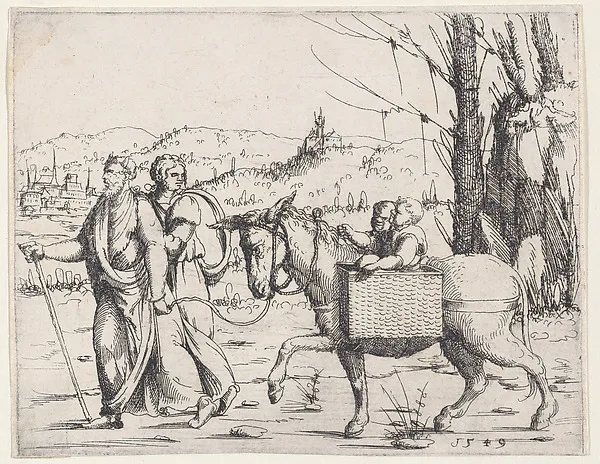
19And the LORD said unto Moses in Midian, Go, return into Egypt: for all the men are dead which sought thy life. 20And Moses took his wife and his sons, and set them upon an ass, and he returned to the land of Egypt: and Moses took the rod of God in his hand.
The rod that became a serpent is now called "the rod of God." Moses carries it not as a shepherd's staff but as an instrument of the Lord's power. Everything is prepared: Aaron is coming to meet him, Jethro has blessed him, the men who wanted to kill him are gone, and he carries the visible sign of God's presence and authority.
21And the LORD said unto Moses, When thou goest to return into Egypt, see that thou do all those wonders before Pharaoh, which I have put in thine hand: but I will harden his heart, that he shall not let the people go. 22And thou shalt say unto Pharaoh, Thus saith the LORD, Israel is my son, even my firstborn: 23And I say unto thee, Let my son go, that he may serve me: and if thou refuse to let him go, behold, I will slay thy son, even thy firstborn.
God names Israel as His own son - the very relationship that makes them precious and inalienable. If Pharaoh refuses, judgment will fall on his own firstborn. The logic is terrible and clear: you took My son into servitude; I will take your son in death. This is the frame for all the plagues to come.
Exodus 4:24-26The Bridegroom of Blood
24And it came to pass by the way in the inn, that the LORD met him, and sought to kill him.
One of the strangest verses in the Bible. Moses is on his way to Egypt with Aaron to deliver God's word, and the Lord moves against him with lethal intent. The text gives no explicit reason. Verses 24-26 are notoriously difficult to interpret. The most widely held explanation: Moses's son has not been circumcised. Circumcision is the sign of the covenant - the mark that binds a person to God's people. Moses, who is about to demand that Pharaoh release God's covenant people, is in breach of the covenant himself.
God cannot send an uncircumcised man to speak for a circumcised people.
25Then Zipporah took a sharp stone, and cut off the foreskin of her son, and cast it at his feet, and said, Surely a bloody husband art thou to me.
Zipporah does not wait for Moses. She takes a sharp stone and performs the circumcision herself. The image is striking - a woman acting where the man delays, using what she has at hand to fulfill the covenant. She is the one who understands what is at stake.
Zipporah, a Midianite woman who has married into Israel's story, understands the covenant before Moses fully does. She takes a sharp stone and performs the circumcision herself - an act that is both tender and terrible. She speaks in riddles: "a bloody husband" may be her way of saying that this blood-sign seals her bond to him and to God's people. Or it may be recoil, a word of horror at what the covenant demands. Commentators have read it both ways for centuries.
26So he let him go: then she said, A bloody husband thou art, because of the circumcision.
The danger passes. "The Lord let him go" - the lethal encounter is ended by the sign of covenant. The phrase "because of the circumcision" might mean "on account of" (the covenant is fulfilled) or "until the circumcision" (once the sign was enacted). The text is deliberately opaque. What is unmistakable: Obedience to the smallest, most intimate commandment - the mark of the covenant cut into the very flesh of the child - is what stays God's hand. The covenant is not abstract or negotiable. It demands everything, down to blood.
Exodus 4:27-31Moses and Aaron Speak
27And the LORD said to Aaron, Go into the wilderness to meet Moses. And he went, and met him in the mount of God, and kissed him. 28And Moses told Aaron all the words of the LORD who had sent him, and all the signs which he had commanded him.
Aaron comes to meet Moses because God sent him. There is a tenderness here - "kissed him." The brothers embrace. Moses, who felt so alone in his calling, now has a partner. He tells Aaron everything: the words God spoke, the signs God gave. What Moses could not do alone, Moses and Aaron will do together. The mouth that is heavy with Moses will be lightened by Aaron's fluency.
29And Moses and Aaron went and gathered together all the elders of the children of Israel: 30And Aaron spake all the words which the LORD had spoken unto Moses, and did the signs in the sight of the people. 31And the people believed: and when they heard that the LORD had visited the children of Israel, and that he had looked upon their affliction, then they bowed their heads and worshipped.
The people believe. They believe because of the signs, and because they hear that God has "looked upon their affliction." God has seen. God remembers. God has not abandoned them in Egypt. The word translated "visited" carries the sense of God drawing near, noticing, remembering. The people respond with worship - the posture of those who know they are seen by someone greater than themselves.
Research trail
Sources & further study
These references support the historical, linguistic, manuscript, and contextual notes in this chapter. Scripture remains the primary text; external sources are provided so readers can inspect the research directly.