Exodus 5
People in this chapter
Exodus 5 is the chapter where deliverance is announced and everything immediately gets worse. In the chapters before, God met Moses at the burning bush, told him His name, gave him signs, and sent him - with Aaron as his mouth - to bring His people out of Egypt. Now Moses and Aaron walk into the most powerful court on earth and deliver the word they were given: Thus saith the LORD God of Israel, Let my people go, that they may hold a feast unto me in the wilderness (v. 1).
The demand is, at its heart, about worship - God is claiming His people for Himself. And Pharaoh meets the claim with a single question that will echo through the whole book: Who is the LORD, that I should obey his voice to let Israel go? I know not the LORD, neither will I let Israel go (v. 2).
Tap any highlighted phrase to jump to the commentary that unpacks it.
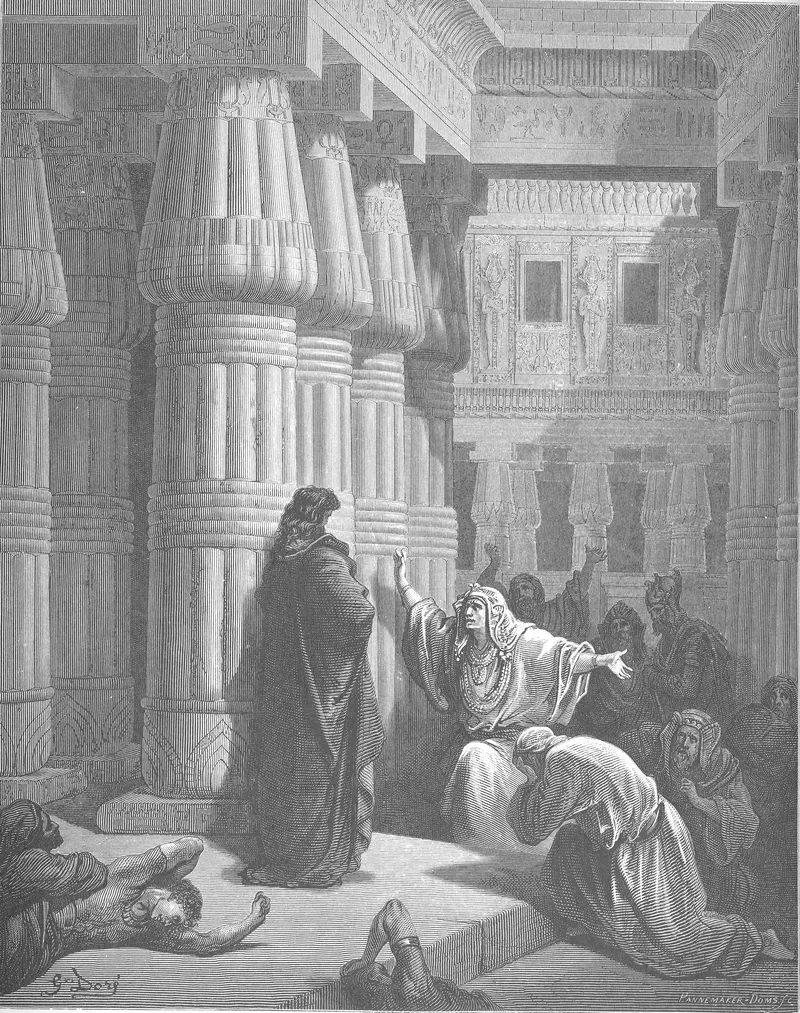
Exodus 5:1-3The Demand, and “Who Is the LORD?”
1And afterward Moses and Aaron went in, and told Pharaoh, Thus saith the LORD God of Israel, Let my people go, that they may hold a feast unto me in the wilderness. 2And Pharaoh said, Who is the LORD, that I should obey his voice to let Israel go? I know not the LORD, neither will I let Israel go. 3And they said, The God of the Hebrews hath met with us: let us go, we pray thee, three days’ journey into the desert, and sacrifice unto the LORD our God; lest he fall upon us with pestilence, or with the sword.
Notice the shape of the demand: Let my people go, that they may hold a feast unto me. The point of the deliverance, from the very first sentence, is the beginning of worship - God is claiming a people for Himself. The slavery is real and God will break it; but the goal beyond the broken chains is a feast in the wilderness, a people gathered to serve the God who made them. That ordering matters, because it tells us what the whole long contest with Pharaoh is finally about: the question of whose these people are - who has the right to their lives, their work, their worship.
Pharaoh thinks the answer is obvious: they are his, and the bricks prove it. God says they are His, and the feast will prove it. Two owners, one people; that is the war, and the brick pits are only its first front.
Watch the second half of the exchange. After Pharaoh's flat refusal, Moses and Aaron soften their language: The God of the Hebrews hath met with us: let us go, we pray thee, three days' journey … lest he fall upon us with pestilence, or with the sword. They reframe the demand as a humble request, even appealing to Pharaoh's self-interest - you would not want a plague loosed in your own land. It is a reasonable, conciliatory move.
And it changes nothing. You cannot negotiate your way past a will that has already decided it does not acknowledge the One who is speaking. The softening is the ordinary human instinct to find a tone that will work. But Exodus 5 is teaching, early, that the obstacle here is not Pharaoh's mood or the wording of the request. The obstacle is a heart that has said I know not the LORD - and only God can move that.
Exodus 5:4-6Get You Unto Your Burdens
4And the king of Egypt said unto them, Wherefore do ye, Moses and Aaron, let the people from their works? get you unto your burdens. 5And Pharaoh said, Behold, the people of the land now are many, and ye make them rest from their burdens. 6And Pharaoh commanded the same day the taskmasters of the people, and their officers, saying,
Pharaoh does not argue theology with Moses; he reaches for the machinery of the state. Get you unto your burdens - back to work - and then, the same day, he issues the order that will fall on a whole people. What is striking is how administrative the cruelty is. There is no rage in it, no shouting; there is a command given to taskmasters, a quota adjusted, a supply withdrawn. This is what oppression usually looks like in the real world: a policy, signed and passed down, that grinds human beings to powder while the one who signed it moves on to the next item.
Pharaoh has heard that God's people want to go and worship, and his calculated answer is to bury the impulse under more labor. If they have time to think about feasts and freedom, the reasoning goes, they have too much time. Crush the margin and you crush the hope. It is the logic of every power that fears what its people might become if they ever lifted their heads.
Exodus 5:7-9Bricks Without Straw
7Ye shall no more give the people straw to make brick, as heretofore: let them go and gather straw for themselves. 8And the tale of the bricks, which they did make heretofore, ye shall lay upon them; ye shall not diminish ought thereof: for they be idle; therefore they cry, saying, Let us go and sacrifice to our God. 9Let there more work be laid upon the men, that they may labour therein; and let them not regard vain words.
Pharaoh names Moses' message with a sneer: let them not regard vain words. The word of the LORD - the promise of a feast, the hope of deliverance - is, to Pharaoh, empty noise, and he is confident that enough labor will drive it out of their heads. There is a brutal theory of the human person underneath the order: keep people exhausted and afraid enough, and they will have no strength left to believe anything. Hope is a luxury of the rested; break the body and you break the dream.
And for a chapter, it seems to work - by verse 21 the people themselves call God's word a sword that has been used to kill them. But Pharaoh has miscalculated the one thing tyrants always miscalculate. The “vain words” were not Moses' invention; they were God's. And a word that God has spoken does not become empty because the one who heard it is tired. It waits. It is still true at the bottom of the pit.
Pharaoh can bury the hope under bricks, but he cannot make the promise false - a buried promise from God is a seed, alive and waiting.
Exodus 5:10-14The Impossible Labor
10And the taskmasters of the people went out, and their officers, and they spake to the people, saying, Thus saith Pharaoh, I will not give you straw. 11Go ye, get you straw where ye can find it: yet not ought of your work shall be diminished. 12So the people were scattered abroad throughout all the land of Egypt to gather stubble instead of straw. 13And the taskmasters hasted them, saying, Fulfil your works, your daily tasks, as when there was straw. 14And the officers of the children of Israel, which Pharaoh’s taskmasters had set over them, were beaten, and demanded, Wherefore have ye not fulfilled your task in making brick both yesterday and to day, as heretofore?
Watch the order travel and the irony sharpen. Pharaoh said I will not give you straw; the taskmasters repeat it word for word; and then the line that breaks the heart: So the people were scattered abroad throughout all the land of Egypt to gather stubble instead of straw. Straw was the leftover stalk from harvest, cut and gathered and ready; stubble is the broken stump left in the field after even the straw is gone - the poorest, most scattered material, requiring the most walking to collect the least usable result.
So the whole nation fans out across Egypt, scouring the fields for fragments, and then must somehow make the same number of bricks as when the straw was simply delivered to their hands. The phrase scattered abroad throughout all the land is doing quiet work: the people who asked to be gathered together for a feast in the wilderness are instead scattered across Egypt picking up stubble. The exact opposite of what they prayed for is what they get.
This is the shape of the chapter - every step toward the promise seems to produce its reverse - and it is precisely the shape that will, by the end of the book, be turned inside out.
And here the machinery finally breaks flesh. The Hebrew officers - the foremen set over their own people - were beaten, because the quota could not be met. This is the moment the impossible math stops being an abstraction and becomes a body bleeding under a rod. Notice the cold injustice of who pays. Pharaoh, who designed the impossibility, feels nothing. The taskmasters, who pass it down, are safe. It is the men in the middle - powerless to change the order, unable to perform it - whose backs absorb the contradiction.
They are beaten for failing to do what no one could do. There is a particular cruelty in being punished not for disobedience but for the limits of the possible, and Scripture does not look away from it; it records the beating plainly, in three words, and lets the injustice stand without explanation. The text trusts us to feel the wrongness. And it plants, in that felt wrongness, the question the whole book is building toward: does God see this? The answer, withheld here, will come like a flood - for the God of the exodus is precisely the God who says, I have seen the affliction of my people … and have heard their cry by reason of their taskmasters; for I know their sorrows (Ex. 3:7).
Exodus 5:15-19The Appeal That Fails
15Then the officers of the children of Israel came and cried unto Pharaoh, saying, Wherefore dealest thou thus with thy servants? 16There is no straw given unto thy servants, and they say to us, Make brick: and, behold, thy servants are beaten; but the fault is in thine own people. 17But he said, Ye are idle, ye are idle: therefore ye say, Let us go and do sacrifice to the LORD. 18Go therefore now, and work; for there shall no straw be given you, yet shall ye deliver the tale of bricks. 19And the officers of the children of Israel did see that they were in evil case, after it was said, Ye shall not minish ought from your bricks of your daily task.
The officers do the reasonable thing: they appeal. They go over the taskmasters' heads, straight to Pharaoh, and lay the contradiction before him as plainly as it can be stated - There is no straw given unto thy servants, and they say to us, Make brick … the fault is in thine own people. It is a clear, logical, almost legal case: the demand is impossible because you have removed the means; the failure is the system's, not ours.
And Pharaoh does not engage a single word of it. He answers reason with a label, repeated for emphasis so it cannot be missed: Ye are idle, ye are idle. This is the move of power that has decided not to listen. He does not refute the argument; he reframes the people who made it. Their request to worship is not a legitimate appeal - it is, he says, mere proof of how much spare time they have.
The logic is airtight and entirely closed: any complaint becomes evidence of idleness, and idleness justifies more work, and more work produces more complaint. You cannot reason your way out of a system whose every input it converts into a reason to tighten the screw. The officers came with a case. They leave having learned that there is no court - that the one with all the power has appointed himself judge, and has already ruled.
The chapter names their dawning realization without flinching: the officers of the children of Israel did see that they were in evil case. They see - the fog of hope clears and the trap stands fully revealed. The appeal has failed; there is no relief coming from Pharaoh; the quota will not move; the beatings will continue. This is the lowest point of the human story in the chapter, and it is important that Scripture lets them arrive at it honestly.
There is no premature comfort here, no voice from heaven yet, no reassurance that it will all work out. There is only the clear-eyed recognition of a people who asked for freedom and received a tighter chain. We should not hurry past this either, because it is where many real lives sit for long stretches - in the evil case, the door tried and found locked, the reasonable appeal exhausted, the situation seen plainly for what it is.
The Bible's honesty here is itself a mercy. It does not pretend the pit is shallower than it is. And by refusing to soften the darkness of verse 19, it makes room for the only light that will actually help: not a denial that things are this bad, but a God who meets His people in the bad and does not consider their evil case the end of the story.
Exodus 5:20-23They Accuse the Deliverer; He Brings It to God
20And they met Moses and Aaron, who stood in the way, as they came forth from Pharaoh: 21And they said unto them, The LORD look upon you, and judge; because ye have made our savour to be abhorred in the eyes of Pharaoh, and in the eyes of his servants, to put a sword in their hand to slay us. 22And Moses returned unto the LORD, and said, LORD, wherefore hast thou so evil entreated this people? why is it that thou hast sent me? 23For since I came to Pharaoh to speak in thy name, he hath done evil to this people; neither hast thou delivered thy people at all.
The accusation lands on the men who carried the promise. The officers come out from their crushing audience with Pharaoh, find Moses and Aaron waiting in the way, and turn the full weight of their bitterness on them: ye have made our savour to be abhorred in the eyes of Pharaoh. The image is visceral - to make someone's savour, their very smell, a stench in another's nostrils. You have made us repulsive, they say; you have made us hateful to the one man who holds our lives, and put a sword in his hand to kill us.
It is desperately unfair to Moses, who did only what God commanded - and it is also deeply human. Pain looks for a face. Pharaoh is unreachable, the system is faceless, God is invisible; but Moses is standing right there, the visible cause of the visible change. So the blame fastens on him. This is one of the loneliest things that can happen to anyone who answers a call: to bring people a true word from God, and to have the very people you came to help decide that you are the reason for their suffering.
The deliverer becomes, in their eyes, the destroyer. And notice - the chapter does not scold the people for it. It records their anguish with compassion. They are crushed under the load and afraid, and the fear has to go somewhere.
And then comes the line that quietly redeems the whole chapter: And Moses returned unto the LORD. He returns to the LORD - he takes the entire unbearable situation, including his own confusion and the people's blame and Pharaoh's cruelty, and carries it straight to God. This is the instinct of true faith under crushing pressure: to go to Him with it. And what Moses brings is a raw prayer, far from polished: Lord, wherefore hast thou so evil entreated this people? why is it that thou hast sent me? He is, in effect, leveling at God the same charge the people leveled at him.
But this is the crucial difference between Moses' complaint and Pharaoh's contempt - Moses brings his bewilderment to God, in God's own presence, still calling Him Lord. Pharaoh says I know not the LORD and turns away; Moses says I do not understand You and turns toward. One is the speech of unbelief. The other is the speech of a faith honest enough to argue, and trusting enough to argue with the only One who can answer.
Research trail
Sources & further study
These references support the historical, linguistic, manuscript, and contextual notes in this chapter. Scripture remains the primary text; external sources are provided so readers can inspect the research directly.
- Exodus 5 · Hebrew + classical Jewish commentaryThe Hebrew text of Exodus 5 with Rashi, Ibn Ezra, and other classical commentators side by side - useful for the heavy theme-word 'avad / 'avodah (to serve, to labor, to be enslaved), for the divine name YHWH behind Pharaoh's “Who is the LORD?” (v. 2), and for token, the fixed “tale” or quota of bricks (vv. 8, 18).
- Brickmakers, Tomb of Rekhmire (ca. 1479-1425 BC)A facsimile of a New Kingdom wall painting from the Theban tomb of the vizier Rekhmire, showing laborers - some of them foreign captives - digging clay, carrying water, and forming and stacking mud bricks under the eye of overseers with rods. It is the closest visual witness we have to the brick labor and the taskmasters of Exodus 5:6-14.
- Exodus 5 ↔ Philippians 2 · Luke 9 · Romans 6Traces the threads tying Pharaoh's “Who is the LORD? … I know not the LORD” (v. 2) to the day when every knee shall bow (Phil. 2:10-11), and the cry Let my people go out of bondage to the great deliverance - the exodos - Christ accomplished (Luke 9:31; Rom. 6).
- Exodus 5 - Translators' NotesThe NET Bible's detailed footnotes on Exodus 5 - the force of Pharaoh's defiant question, the brick-and-straw labor of Egyptian store-cities, the “tale” (fixed quota) of bricks, and the grammar of Moses' honest complaint to the LORD in verses 22-23.
Where this echoes in Scripture
The Demand, and “Who Is the LORD?”
- Exodus 14:25Let us flee from the face of Israel; for the LORD fighteth for them against the Egyptians.Pharaoh's “Who is the LORD?” answered - by the sea, the Egyptians know exactly who He is.
- Philippians 2:10-11That at the name of Jesus every knee should bow... and that every tongue should confess that Jesus Christ is Lord.The defiant question of verse 2 finally and universally answered - every knee, every tongue.
- Luke 9:31Who appeared in glory, and spake of his decease which he should accomplish at Jerusalem.Let my people go deepened - the Greek for “decease” is exodos, Christ's great leading-out.
- Romans 6:17-18Ye were the servants of sin... Being then made free from sin, ye became the servants of righteousness.The deepest bondage and the truest exodus - freedom that is a transfer of service, as in verse 1.
Bricks Without Straw
- Exodus 1:13-14And the Egyptians made the children of Israel to serve with rigour... in morter, and in brick.The bondage Pharaoh now intensifies - the same brick labor, the same root 'avad for their service.
- Exodus 1:9-10Behold, the people of the children of Israel are more and mightier than we... let us deal wisely with them.Pharaoh's old fear surfacing again in verse 5 - “the people are many” - oppression born of dread.
- Proverbs 21:1The king's heart is in the hand of the LORD... he turneth it whithersoever he will.The deeper truth under Pharaoh's policy - even the tyrant's heart is not beyond God's reach.
The Impossible Labor
- Exodus 3:7I have surely seen the affliction of my people... and have heard their cry by reason of their taskmasters; for I know their sorrows.The answer the beaten officers cannot yet hear - God has already seen the taskmasters and their rods.
- Isaiah 53:5He was wounded for our transgressions, he was bruised for our iniquities... and with his stripes we are healed.The dark foreshadow made gospel - the One who bears stripes not His own, on purpose, for us.
- John 19:1Then Pilate therefore took Jesus, and scourged him.The innocent beaten unjustly (v. 14) - fulfilled in the One who opened not His mouth.
The Appeal That Fails
- Ecclesiastes 4:1I considered all the oppressions... and they had no comforter; and on the side of their oppressors there was power.The “evil case” of verse 19 named in wisdom - the oppressed with no comforter, the oppressor with the power.
- Psalm 9:9The LORD also will be a refuge for the oppressed, a refuge in times of trouble.The court above Pharaoh's court - the throne that hears what Pharaoh refused to hear.
- Luke 18:7-8And shall not God avenge his own elect, which cry day and night unto him... I tell you that he will avenge them speedily.The unjust judge who would not hear, and the Judge above him who will - the recourse Pharaoh denied.
They Accuse the Deliverer; He Brings It to God
- Exodus 6:1Then the LORD said unto Moses, Now shalt thou see what I will do to Pharaoh.God's immediate answer to Moses' complaint - the deliverance Moses says has not happened “at all” is about to begin.
- 1 Timothy 2:5There is one God, and one mediator between God and men, the man Christ Jesus.What Moses dimly becomes in verse 22 - the one who carries the people's complaint to God - fulfilled in Christ.
- Hebrews 5:7Who... offered up prayers and supplications with strong crying and tears unto him that was able to save him... and was heard.The Mediator's cry, carried perfectly and heard - where Moses' raw cry points.
- Habakkuk 1:2O LORD, how long shall I cry, and thou wilt not hear! even cry out unto thee of violence, and thou wilt not save!The honest complaint of faith, brought to God's own face - the same prayer as Moses' in verse 22.