John 19
People in this chapter
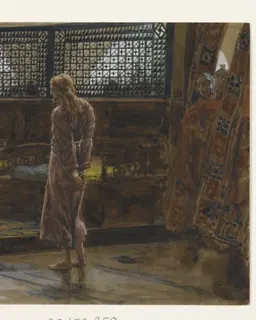
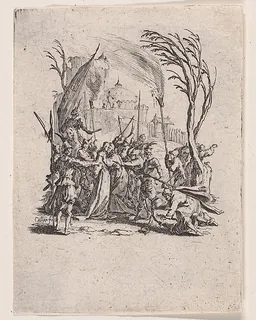
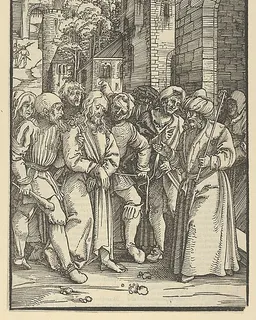
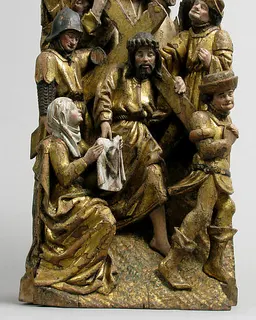
The trial has reached its terrible turn. Pilate, hoping a lesser cruelty might satisfy the crowd, has Jesus scourged, and the soldiers turn the punishment into a game: they plait a crown of thorns, press it onto His head, throw a purple robe over His torn back, and come up to Him one by one - Hail, King of the Jews! - and strike Him in the face (vv. 1-3). Then Pilate brings Him out, broken and bleeding, and says the words John means us never to forget: Behold the man! (v. 5).
He says it to provoke pity, perhaps to shame the crowd into letting the matter drop. But the chief priests only cry the louder, Crucify him, crucify him, until at last, cornered by the threat that he is no friend of Caesar, Pilate hands Jesus over.1
Tap any highlighted phrase to jump to the commentary that unpacks it.
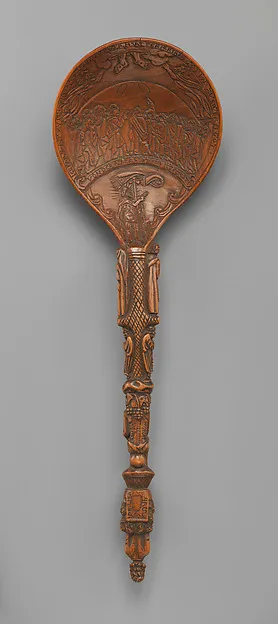
John 19:1-16aBehold the Man
1Then Pilate therefore took Jesus, and scourged him. 2And the soldiers platted a crown of thorns, and put it on his head, and they put on him a purple robe, 3And said, Hail, King of the Jews! and they smote him with their hands. 4Pilate therefore went forth again, and saith unto them, Behold, I bring him forth to you, that ye may know that I find no fault in him. 5Then came Jesus forth, wearing the crown of thorns, and the purple robe. And Pilate saith unto them, Behold the man!
The chapter opens with two words that the Gospel passes over almost without comment, and that we should not: scourged him (v. 1). Roman scourging was a brutality designed to break a body short of killing it - a flogging with a whip whose leather thongs were weighted to tear the flesh. Pilate orders it not as the prelude to crucifixion but, by John's account, as a desperate middle course: perhaps a beating this severe will satisfy the crowd and let him release a man he has three times declared innocent.
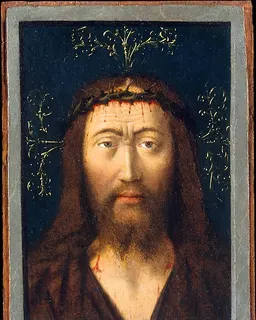
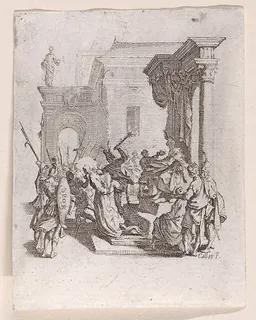
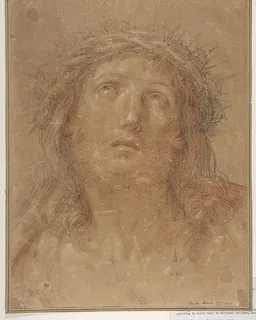
It does not. And the soldiers, given a condemned man for an afternoon, turn the punishment into sport. The soldiers platted a crown of thorns, and put it on his head, and they put on him a purple robe (v. 2). Every piece of it is a parody of royalty - the thorn-crown for a diadem, the purple robe of an emperor, the mocking salute Hail, King of the Jews! (v. 3) in place of homage - and they punctuate the joke by striking Him in the face.
They mean it all as ridicule. They do not know they are dressing the King of kings for His coronation.
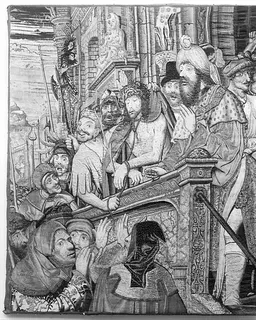
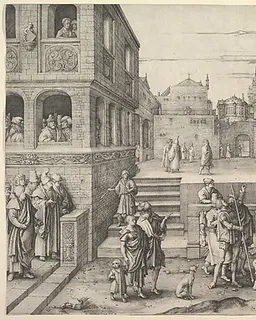
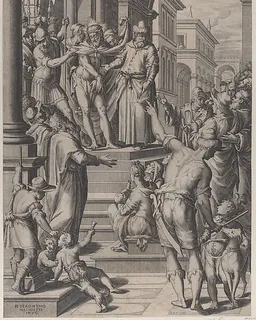
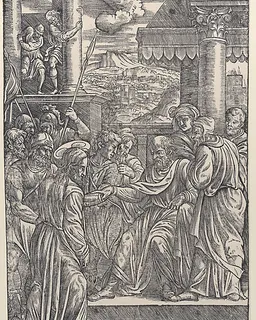
Pilate brings Him out to the crowd in the costume of their mockery, beaten and bleeding, and says it: Behold the man! (v. 5). The words drip with strategy. Pilate wants the crowd to look - to see how pitiful, how harmless, how thoroughly humiliated this supposed rival to Caesar already is - and to let their fury spend itself in the seeing. Behold, I bring him forth to you, that ye may know that I find no fault in him (v. 4).
It is a public confession of innocence wrapped around a public display of cruelty: Pilate declares Jesus guiltless and then parades Him in thorns and welts, hoping the spectacle will close the matter. But John, telling the story long after, hears something in Behold the man that Pilate never intended. Here, in this broken figure, is humanity's true representative and humanity's true King, standing where He has chosen to stand. The crowd is meant to look and feel pity; the reader is meant to look and worship.
6When the chief priests therefore and officers saw him, they cried out, saying, Crucify him, crucify him. Pilate saith unto them, Take ye him, and crucify him: for I find no fault in him. 7The Jews answered him, We have a law, and by our law he ought to die, because he made himself the Son of God. 8When Pilate therefore heard that saying, he was the more afraid; 9And went again into the judgment hall, and saith unto Jesus, Whence art thou? But Jesus gave him no answer. 10Then saith Pilate unto him, Speakest thou not unto me? knowest thou not that I have power to crucify thee, and have power to release thee? 11Jesus answered, Thou couldest have no power at all against me, except it were given thee from above: therefore he that delivered me unto thee hath the greater sin.
The display backfires. Far from softening, the chief priests and officers cry out the harder - Crucify him, crucify him (v. 6) - and when Pilate, exasperated, tells them to take Him and crucify Him themselves, they finally name their real charge: by our law he ought to die, because he made himself the Son of God (v. 7). And at that word something shifts in Pilate. When Pilate therefore heard that saying, he was the more afraid (v. 8).
The hardened governor, who has handled rebels and zealots before, is unsettled. He has already sensed there is something other about this silent Prisoner; now the claim that He is the Son of God touches a nerve of dread. So he goes back inside and asks the question that haunts the whole chapter: Whence art thou? (v. 9) - where are You really from? And Jesus, who has answered so much, gives him no answer at all.
The silence is its own reply. Pilate is not asking in order to believe; he is asking in order to escape, and to a man looking only for a way out, heaven has nothing more to say.1
Stung by the silence, Pilate reaches for the one thing he is sure of - his power: knowest thou not that I have power to crucify thee, and have power to release thee? (v. 10). It is the boast of a man who governs by force and assumes force is the final word. Jesus' answer dismantles the assumption without raising its voice: Thou couldest have no power at all against me, except it were given thee from above (v. 11).
Pilate's authority is real, but it is borrowed - granted from above, held on loan, answerable to the One who gave it. The judge is being judged by the Prisoner at his bar. And Jesus draws a line of responsibility through the whole scene: therefore he that delivered me unto thee hath the greater sin. Pilate is guilty, but those who handed Jesus over against the light they had are guiltier still. What the verse makes unmistakable is that no one is seizing Jesus' life from Him.
The power on display in that hall is permitted power, and it goes only as far as the Father allows - which is to say, exactly as far as the Son has willed to go.
12And from thenceforth Pilate sought to release him: but the Jews cried out, saying, If thou let this man go, thou art not Caesar’s friend: whosoever maketh himself a king speaketh against Caesar. 13When Pilate therefore heard that saying, he brought Jesus forth, and sat down in the judgment seat in a place that is called the Pavement, but in the Hebrew, Gabbatha. 14And it was the preparation of the passover, and about the sixth hour: and he saith unto the Jews, Behold your King! 15But they cried out, Away with him, away with him, crucify him. Pilate saith unto them, Shall I crucify your King? The chief priests answered, We have no king but Caesar. 16Then delivered he him therefore unto them to be crucified. And they took Jesus, and led him away.
Now the trap closes on Pilate from the other side. He sought to release him (v. 12) - the fear of verse 8 has become a will to let Jesus go - but the crowd plays the card he cannot beat: If thou let this man go, thou art not Caesar's friend. To a Roman governor that is a threat against his career and possibly his life; a report to a jealous emperor that he had freed a man claiming kingship could end him.
So he brings Jesus out to the judgment seat, and John fixes the moment with eerie precision: it was the preparation of the passover, and about the sixth hour (v. 14) - the very hours when, across the city, the Passover lambs were beginning to be made ready for slaughter. Behold your King! Pilate says - one last bitter taunt - and the chief priests answer with words that, on the lips of those charged to await God's anointed King, are the deepest tragedy of the chapter: We have no king but Caesar (v. 15).
To be rid of the true King they pledge themselves to Caesar. And so Pilate delivers Him up, and they lead Him away.
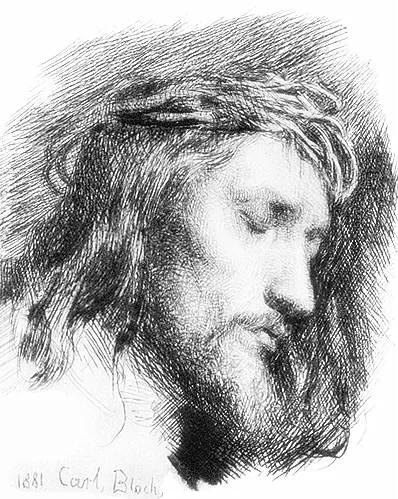
John 19:16b-24The King of the Jews
17And he bearing his cross went forth into a place called the place of a skull, which is called in the Hebrew Golgotha: 18Where they crucified him, and two other with him, on either side one, and Jesus in the midst. 19And Pilate wrote a title, and put it on the cross. And the writing was, JESUS OF NAZARETH THE KING OF THE JEWS. 20This title then read many of the Jews: for the place where Jesus was crucified was nigh to the city: and it was written in Hebrew, and Greek, and Latin. 21Then said the chief priests of the Jews to Pilate, Write not, The King of the Jews; but that he said, I am King of the Jews. 22Pilate answered, What I have written I have written.
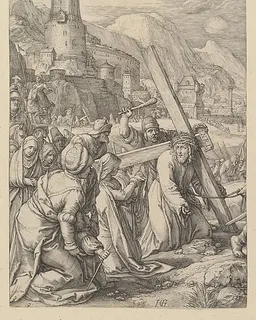
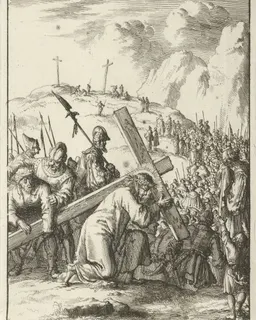
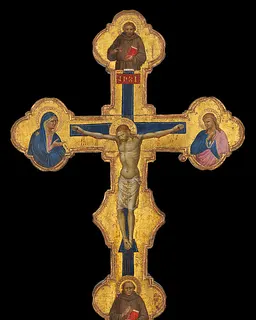
John records the crucifixion itself with astonishing restraint. And he bearing his cross went forth into a place called the place of a skull, which is called in the Hebrew Golgotha: where they crucified him (vv. 17-18). The horror of crucifixion needed no description for his first readers; they had seen it. So John simply states it - they crucified him - and lets the bare fact carry its weight. Notice the dignity even in his telling: Jesus goes bearing his cross, walking out to the place of death as One who has set His face to go there.
He is crucified in the midst, between two others - placed, as it were, at the center, the position of the chief offender, and yet the position of the One around whom everything turns. The name of the place is grim and fitting: the place of a skull. To this barren, public spot just outside the city wall, where Rome displayed its victims as a warning, the Lord of life is brought to die. The execution ground becomes the holiest ground on earth.
Over His head Pilate fixes a title, and refuses to take it down. JESUS OF NAZARETH THE KING OF THE JEWS (v. 19) - written, John tells us with care, in Hebrew, and Greek, and Latin (v. 20), the three great languages of that world: the sacred tongue of Israel, the common tongue of the nations, the official tongue of the empire. Pilate intended it partly as a charge and partly as a last jab at the rulers who had cornered him; but the effect is a proclamation to every kind of person who could read, posted at the crossroads of the world.
The chief priests see the danger and protest: Write not, The King of the Jews; but that he said, I am King of the Jews (v. 21) - do not let it stand as a statement of fact. And Pilate, who has bent to them at every turn, finally will not bend: What I have written I have written (v. 22). The obstinacy of a frustrated official becomes, without his knowing it, the truth nailed up for all nations to read.
In Hebrew, Greek, and Latin alike, the King reigns from His cross.
23Then the soldiers, when they had crucified Jesus, took his garments, and made four parts, to every soldier a part; and also his coat: now the coat was without seam, woven from the top throughout. 24They said therefore among themselves, Let us not rend it, but cast lots for it, whose it shall be: that the scripture might be fulfilled, which saith, They parted my raiment among them, and for my vesture they did cast lots. These things therefore the soldiers did.
At the foot of the cross the ordinary cruelty of the scene goes on. The execution squad claims the victim's clothing as their perquisite, and they divide it: took his garments, and made four parts, to every soldier a part (v. 23). But His coat - the seamless inner garment, woven from the top throughout - cannot be split without ruining it, so they gamble for it whole: Let us not rend it, but cast lots for it, whose it shall be (v. 24).
It is a small, callous detail: soldiers throwing dice for a dead man's shirt while He hangs above them. And John, watching, sees Scripture come true to the letter. Centuries before, a psalm of suffering had said exactly this - They part my garments among them, and cast lots upon my vesture (Ps. 22:18).2 The soldiers have no idea they are acting out an ancient word; they are simply dividing spoils.
Yet down to the difference between what was parted and what was gambled for, the prophecy is fulfilled. The God who foresaw the cross foresaw even the dice at its foot.
John 19:25-30It Is Finished
25Now there stood by the cross of Jesus his mother, and his mother’s sister, Mary the wife of Cleophas, and Mary Magdalene. 26When Jesus therefore saw his mother, and the disciple standing by, whom he loved, he saith unto his mother, Woman, behold thy son! 27Then saith he to the disciple, Behold thy mother! And from that hour that disciple took her unto his own home.
Amid the soldiers and the scoffers, John lifts our eyes to a small group standing close: Now there stood by the cross of Jesus his mother, and his mother's sister, Mary the wife of Cleophas, and Mary Magdalene (v. 25). They have not fled. While most have scattered, these women and the beloved disciple stand within sight of the cross, sharing what little can be shared - presence. And from the height of His own agony, Jesus turns His attention outward, to His mother.
Woman, behold thy son! He says to her, and to the disciple, Behold thy mother! (vv. 26-27). He is dying, and His thought is for her care. Mary, who has followed Him to this place, will not be left alone; He places her into the keeping of the disciple He loved, and that disciple takes her, from that hour, into his own home. There is a quiet glory in it. The Son who is in the act of finishing the world's redemption still has room in His heart for one widowed mother's tomorrow.
The love that is about to embrace the whole world reaches all the way to the woman standing at His feet.
28After this, Jesus knowing that all things were now accomplished, that the scripture might be fulfilled, saith, I thirst. 29Now there was set a vessel full of vinegar: and they filled a spunge with vinegar, and put it upon hyssop, and put it to his mouth. 30When Jesus therefore had received the vinegar, he said, It is finished: and he bowed his head, and gave up the ghost.
Two words break from the cross before the last: I thirst (v. 28). They are utterly human. The One through whom all the seas were made hangs in the dust of Golgotha and craves a sip of water; He enters the body's suffering to the dregs. Yet John frames the cry with care - Jesus speaks it knowing that all things were now accomplished, that the scripture might be fulfilled. Even this thirst is not random; an old psalm of the righteous sufferer had said, in my thirst they gave me vinegar to drink (Ps. 69:21), and here a sponge of vinegar - the cheap sour wine of soldiers - is lifted to His lips on a stalk of hyssop.
The detail of the hyssop would not be lost on a reader who knew the Passover, for hyssop was the very branch used to brush the lamb's blood on the doorposts in Egypt (Exod. 12:22). The whole scene quietly gathers the threads of Scripture toward a single point. He thirsts as a real man in real pain; He thirsts as the Sufferer the Scriptures foretold; and He is about to speak the word that all of it has been moving toward.
John 19:31-37A Bone of Him Shall Not Be Broken
31The Jews therefore, because it was the preparation, that the bodies should not remain upon the cross on the sabbath day, (for that sabbath day was an high day,) besought Pilate that their legs might be broken, and that they might be taken away. 32Then came the soldiers, and brake the legs of the first, and of the other which was crucified with him. 33But when they came to Jesus, and saw that he was dead already, they brake not his legs: 34But one of the soldiers with a spear pierced his side, and forthwith came there out blood and water. 35And he that saw it bare record, and his record is true: and he knoweth that he saith true, that ye might believe.
A grim piece of business follows, and John watches it become prophecy. Because the sabbath was drawing on - and not an ordinary sabbath but the high day of the Passover week - the bodies could not be left hanging, so the leaders ask Pilate to hasten death by breaking the victims' legs (v. 31). It was a known cruelty: with the legs shattered a crucified man could no longer push up to breathe, and the end came quickly.
The soldiers break the legs of the two crucified with Jesus (v. 32). But when they came to Jesus, and saw that he was dead already, they brake not his legs (v. 33). He had already given up His spirit; there was nothing to hasten. And so, by the soldiers' routine decision and the simple fact of His death, not one of His bones was broken. John pauses here as nowhere else in the chapter to swear to what he saw: he that saw it bare record, and his record is true… that ye might believe (v. 35).
He wants us to know this is not legend but eyewitness - he stood there, he saw it, and he is telling the truth.
Then comes the spear. To make certain Jesus was dead, one of the soldiers with a spear pierced his side, and forthwith came there out blood and water (v. 34). John records it as the plain physical fact it was - the body of Jesus, run through, releasing blood and a clear watery fluid - and he records it precisely because it proves death was real. The spear settled the fact of His death beyond question. But John, who tells us so insistently that he saw this, plainly means us to ponder it as well.
Throughout this Gospel water and blood have carried weight - the water of new birth and of the Spirit Jesus promised would flow from Him (John 3:5; 7:38-39), the blood that is His life poured out. Now, from His opened side, both flow. He does not dwell on it or decode it for us; he simply lays the fact before our eyes and lets it speak. From the dead body of the Lord come blood and water - His life given, His cleansing freely poured out.2
36For these things were done, that the scripture should be fulfilled, A bone of him shall not be broken. 37And again another scripture saith, They shall look on him whom they pierced.
John now names the two Scriptures he has watched come true. The first: A bone of him shall not be broken (v. 36). These words were spoken first of the Passover lamb, the lamb whose blood marked the doors in Egypt - neither shall ye break a bone thereof (Exod. 12:46) - and echoed in the psalm of the righteous one the LORD keeps, he keepeth all his bones: not one of them is broken (Ps. 34:20).
The soldiers, breaking legs as a matter of course, simply skipped the man already dead; and in that small omission an ancient law about the lamb was fulfilled on the body of Jesus. The second Scripture is fulfilled by the spear: They shall look on him whom they pierced (v. 37) - words from the prophet Zechariah, where the LORD says His people shall look upon me whom they have pierced, and they shall mourn (Zech. 12:10).2 The thrust of the soldier's spear did not merely confirm a death; it set before the world the pierced One that prophecy said all would one day behold.
John's point is steady and clear: not one of these things drifted loose of God's purpose. The unbroken bones, the pierced side - each was written long before, and each came true.
John 19:38-42In the Garden a New Sepulchre
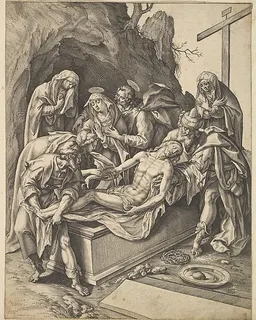
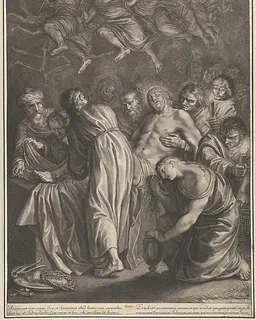
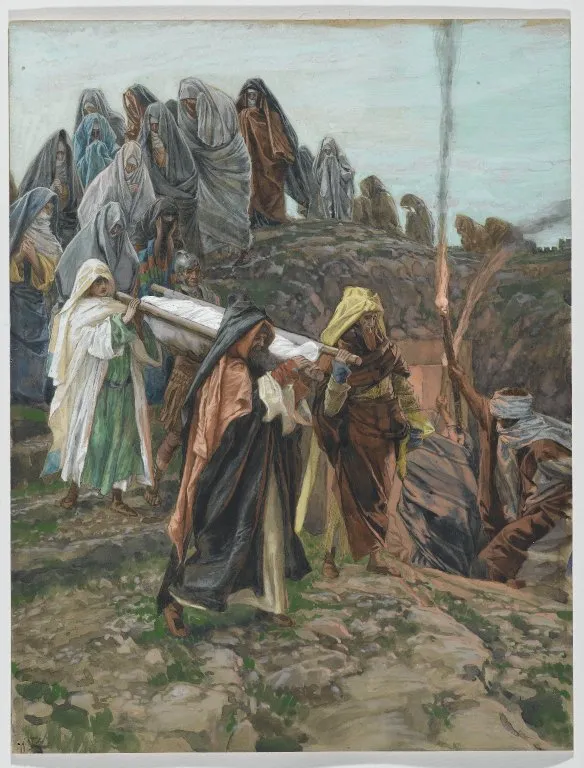
38And after this Joseph of Arimathaea, being a disciple of Jesus, but secretly for fear of the Jews, besought Pilate that he might take away the body of Jesus: and Pilate gave him leave. He came therefore, and took the body of Jesus. 39And there came also Nicodemus, which at the first came to Jesus by night, and brought a mixture of myrrh and aloes, about an hundred pound weight. 40Then took they the body of Jesus, and wound it in linen clothes with the spices, as the manner of the Jews is to bury.
When the crowds have gone and the cross stands empty against the evening, two unlikely men step forward. Joseph of Arimathaea, being a disciple of Jesus, but secretly for fear of the Jews, besought Pilate that he might take away the body of Jesus (v. 38). Joseph had been a hidden disciple, his faith kept quiet for fear of what open allegiance would cost him. Now, with Jesus dead and the danger at its height, he does the very thing his fear had prevented - he goes to the governor, asks for the body, and claims it as his own to bury.
What he would not risk while Jesus lived, he risks now that Jesus has died. And he does not come alone. There came also Nicodemus, which at the first came to Jesus by night (v. 39) - the same ruler who had once crept through the dark to question Jesus and heard that a man must be born again. He too steps into the open, and he comes laden: a mixture of myrrh and aloes, about an hundred pound weight. It is an enormous quantity, a king's burial, far more than custom required - the lavish gift of a man no longer hiding.
Two secret disciples, in the hour everyone else has fled, openly take their Lord into their hands.
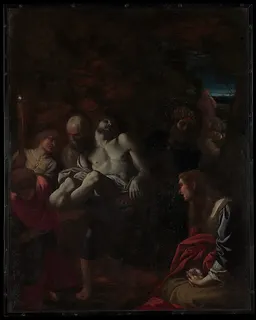
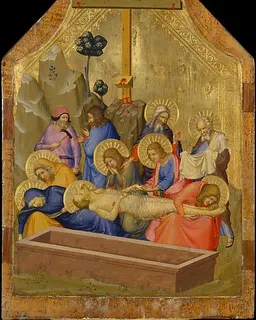
Together they tend the body with reverent care. Then took they the body of Jesus, and wound it in linen clothes with the spices, as the manner of the Jews is to bury (v. 40). There is tenderness in the act - the gentle wrapping in clean linen, the costly myrrh and aloes laid in among the folds, the careful following of the burial customs of their people. These men are honoring a body they loved.
And the lavishness of the spices - that hundred pound weight Nicodemus carried - says without words what they could not say in life: this was no ordinary man, and they will not bury Him as one. The myrrh, a fragrance of both love and death, recalls the costly anointing Mary had poured out at Bethany against this very day. What the watching world saw as the shameful end of a condemned criminal, these two treated as the burial of a king.
Devotion that had hidden in the shadows now does in the open what love does: it spends its best on the beloved, even in the grave.
41Now in the place where he was crucified there was a garden; and in the garden a new sepulchre, wherein was never man yet laid. 42There laid they Jesus therefore because of the Jews’ preparation day; for the sepulchre was nigh at hand.
The chapter ends in a garden. Now in the place where he was crucified there was a garden; and in the garden a new sepulchre, wherein was never man yet laid (v. 41). Every word of it carries quiet promise. A garden - the same word that opens the whole Bible's story, where a garden was the place of life before it became the place of loss; and here, beside the place of the skull, a garden waits.
A new sepulchre, cut fresh from the rock, wherein was never man yet laid - no other death had ever touched it; the tomb is undefiled, kept, as if reserved. They lay Him there in haste, for the sabbath was almost upon them and the tomb was near (v. 42). And so the body of the Lord is sealed in the rock, and the sabbath falls, and to every eye the story is over: the King is dead, the Lamb is slain, the stone is in place.
Yet John has chosen his details with care, and they whisper against the silence. A garden. A tomb that has never held the dead. The work is finished, and the King lies still - but a tomb that was never used for anyone is not a tomb that looks built to keep its occupant. The grave is new, and the third day is coming.
Research trail
Sources & further study
These references support the historical, linguistic, manuscript, and contextual notes in this chapter. Scripture remains the primary text; external sources are provided so readers can inspect the research directly.
- John 19 - Translators' NotesThe NET Bible's detailed footnotes on John 19 - the sense of the scourging and the soldiers' mockery (vv. 1-3), Pilate's growing fear and the meaning of “from above” (vv. 8-11), the hour and the day of preparation that align Jesus' death with the Passover (v. 14), and the force of the single word translated “It is finished” in verse 30.
- John 19 ↔ Psalm 22 · Psalm 34 · Exodus 12 · Zechariah 12Traces the threads tying John 19 to the rest of Scripture - the parting of the garments and casting of lots (v. 24) against Psalm 22:18, the unbroken bones (v. 36) against Psalm 34:20 and the Passover lamb of Exodus 12:46, and the pierced side (v. 37) against Zechariah 12:10, “they shall look upon me whom they have pierced.”
- John 19 · Greek interlinear + lexiconThe Greek text of John 19 word by word, with parsing and lexical links - useful for tetelestai (v. 30, the single perfect-tense word rendered “It is finished”), paredoken to pneuma (v. 30, “gave up the ghost,” literally “delivered up His spirit”), the threefold inscription of verse 20, and the blood and water of verse 34.
Where this echoes in Scripture
Behold the Man
- Isaiah 53:3-5He is despised and rejected of men... he was wounded for our transgressions, he was bruised for our iniquities.The scourged and despised figure of verses 1-5 - the suffering Servant, wounded for others, foreseen long before.
- John 10:17-18No man taketh it from me, but I lay it down of myself. I have power to lay it down, and I have power to take it again.The truth behind verse 11 - no power touches Jesus except what He permits; He lays His life down willingly.
- Philippians 2:6-8made himself of no reputation, and took upon him the form of a servant... and became obedient unto death, even the death of the cross.The King crowned with thorns (vv. 2-5) - majesty hidden in humiliation, obedient all the way to the cross.
- Genesis 3:17-18cursed is the ground for thy sake... Thorns also and thistles shall it bring forth to thee.The thorns of verse 2 - the emblem of the curse, now pressed onto the brow of the One who bears the curse away.
- Matthew 26:39O my Father, if it be possible, let this cup pass from me: nevertheless not as I will, but as thou wilt.The willing obedience underlying verse 11 - the Son surrendering to the Father's plan before Pilate ever spoke.
The King of the Jews
- Psalm 22:18They part my garments among them, and cast lots upon my vesture.The exact scene at the foot of the cross in verses 23-24 - foretold, to the detail, a thousand years before.
- John 12:32-33And I, if I be lifted up from the earth, will draw all men unto me. This he said, signifying what death he should die.The cross as throne (vv. 18-19) - the King lifted up to draw all nations to Himself.
- Psalm 22:27-28All the ends of the world shall remember and turn unto the LORD... for the kingdom is the LORD's.Where the psalm of the cross ends - the worldwide reign announced by the title in three tongues (v. 20).
- Colossians 2:14-15nailing it to his cross... having spoiled principalities and powers, he made a shew of them openly, triumphing over them in it.The cross as the place of victory (v. 18) - the King triumphing through the very instrument of His death.
- Revelation 19:16And he hath on his vesture and on his thigh a name written, KING OF KINGS, AND LORD OF LORDS.The title of verse 19 made final - the King mocked at Golgotha revealed as King of kings.
It Is Finished
- John 17:4I have glorified thee on the earth: I have finished the work which thou gavest me to do.The work that is “finished” in verse 30 - named the night before as the work the Father gave the Son to do.
- John 10:17-18I lay down my life... No man taketh it from me, but I lay it down of myself.What “he bowed his head, and gave up the ghost” means (v. 30) - a life laid down by choice, not taken.
- Luke 23:46Father, into thy hands I commend my spirit: and having said thus, he gave up the ghost.The delivering up of His spirit in verse 30 - released, in trust, into the Father's hands.
- Psalm 69:21They gave me also gall for my meat; and in my thirst they gave me vinegar to drink.The thirst and the vinegar of verses 28-29 - foretold in the psalm of the righteous sufferer.
- Hebrews 10:12-14this man, after he had offered one sacrifice for sins for ever... For by one offering he hath perfected for ever them that are sanctified.The meaning of “It is finished” (v. 30) - one offering, once for all, the work complete and lasting.
A Bone of Him Shall Not Be Broken
- Exodus 12:46in one house shall it be eaten... neither shall ye break a bone thereof.The law of the Passover lamb fulfilled in verse 36 - not a bone of Jesus, the true Lamb, was broken.
- Psalm 34:20He keepeth all his bones: not one of them is broken.The word fulfilled when the soldiers passed Jesus by (vv. 33, 36) - the LORD keeps the bones of His righteous One.
- Zechariah 12:10they shall look upon me whom they have pierced, and they shall mourn for him.The prophecy of the spear in verses 34, 37 - the pierced One whom a mourning people will behold and be cleansed.
- 1 Corinthians 5:7Christ our passover is sacrificed for us.What the unbroken bones declare (v. 36) - Jesus is the Passover lamb the ancient feast foreshadowed.
- Revelation 1:7Behold, he cometh with clouds; and every eye shall see him, and they also which pierced him.The looking of verse 37 carried to its end - the day all the world beholds the pierced One.
In the Garden a New Sepulchre
- 1 Corinthians 15:3-4Christ died for our sins according to the scriptures; and that he was buried, and that he rose again the third day according to the scriptures.The burial of verses 38-42 as gospel - He truly died and was truly buried, the third day already in view.
- Isaiah 53:9And he made his grave with the wicked, and with the rich in his death.Fulfilled in the burial (vv. 38-42) - crucified among criminals, laid in the new tomb of a rich man.
- John 3:1-2a man of the Pharisees, named Nicodemus, a ruler of the Jews: The same came to Jesus by night.The Nicodemus of verse 39 - the man who once came in the dark now openly tends the body of his Lord.
- John 12:32And I, if I be lifted up from the earth, will draw all men unto me.Seen first in Joseph and Nicodemus (vv. 38-39) - the lifted-up Christ drawing hidden disciples into the open.
- Matthew 27:59-60he wrapped it in a clean linen cloth, And laid it in his own new tomb, which he had hewn out in the rock.The same burial as verses 40-42 - the body wound in linen and laid in a new, unused tomb.