John 3
People in this chapter
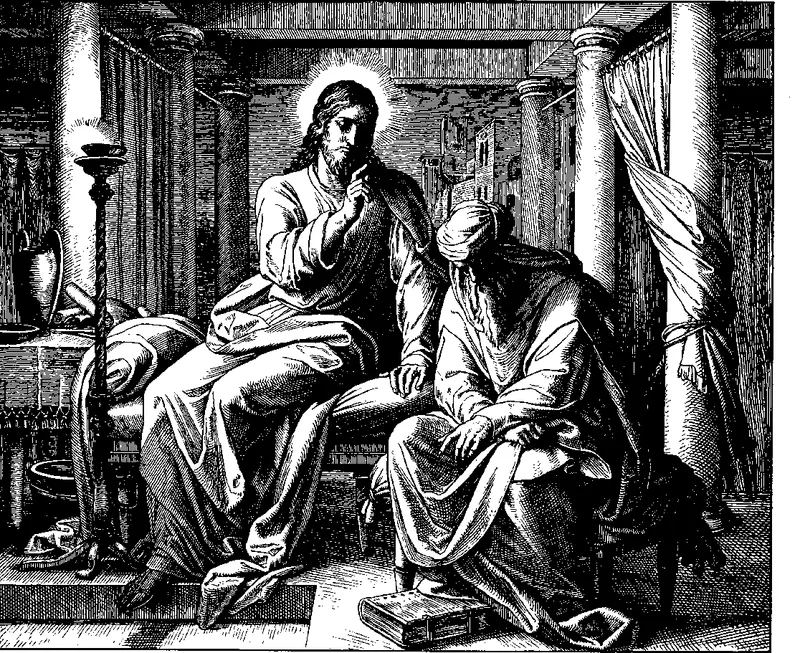
A man named Nicodemus - a Pharisee, a ruler of the Jews, a teacher of teachers - comes to Jesus by night. He comes with a careful, respectful opening: Rabbi, we know that thou art a teacher come from God: for no man can do these miracles that thou doest, except God be with him (v. 2). It is as far as his learning can take him, and it is not far enough. Jesus answers not the compliment but the need beneath it: Verily, verily, I say unto thee, Except a man be born again, he cannot see the kingdom of God (v. 3).
Nicodemus hears the words and stumbles - How can a man be born when he is old? (v. 4) - and his confusion is the door through which the chapter's great theme enters: there is a birth no person can arrange for himself, a life that comes only from above.
Tap any highlighted phrase to jump to the commentary that unpacks it.
John 3:1-13Ye Must Be Born Again
1There was a man of the Pharisees, named Nicodemus, a ruler of the Jews: 2The same came to Jesus by night, and said unto him, Rabbi, we know that thou art a teacher come from God: for no man can do these miracles that thou doest, except God be with him. 3Jesus answered and said unto him, Verily, verily, I say unto thee, Except a man be born again, he cannot see the kingdom of God. 4Nicodemus saith unto him, How can a man be born when he is old? can he enter the second time into his mother’s womb, and be born? 5Jesus answered, Verily, verily, I say unto thee, Except a man be born of water and of the Spirit, he cannot enter into the kingdom of God. 6That which is born of the flesh is flesh; and that which is born of the Spirit is spirit. 7Marvel not that I said unto thee, Ye must be born again.
Three small details set the scene, and each one matters. He is a man of the Pharisees - trained in the Law, careful, devout. He is a ruler of the Jews - a member of the ruling council, a man of standing with much to lose. And the same came to Jesus by night (vv. 1-2). The night will sound again at the chapter's end, where men loved darkness rather than light; here it whispers caution, a man drawn toward the light but not yet willing to be seen near it.
His opening is generous as far as it goes: Rabbi, we know that thou art a teacher come from God: for no man can do these miracles that thou doest, except God be with him. Notice the plural - we know - as though he speaks for a circle of cautious admirers, none of them ready to stand alone. And notice the category: teacher. Nicodemus has placed Jesus in the highest slot his world had - a rabbi with God's evident backing.
It is a true thing to say, and it is far short of the truth. Jesus will not let the conversation stay where Nicodemus tried to start it.
Jesus answers a statement Nicodemus had not quite turned into a question, and He answers it from beneath: Except a man be born again, he cannot see the kingdom of God (v. 3). The solemn Verily, verily marks it as weighty and certain. And it lands as an absolute, not a suggestion - not it would help to but he cannot without it. A man who has come to discuss what Jesus teaches is told that the kingdom is not first a matter of learning at all, but of birth. You did not study your way into your first life; you were born into it, helpless and new.
Just so, Jesus says, with the life of the kingdom. Nicodemus takes the word in the only sense his reason allows and is baffled: How can a man be born when he is old? can he enter the second time into his mother's womb, and be born? (v. 4). He is not being foolish; he is being literal, and the literal reading runs into a wall. That wall is exactly where Jesus wants him - at the end of what flesh and effort can do, ready to hear of a birth that comes from somewhere else.
Jesus restates the necessity, now with two words joined: Except a man be born of water and of the Spirit, he cannot enter into the kingdom of God (v. 5). Then He draws the line that interprets it: That which is born of the flesh is flesh; and that which is born of the Spirit is spirit (v. 6). Whatever else is heard in water, the contrast Jesus presses is plain and unmistakable - there is a birth that belongs to the realm of the flesh, the ordinary, the natural; and there is a birth that belongs to the realm of the Spirit, and it is this second birth that opens the kingdom.
The emphasis falls squarely on the Spirit. Flesh can only ever bring forth more flesh; it cannot lift itself into the life of God any more than a thing can give birth to what it does not possess. Something must come from outside and above - the Spirit, who alone begets spirit. This is why Jesus tells Nicodemus, Marvel not (v. 7): the saying is astonishing, but it is not strange once you see that the kingdom is God's own life, and only God's own Spirit can impart it.
The reverent reader hears the text say this much clearly: entrance into the kingdom is a birth wrought by the Spirit, received from above, and not a thing the flesh can accomplish for itself.1
8The wind bloweth where it listeth, and thou hearest the sound thereof, but canst not tell whence it cometh, and whither it goeth: so is every one that is born of the Spirit. 9Nicodemus answered and said unto him, How can these things be? 10Jesus answered and said unto him, Art thou a master of Israel, and knowest not these things? 11Verily, verily, I say unto thee, We speak that we do know, and testify that we have seen; and ye receive not our witness. 12If I have told you earthly things, and ye believe not, how shall ye believe, if I tell you of heavenly things? 13And no man hath ascended up to heaven, but he that came down from heaven, even the Son of man which is in heaven.
Jesus presses the point home with an image drawn from the open air: The wind bloweth where it listeth, and thou hearest the sound thereof, but canst not tell whence it cometh, and whither it goeth: so is every one that is born of the Spirit (v. 8). Everyone has stood in a gust of wind. You feel it on your face, you hear it move through the trees, you watch it bend the grass - and you cannot summon it, steer it, or trace it to its source.
It comes where it listeth, where it pleases, on its own freedom. So it is, Jesus says, with everyone born of the Spirit. The new birth is the free, sovereign moving of God, as real as wind and as far beyond our control. You can no more manufacture it than you can bottle a breeze. But you are not left guessing whether it is real: just as the wind is known by its sound and its effect, so the Spirit's work is known by what it produces in a life.
This is meant to humble Nicodemus - and us. The kingdom does not yield to mastery. It is entered by a birth we receive, not a feat we achieve.
Nicodemus is reduced to one honest question: How can these things be? (v. 9). Jesus answers with a gentle reproach that is also an invitation: Art thou a master of Israel, and knowest not these things? (v. 10). The very Scriptures Nicodemus taught had spoken of God giving a new heart and putting His Spirit within His people; a master of Israel ought to have ears for talk of cleansing and the Spirit and inward renewal.
Then Jesus widens the frame from the new birth to His own standing to speak of such things at all: We speak that we do know, and testify that we have seen; and ye receive not our witness (v. 11). If the plainer matters - earthly things, things illustrated by womb and wind - meet with unbelief, how will the deeper heavenly things be received (v. 12)? And here Jesus says something only He could say: no man hath ascended up to heaven, but he that came down from heaven, even the Son of man which is in heaven (v. 13).
No human being has climbed up to bring heaven's secrets down. There is One who can speak of heavenly things, because He came down from there. The whole conversation has been turning toward Him, and now it arrives: the new birth Nicodemus cannot grasp will be made possible by the One who came down, and who must, He will say next, be lifted up.
John 3:14-21God So Loved the World
14And as Moses lifted up the serpent in the wilderness, even so must the Son of man be lifted up: 15That whosoever believeth in him should not perish, but have eternal life. 16For God so loved the world, that he gave his only begotten Son, that whosoever believeth in him should not perish, but have everlasting life. 17For God sent not his Son into the world to condemn the world; but that the world through him might be saved. 18He that believeth on him is not condemned: but he that believeth not is condemned already, because he hath not believed in the name of the only begotten Son of God.
Jesus answers the question of how a dying world can receive life by reaching back into Israel's own wilderness. And as Moses lifted up the serpent in the wilderness, even so must the Son of man be lifted up (v. 14). The reference is to a strange and vivid episode: the people, bitten by a plague of fiery serpents and dying, are told by God to make a serpent of bronze and set it on a pole; and it came to pass, that if a serpent had bitten any man, when he beheld the serpent of brass, he lived (Num. 21:9).
There was no cure to drink, no work to perform - only a thing lifted up, and a look. The bitten who looked, lived; the bitten who would not look, died. Jesus says His own lifting up will be like that. The phrase lifted up in John always carries the cross within it - He will be lifted up on a tree, in plain sight, where the dying may look and live. The parallel is exact and humbling: as the bronze serpent bore the image of the very thing that was killing the people, so the sinless One would be lifted up bearing the weight of the very sin that is killing us.
And the cure is the same - not a feat, but a look of faith. That whosoever believeth in him should not perish, but have eternal life (v. 15).1
And now the sentence that the rest of the Bible seems to gather around: For God so loved the world, that he gave his only begotten Son, that whosoever believeth in him should not perish, but have everlasting life (v. 16). Every word bears weight. The first mover is God - the whole of salvation begins with His reaching down. The motive is love - not reluctance, not mere justice, but love, and love so great that the little word so strains to measure it.
The object is the world - not a favored nation, not the deserving few, but the world in all its rebellion and need, the very world that lay in darkness. The gift is his only begotten Son - the dearest thing heaven had, given, not loaned. The open door is whosoever - the widest word in the verse, leaving no one out who will come; not the qualified, not the impressive, but anyone who believes. The condition is faith, not achievement - believeth in him. And the two ends laid out are the same two Jesus has held before Nicodemus all along: perish, or have everlasting life. This is the gospel in a single breath: the love of God, giving the Son, opening life to whoever will believe.
Lest the talk of perishing be mistaken for the reason He came, Jesus says plainly why the Son was sent: God sent not his Son into the world to condemn the world; but that the world through him might be saved (v. 17). The world already lay under the shadow of its own rebellion; it needed no fresh sentence. What it needed was rescue, and rescue is the errand. The Son came as a Saviour with an open hand.
Then verse 18 draws the line with great care: He that believeth on him is not condemned: but he that believeth not is condemned already, because he hath not believed in the name of the only begotten Son of God. Notice the words. Of the believer it says not condemned - the sentence is lifted, the rescue received. Of the one who refuses it does not say will be condemned by some new act of judgment, but condemned already. The condemnation is not a punishment Christ came to inflict; it is the ruin already underway, which He came to save people out of.
To refuse the rescue is to remain where one already was. The verse keeps the spotlight exactly where Jesus has kept it - on the Saviour offered, and on the believing or refusing of Him.
19And this is the condemnation, that light is come into the world, and men loved darkness rather than light, because their deeds were evil. 20For every one that doeth evil hateth the light, neither cometh to the light, lest his deeds should be reproved. 21But he that doeth truth cometh to the light, that his deeds may be made manifest, that they are wrought in God.
Jesus closes the discourse by naming what the refusal really is: And this is the condemnation, that light is come into the world, and men loved darkness rather than light, because their deeds were evil (v. 19). The light has come into the world, near and available, just as in the opening of the Gospel the light shines in darkness. The tragedy is a matter of love: men loved darkness rather than light. The problem turns out to be not chiefly the mind but the heart - not that the evidence is too thin, but that the light exposes what people would rather keep hidden.
Jesus explains the logic: every one that doeth evil hateth the light, neither cometh to the light, lest his deeds should be reproved (v. 20). Light is unwelcome to anyone with something to hide; it shows what we would rather leave in shadow. But the door swings the other way too: he that doeth truth cometh to the light (v. 21). The honest heart is not afraid of exposure, because it has nothing to protect and everything to bring into the open.
And so the long night that opened the chapter finds its meaning. Nicodemus came in the dark; the question the chapter quietly leaves with every reader is whether we will come to the light.
John 3:22-36He Must Increase, But I Must Decrease
22After these things came Jesus and his disciples into the land of Judaea; and there he tarried with them, and baptized. 23And John also was baptizing in Aenon near to Salim, because there was much water there: and they came, and were baptized. 24For John was not yet cast into prison. 25Then there arose a question between some of John’s disciples and the Jews about purifying. 26And they came unto John, and said unto him, Rabbi, he that was with thee beyond Jordan, to whom thou barest witness, behold, the same baptizeth, and all men come to him. 27John answered and said, A man can receive nothing, except it be given him from heaven. 28Ye yourselves bear me witness, that I said, I am not the Christ, but that I am sent before him.
The scene moves from a darkened room to the open country by the Jordan, where John the Baptist is still baptizing because there was much water there (v. 23). A small dispute about purifying stirs up something larger in John's disciples, and they bring it to him with an edge of alarm: Rabbi, he that was with thee beyond Jordan, to whom thou barest witness, behold, the same baptizeth, and all men come to him (v. 26).
It is the language of rivalry - all men are going to Him instead of to you; your crowds are thinning. Here is the test that breaks lesser men: another is rising, and your own star is setting. John's answer is the answer of a free and settled soul: A man can receive nothing, except it be given him from heaven (v. 27). Every gift, every office, every season of influence is on loan from above; none of it is owned, so none of it can be stolen.
And he reminds them what he had said from the first: I am not the Christ, but… I am sent before him (v. 28). He had never claimed the center. A forerunner who resents being overtaken has forgotten what he was for.
29He that hath the bride is the bridegroom: but the friend of the bridegroom, which standeth and heareth him, rejoiceth greatly because of the bridegroom’s voice: this my joy therefore is fulfilled. 30He must increase, but I must decrease.
John reaches for an image to explain his joy, and it is one of the loveliest in the Gospels: He that hath the bride is the bridegroom: but the friend of the bridegroom, which standeth and heareth him, rejoiceth greatly because of the bridegroom's voice: this my joy therefore is fulfilled (v. 29). The picture is a wedding. The bride belongs to the bridegroom - that is the whole point of the day. The friend of the bridegroom, the one who has made the arrangements and now stands at the side, has one role left: to listen for the bridegroom's voice and rejoice that the marriage has come.
It would be a strange friend who tried to keep the bride for himself, or sulked because the day was not about him. His joy is precisely in the bridegroom's gladness. So John casts himself: the people are not his to keep; they are the bride being brought to her true bridegroom, and the sound of that voice - the bridegroom's voice - completes his happiness rather than spoiling it. Then comes the one line everyone remembers, and it carries no bitterness at all: He must increase, but I must decrease (v. 30).
It is not the sigh of a man losing ground; it is the settled gladness of a man whose whole purpose was to point past himself, watching it come true.
31He that cometh from above is above all: he that is of the earth is earthly, and speaketh of the earth: he that cometh from heaven is above all. 32And what he hath seen and heard, that he testifieth; and no man receiveth his testimony. 33He that hath received his testimony hath set to his seal that God is true. 34For he whom God hath sent speaketh the words of God: for God giveth not the Spirit by measure unto him. 35The Father loveth the Son, and hath given all things into his hand. 36He that believeth on the Son hath everlasting life: and he that believeth not the Son shall not see life; but the wrath of God abideth on him.
The closing verses lift the reader's eyes from John to the One he keeps pointing toward, and explain just why He must increase. He that cometh from above is above all: he that is of the earth is earthly, and speaketh of the earth: he that cometh from heaven is above all (v. 31). The contrast is between origins. John, like every prophet before him, is of the earth; his words, true as they are, are spoken from within the human story.
But Jesus cometh from above, from heaven, and so He stands above all. This is why the discourse can speak of heavenly things (v. 12): the One speaking has come down from where they are. What he hath seen and heard, that he testifieth (v. 32) - He speaks not at second hand but from firsthand sight of the Father. And though many will not receive His witness, the one who does hath set to his seal that God is true (v. 33), putting his own name, as it were, to the trustworthiness of God.
The reason follows: he whom God hath sent speaketh the words of God: for God giveth not the Spirit by measure unto him (v. 34). Others received the Spirit in portions, for particular tasks; on Him the Spirit rests without measure, without limit. To hear Jesus, John is saying, is to hear God Himself speak.
The chapter ends as it began - on love and on life. The Father loveth the Son, and hath given all things into his hand (v. 35). The love that gave the Son to the world (v. 16) is, first of all, the love within the very life of God: the Father loves the Son. And out of that love flows authority - all things have been given into his hand. Nothing is held back; everything that concerns our salvation has been entrusted to the Son.
And so the final verse presses the whole chapter to its point, with the two destinies Jesus has set before Nicodemus from the first: He that believeth on the Son hath everlasting life: and he that believeth not the Son shall not see life; but the wrath of God abideth on him (v. 36). Notice the present tense - the believer hath everlasting life now, already, as a present possession, not merely a future hope. And notice the solemn weight of the alternative: to refuse the Son is not a neutral act; it is to remain under a wrath that abideth - that was already there and is not lifted, because the one rescue has been refused.
The verse holds out the same open hand as verse 16 and the same warning as verse 18: life is in the Son, freely given to whoever believes; to turn from Him is to turn from life itself.
Research trail
Sources & further study
These references support the historical, linguistic, manuscript, and contextual notes in this chapter. Scripture remains the primary text; external sources are provided so readers can inspect the research directly.
- John 3 ↔ Numbers 21 · Ezekiel 36 · the GospelsTraces the threads tying John 3 to the rest of Scripture - the serpent lifted up (vv. 14-15) read against Numbers 21:8-9, the new birth “of water and of the Spirit” (v. 5) read against the cleansing-and-new-heart promise of Ezekiel 36:25-27, and the love that gives the Son (v. 16) read across the Gospels and epistles.
- John 3 · Greek interlinear + lexiconThe Greek text of John 3 word by word, with parsing and lexical links - useful for anothen (vv. 3, 7, the “again / from above” that Nicodemus mishears), gennao (the verb “to be born” that runs through the chapter), pneuma (v. 8, the one word that means both “wind” and “Spirit”), and monogenes (vv. 16, 18, “only begotten”).
- John 3 - Translators' NotesThe NET Bible's detailed footnotes on John 3 - the deliberate double meaning of anothen in verses 3 and 7, the much-discussed phrase “born of water and of the Spirit” in verse 5, the wordplay on wind and Spirit in verse 8, and where the red-letter quotation of Jesus may end as the chapter moves into verses 16-21.
Where this echoes in Scripture
Ye Must Be Born Again
- Ezekiel 36:25-27A new heart also will I give you, and a new spirit will I put within you... And I will put my spirit within you.The promise a “master of Israel” should have known (v. 10) - cleansing and a new spirit, the new birth Jesus presses on Nicodemus.
- John 1:12-13as many as received him... which were born, not of blood, nor of the will of the flesh, nor of the will of man, but of God.The new birth named at the Gospel's opening - born of God, not of flesh, exactly as in verses 5-6.
- 1 Peter 1:23Being born again, not of corruptible seed, but of incorruptible, by the word of God.The same new birth (vv. 3, 7) - a life begotten from above, not from perishable flesh.
- Titus 3:5he saved us, by the washing of regeneration, and renewing of the Holy Ghost.Salvation as the Spirit's renewing work (vv. 5-8) - not earned by deeds but given from above.
- Acts 2:2there came a sound from heaven as of a rushing mighty wind, and it filled all the house.The wind-and-Spirit image of verse 8 made visible - the Spirit's coming heard like wind.
God So Loved the World
- Numbers 21:8-9Make thee a fiery serpent, and set it upon a pole... when he beheld the serpent of brass, he lived.The wilderness sign Jesus claims in verses 14-15 - a thing lifted up, and the dying who looked, lived.
- John 12:32-33And I, if I be lifted up from the earth, will draw all men unto me. This he said, signifying what death he should die.Jesus names what “lifted up” means (v. 14) - the cross, drawing all to Himself.
- Romans 5:8God commendeth his love toward us, in that, while we were yet sinners, Christ died for us.The love of verse 16 measured - given not to the deserving but to sinners.
- 1 John 4:9-10God sent his only begotten Son into the world, that we might live through him... and sent his Son to be the propitiation for our sins.Verse 16 echoed almost word for word - the only begotten Son sent in love that we might live.
- Isaiah 45:22Look unto me, and be ye saved, all the ends of the earth: for I am God, and there is none else.The look-and-live of verses 14-15 in the prophets - salvation by looking to God, open to the ends of the earth.
He Must Increase, But I Must Decrease
- John 1:29-30Behold the Lamb of God... This is he of whom I said, After me cometh a man which is preferred before me.John pointing away from himself to Christ, as in verses 28-30 - always the forerunner, never the center.
- 2 Corinthians 4:5For we preach not ourselves, but Christ Jesus the Lord; and ourselves your servants for Jesus' sake.The pattern of verse 30 in the apostles - the witness who decreases that Christ may increase.
- Matthew 28:18All power is given unto me in heaven and in earth.The truth of verse 35 from Jesus' own lips - all things given into the Son's hand.
- 1 John 5:11-12God hath given to us eternal life, and this life is in his Son. He that hath the Son hath life.The two destinies of verse 36 - everlasting life in the Son, and no life apart from Him.
- John 3:16For God so loved the world, that he gave his only begotten Son, that whosoever believeth in him should not perish, but have everlasting life.The chapter's heart, sounded again at its close (v. 36) - believing on the Son is everlasting life.