Acts 2
People in this chapter
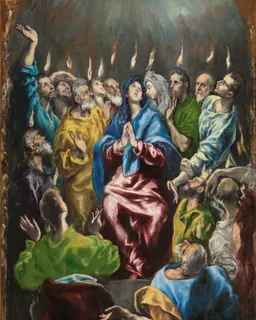
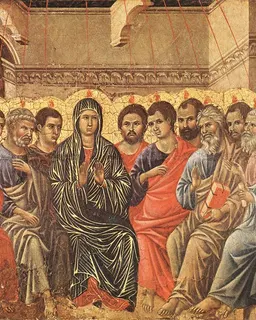
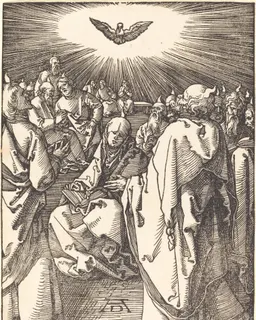
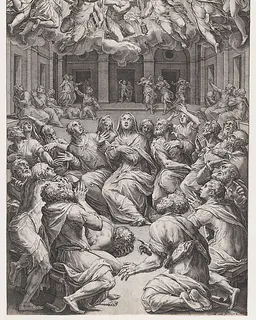
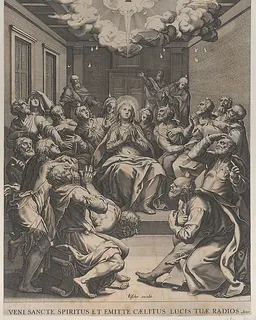
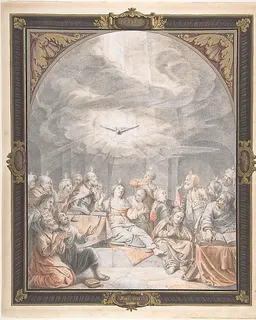
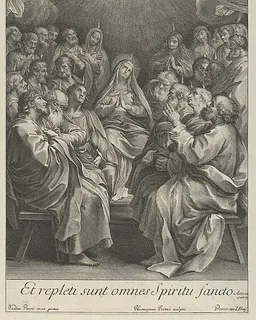
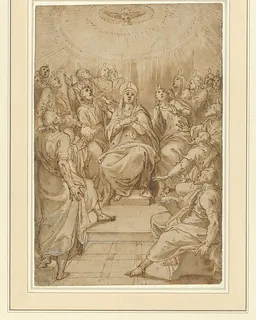
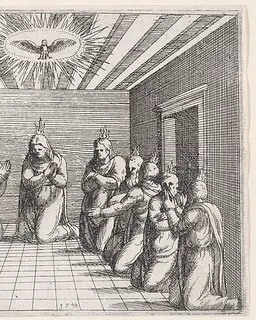
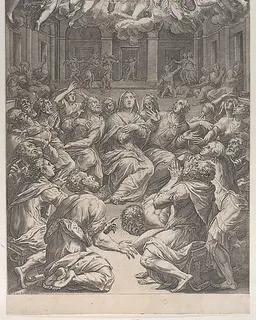
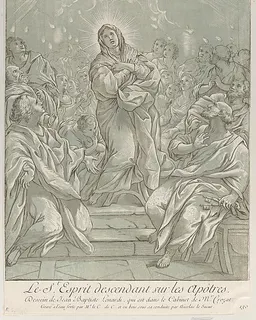
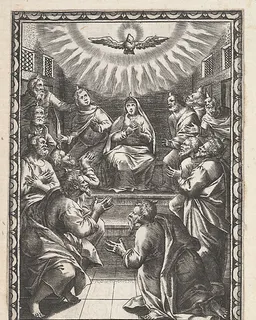
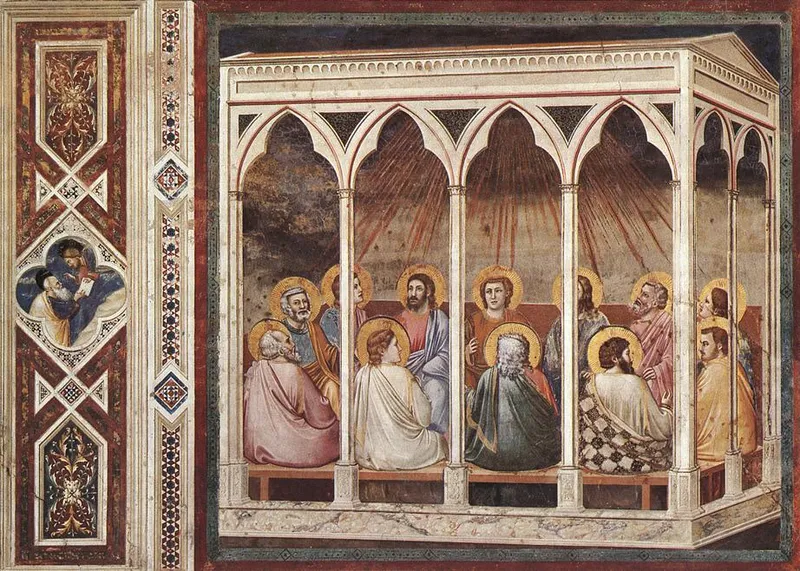
They had been told to wait, and they waited. For ten days the believers prayed in an upper room in Jerusalem, while the city below filled with pilgrims for the feast.1 Then it came. A sound like a violent wind, filling the whole house. Fire that split into tongues and rested on each of them. And the men of Galilee spilled into the street speaking languages they had never learned.
Tap any highlighted phrase to jump to the commentary that unpacks it.
Acts 2:1-4The Sound from Heaven
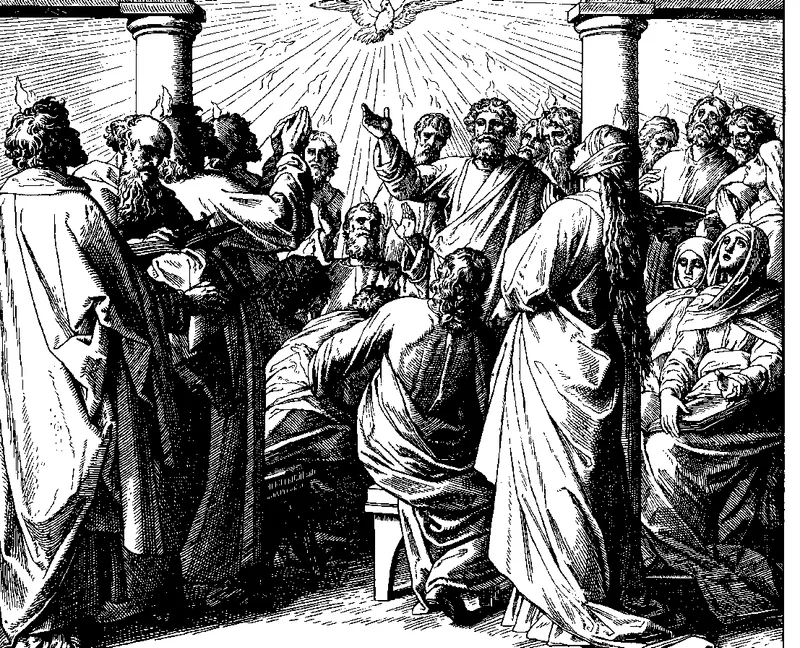
1And when the day of Pentecost was fully come, they were all with one accord in one place. 2And suddenly there came a sound from heaven as of a rushing mighty wind, and it filled all the house where they were sitting. 3And there appeared unto them cloven tongues like as of fire, and it sat upon each of them. 4And they were all filled with the Holy Ghost, and began to speak with other tongues, as the Spirit gave them utterance.
God could have come as a whisper. He comes as a sound that fills the whole house and carries into the street, loud enough that strangers stop and ask what is happening. The same Spirit hovered over the waters at the first creation, and the same wind blew across Ezekiel's valley until dry bones stood up and lived. Now that wind fills a room of frightened people, and a second creation begins. The timing is no accident.
Pentecost1 is Shavuot, one of Israel's three pilgrimage feasts, so the city is already packed with devout pilgrims from every nation - the exact crowd God wants in earshot.
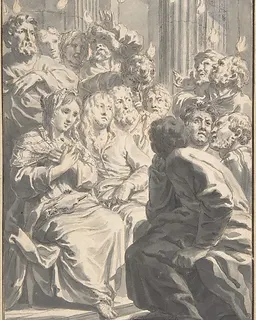
Then the fire comes, and it does not consume - it rests. The flame divides into tongues and settles on each of them, one apiece. Israel had seen God in fire before: the bush that burned without burning up, the pillar that went before them in the dark. Always it had marked where God was. Here the fire comes to rest on ordinary heads, and the message is unmistakable - God now dwells in people.
Acts 2:5-13The Crowd Gathers
5And there were dwelling at Jerusalem Jews, devout men, out of every nation under heaven. 6Now when this was noised abroad, the multitude came together, and were confounded, because that every man heard them speak in his own language. 7And they were all amazed and marvelled, saying one to another, Behold, are not all these which speak Galilaeans? 8And how hear we every man in our own tongue, wherein we were born? 11Cretes and Arabians, we do hear them speak in our tongues the wonderful works of God.
The list is overwhelming. Parthians, Medes, Elamites, Mesopotamians, Judeans, Cappadocians, Pontus, Asia, Phrygia, Pamphylia, Egypt, Libya, Rome, Crete, Arabia. These are Jewish pilgrims, devout believers gathered for a feast. They represent the entire reach of the diaspora2 - the scattered people of God, dwelling in every corner of the known world. And suddenly, they all hear in their own language. The Spirit breaks every barrier at once.
They are amazed. They marvel. This is the response of people encountering the impossible. Galilean fishermen - uneducated, unlettered - speaking with the fluency of native speakers in languages they have never studied. The only explanation is the power of God.
The Spirit could have given one shared language and made everyone learn it. Instead He gave the disciples the languages of the listeners. The gospel comes to each pilgrim in the dialect of his own childhood, the voice his mother used. That is the first thing the Spirit does in Acts, and it tells you something about how God means to reach you: by walking into your own country, your own language, your own life.
Acts 2:14-21Peter Stands Up
14But Peter, standing up with the eleven, lifted up his voice, and said unto them, Ye men of Judaea, and all ye that dwell at Jerusalem, be this known unto you, and hearken to my words: 15For these are not drunken, as ye suppose, seeing it is but the third hour of the day. 16But this is that which was spoken by the prophet Joel; 17And it shall come to pass in the last days, saith God, I will pour out of my Spirit upon all flesh: and your sons and your daughters shall prophesy, and your young men shall see visions, and your old men shall dream dreams: 20The sun shall be turned into darkness, and the moon into blood, before that great and notable day of the Lord come:
This is the same Peter who, a few weeks before, denied he even knew Jesus. Three times he said, "I know not the man." Now he stands and lifts up his voice3 in boldness. The Spirit has made him sure. He knows himself to be a witness to the resurrection. That certainty is louder than any threat.
Peter quotes Joel 2:284. Joel had promised that in the last days, God would pour out His Spirit on all flesh - sons and daughters, servants and handmaids, young and old. Everyone. Peter is saying: you are in the last days. You are living in the day the prophet saw. What you are witnessing is Scripture being fulfilled.
Joel had painted the end with a darkened sun and a blood-red moon, the great and terrible day of the Lord. Peter looks at the wind and fire around him and says, in effect, that countdown has started. The age the prophets strained to see is the age you are standing in. That is not meant to frighten you so much as to wake you: the time is short, the Spirit is being poured out, and the door is open while it is still called today.
Acts 2:22-36Jesus Exalted
22Ye men of Israel, hear these words; Jesus of Nazareth, a man approved of God among you by miracles and wonders and signs, which God did by him in the midst of you, as ye yourselves also know: 23Him, being delivered by the determinate counsel and foreknowledge of God, ye have taken, and by wicked hands have crucified and slain: 24Whom God hath raised up, having loosed the pains of death: because it was not possible that he should be holden of it. 33Therefore being by the right hand of God exalted, and having received of the Father the promise of the Holy Ghost, he hath shed forth this, which ye now see and hear. 36Therefore let all the house of Israel know assuredly, that God hath made that same Jesus, whom ye have crucified, both Lord and Christ.
Peter begins with what they cannot deny: they saw the miracles. They saw Jesus of Nazareth doing deeds that only God could do. This is a claim about what happened before their eyes. But then he pivots. They approved Him with their own eyes - and then they crucified Him. The same people. The same nation. The contradiction is wrenching.
But God raised Him. The pains of death could not hold Him. This is the crux of Peter's sermon. God's power broke through what seemed like a final ending. The stone was rolled away. The grave could not contain Him. If there is any power greater than death, Jesus rose from it. And if Jesus rose from it, He is the Lord.
Exalted to the right hand of God. This is the Ascension spoken in one phrase. Jesus is alive and seated at the right hand of God - the place of power and authority. And from that position, He has poured out the Spirit you are witnessing. The risen Christ is performing these wonders through His followers. He is still present. Still acting. Still ruling.
Acts 2:37-39Cut to the Heart
37Now when they heard this, they were pricked in their heart, and said unto Peter and to the rest of the apostles, Men and brethren, what shall we do? 38Then Peter said unto them, Repent, and be baptized every one of you in the name of Jesus Christ for the remission of sins, and ye shall receive the gift of the Holy Ghost. 39For the promise is unto you, and to your children, and to all that are afar off, even as many as the LORD our God shall call.
The verb is sharp - a stab, a puncture wound. This is not gentle conviction or a vague sense of guilt. Something in Peter's words has gone through these people like a blade, and they cannot un-know it: the man their city executed was the Lord. Their question is not academic. What shall we do? is the cry of someone who has just realized the ground has shifted under his feet. And right there, in their worst moment, Peter hands them a door.
The path forward is specific. Repent - turn around. Believe in the name of Jesus Christ. Be baptized. The remission of sins - forgiveness - is offered to all who do these things. And the gift of the Holy Ghost will follow. This is an immediate offer. Today, you can be baptized. Today, you can receive the Spirit.
The promise extends to children, to the distant regions, to all whom the Lord calls. This is the universalization of grace. The Spirit is poured out upon all flesh, upon all who call upon the name of the Lord. Repentance and baptism are the door, open to everyone.
Acts 2:40-41Three Thousand Baptized
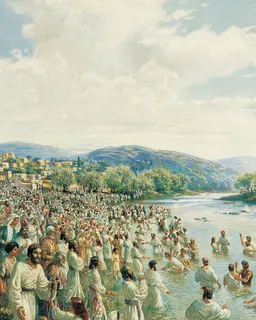
40And with many other words did he testify and exhort, saying, Save yourselves from this untoward generation. 41Then they that gladly received his word were baptized: and the same day there were added unto them about three thousand souls.
The crowd is not a faceless mass to Peter; it is full of individuals, and he pleads with them one by one. Step out, he says. The generation around you is drifting toward judgment, but you do not have to drift with it. Salvation here is a decision each person makes against the current, and Peter keeps urging until the ones who will, do.
Three thousand, in one day. The room of a hundred and twenty becomes a city within a city. There is an old echo here that the day itself would have stirred: Pentecost recalls Sinai, where the law was first given - and on that day, when the people had broken faith, three thousand fell (Exodus 32:28). Now, on the feast that remembers it, the Spirit is given instead of the tablets, and three thousand are made alive. The number that once marked a grave now marks a birth.
Acts 2:42-47Community Life
42And they continued stedfastly in the apostles’ doctrine and fellowship, and in breaking of bread, and in prayers. 44And all that believed were together, and had all things common; 45And sold their possessions and goods, and parted them to all men, as every man had need. 46And they, continuing daily with one accord in the temple, and breaking bread from house to house, did eat their meat with gladness and singleness of heart, 47Praising God, and having favour with all the people. And the Lord added to the church daily such as should be saved.
The early church is held up by four pillars: doctrine, fellowship, breaking of bread, and prayers5. Not one of these stands alone. They teach the apostles' doctrine - the living memory of Jesus' words and acts. They are in fellowship - koinonia, sharing life together. They break bread - the Lord's Supper, remembering His sacrifice. They pray. These four practices wove them together into a community so strong that it could not be broken by persecution or fear.
They have all things common, because the Spirit made it possible for them to do so. Those who owned lands sold them. Those who had goods shared them. Need was the measure. This is love made visible. The new birth gives people the freedom to let go.
Breaking bread from house to house - in homes as well as in the temple. This is the Lord's Supper as a living, daily practice. They remember the body and blood of Christ as they share ordinary meals together. Every meal becomes sacred. Every gathering becomes worship.
Research trail
Sources & further study
These references support the historical, linguistic, manuscript, and contextual notes in this chapter. Scripture remains the primary text; external sources are provided so readers can inspect the research directly.
- PentecostOpen-access SBL entry on Pentecost as one of Israel's three pilgrimage festivals, covering the biblical origins and Jewish celebration.
- Athenian Agora ExcavationsArchaeological excavations of Jerusalem temple precinct and pilgrimage routes - context for the diaspora pilgrims gathering at Pentecost.
- Peter's Pentecost Sermon (Acts 2:14-36) - Textual TraditionInstitute for New Testament Textual Research; manuscript evidence and variant readings in Peter's proclamation of resurrection.
- Joel 2:28Full Hebrew text of Joel 2:28 with English translation and cross-references - the promise Peter quotes at Pentecost.
- Koinonia and Christian Community in Early ActsScholarly monograph on fellowship, shared meals, and the economics of the early Jerusalem church community.
- Psalms 16Full Hebrew text of Psalm 16 with English and rabbinic commentary - the Davidic psalm Peter applies messianically.
- Glossolalia in the Early ChurchScholarly treatment of speaking in tongues as linguistic phenomenon and spiritual gift in apostolic witness.
Where this echoes in Scripture
The Sound from Heaven
- Genesis 1:2And the Spirit of God moved upon the face of the waters.The same Spirit that hovered over the first creation now fills the room where the new one begins.
- Ezekiel 37:9-10Come from the four winds, O breath, and breathe upon these slain... and the breath came into them, and they lived.Wind from heaven breathing life into the lifeless - the picture behind the rushing sound of verse 2.
- Luke 24:49tarry ye in the city of Jerusalem, until ye be endued with power from on high.The command to wait that the disciples were obeying when the Spirit fell.
- John 14:16-17he shall give you another Comforter, that he may abide with you for ever; even the Spirit of truth.Jesus' promise that the Spirit would not merely visit but dwell in His people.
The Crowd Gathers
- Genesis 11:7-9let us go down, and there confound their language... therefore is the name of it called Babel.At Babel God scattered humanity by confusing their speech; at Pentecost He gathers them by understood speech.
- 1 Corinthians 14:21-22With men of other tongues and other lips will I speak unto this people... tongues are for a sign.Paul reads tongues as a sign aimed outward, toward those who do not yet believe.
- Revelation 7:9-10a great multitude... of all nations, and kindreds, and people, and tongues, stood before the throne.Where the gathering of the nations is finally headed - every tongue praising before the Lamb.
Peter Stands Up
- Joel 2:28-32I will pour out my spirit upon all flesh... whosoever shall call on the name of the LORD shall be delivered.The prophecy Peter quotes - the Spirit on all flesh, and deliverance for all who call on the name.
- Romans 10:13For whosoever shall call upon the name of the Lord shall be saved.Paul lifts Joel's same line and, like Peter, reads “the Lord” as Jesus.
- 1 Thessalonians 5:2the day of the Lord so cometh as a thief in the night.The coming day Peter holds in view - real and certain, but not yet, leaving room for mercy now.
- Numbers 11:29would God that all the LORD's people were prophets, and that the LORD would put his spirit upon them!Moses' longing that the Spirit would rest on everyone, not a few - answered at Pentecost.
Jesus Exalted
- Psalm 16:8-11thou wilt not leave my soul in hell; neither wilt thou suffer thine Holy One to see corruption.The Davidic psalm Peter quotes - words too large for David's own grave, fulfilled in the Resurrection.
- Psalm 110:1The LORD said unto my Lord, Sit thou at my right hand, until I make thine enemies thy footstool.Peter cites this in verses 34-35 to explain how Jesus could be David's Lord, seated at God's right hand.
- Philippians 2:9-11God also hath highly exalted him, and given him a name which is above every name.The exaltation of verse 33 spelled out - the crucified one lifted to the highest place.
- Acts 4:10-12whom ye crucified, whom God raised from the dead... neither is there salvation in any other.Peter preaches the same crucified-and-raised Jesus again, days later, before the rulers.
Cut to the Heart
- Ezekiel 36:25-27I will sprinkle clean water upon you... A new heart also will I give you... and I will put my spirit within you.Washing and a new spirit promised together - the pattern Peter offers as baptism and the gift of the Holy Ghost.
- Acts 3:19Repent ye therefore, and be converted, that your sins may be blotted out.Peter's very next sermon presses the same call to turn and be forgiven.
- Acts 22:16arise, and be baptized, and wash away thy sins, calling on the name of the Lord.The same summons spoken to Saul of Tarsus - repentance, baptism, and the name of Jesus.
- Ephesians 2:13ye who sometimes were far off are made nigh by the blood of Christ.The promise “to all that are afar off” (v. 39) reaching outsiders through the cross.
Three Thousand Baptized
- Exodus 32:28there fell of the people that day about three thousand men.The three thousand who died at Sinai when the law was broken - the dark mirror of the three thousand reborn here.
- 2 Corinthians 3:6the letter killeth, but the spirit giveth life.Paul names the very contrast Pentecost dramatizes - law and Spirit, death and life.
- John 4:35-36lift up your eyes... for they are white already to harvest.Jesus' image of a sudden ready harvest, gathered here in a single day.
Community Life
- Acts 4:32-35the multitude of them that believed were of one heart and of one soul... they had all things common.The same shared life described again - and the same Spirit-born generosity behind it.
- 1 Corinthians 12:12-13For as the body is one, and hath many members... so also is Christ.Paul's name for what is forming here - one body of Christ made of many members.
- Luke 24:30-31as he sat at meat... he took bread, and blessed it... and their eyes were opened, and they knew him.On the Emmaus road Jesus is recognized in the breaking of bread - the act now at the center of their life together.
- Hebrews 10:24-25not forsaking the assembling of ourselves together... but exhorting one another.The same conviction the early church lived by - that faith is kept in company, not alone.