Acts 3
People in this chapter
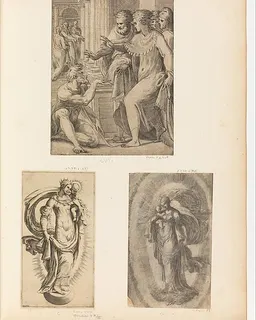
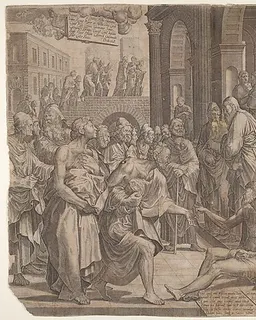
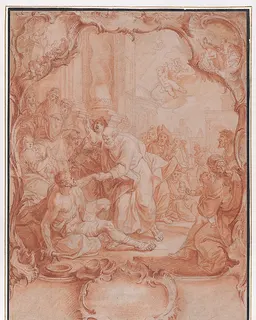
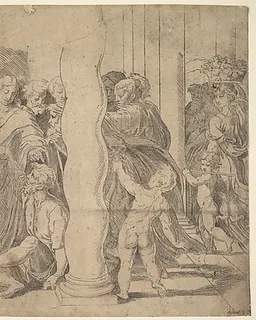
A man sits at the temple gate called Beautiful, lame from birth, carried there every day to beg.1 For forty years he has watched the able-bodied stream past him into worship. Peter and John come up at the hour of prayer. He asks for coins. Peter has none. What he says instead lifts the man to his feet: In the name of Jesus Christ of Nazareth rise up and walk. The beggar who could not be carried leaps into the temple on his own legs, praising God.
Tap any highlighted phrase to jump to the commentary that unpacks it.
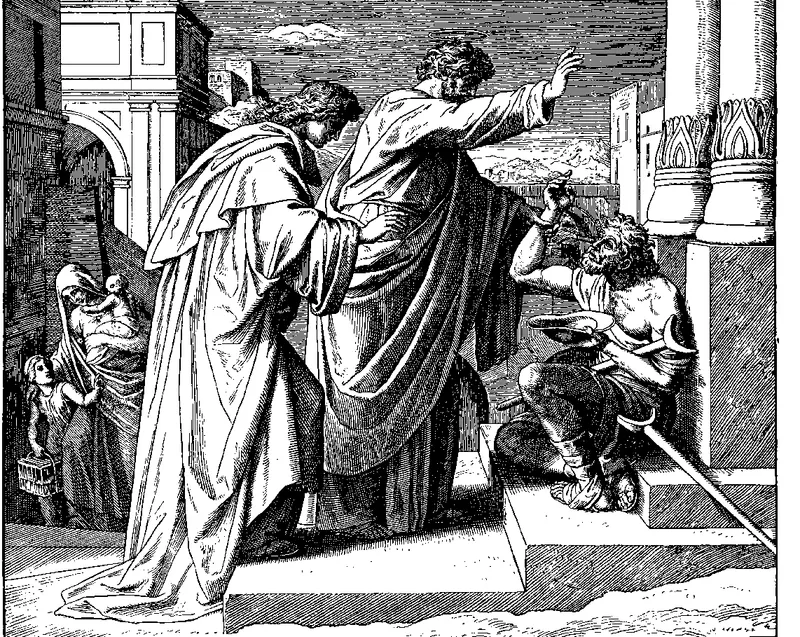
Acts 3:1-5The Hour of Prayer
1Now Peter and John went up together into the temple at the hour of prayer, being the ninth hour. 2And a certain man lame from his mother’s womb was carried, whom they laid daily at the gate of the temple which is called Beautiful, to ask alms of them that entered into the temple; 3Who seeing Peter and John about to go into the temple asked an alms. 4And Peter, fastening his eyes upon him with John, said, Look on us. 5And he gave heed unto them, expecting to receive something of them.
The ninth hour in Jewish reckoning is about three in the afternoon - the time of the evening sacrifice and daily prayers. The apostles are not hiding. They move openly through Jerusalem in the temple, at the hour when the most people are present. This is the first sign of the boldness the Holy Ghost granted them. They have no reason to fear; they have been told to wait in Jerusalem, and they have. Now they move.
Of all the places to set a man who cannot walk, his keepers chose a threshold. The Beautiful gate, likely the great bronze Nicanor Gate, was the main passage into the inner court. He is laid right at the boundary between the outer court where anyone can go and the inner court where only the ritually fit may enter. Forty years he has watched others cross that line. He cannot.
He is “carried daily” - carried1, the word pressing on total dependence. He cannot even get himself to his own begging spot. He is daily moved by others' hands. It is a portrait of helplessness so complete that it seems permanent. Forty years at the gate. Forty years of the same view, the same question, the same answer: alms.
Acts 3:6-8Silver and Gold Have I None
6Then Peter said, Silver and gold have I none; but such as I have give I thee: In the name of Jesus Christ of Nazareth rise up and walk. 7And he took him by the right hand, and lifted him up: and immediately his feet and ankle bones received strength. 8And he leaping up stood, and walked, and entered with them into the temple, walking, and leaping, and praising God.
Peter does not apologize for his poverty. He does not say, “I wish I could help but I'm a fisherman.” Instead, he pivots: What I have, I give you. What he hands the man is infinitely greater than coins. The beggar has spent forty years begging for silver. In one sentence, Peter frees him from the need to beg at all.
He leaps. The man who could not be carried anywhere under his own power suddenly springs upright. He walks. Then he enters the temple. He does what he has been barred from for his whole life: he crosses the threshold into the inner court. The beauty runs deeper than the physical fact, into what it means. He is no longer an outsider. He is no longer excluded. He walks where only the ritually able may walk.
Acts 3:9-12Wonder and Astonishment
9And all the people saw him walking and praising God: 10And they knew that it was he which sat for alms at the Beautiful gate of the temple: and they were filled with wonder and amazement at that which had happened unto him. 11And as the lame man which was healed held Peter and John, all the people ran together unto them in the porch that is called Solomon’s, greatly wondering. 12And when Peter saw it, he answered unto the people, Ye men of Israel, why marvel ye at this? or why look ye so earnestly on us, as though by our own power or holiness we had made this man to walk?
The man who spent forty years at the threshold does not slip quietly inside. He walks and leaps and shouts his thanks all at once, a body and a voice released in the same instant. Yesterday he was scenery; today he is loud worship. Notice that the healing did not stop at his feet. It opened his mouth. When God mends the thing you thought was permanent, the praise tends to come out the same way - too glad to be dignified.
The crowd drags the scene from the gate into the long covered colonnade on the temple's east side, public ground open to anyone - the same porch where Jesus once walked and taught. Peter will preach here in the open, in daylight, with nothing hidden.
Peter is quick to redirect. The crowd is looking at him and John as though their power has done this. Peter sees the danger - the moment of wonder can become a moment of false faith, faith in the apostles when it should rest in Christ. So he redirects immediately, stepping out of the way so the crowd can see the Healer behind the hands.
Acts 3:13-16The God of Abraham and the Resurrection
13The God of Abraham, and of Isaac, and of Jacob, the God of our fathers, hath glorified his Son Jesus; whom ye delivered up, and denied him in the presence of Pilate, when he was determined to let him go. 14But ye denied the Holy One and the Just, and desired a murderer to be granted unto you; 15And killed the Prince of life, whom God hath raised from the dead; whereof we are witnesses. 16And his name through faith in his name hath made this man strong, whom ye see and know: yea, the faith which is by him hath given him this perfect soundness in the presence of you all.
Peter anchors Jesus in the covenant history of Israel. The God of Abraham, Isaac, and Jacob - the God who made the promises - has glorified Jesus. Peter is telling them: the God you worship, the God of your fathers, the God who made the covenant - He has raised Jesus. They are being asked to recognize what God has done within the story they already know.
Peter does not soften the accusation. They delivered Him up. They denied Him. They chose a murderer instead. These are hard words. But notice the structure. Peter names the guilt first. Only then can he offer the cure. Repentance always begins with the truth about what you did. And only after the truth comes the healing.
The healing is attributed to faith - faith in the name of Jesus. It is a meeting: the apostles' faith in the power of the risen Jesus, and the man's willingness to stand and walk. Faith in Christ, expressed through obedience, produces the healing. The man is made strong.
Acts 3:17-21Times of Refreshing
17And now, brethren, I wot that through ignorance ye did it, as did also your rulers. 18But those things, which God before had shewed by the mouth of all his prophets, that Christ should suffer, he hath so fulfilled. 19Repent ye therefore, and be converted, that your sins may be blotted out, when the times of refreshing shall come from the presence of the Lord; 20And he shall send Jesus Christ, which before was preached unto you: 21Whom the heaven must receive until the times of restitution of all things, which God hath spoken by the mouth of all his holy prophets since the world began.
Having just charged them with killing the author of life, Peter opens a door. He does not excuse what they did; he explains it. They acted without knowing whom they were crucifying. But that excuse has an expiration date - it expired the moment He rose and they heard it. The light has come. From here on they know, which is exactly why the offer of repentance can now be made.
Peter places the cross as the fulfillment of what the prophets foretold. The suffering of the Messiah was written long before. It was the plan. This is how Peter helps them reframe what seemed like catastrophe - the apparent victory of His enemies - as the unfolding of God's design.
What is offered is refreshing. The word suggests relief, revival, restoration. Imagine being parched and suddenly coming to water. That is the tone of Peter's offer. Your sins can be blotted out. You can come alive again. The times of refreshing come from the presence of the Lord, from His nearness. Repentance is the turning that puts you in reach of His presence.
Acts 3:22-26The Prophet Like Moses and the Seed of Abraham
22For Moses truly said unto the fathers, A prophet shall the Lord your God raise up unto you of your brethren, like unto me; him shall ye hear in all things whatsoever he shall say unto you. 23And it shall come to pass, that every soul, which will not hear that prophet, shall be destroyed from among the people. 24Yea, and all the prophets from Samuel and those that follow after, as many as have spoken, have likewise foretold of these days. 25Ye are the children of the prophets, and of the covenant which God made with our fathers, saying unto Abraham, And in thy seed shall all the kindreds of the earth be blessed. 26Unto you first God, having raised up his Son Jesus, sent him to bless you, in turning away every one of you from his iniquities.
Peter quotes Deuteronomy 18:152 and the promise of a prophet like Moses. For a Jew, Moses is the greatest figure in history - the one who spoke with God face to face, who led Israel out of bondage, who received the Torah. When Peter says Jesus is like Moses, he means the one who will be what Moses was is now here - the one who will do what only the greatest leader Israel has known did. This is Jesus. To receive Him is to receive what Moses pointed toward.
The covenant God made with Abraham is the foundation of all hope in Scripture. And now Peter tells the crowd: You are the children of the prophets and of that covenant. Your identity is in the ancient promise. That promise is now being fulfilled. You are being called into what you already belong to - if you will receive it.
The promise to Abraham was that in his seed all the families of the earth would be blessed3, reaching from the start across all nations. Peter is expanding their vision. The God who blessed Abraham is at work now through Jesus to bless not just this crowd but every nation. They are the gateway of the blessing, not its boundary.
Notice the structure: “Unto you first God, sending his Son Jesus, hath raised him up.” The raising of Jesus is presented as the sending. The resurrection is the fulfillment of the Son being sent. He was sent to bless you by turning you from your iniquities. The healing of the beggar points toward the ultimate work: the healing of your soul from sin. That is what Jesus was sent to accomplish.
Research trail
Sources & further study
These references support the historical, linguistic, manuscript, and contextual notes in this chapter. Scripture remains the primary text; external sources are provided so readers can inspect the research directly.
- Temple Tax Coinage and Jewish PilgrimageNumismatic and archaeological evidence for the temple worship system and pilgrimage economy in first-century Jerusalem.
- Deuteronomy 18:15 - The Prophet Like MosesHebrew Bible text and commentary on the Mosaic promise Peter invokes; central to Second Temple messianic expectation.
- Genesis 12:3 ↔ Acts 3:25 - Covenant BlessingCross-reference showing how Peter applies the Abrahamic covenant promise of blessing all nations to the risen Jesus.
- Apokatastasis in Acts 3:21Institute for New Testament Textual Research; restoration / restitution terminology in early apostolic preaching.
Where this echoes in Scripture
The Hour of Prayer
- Acts 2:46And they, continuing daily with one accord in the temple…The same temple courts where the apostles keep showing up in the open, at the hours of prayer.
- Luke 18:35-43A certain blind man sat by the way side begging…Another beggar at the roadside whom Jesus stops for and heals - the pattern Peter now repeats in His name.
- Mark 10:21Then Jesus beholding him loved him…Jesus, too, fixed His eyes on a person before anything changed; attention comes first.
Silver and Gold Have I None
- Acts 4:10…by the name of Jesus Christ of Nazareth…doth this man stand here before you whole.Hauled before the council the next day, Peter names the same name as the whole explanation.
- Acts 4:12Neither is there salvation in any other…none other name…whereby we must be saved.The name that mends a body is the name that saves a soul.
- John 14:13-14And whatsoever ye shall ask in my name, that will I do…Acting in His name means standing in His authority, as Jesus promised.
- Philippians 2:9-10…a name which is above every name: that at the name of Jesus every knee should bow…The name spoken over a beggar is the name before which all creation will bend.
Wonder and Astonishment
- Acts 14:11-15Sirs, why do ye these things? We also are men of like passions with you…At Lystra Paul does exactly what Peter does here - refuses the crowd's worship and points past himself.
- John 10:23And Jesus walked in the temple in Solomon's porch.The very colonnade the crowd now fills is where Jesus Himself had taught.
- John 15:5…without me ye can do nothing.The apostles claim no power of their own; the life runs through them from Christ.
The God of Abraham and the Resurrection
- Acts 4:12Neither is there salvation in any other…none other name…whereby we must be saved.The risen author of life is the one name in which rescue is found.
- Hebrews 2:10…to make the captain of their salvation perfect through sufferings.The same word Peter uses, archegos - the Pioneer who goes first through death into life.
- Acts 2:23-24…ye have taken, and by wicked hands have crucified and slain: whom God hath raised up…Peter's settled pattern: name the killing plainly, then announce the resurrection.
- Revelation 1:18I am he that liveth, and was dead; and, behold, I am alive for evermore…The one they killed now holds the keys of death in His own hand.
Times of Refreshing
- Luke 24:26-27Ought not Christ to have suffered these things…? And beginning at Moses…The risen Jesus had already shown that the Messiah's suffering was foretold by all the prophets - the very point Peter presses.
- Acts 1:11…this same Jesus…shall so come in like manner as ye have seen him go into heaven.Heaven receives Him now; He returns at the restitution of all things.
- Isaiah 53:5-6But he was wounded for our transgressions…the LORD hath laid on him the iniquity of us all.The prophetic word that the Christ should suffer, written long before the cross.
- Acts 2:38Repent, and be baptized…and ye shall receive the gift of the Holy Ghost.The same call Peter gave at Pentecost - repent, be converted, sins blotted out.
The Prophet Like Moses and the Seed of Abraham
- Deuteronomy 18:15The LORD thy God will raise up unto thee a Prophet…like unto me; unto him ye shall hearken.The promise Peter quotes - a prophet to heed above all others.
- Genesis 22:18And in thy seed shall all the nations of the earth be blessed…The Abrahamic promise Peter says is now reaching its target through Jesus.
- Galatians 3:16…And to thy seed, which is Christ.Paul reads the single “seed” of the promise as Christ Himself.
- John 1:21Art thou that prophet? And he answered, No.Israel was actively watching for the Mosaic prophet; Peter announces He has come.