Painter of the Bible
Parmigianino (Girolamo Francesco Maria Mazzola)
Parmigianino — born Girolamo Francesco Maria Mazzola in Parma in 1503 — was the most refined of the High Renaissance Mannerists and the painter who carried Correggio's soft, light-filled manner toward the elongated, hype…

Their faith
Why Parmigianino (Girolamo Francesco Maria Mazzola) painted Christ
Parmigianino, born Girolamo Francesco Maria Mazzola, was deeply influenced by the Christian faith that permeated the culture of Renaissance Italy. His artistic journey began in the nurturing environment of his family, with both his uncles being painters, which instilled in him a reverence for the sacred. His works were often commissioned for religious settings, reflecting a commitment to faith that was evident in his devotion to capturing divine subjects. Parmigianino's artistic practice was characterized by a meticulous approach to scripture and spirituality, which guided his creative expressions. His time in Rome, where he was embraced by Pope Clement VII, further solidified his connection to the Church, allowing him to create art that resonated with the spiritual aspirations of his time.
This profound faith is beautifully illustrated in works such as the "Madonna with the Long Neck," where the elongated figures and dreamlike composition evoke a sense of ethereal grace. The painting, commissioned for a funerary chapel, reflects not only the artist's technical prowess but also his desire to convey the divine mystery of motherhood and Christ's presence. Similarly, in the "Vision of Saint Jerome," Parmigianino captures the intensity of spiritual contemplation, inviting viewers to engage with the sacred narrative. Despite the challenges he faced, including the turmoil of the Sack of Rome, Parmigianino's devotion to his craft and faith shines through in his art, allowing his spiritual vision to transcend time and continue to inspire those who encounter his work today.
Life & work
Parmigianino — born Girolamo Francesco Maria Mazzola in Parma in 1503 — was the most refined of the High Renaissance Mannerists and the painter who carried Correggio's soft, light-filled manner toward the elongated, hyper-elegant figural style that defined Italian painting in the second quarter of the sixteenth century. Trained first by his uncles, the painters Pier Ilario and Michele Mazzola, after his father's early death, and then in the orbit of Correggio in Parma, he traveled to Rome around 1524 with samples of his work — the Self-Portrait in a Convex Mirror among them — and was almost immediately taken up by Pope Clement VII and the Roman intellectual circle that surrounded him. The Sack of Rome in 1527 forced him to flee; he died in Casalmaggiore in 1540, just thirty-seven years old.
His Madonna with the Long Neck (Uffizi, Florence, c. 1535–1540), commissioned for the funerary chapel of Elena Baiardi in Parma, is the iconic statement of the Mannerist religious image: an impossibly attenuated Virgin holds a serpentine Christ Child, surrounded by attendant angels of the same etiolated grace, with a single tiny prophet and an isolated marble column receding into a dreamlike background. Left unfinished at the painter's death, it was installed in Parma's Santa Maria dei Servi and remained there until the eighteenth century.
His other religious masterworks include the Vision of Saint Jerome (National Gallery, London, 1526–1527), painted in Rome and one of the great altarpieces of the Sack-era city; the great frescoes in the church of Santa Maria della Steccata in Parma (1531–1539), whose endless delays — Parmigianino was distracted by his obsession with alchemy in his last years — eventually landed him in court for breach of contract; the Madonna of the Rose (Dresden, c. 1530); and a long sequence of intimate panel paintings of the Holy Family and the Virgin and Child.
He was also a prolific etcher and the introducer of etching as a serious artist's medium in Italy. His prints — soft, almost drawn-in-the-air lines achieved through a technique he developed himself — survived the eclipse of his painted reputation in the seventeenth century and influenced Federico Barocci, the Carracci, and the early Italian Baroque generation.
Notable works in detail
met-391601
Resurrection, etched by Parmigianino around 1515 (early in his career, in his pre-Roman Parma years) and now in the Metropolitan Museum of Art in New York, is one of the early prints by the artist who is widely credited as the introducer of etching as a serious artist's medium in Italy. The composition shows Christ rising from the open tomb in the predawn light, his right arm raised in benediction, his banner of Resurrection in his left hand, while the Roman soldiers below are scattered across the foreground in poses of unconscious sleep or panicked awakening. The technique — soft, almost drawn-in-the-air lines achieved through Parmigianino's own version of the etching needle and ground — gave the print a delicate atmospheric quality unmatched in contemporary Italian engraving. The print circulated through European print collections in editions for over a century after his early death.
met-391588
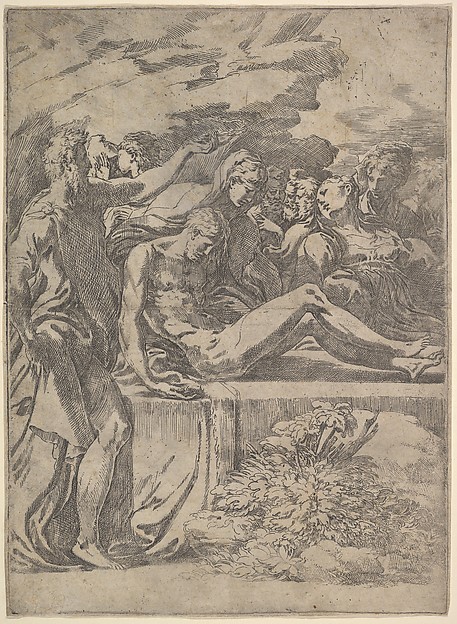
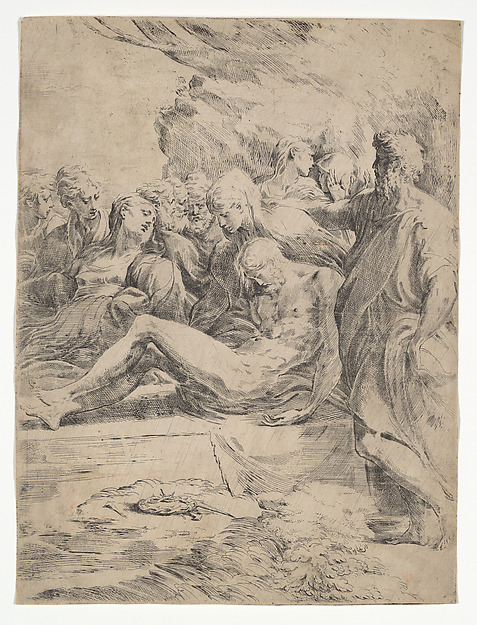
Entombment, etched by Parmigianino around 1520 in his late Parma years immediately before his move to Rome, depicts the moment after the Deposition in which the body of Christ is being carried by the mourners to the rock-cut tomb. Parmigianino stages the scene as a dense vertical composition: the body of Christ supported by Joseph of Arimathea and Nicodemus in the foreground, the swooning Virgin in the arms of John behind, the Magdalene kneeling at the feet, with the small landscape and the tomb opening visible in the deeper background. The etched line is the unmistakable Parmigianino signature — soft, swelling, almost drawn — and the elongated proportions and serpentine figural torsion already anticipate the Mannerist intensities of his great Roman and Bolognese paintings of the next decade.
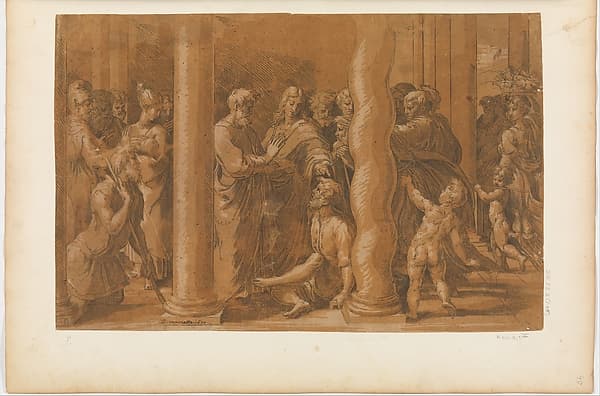
St. Peter and St. John Healing the Cripples at the Gate of the Temple
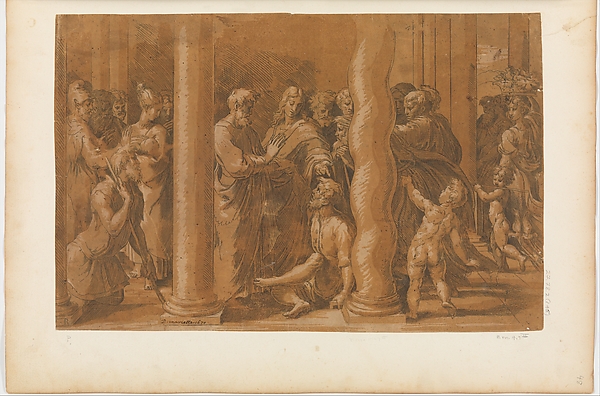
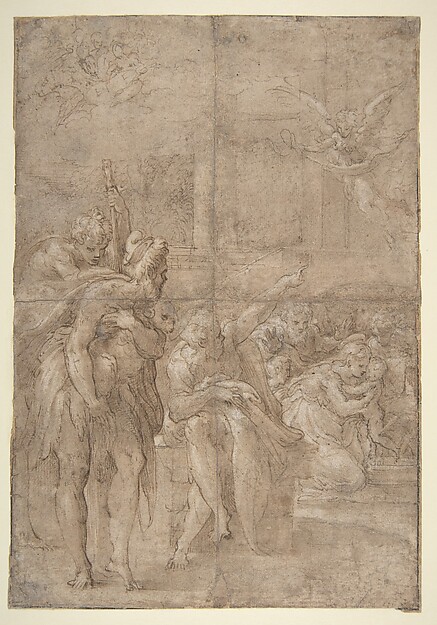
Saints Peter and John Healing the Cripples at the Gate of the Temple, drawn by Parmigianino around 1503 (early in his career, in his Parma workshop years) in pen and ink with brown wash on paper and now in the Metropolitan Museum of Art in New York, illustrates the episode from Acts 3 in which the apostles Peter and John, going up to the Temple at the hour of prayer, encounter and heal a man lame from birth who had been laid daily at the gate to ask alms. Parmigianino stages the scene as a small dense narrative encounter outside the Temple: Peter on the left with his right arm extended in command, the lame man in the foreground in the act of rising to his feet, John behind Peter watching, with a small crowd of onlookers gathered around. The drawing demonstrates the early Parmigianino draughtsmanship that the Roman years would refine to its supreme statement.
Bible scenes Parmigianino (Girolamo Francesco Maria Mazzola) painted
Luke
Acts
Revelation
James
Matthew