Acts 14
People in this chapter
At Lystra a crowd watches a man who never walked stand up and leap, and they reach for the only explanation they have: the gods have come down.1 Priests bring oxen. Garlands are laid at the gate. Within a day the same crowd has picked up stones, and Paul is dragged outside the wall for dead. He gets up. He walks back in. The next morning he turns around and comes back through every city that hurt him.
Tap any highlighted phrase to jump to the commentary that unpacks it.
Acts 14:1-4Iconium: The City Divides
1And it came to pass in Iconium, that they went both together into the synagogue of the Jews, and so spake, that a great multitude both of the Jews and also of the Greeks believed. 2But the unbelieving Jews stirred up the Gentiles, and made their minds evil affected against the brethren. 3Long time therefore abode they speaking boldly in the Lord, which gave testimony unto the word of his grace, and granted signs and wonders to be done by their hands. 4But the multitude of the city was divided: and part held with the Jews, and part with the apostles.
In Iconium2 they speak, and believers multiply. The response is immediate and real. Greeks and Jews both turn to Christ. This is not tentative faith - Luke says they “believed.” There is no apology for boldness. The apostles did not tone down the message to avoid offense. They spoke plainly of grace and the resurrection. And the Spirit moved.
But not everyone. The unbelieving Jews - those who refuse the testimony - stir up opposition. Notice the word: they make the Gentiles' minds “evil affected.” Unbelief is contagious. One refusal kindles others. What begins as one group's “no” becomes a city's hostility. This is the power of narrative in opposition: whoever controls the story controls the crowd.
Paul and Barnabas stay in Iconium and speak boldly. The Lord gives them signs and wonders. The word semeion means a sign - something that points beyond itself, that shows God's hand at work. Miracles are the signal, God saying: This message is from me.
Acts 14:5-7They Flee, But Keep Preaching
5And when there was an assault made both of the Gentiles, and also of the Jews with their rulers, to use them despitefully, and to stone them, 6They were ware of it, and fled unto Lystra and Derbe, cities of Lycaonia, and unto the region that lieth round about: 7And there they preached the gospel.
The opposition escalates. It is not just debate now; it is violence. The rulers - the civic leadership - join the effort to stone them. At this moment, Paul and Barnabas make a crucial decision: they do not stand and resist. They flee. Martyrdom has its time. But so does prudence. They escape to Lystra and Derbe.
Acts 14:8-10The Lame Man at Lystra
8And there sat a certain man at Lystra, impotent in his feet, being a cripple from his mother’s womb, who never had walked: 9The same heard Paul speak: who stedfastly beholding him, and perceiving that he had faith to be healed, 10Said with a loud voice, Stand upright on thy feet. And he leaped and walked.
The man is dynamai - without power, impotent. He is a cripple from his mother's womb. This is not a recent illness. This is his entire life. He has sat. He has not walked. He has not stood. The condition seems permanent. It has the weight of nature, of destiny. Forty years in Acts 3 with the Beautiful Gate. A lifetime here with this man at Lystra1. Both designed to show us what impossible looks like to human judgment.
Paul perceives something in the man - faith. Not faith that the healing will happen, necessarily, but faith that it can. Paul sees something in his posture, his attention, his openness. The man has heard Paul speak about Jesus. Something in that word has unlocked a possibility in him. He has believed. And Paul, seeing the faith, acts on it. The healing is the meeting of that faith with God's power.
Acts 14:11-15The Gods Have Come Down
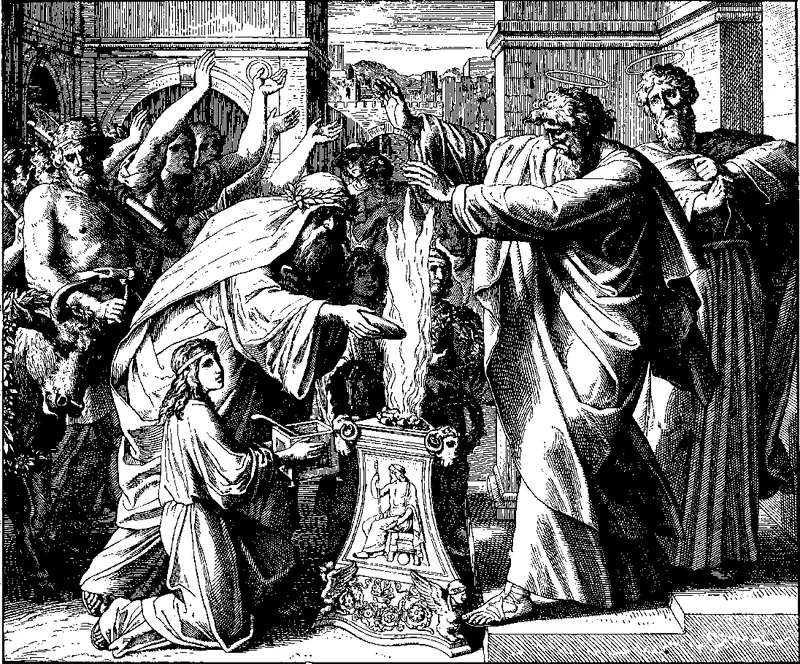
11And when the people saw what Paul had done, they lifted up their voices, saying in the speech of Lycaonia, The gods are come down to us in the likeness of men. 12And they called Barnabas, Jupiter; and Paul, Mercurius, because he was the chief speaker. 13Then the priest of Jupiter, which was before their city, brought oxen and garlands unto the gates, and would have done sacrifice with the people. 14Which when the apostles, Barnabas and Paul, heard of, they rent their clothes, and ran in among the people, crying out, 15And saying, Sirs, why do ye these things? We also are men of like passions with you, and preach unto you that ye should turn from these vanities unto the living God, which made heaven, and earth, and the sea, and all things that are therein:
The crowd sees a miracle and draws a conclusion: the gods have come down. This is not primitive ignorance. This is how their world works. Divine power means divinity. A man healed means a god has walked. The logic is flawless within their framework. But Paul and Barnabas operate within a different framework entirely. They do not accept the crowd's interpretation. What the crowd sees as proof that they are gods, Paul sees as proof that they must immediately speak.
Jupiter and Mercury. The king of gods and the messenger god. Paul is Mercury because he speaks. Barnabas is Jupiter because he is silent and majestic. The crowd has named them according to their theology, their stories, their longings. And they are about to sacrifice to them. The priest is bringing oxen. The garlands are ready. The machinery of worship is turning toward human beings. This echoes the Anatolian myth of Baucis and Philemon3, where gods arrive disguised as mortals, testing mortal hospitality.
Acts 14:15-18We Also Are Men of Like Passions
16Who in times past suffered all nations to walk in their own ways. 17Nevertheless he left not himself without witness, in that he did good, and gave us rain from heaven, and fruitful seasons, filling our hearts with food and gladness. 18And with these sayings scarce restrained they the people, that they had not done sacrifice unto them.
Most men handed a crown grab it. Paul does the opposite - he insists on his own smallness. Of like passions renders the Greek pathos: feeling, hunger, suffering, the whole weight of being mortal. We feel what you feel. We hunger. We die. You cannot worship us, because we are not the answer to anything you need. But then he pivots, and the pivot is the whole point: there is an answer, a God who never left Himself without witness. Now listen.
God did not abandon the nations who walked their own way. He left Himself a witness: the created world. Rain. Seasons. Crops. The human heart filled with food and gladness. Every living person has evidence of God's care in the simple fact of their existence. Paul points them from the false gods to the God who has been feeding them their whole lives. The answer is not Mercury and Jupiter. The answer is present in every harvest, every rain, every meal.
Even with all this, the crowd scarce refrains from sacrifice. The liturgy of false worship is powerful. The habit is deep. The priest is ready. The oxen are led. Paul has to speak with intensity and clarity to turn their direction even slightly. This is the power of idolatry: it is almost unstoppable once it begins. Better to never begin than to try to stop it.
Acts 14:19-22Stoned and Left for Dead
19And there came thither certain Jews from Antioch and Iconium, who persuaded the people, and, having stoned Paul, drew him out of the city, supposing he had been dead. 20Howbeit, as the disciples stood round about him, he rose up, and came into the city: and the next day he departed with Barnabas to Derbe. 21And when they had preached the gospel to that city, and had taught many, they returned again to Lystra, and to Iconium, and Antioch, 22Confirming the souls of the disciples, and exhorting them to continue in the faith, and that we must through much tribulation enter into the kingdom of God.
The opposition that began in Iconium has followed Paul. The unbelieving Jews persuade the crowd. The crowd stones. Paul falls. They drag his body outside the city wall as if to bury it there. They suppose him dead. The apostles who have gathered do not flee. They stand around him. And Paul rises.
How? Luke does not explain. Paul had been stoned and left for dead, and now he rises and walks back into the city4 - back toward the people who just tried to kill him. He is marked; the scars must show. But he moves. The next day he leaves for Derbe. This is not a resurrection like Christ's; it is a man who should be dead, walking. And if you have ever gotten up from something that should have finished you and found you were somehow still moving, this is the same Spirit.
The strength was never your own.
Then comes the remarkable choice: Paul does not stay in safe Derbe. After preaching there, he does the unthinkable. He returns to Lystra, to Iconium, to Antioch - the very cities that have tried to kill him. Not to hide. Not to flee again. But to strengthen the disciples, to ordain leaders, to consolidate the work. This is courage of a different order. This is the willingness to face the knife twice.
Acts 14:23-25Ordaining Elders and Commending to the Lord
23And when they had ordained them elders in every church, and had prayed with fasting, they commended them to the Lord, on whom they believed. 24And after they had passed throughout Pisidia, they came to Pamphylia. 25And when they had preached the word in Perga, they went down into Attalia:
Paul and Barnabas do not build on themselves. They ordain elders in every church. They establish leadership. The work will not depend on traveling apostles who blow through town. The churches will have shepherds, local leaders who know the people, who have proven themselves, who can tend the flock long-term. This is apostolic wisdom: do not leave churches orphaned. Leave them led.
Notice the method: prayer and fasting. This is not bureaucratic appointment5. This is spiritual consecration. They fast - they deny themselves food, they clear space for prayer - and they commend the elders to the Lord. They place the responsibility on God. These leaders are not Paul's or Barnabas's. They are the Lord's.
The journey loops back. They came up through Asia Minor preaching. Now they are on the return leg, heading back to the coast, to Antioch, to home. But they are not hurrying. They pause. They teach. They ordain. The return is as deliberate as the advance. This is the shape of faithful work: go with the gospel, establish the believers, ordain the leaders, trust them to the Lord, return.
Acts 14:26-28Back to Antioch and the Report
26And thence sailed to Antioch, from whence they had been recommended to the grace of God for the work which they fulfilled. 27And when they were come, and had gathered the church together, they rehearsed all that God had done with them, and how he had opened the door of faith unto the Gentiles. 28And there they abode long time with the disciples.
They return to where they started. The work began at Antioch. They were sent from there. They return there to report, to gather the church, to tell them what God did. In a world with no email, no printing press, no mass media, the report was everything. Word of mouth. Testimony. Face to face. Paul and Barnabas are the living witnesses, and they are present in the gathered assembly.
Luke chooses a heavy word for the report: exegeomai, to unfold, to draw out the meaning. Paul and Barnabas tell the whole arc - opposition, conversion, a stoning survived, elders ordained - so the church sees the hand behind it. They walk away with the shape of how God works.
And here is the headline they carry home: God had opened the door of faith to the Gentiles. A door means access - an opening for the very nations long assumed to be outside the covenant. The God who shut no one out had been holding it ajar all along. The mission is global. The gospel honors no ethnic boundary. This is what Paul and Barnabas saw with their own eyes on the road through Galatia, and this is what they came back to tell.
The whole adventure ends in an anticlimax, and that is the point. After the miracles, the riot, the stoning, the long dangerous loop home, the last thing Luke records is that they stayed. They did not chase the next frontier. They pastored. They taught. They let what they had planted grow up around them. The closing note of the first great missionary journey is presence - the slow, unglamorous work of abiding with people.
Research trail
Sources & further study
These references support the historical, linguistic, manuscript, and contextual notes in this chapter. Scripture remains the primary text; external sources are provided so readers can inspect the research directly.
- LystraOpen-access SBL entry on Lystra in Lycaonia, where Paul healed the cripple and was mistaken for Mercury, with archaeological context.
- IconiumOpen-access SBL entry on Iconium (modern Konya), a major city on Paul's first missionary journey through Galatia.
- Ovid, Metamorphoses 8 - Baucis & PhilemonOvid's account of the Baucis and Philemon myth - the Anatolian tale of gods arriving in mortal form, echoed in the Lystra crowd's belief.
- Apostolic Resilience and Divine RestorationStudy of apostolic suffering and divine restoration in Paul's ministry, particularly resurrection from persecution and stoning in Acts 14.
- Presbyter Ordination and Apostolic SuccessionAnalysis of early Christian elder ordination practices and apostolic succession through prayer and commissioning in the first missionary journey.
- Tribulation and Kingdom EntranceCross-references on the necessity of suffering for gospel witness and entry into God's kingdom, echoing Acts 14:22 throughout Scripture.
Where this echoes in Scripture
The Lame Man at Lystra
- Acts 3:6-8In the name of Jesus Christ of Nazareth rise up and walk… And he leaping up stood, and walked.Peter at the Beautiful Gate, the same scene as verses 8-10 - a lifelong cripple commanded to rise in Jesus' name.
- Mark 2:11-12I say unto thee, Arise, and take up thy bed… And immediately he arose, took up the bed, and went forth.The voice Paul borrows in verse 10 - Jesus standing the powerless upright with a word.
- Matthew 28:20Lo, I am with you alway, even unto the end of the world.The promise Lystra makes visible - Christ present and healing through the apostle's mouth.
- John 14:12He that believeth on me, the works that I do shall he do also.Why an ordinary man's command carries the power of verse 10.
Stoned and Left for Dead
- John 16:33In the world ye shall have tribulation: but be of good cheer; I have overcome the world.Jesus naming the same thlipsis of verse 22, and the victory underneath it.
- Luke 9:23If any man will come after me, let him deny himself, and take up his cross daily, and follow me.The cost Paul is describing in verse 22 - the cross is daily, not occasional.
- Romans 8:17If so be that we suffer with him, that we may be also glorified together.Paul's settled theology of verse 22 - the suffering and the kingdom are joined.
- 2 Timothy 3:11-12persecutions… at Lystra… all that will live godly in Christ Jesus shall suffer persecution.Paul looking back on this very stoning, drawing the same rule for everyone after him.