Acts 13
People in this chapter
A church is fasting and praying, and the Holy Spirit interrupts with a name. Separate me Barnabas and Saul for the work whereunto I have called them. Hands are laid on the two. They are sent. The first missionary journey leaves the dock at Antioch and sails for Cyprus1, where a court sorcerer fights them and goes blind, and the governor believes. The gospel has begun moving out past every border Israel ever knew.
Tap any highlighted phrase to jump to the commentary that unpacks it.
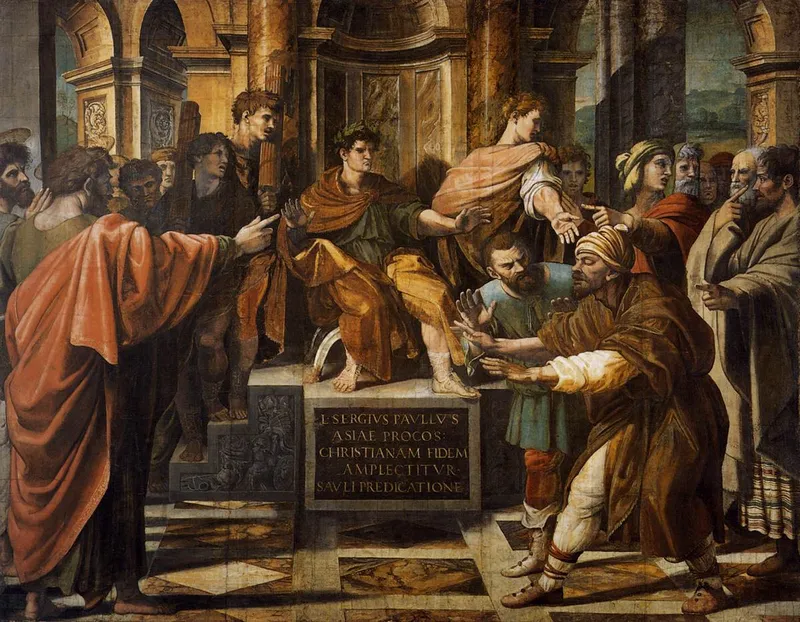
Acts 13:1-3The Laying On of Hands
1Now there were in the church that was at Antioch certain prophets and teachers; as Barnabas, and Simeon that was called Niger, and Lucius of Cyrene, and Manaen, which had been brought up with Herod the tetrarch, and Saul. 2As they ministered to the Lord, and fasted, the Holy Ghost said, Separate me Barnabas and Saul for the work whereunto I have called them. 3And when they had fasted and prayed, and laid their hands on them, they sent them away.
The church at Antioch is gathered not for a quick decision or a casual meeting. They are fasting - denying themselves food to focus on prayer and listening. Fasting in Scripture is the body's way of saying: this matters more than feeding myself. The church takes the commissioning of Paul and Barnabas with that kind of seriousness.
The laying on of hands is an ancient sign of commissioning and blessing2. When the church lays hands on Paul and Barnabas, they are placing themselves with these two in covenant. Those who remain will pray. Those who go will preach. The work belongs to all of them.
Acts 13:4-12Cyprus: The Sorcerer and the Proconsul
4So they, being sent forth by the Holy Ghost, departed unto Seleucia; and from thence they sailed to Cyprus. 5And when they were at Salamis, they preached the word of God in the synagogues of the Jews: and they had also John to their minister. 6And when they had gone through the isle unto Paphos, they found a certain sorcerer, a false prophet, a Jew, whose name was Barjesus: 7Which was with the deputy of the country, Sergius Paulus, a prudent man; who called for Barnabas and Saul, and desired to hear the word of God.
The Spirit sets Paul apart. Barnabas joins him. Two sent out, two witnesses. Now the word leaves Jerusalem's shadow and spreads to Cyprus. A new frontier opens.
8But Elymas the sorcerer (for so is his name by interpretation) withstood them, seeking to turn away the deputy from the faith. 9Then Saul, (who also is called Paul,) filled with the Holy Ghost, set his eyes on him, 10And said, O full of all subtilty and all mischief, thou child of the devil, thou enemy of all righteousness, wilt thou not cease to pervert the right ways of the Lord? 11And now, behold, the hand of the Lord is upon thee, and thou shalt be blind, not seeing the sun for a season. And immediately there fell on him a mist and a darkness; and he went about seeking some to lead him by the hand. 12Then the deputy, when he saw what was done, believed, being astonished at the doctrine of the Lord.
Bar-jesus means "son of Jesus" - an ironic name for a man who opposes the true Jesus. He is a sorcerer and a false prophet, a man who trades in spiritual deception. The fact that he is a Jew makes the opposition clearer: the false prophet and the true are both present, and the choice falls to Sergius Paulus3, a proconsul whose historical existence is confirmed by inscription.
Opposition is not absent from the gospel. From the start, there are those who withstand it. Elymas sees his influence threatened4. A proconsul interested in hearing the gospel is a proconsul no longer under the sorcerer's sway. The sorcerer does not argue - he tries to prevent the hearing of the word.
Acts 13:13-25Pisidian Antioch: A New Audience
13Now when Paul and his company loosed from Paphos, they came to Perga in Pamphylia: and John departing from them returned to Jerusalem. 14But when they departed from Perga, they came to Antioch in Pisidia, and went into the synagogue on the sabbath day, and sat down. 15And after the reading of the law and the prophets the rulers of the synagogue sent unto them, saying, Ye men and brethren, if ye have any word of exhortation for the people, say on. 16Then Paul stood up, and beckoning with his hand said, Men of Israel, and ye that fear God, give audience.
Paul has arrived at Pisidian Antioch5, a city in what is now Turkey. This is gentile territory - far from Jerusalem. Yet the synagogue is there, a gathering of Jews and God-fearers, Gentiles drawn to the faith of Israel. Paul is invited to speak. And what he does next is remarkable: he tells the entire history of Israel in a single sermon.
Acts 13:26-41The David Sermon: From Promise to Resurrection
26Men and brethren, children of the stock of Abraham, and whosoever among you feareth God, to you is the word of this salvation sent. 32And we declare unto you glad tidings, how that the promise which was made unto the fathers, 33God hath fulfilled the same unto us their children, in that he hath raised up Jesus again; as it is also written in the second psalm, Thou art my Son, this day have I begotten thee. 34And as concerning that he raised him up from the dead, now no more to return to corruption, he said on this wise, I will give you the sure mercies of David.
Paul pivots from Israel's history to the resurrection. Everything that has been said about David is now said about David's greater Son - raised, never to see corruption.
35Wherefore he saith also in another psalm, Thou shalt not suffer thine Holy One to see corruption. 36For David, after he had served his own generation by the will of God, fell on sleep, and was laid unto his fathers, and saw corruption: 37But he, whom God raised again, saw no corruption. 38Be it known unto you therefore, men and brethren, that through this man is preached unto you the forgiveness of sins: 39And by him all that believe are justified from all things, from which ye could not be justified by the law of Moses.
Two kinds of listeners sit in that synagogue: Jews bound by the covenant, and Gentiles who have come to honor the God of Israel from the edges. Paul addresses both, and then makes a claim that should stop the room. The promise sworn to Abraham and renewed to David is being kept. Now. Today. In a man God raised from the dead.
God has been forgiving sin since Eden. What Paul announces here is the address on the announcement: it now goes out to everyone, Jew and Gentile alike, on the single condition of believing the risen Christ. And Paul names something the law of Moses could never hand a person - to be justified, declared clear and righteous before God. The law could show you the debt. It could never cancel it. This does.
Acts 13:42-52The Door Opens to the Gentiles
42And when the Jews were gone out of the synagogue, the Gentiles besought that these words might be preached to them the next sabbath. 44And the next sabbath day came almost the whole city together to hear the word of God. 45But when the Jews saw the multitudes, they were filled with envy, and spake against those things which were spoken by Paul, contradicting and blaspheming. 46Then Paul and Barnabas waxed bold, and said, It was necessary that the word of God should first have been spoken to you: but seeing ye put it from you, and judge yourselves unworthy of everlasting life, lo, we turn to the Gentiles.
The Gospel stirs joy in the city - but jealousy in the synagogue. Some believe; some rage. The same message splits crowds. Light exposes what was hidden.
48And when the Gentiles heard this, they were glad, and glorified the word of the Lord: and as many as were ordained to eternal life believed. 49And the word of the Lord was published throughout all the region. 50But the Jews stirred up the devout and honourable women, and the chief men of the city, and raised persecution against Paul and Barnabas, and expelled them out of their coasts. 51But they shook off the dust of their feet against them, and came unto Iconium. 52And the disciples were filled with joy, and with the Holy Ghost.
Opposition is not long in coming. What began as interest becomes jealousy. The synagogue leaders see the crowd and see their influence threatened. They resort to mockery and contradiction. But their opposition does not deter Paul. It clarifies the moment. The gospel is not rejected by all. It is rejected by these leaders. Others are listening.
The Gentiles are glad - a spontaneous joy at hearing that forgiveness and righteousness are available to them. They have been on the outside of the covenant for centuries. Now the door opens. They do not debate. They do not delay. They are appointed to eternal life, and they believe. This is the heart of Paul's gospel: the gospel that was first for the Jews is now - equally, unreservedly - for the Gentiles.
The gesture of shaking off dust is a sign of separation, a statement of judgment: "Your rejection of the gospel is noted. We leave it with you and move on." Yet it is not done in anger. Paul and Barnabas shake the dust and go to the next city. The gospel does not stay where it is refused. It moves to those who will hear.
Persecution has just begun - the crowd, the jealousy, the expulsion from the city. Yet the disciples are filled with joy, right in the midst of it. They have been counted worthy to suffer for the name of Jesus, and that is cause for rejoicing.
Research trail
Sources & further study
These references support the historical, linguistic, manuscript, and contextual notes in this chapter. Scripture remains the primary text; external sources are provided so readers can inspect the research directly.
- CyprusGazetteer of Cyprus with archaeological site data including Salamis and Paphos, locations in Acts 13:4-12.
- Commissioning and Apostolic MissionStudy of laying on of hands and commissioning practices in early Christian communities and missionary sending.
- Sergius PaulusOpen-access SBL entry on the proconsul of Cyprus, with archaeological evidence for the historical figure.
- Sorcery and Magic Opposition in Early ChristianityAnalysis of conflict between apostolic power and pagan sorcery, particularly Elymas the sorcerer's resistance to Paul's preaching.
- Antioch of PisidiaArchaeological site data for Pisidian Antioch, where Paul preached in the synagogue and the gospel reached the Gentiles.
- Saul / Paul Name ChangeCross-reference study tool for tracing the name Saul to Paul throughout Scripture and understanding its theological significance.
Where this echoes in Scripture
The Laying On of Hands
- Acts 1:8ye shall be witnesses unto me both in Jerusalem, and in all Judaea, and in Samaria, and unto the uttermost part of the earth.The promise being kept in verses 2-3 - the Spirit pushing the witness out toward the nations.
- Acts 14:26-27they sailed to Antioch... And when they were come... they rehearsed all that God had done with them.The far end of this sending - the same church receives them back and hears the report.
- Numbers 27:18-23lay thine hand upon him... And he laid his hands upon him, and gave him a charge.The older pattern behind verse 3 - hands laid on to commission someone for God's work.
- Galatians 1:15-16it pleased God, who separated me from my mother's womb... to reveal his Son in me, that I might preach him among the heathen.Paul's own word for what happens here - separated, set apart by God for the nations.
Cyprus: The Sorcerer and the Proconsul
- 2 Corinthians 5:17if any man be in Christ, he is a new creature: old things are passed away; behold, all things are become new.The truth behind the name change in verse 9 - the old self gone, the new one standing in its place.
- Acts 9:1-6Saul, Saul, why persecutest thou me?... Lord, what wilt thou have me to do?Where Saul the persecutor met the risen Christ - the encounter the new name carries.
- Exodus 7:11-12the magicians of Egypt, they also did in like manner with their enchantments... but Aaron's rod swallowed up their rods.The old pattern repeated at Paphos - God's servant against the court sorcerer, and the sorcerer loses.
- 1 John 3:8the Son of God was manifested, that he might destroy the works of the devil.Why Elymas, the “child of the devil” (v. 10), cannot finally stand against the word.
Pisidian Antioch: A New Audience
- Acts 7:2-53Men, brethren, and fathers, hearken; The God of glory appeared unto our father Abraham...Stephen's sweep through Israel's history - the same method Paul uses here, turned toward invitation.
- 2 Timothy 4:11Take Mark, and bring him with thee: for he is profitable to me for the ministry.The John Mark who turns back in verse 13, later restored - the falling-away is not the end of him.
- 1 Peter 3:15be ready always to give an answer to every man that asketh you a reason of the hope that is in you.The readiness Paul models in verse 16 - knowing the story well enough to tell it when asked.
The David Sermon: From Promise to Resurrection
- Psalm 2:7I will declare the decree: the LORD hath said unto me, Thou art my Son; this day have I begotten thee.The coronation line Paul fastens to Easter in verse 33 - the throne psalm read as resurrection.
- Romans 1:3-4declared to be the Son of God with power... by the resurrection from the dead.Paul's own commentary on verse 33 - the rising is what publicly marks Jesus as the Son.
- Isaiah 55:3I will make an everlasting covenant with you, even the sure mercies of David.The promise quoted in verse 34 - covenant mercy made permanent in one greater than David.
- Acts 2:24-31thou wilt not leave my soul in hell, neither wilt thou suffer thine Holy One to see corruption.Peter preaching the same Psalm 16 argument Paul uses in verses 35-37 - David died; his Son did not.
- Hebrews 7:24-25this man, because he continueth ever, hath an unchangeable priesthood... able... to save them to the uttermost.Why the mercies are “sure” (v. 34) - a Savior who never dies again cannot fail a promise.
The Door Opens to the Gentiles
- John 10:16Other sheep I have, which are not of this fold: them also I must bring... and there shall be one fold, and one shepherd.The Shepherd's promise behind the open door of verse 46 - the outsiders He always meant to gather.
- Isaiah 49:6I will also give thee for a light to the Gentiles, that thou mayest be my salvation unto the end of the earth.The commission Paul cites in verse 47 - Israel's calling to carry light to the nations.
- Matthew 10:14whosoever shall not receive you... shake off the dust of your feet.Jesus' own instruction behind the gesture in verse 51 - judgment left, the messengers move on.
- Acts 5:41rejoicing that they were counted worthy to suffer shame for his name.The same joy-in-persecution as verse 52 - gladness that the suffering is for Jesus.
- Romans 8:30whom he did predestinate, them he also called: and whom he called, them he also justified.The “appointed to eternal life” of verse 48 - God's own draw behind every believing heart.