Exodus 7
People in this chapter
Exodus 7 is where the long duel with Egypt truly begins. In the chapters before, God met Moses at the burning bush, named Himself, and sent him - with Aaron as his mouth - to demand that Pharaoh let Israel go; and the first attempt only made the burden heavier. Now God reframes the whole confrontation in a single startling sentence: See, I have made thee a god to Pharaoh: and Aaron thy brother shall be thy prophet (v. 1).
The man who once protested that he was not eloquent is set as God's representative before the mightiest throne on earth, his words carrying the weight of the One who sends them. And God tells him plainly how the contest will unfold - Pharaoh will not listen, the signs and wonders will multiply, and through it all one truth will be driven home until even Egypt cannot deny it: the Egyptians shall know that I am the LORD (v. 5).1
Tap any highlighted phrase to jump to the commentary that unpacks it.
Exodus 7:1-5A God to Pharaoh, a Prophet to Speak
1And the LORD said unto Moses, See, I have made thee a god to Pharaoh: and Aaron thy brother shall be thy prophet. 2Thou shalt speak all that I command thee: and Aaron thy brother shall speak unto Pharaoh, that he send the children of Israel out of his land. 3And I will harden Pharaoh’s heart, and multiply my signs and my wonders in the land of Egypt. 4But Pharaoh shall not hearken unto you, that I may lay my hand upon Egypt, and bring forth mine armies, and my people the children of Israel, out of the land of Egypt by great judgments. 5And the Egyptians shall know that I am the LORD, when I stretch forth mine hand upon Egypt, and bring out the children of Israel from among them.
The chapter opens on a sentence that can be misheard if it is not read closely: See, I have made thee a god to Pharaoh: and Aaron thy brother shall be thy prophet (v. 1). It is a description of relation and role. Moses will stand before Pharaoh as God's representative - the one through whom God's authority confronts the throne - and Aaron will be to Moses what a prophet is to God: the mouth that carries the word outward.
The pattern is stated plainly in the next verse: Thou shalt speak all that I command thee: and Aaron … shall speak unto Pharaoh (v. 2). The word originates with God, passes to Moses, and is declared by Aaron. What makes Moses formidable before Pharaoh is that he comes bearing a word from the One who sent it - the man who stammered and shrank back at the burning bush now carries the weight of the living God.
In Egypt, where Pharaoh was himself regarded as a god, this is a direct challenge laid at the foot of the throne: another authority has arrived, and it does not bow.
Before a single plague falls, God tells Moses the shape of the whole campaign - and it is not the shape Moses would have chosen. I will harden Pharaoh's heart, and multiply my signs and my wonders … But Pharaoh shall not hearken unto you (vv. 3-4). God promises a long resistance, sign upon sign, judgment upon judgment. This is important for understanding everything that follows. The drawn-out struggle is not a sign that God's plan is failing or that Pharaoh is winning round after round.
The prolonging is itself purposeful. A single, easy release would have settled nothing and revealed little. By contrast, a contest stretched across ten plagues, each one mounting on the last, leaves the question of who is sovereign over Egypt answered beyond all dispute - for Israel, for Egypt, and for every generation that would read the account. God is making Himself known through a long and deliberate revelation.
Exodus 7:6-7Old Men Who Simply Obeyed
6And Moses and Aaron did as the LORD commanded them, so did they. 7And Moses was fourscore years old, and Aaron fourscore and three years old, when they spake unto Pharaoh.
Two quiet details close the section, and both are doing more than they seem. First: And Moses and Aaron did as the LORD commanded them, so did they (v. 6). After all the foretold difficulty - the hardened heart, the refusal, the long judgment - the brothers simply obey. The emphatic repetition, so did they, underlines a faithfulness that does not depend on knowing the outcome will be easy. They have just been told the road will be hard, and they walk it anyway.
Second: Moses was fourscore years old, and Aaron fourscore and three years old, when they spake unto Pharaoh (v. 7). These are not young men flush with ambition; Moses is eighty, Aaron eighty-three. A lifetime lies behind them - for Moses, forty years in Egypt and forty in the wilderness of Midian. Their age is itself a witness. The power on display in the chapters to come will be visibly not their own; no one will mistake the wonders of Egypt for the vigor of two old men.
And it answers, quietly, the protest Moses once made about his own inadequacy: God's purposes do not wait on human strength or youth. They wait on God's time, and they call whoever God calls, at whatever age, to speak what they have been given.
Exodus 7:8-11A Serpent, and a Counterfeit
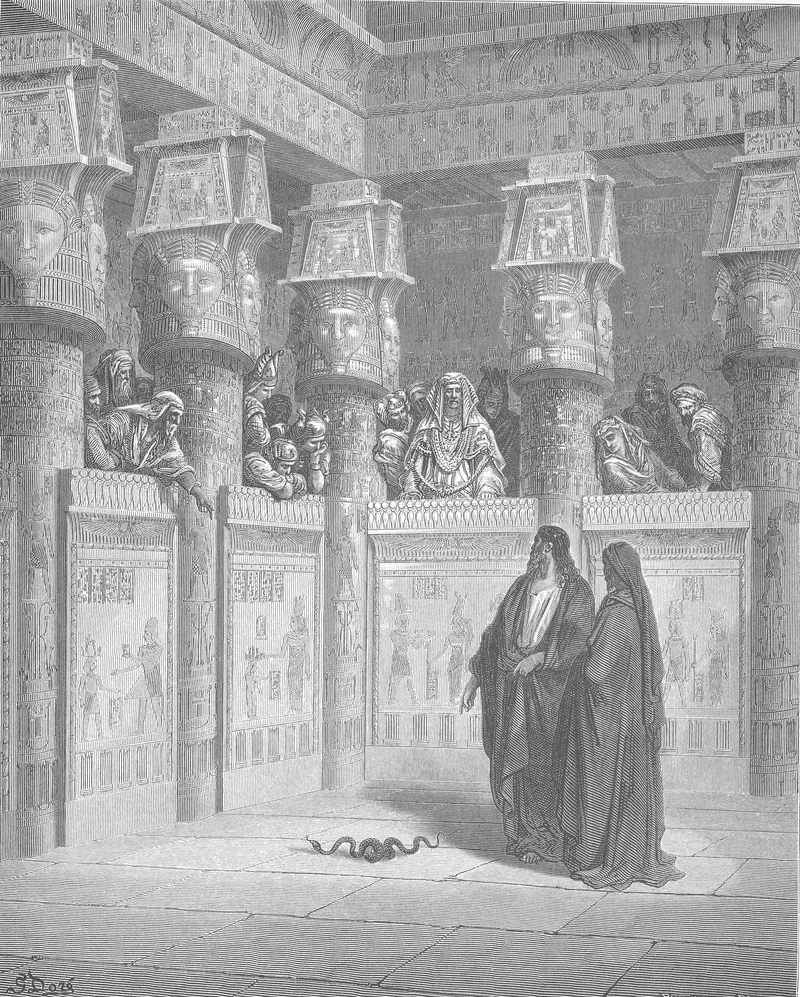
8And the LORD spake unto Moses and unto Aaron, saying, 9When Pharaoh shall speak unto you, saying, Shew a miracle for you: then thou shalt say unto Aaron, Take thy rod, and cast it before Pharaoh, and it shall become a serpent. 10And Moses and Aaron went in unto Pharaoh, and they did so as the LORD had commanded: and Aaron cast down his rod before Pharaoh, and before his servants, and it became a serpent. 11Then Pharaoh also called the wise men and the sorcerers: now the magicians of Egypt, they also did in like manner with their enchantments.
God anticipates the demand before Pharaoh makes it: When Pharaoh shall speak unto you, saying, Shew a miracle for you (v. 9). A king who claims divine standing will want proof of any rival authority, and God is ready with it. The instruction is precise - Aaron is to cast down the rod, and it will become a serpent - and the brothers do exactly as commanded: Aaron cast down his rod before Pharaoh, and before his servants, and it became a serpent (v. 10).
Notice the setting. This is no private wonder worked in a corner; it happens before Pharaoh, and before his servants - the full court, the watching officials, the assembled power of Egypt. The sign is public, witnessed, and meant to be. And it is not described as an illusion or a clever trick: the rod became a serpent. The God who is challenging the throne of Egypt does so openly, in the throne room, where everyone can see.
Pharaoh does not yield; he summons his own specialists: the wise men and the sorcerers … the magicians of Egypt, they also did in like manner with their enchantments (v. 11). The detail is important and easily rushed past. Scripture does not say the magicians faked it or that nothing happened; it says they did in like manner - their rods became serpents too (v. 12). The Bible does not pause here to explain the source or nature of their power; it simply reports that a counterfeit was produced.
And this is exactly how the powers of darkness so often work - through imitation, by producing a near-likeness that blurs the line and lets a hard heart tell itself the rival authority is nothing special. Pharaoh's magicians give him precisely the excuse he wants: our men can do that too. The counterfeit's whole strategy is to be similar enough to neutralize the sign - to let the observer shrug and look away. The next words will make the gap between similar and supreme unmistakably plain.
Exodus 7:12-13Aaron's Rod Swallowed Up Their Rods
12For they cast down every man his rod, and they became serpents: but Aaron’s rod swallowed up their rods. 13And he hardened Pharaoh’s heart, that he hearkened not unto them; as the LORD had said.
The whole contest of the chapter is compressed into one clause: but Aaron's rod swallowed up their rods (v. 12). For a moment the scene looked like a draw - Aaron's serpent, the magicians' serpents, power answered by power. Then Aaron's rod consumes them all, and the apparent parity collapses. The counterfeit could copy the sign; it could not survive contact with the real thing. This is the difference the chapter wants seen: Egypt's power was real, but subordinate. There is an order in the unseen world, and the order has already been settled.
The LORD does not enter the contest as one contender among equals, hoping to prevail; He enters as the One whose power swallows every rival whole. And there is a quiet irony the court could not have missed: the rod that does the swallowing is the rod of the LORD, in the hand of His servant - the imitations multiply, and are devoured. Egypt's magic could reproduce the form; the LORD held the substance that consumed it.
And then, having seen the sign and seen the counterfeit swallowed, Pharaoh closes himself: he hardened Pharaoh's heart, that he hearkened not unto them; as the LORD had said (v. 13). This is the first of the chapter's hardening statements to fall after a sign, and it must be read with care, exactly as Scripture frames it. The book of Exodus does two things, side by side, and does not collapse them. It says the LORD would harden Pharaoh's heart (v. 3; later 9:12), and it says Pharaoh hardened his own heart and would not hear (here, and explicitly at 8:15, 8:32).
Both are true in the text; neither is allowed to erase the other. The Bible does not give us a system that resolves the tension - it does not say Pharaoh was a helpless puppet with no real choice, nor that God was merely a bystander to a wholly independent will. It holds the mystery open. Pharaoh genuinely refuses; he is genuinely responsible; he hardens his own heart against what he has plainly seen. And over it all stands the sovereign purpose of God, who declared the outcome before it came.
The apostle Paul, centuries later, would stand before this very mystery and ponder it without dissolving it (Rom. 9). The faithful response is not to force a resolution the text withholds, but to let both truths stand - the awful freedom of the refusing heart, and the unshaken sovereignty of God.
Exodus 7:14-25The Nile Turned to Blood
14And the LORD said unto Moses, Pharaoh’s heart is hardened, he refuseth to let the people go. 15Get thee unto Pharaoh in the morning; lo, he goeth out unto the water; and thou shalt stand by the river’s brink against he come; and the rod which was turned to a serpent shalt thou take in thine hand. 16And thou shalt say unto him, The LORD God of the Hebrews hath sent me unto thee, saying, Let my people go, that they may serve me in the wilderness: and, behold, hitherto thou wouldest not hear. 17Thus saith the LORD, In this thou shalt know that I am the LORD: behold, I will smite with the rod that is in mine hand upon the waters which are in the river, and they shall be turned to blood. 18And the fish that is in the river shall die, and the river shall stink; and the Egyptians shall lothe to drink of the water of the river.
God sends Moses to meet Pharaoh at a particular place and hour: Get thee unto Pharaoh in the morning; lo, he goeth out unto the water; and thou shalt stand by the river's brink against he come (v. 15). Every element is chosen. The morning is the time of clear light, when nothing can be done in shadow. The water - the Nile - is where Pharaoh goes, very likely for the morning rituals by which Egypt honored the river it depended on and revered.
And Moses is to be standing there, waiting, rod in hand, when the king arrives. The confrontation is deliberately staged at the riverbank, because the river is precisely what is about to be struck. The message Moses carries is unchanged from the start - Let my people go, that they may serve me in the wilderness (v. 16) - and so is the indictment: hitherto thou wouldest not hear. The demand has not softened, and neither has Pharaoh.
What changes now is that words give way to the first of the great signs.
God states the purpose of the plague before He sends it, and the purpose is not vengeance - it is knowledge: In this thou shalt know that I am the LORD (v. 17). This is the answer beginning to come to the question Pharaoh hurled in chapter 5: Who is the LORD, that I should obey his voice? … I know not the LORD (5:2). Pharaoh said he did not know the LORD; God now sets out, plague by plague, to make Himself known - and He starts at the very source of Egypt's life and confidence.
The first plague is, in this sense, an argument made visible. It does not merely punish; it reveals. And the target could not be more pointed. Pharaoh claimed a divine standing of his own and presided over a land that worshiped the Nile; God will strike that river first, turning the boast of Egypt into a thing of death, so that the question who is the LORD? begins to answer itself in the stench rising off the water.
19And the LORD spake unto Moses, Say unto Aaron, Take thy rod, and stretch out thine hand upon the waters of Egypt, upon their streams, upon their rivers, and upon their ponds, and upon all their pools of water, that they may become blood; and that there may be blood throughout all the land of Egypt, both in vessels of wood, and in vessels of stone. 20And Moses and Aaron did so, as the LORD commanded; and he lifted up the rod, and smote the waters that were in the river, in the sight of Pharaoh, and in the sight of his servants; and all the waters that were in the river were turned to blood. 21And the fish that was in the river died; and the river stank, and the Egyptians could not drink of the water of the river; and there was blood throughout all the land of Egypt.
The reach of the plague is total. God names water in every form - their streams … their rivers … their ponds … all their pools of water - and then presses the point to its limit: both in vessels of wood, and in vessels of stone (v. 19). The Nile and its tributaries, and even water already drawn off and stored in a jar or a basin - all becomes blood. There is no reservoir untouched, no clever workaround, no quiet supply Egypt can fall back on.
And the striking is done openly: Aaron lifts the rod and smites the waters in the sight of Pharaoh, and in the sight of his servants (v. 20), and all the waters of the river are turned to blood. Then the consequences unfold with grim plainness - the fish that was in the river died; and the river stank (v. 21). The Nile was Egypt's abundance: its fish fed the people, its yearly flood made the land fertile, its current carried their commerce.
In a stroke that source of life becomes a channel of death and a stench in the nostrils of the whole land. What Egypt trusted most has been struck first, and struck completely.
22And the magicians of Egypt did so with their enchantments: and Pharaoh’s heart was hardened, neither did he hearken unto them; as the LORD had said. 23And Pharaoh turned and went into his house, neither did he set his heart to this also. 24And all the Egyptians digged round about the river for water to drink; for they could not drink of the water of the river. 25And seven days were fulfilled, after that the LORD had smitten the river.
Once again the magicians produce a copy - the magicians of Egypt did so with their enchantments (v. 22) - and once again the copy gives Pharaoh exactly the excuse his heart is looking for. But look at what their imitation actually accomplishes. The land is already drowning in blood; the magicians, by making still more, only add to the ruin. They can reproduce the destruction; they cannot reverse it. Not one of them can turn a single jar of blood back into water, restore a dead fish to the river, or give the people something to drink.
This is the deep poverty of the counterfeit laid bare: mimicry has no power to heal, to provide, to make alive. And so the chapter ends in a series of stark images. Pharaoh turned and went into his house, neither did he set his heart to this also (v. 23) - he simply walks away, refusing even to take it to heart, while his people are reduced to digging frantically along the riverbanks for water to drink (v. 24), hoping the sand might filter what the river no longer offers.
And the judgment stands its full term: seven days were fulfilled, after that the LORD had smitten the river (v. 25). A whole week of a nation parched beside its own great river - and a king who would not bend.
Research trail
Sources & further study
These references support the historical, linguistic, manuscript, and contextual notes in this chapter. Scripture remains the primary text; external sources are provided so readers can inspect the research directly.
- Exodus 7 - Translators' NotesThe NET Bible's detailed footnotes on Exodus 7 - the sense of Moses made “a god to Pharaoh” (v. 1), the grammar and theology of the hardening statements (vv. 3, 13, 22), the Egyptian magicians' “enchantments” (v. 11), and the scope of the first plague on the Nile and all the waters of Egypt (vv. 19-21).
- Exodus 7 · Hebrew + classical Jewish commentaryThe Hebrew text of Exodus 7 with Rashi, Ibn Ezra, and other classical commentators side by side - useful for the refrain ani YHWH, “I am the LORD” (v. 5), for the two verbs behind “hardened,” chazaq (to strengthen) and qashah (to make hard), that run through the plague narrative, and for tannin, the “serpent” or great creature the rod becomes (vv. 9-12).
- Exodus 7 ↔ Colossians 2 · Philippians 2 · Psalm 96 · Revelation 16Traces the threads tying the rod that swallows the rods (v. 12) to the One who spoiled principalities and powers (Col. 2:15), the refrain that ye may know that I am the LORD (v. 5) to the day when every knee shall bow (Phil. 2:10-11), and the Nile turned to blood (v. 20) to the judgment on the idols of the nations (Ps. 96:5) and the waters that become blood in Revelation 16.
Where this echoes in Scripture
Old Men Who Simply Obeyed
- Exodus 4:16He shall be thy spokesman unto the people... and thou shalt be to him instead of God.The relation of verse 1 defined - Moses as the source of the word, Aaron as the prophet who speaks it.
- Deuteronomy 18:18I will raise them up a Prophet from among their brethren, like unto thee, and will put my words in his mouth.The prophetic office Moses fills here, pointing to the greater Prophet who speaks all God commands.
- John 12:49I have not spoken of myself; but the Father which sent me, he gave me a commandment, what I should say.The sent one who speaks not his own word (vv. 1-2), fulfilled in the One sent by the Father.
- Exodus 14:4And I will be honoured upon Pharaoh... that the Egyptians may know that I am the LORD.The purpose announced in verse 5 carried to its end - Egypt brought to know who the LORD is.
- Romans 9:17For the scripture saith unto Pharaoh, Even for this same purpose have I raised thee up, that I might shew my power in thee.Paul's reflection on the foretold purpose of verses 3-5 - that God's name be declared in all the earth.
Aaron's Rod Swallowed Up Their Rods
- Exodus 4:2-4And he said, A rod... and it became a serpent... and it became a rod in his hand.The same rod, first given as a sign to Moses, now wielded against Egypt's power (vv. 9-12).
- Colossians 2:15And having spoiled principalities and powers, he made a shew of them openly, triumphing over them in it.The rod that swallows the rods (v. 12) fulfilled - every dark power disarmed and openly defeated in Christ.
- 2 Timothy 3:8Now as Jannes and Jambres withstood Moses, so do these also resist the truth.The magicians of verse 11 named in the New Testament as a pattern of counterfeit resistance to the truth.
- 1 Corinthians 15:54Death is swallowed up in victory.The swallowing of verse 12 carried to its end - the last enemy itself consumed by the power of God.
- Romans 9:17-18Therefore hath he mercy on whom he will have mercy, and whom he will he hardeneth.Paul standing before the mystery of the hardening (v. 13) - held open, not resolved into a formula.
The Nile Turned to Blood
- Exodus 5:2Who is the LORD, that I should obey his voice... I know not the LORD, neither will I let Israel go.The question the plagues answer - “that thou shalt know that I am the LORD” (v. 17) begins the reply.
- Exodus 12:12Against all the gods of Egypt I will execute judgment: I am the LORD.The strike on the Nile (vv. 17-21) named for what it is - judgment on the gods of Egypt.
- Psalm 96:5For all the gods of the nations are idols: but the LORD made the heavens.The verdict the blood-red Nile makes visible - the gods of the nations are nothing before the LORD.
- Philippians 2:9-11That at the name of Jesus every knee should bow... and that every tongue should confess that Jesus Christ is Lord.The purpose of verse 5 - that all should know the LORD - carried to its consummation in Christ.
- Revelation 16:4And the third angel poured out his vial upon the rivers and fountains of waters; and they became blood.The first plague's sign (v. 20) sounding again at the end - the waters of judgment turned to blood.