Exodus 12
People in this chapter
Exodus 12 is the night God saves His people. It is the centerpiece of Israel's identity - so central that when the New Testament writers look for the language to describe Jesus' death, they reach back to this chapter. What happens on this night shapes everything that comes after: the Law, the Tabernacle, the priesthood, every sacrifice, every feast. For a Hebrew reader, the Passover is not just a historical memory. It is the theological answer to the question: How does God save?
Tap any highlighted phrase to jump to the commentary that unpacks it.
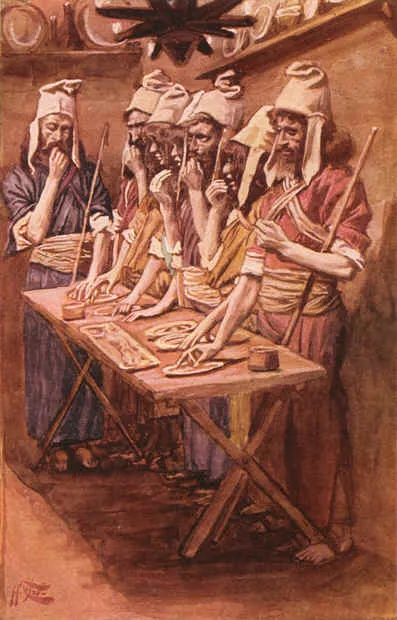
Exodus 12:1-14The Lamb Selected and Slain
1And the LORD spake unto Moses and Aaron in the land of Egypt, saying, 2This month shall be unto you the beginning of months: it shall be the first month of the year to you. 3Speak ye unto all the congregation of Israel, saying, In the tenth day of this month they shall take to them every man a lamb, according to the house of their fathers, a lamb for an house:
God tells Moses and Aaron in Egypt that this month is to mark the beginning of months, the first month of their year. On the tenth day every household is to take a lamb, and any home too small to eat a whole lamb is to join with the nearest neighbor so that none is wasted.
4And if the household be too little for the lamb, let him and his neighbour next unto his house take it according to the number of the souls; every man according to his eating shall make your count for the lamb. 5Your lamb shall be without blemish, a male of the first year: ye shall take it out from the sheep, or from the goats: 6And ye shall keep it up until the fourteenth day of the same month: and the whole assembly of the congregation of Israel shall kill it in the evening. 7And they shall take of the blood, and strike it on the two side posts and on the upper door post of the houses, wherein they shall eat it.
The lamb is slain and marked. Blood on the doorposts and lintel. The sign is set. Now comes the next step - not just dying, but eating. The covenant is not only about what's done to save you, but what you do in response. You take it. You eat it. You make the sacrifice part of yourself.
8And they shall eat the flesh in that night, roast with fire, and unleavened bread; and with bitter herbs they shall eat it. 9Eat not of it raw, nor sodden at all with water, but roast with fire; his head with his legs, and with the purtenance thereof. 10And ye shall let nothing of it remain until the morning; and that which remaineth of it until the morning ye shall burn with fire.
The lamb is to be roasted with fire and eaten that same night with unleavened bread and bitter herbs, not raw and not boiled in water. None of it is to be left until morning, and whatever remains is burned with fire.
11And thus shall ye eat it; with your loins girded, your shoes on your feet, and your staff in your hand; and ye shall eat it in haste: it is the LORD’s passover. 12For I will pass through the land of Egypt this night, and will smite all the firstborn in the land of Egypt, both man and beast; and against all the gods of Egypt I will execute judgment: I am the LORD. 13And the blood shall be to you for a token upon the houses where ye are: and when I see the blood, I will pass over you, and the plague shall not be upon you to destroy you, when I smite the land of Egypt. 14And this day shall be unto you for a memorial; and ye shall keep it a feast to the LORD throughout your generations; ye shall keep it a feast by an ordinance for ever.
The lamb is taken on the tenth day and kept until the fourteenth. Four days of inspection. The family lives with the lamb they will eat. They watch it. They care for it. They know it. When the knife comes, the sacrifice is personal. It is the cost made visible.
The Hebrew erev means twilight - the in-between time, the boundary between day and night. Jesus dies at this hour. The Gospels align His crucifixion with the Passover lamb, slain at twilight on the fourteenth of Nisan. Matthew, Mark, and Luke all position it this way. Even the time of death is a foreshadowing.
The blood is marked on two side posts and the upper door post - the lintel. When you mark all three, the shape is the shape of a cross. The ancient Church, knowing this, saw in the blood-marked doorway a type of the cross itself: the lamb's blood pointing forward to the instrument where the Lamb of God would shed His blood.
The bitter herbs (maror in later tradition) are the taste of slavery. The family eats the lamb with the flavor of affliction still on their tongue. It is not a feast of celebration alone. It is a feast of remembrance - remembrance of the bondage that the lamb frees them from. The bitterness and the salvation are intertwined.
Exodus 12:15-17Seven Days of Unleavened Bread
15Seven days shall ye eat unleavened bread; even the first day ye shall put away leaven out of your houses: for whosoever eateth leavened bread from the first day until the seventh day, that soul shall be cut off from Israel. 16And in the first day there shall be an holy convocation, and in the seventh day there shall be an holy convocation to you; no manner of work shall be done in them, save that which every man must eat, that only may be done of you. 17And ye shall observe the feast of unleavened bread; for in this selfsame day have I brought your armies out of the land of Egypt: therefore shall ye observe this day in your generations by an ordinance for ever.
Exodus 12:18-28The Feast Made Law
18In the first month, on the fourteenth day of the month at even, ye shall eat unleavened bread, until the one and twentieth day of the month at even. 19Seven days shall there be no leaven found in your houses: for whosoever eateth that which is leavened, even that soul shall be cut off from the congregation of Israel, whether he be a stranger, or born in the land. 20Ye shall eat nothing leavened; in all your habitations shall ye eat unleavened bread.
The law has been spoken from Sinai. Now it falls to the leaders to carry it out. The shift is decisive: from God's word to human action, from command to execution, from what must be done to how it is done. The elders are named. Responsibility lands on their shoulders.
21Then Moses called for all the elders of Israel, and said unto them, Draw out and take you a lamb according to your families, and kill the passover. 22And ye shall take a bunch of hyssop, and dip it in the blood that is in the bason, and strike the lintel and the two side posts with the blood that is in the bason; and none of you shall go out at the door of his house until the morning. 23For the LORD will pass through to smite the Egyptians; and when he seeth the blood upon the lintel, and on the two side posts, the LORD will pass over the door, and will not suffer the destroyer to come in unto your houses to smite you. 24And ye shall observe this thing for an ordinance to thee and to thy sons for ever.
Moses summons the elders and tells them to draw out a lamb for each family and kill it, then take a bunch of hyssop, dip it in the blood, and strike the lintel and the two side posts, with no one leaving the house until morning. When the Lord passes through to strike the Egyptians and sees the blood, He will pass over that door and not let the destroyer enter; they are to keep this rite as an ordinance for their children forever.
25And it shall come to pass, when ye be come to the land which the LORD will give you, according as he hath promised, that ye shall keep this service. 26And it shall come to pass, when your children shall say unto you, What mean ye by this service? 27That ye shall say, It is the sacrifice of the LORD’s passover, who passed over the houses of the children of Israel in Egypt, when he smote the Egyptians, and delivered our houses. And the people bowed the head and worshipped. 28And the children of Israel went away, and did as the LORD had commanded Moses and Aaron, so did they.
Leaven is a metaphor for corruption. It spreads through the whole batch. The command to remove it is not merely practical - it is theological. For seven days, the household becomes a place of purity. Paul uses this same image: "Christ our passover is sacrificed for us: therefore let us keep the feast, not with old leaven, neither with the leaven of malice and wickedness; but with the unleavened bread of sincerity and truth" (1 Cor. 5:7-8). The feast of unleavened bread becomes a parable of what happens when the Lamb saves you.
Hysop is a small, humble plant - the opposite of a grand implement. In Psalm 51:7, the psalmist cries, "Purge me with hyssop, and I shall be clean." David thinks of salvation as hyssop: small, humble, lowly. The blood is applied with the instrument of the smallest, most fragile plant. It is applied by the hands of ordinary people in ordinary houses. There is no priest yet, no tabernacle yet. Just a family and a bush and the blood of a lamb 1.
The verb pesach means to pass over, to skip over, to spring over. The destroyer comes. The angel of death moves through Egypt. There is a mark on this doorway. And so it passes over. Death passes over this house because the blood marks it. The covenant is made in a mark on wood 2.
Exodus 12:29-36The Death of the Firstborn
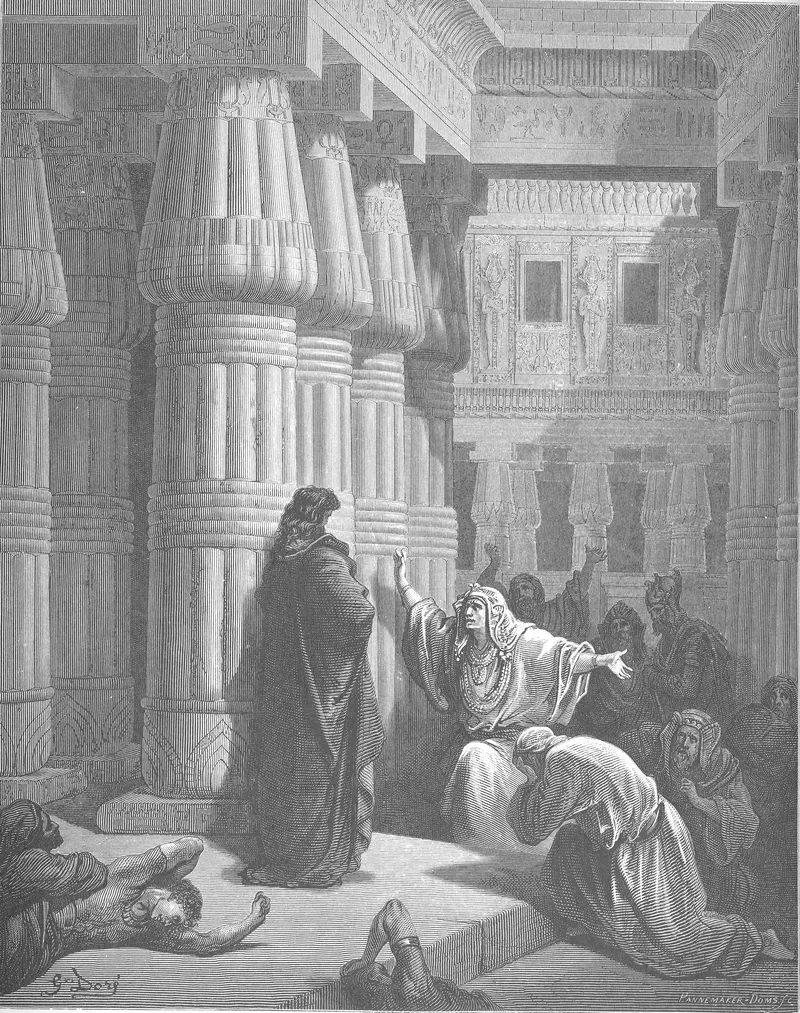
29And it came to pass, that at midnight the LORD smote all the firstborn in the land of Egypt, from the firstborn of Pharaoh that sat on his throne unto the firstborn of the captive that was in the dungeon; and all the firstborn of cattle. 30And Pharaoh rose up in the night, he, and all his servants, and all the Egyptians; and there was a great cry in Egypt; for there was not a house where there was not one dead. 31And he called for Moses and Aaron by night, and said, Rise up, and get you forth from among my people, both ye and the children of Israel; and go, serve the LORD, as ye have said. 32Also take your flocks and your herds, as ye have said, and be gone; and bless me also.
At midnight the Lord strikes down every firstborn in Egypt, from Pharaoh's heir on the throne to the captive in the dungeon, along with the firstborn of the livestock. Pharaoh rises in the night amid a great cry through the land, summons Moses and Aaron, and orders Israel to leave with their flocks and herds, even asking for a blessing.
33And the Egyptians were urgent upon the people, that they might send them out of the land in haste; for they said, We be all dead men. 34And the people took their dough before it was leavened, their kneadingtroughs being bound up in their clothes upon their shoulders. 35And the children of Israel did according to the word of Moses; and they borrowed of the Egyptians jewels of silver, and jewels of gold, and raiment: 36And the LORD gave the people favour in the sight of the Egyptians, so that they lent unto them such things as they required. And they spoiled the Egyptians.
At midnight. In darkness, while Israel sleeps - or keeps vigil, watching the blood on the doorpost. This is the hardest part of the Exodus story. The firstborn of Egypt die. The firstborn of the cattle die. Pharaoh's own heir dies. From the throne to the dungeon, death comes to every firstborn. It is the judgment God brings on a nation that has enslaved His people, hardened their hearts with cruelty, and refused the word of God again and again.
The Passover is not only a salvation story for Israel. It is a judgment story for Egypt. And it is addressed honestly in scripture, as the answer to the question: How does God save His people when evil stands in the way? With judgment. With the sword. With death passing through.
Exodus 12:37-39The Mixed Multitude Departs
37And the children of Israel journeyed from Rameses to Succoth, about six hundred thousand on foot that were men, beside children. 38And a mixed multitude went up also with them; and flocks, and herds, even very much cattle. 39And they baked unleavened cakes of the dough which they brought forth out of Egypt, for it was not leavened; because they were thrust out of Egypt, and could not tarry, neither had they prepared for themselves any victual.
Six hundred thousand men, "beside children." The text does not count them. They are beyond counting. The deliverance is so vast that the Scripture gives up the math and points instead at the overflow. A nation. An exodus. An impossibility made real.
Exodus 12:40-42The Departure
40Now the sojourning of the children of Israel, who dwelt in Egypt, was four hundred and thirty years. 41And it came to pass at the end of the four hundred and thirty years, even the selfsame day it came to pass, that all the hosts of the LORD went out from the land of Egypt. 42It is a night to be much observed unto the LORD for bringing them out from the land of Egypt: this is that night of the LORD to be observed of all the children of Israel in their generations.
Genesis 15:13 prophesied: "Know of a surety that thy seed shall be a stranger in a land that is not theirs, and shall serve them; and they shall afflict them four hundred years." Now the time is fulfilled. The promise God made to Abraham in the dark is kept to Abraham's descendants in Egypt. The delay was not forgotten. The faithfulness was not abandoned. The fourth generation lived to see the exodus. The word of God proved sure.
Exodus 12:43-51The Ordinance for Ever
43And the LORD said unto Moses and Aaron, This is the ordinance of the passover: There shall no stranger eat thereof: 44But every man’s servant that is bought for money, when thou hast circumcised him, then shall he eat thereof. 45A foreigner and an hired servant shall not eat thereof. 46In one house shall it be eaten; thou shalt not carry forth ought of the flesh abroad out of the house; neither shall ye break a bone thereof.
The Passover meal has its own rules - eaten in one house, no bone broken, no stranger sharing. The night that delivered Israel becomes a sacrament with edges3.
47All the congregation of Israel shall keep it. 48And when a stranger shall sojourn with thee, and will keep the passover to the LORD, let all his males be circumcised, and then let him come near and keep it; and he shall be as one that is born in the land: for no uncircumcised person shall eat thereof. 49One law shall be to him that is homeborn, and unto the stranger that sojourneth among you. 50Thus did all the children of Israel; as the LORD commanded Moses and Aaron, so did they. 51And it came to pass the selfsame day, that the LORD did bring the children of Israel out of the land of Egypt by their armies.
It is an odd detail to include. The lamb is slain, roasted, eaten. Why specify that no bone shall be broken? It seems minor. But nearly fifteen hundred years later, on a hill called Golgotha, this detail will become central. A man will hang on a cross, and soldiers will come to break His legs - the standard practice to hasten death. But when they come to Jesus, they find He is already dead. So they do not break His legs.
And John, writing the gospel, will quote this verse: "These things were done, that the scripture should be fulfilled, A bone of him shall not be broken" (John 19:36). The oddness of the detail reveals its purpose. It was written into the Passover ordinance so that when the Lamb of God was slain, the people of God would recognize Him.
Research trail
Sources & further study
These references support the historical, linguistic, manuscript, and contextual notes in this chapter. Scripture remains the primary text; external sources are provided so readers can inspect the research directly.
Where this echoes in Scripture
The Lamb Selected and Slain
- John 1:29Behold the Lamb of God, which taketh away the sin of the world.John the Baptist names Jesus the true Passover lamb.
- 1 Corinthians 5:7Christ our passover is sacrificed for us.Paul makes the connection direct - the cross is the new Passover.
- 1 Peter 1:18-19Ye were redeemed… with the precious blood of Christ, as of a lamb without blemish.Peter recasts the unblemished lamb of Exodus 12 as Christ.
- Revelation 5:6, 12A Lamb as it had been slain… Worthy is the Lamb that was slain.The slain lamb takes the throne.