Painter of the Bible
Raffaello Sanzio da Urbino
Raphael — born in Urbino, trained under his father and then in Pietro Perugino's Umbrian workshop, established in Florence by 1504 and in Rome by 1508 — produced in less than two decades a body of work that became the Eu…

Their faith
Why Raffaello Sanzio da Urbino painted Christ
Raffaello Sanzio da Urbino, known to us as Raphael, was deeply influenced by the Christian faith that permeated the culture of Renaissance Italy. Trained in the artistic traditions of his father and the workshop of Pietro Perugino, Raphael’s works reflect a profound reverence for scripture and the divine. His dedication to his craft was not merely professional; it was a devotional practice that sought to glorify God through beauty. Raphael’s faith is evident in his choice of subjects, often depicting scenes from the Bible with a sense of grace and spiritual depth. His commitment to his art was so strong that he requested to be buried in the Pantheon, a testament to his desire to be close to the divine even in death.
Raphael's faith significantly shaped his artistic vision, particularly in his renowned depictions of the Virgin Mary and the Christ Child. His masterpieces, such as the Sistine Madonna and the Madonna della Seggiola, exemplify his ability to convey the sacred through serene expressions and harmonious compositions. These works not only established the visual archetype of the Madonna for centuries but also invite viewers into a deeper contemplation of the divine mystery of Christ's incarnation. The beauty and devotion encapsulated in Raphael's paintings continue to inspire and uplift the hearts of those who encounter them, reminding us of the eternal connection between art and faith.
Life & work
Raphael — born in Urbino, trained under his father and then in Pietro Perugino's Umbrian workshop, established in Florence by 1504 and in Rome by 1508 — produced in less than two decades a body of work that became the European standard for what religious painting was supposed to look like. He died at thirty-seven; what he made before that has shaped the visual imagination of the Western Church ever since.
In Rome he frescoed the four papal apartments now called the Stanze of Raphael — the Stanza della Segnatura with its School of Athens and Disputation of the Holy Sacrament, the Stanza di Eliodoro, the Stanza dell'Incendio, and the Stanza di Costantino — in collaboration with a workshop that included Giulio Romano, Giovan Francesco Penni, and others. He designed ten tapestries for the Sistine Chapel: the cartoons (now in the Victoria and Albert Museum) include the Miraculous Draught of Fishes, Christ's Charge to Peter, the Healing of the Lame Man, the Death of Ananias, Saint Paul Preaching at Athens, and the Conversion of the Proconsul.
His Madonnas, scattered now across European and American collections — the Sistine Madonna in Dresden, the Madonna del Cardellino in the Uffizi, the Madonna of the Meadow in Vienna, the Alba Madonna and the Small Cowper Madonna in Washington, the Madonna della Seggiola in the Pitti — fixed the visual type of the Virgin and Child for four centuries. His final painting, the Transfiguration, was carried to his funeral and now hangs in the Vatican Museums.
He died on Good Friday 1520 and was buried, by his own request, in the Pantheon in Rome, where his tomb is still visited.
Notable works in detail
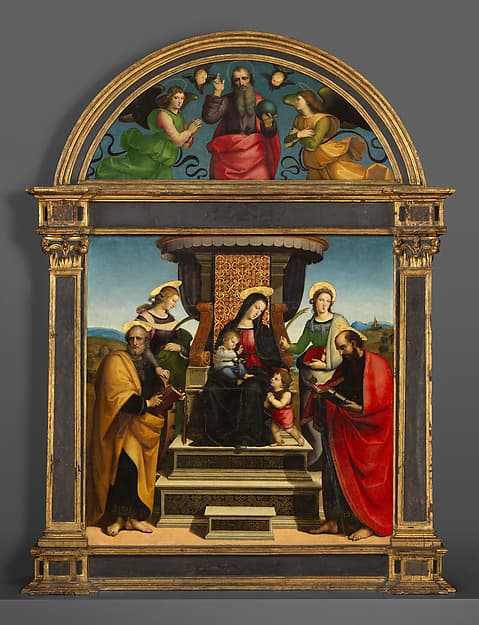
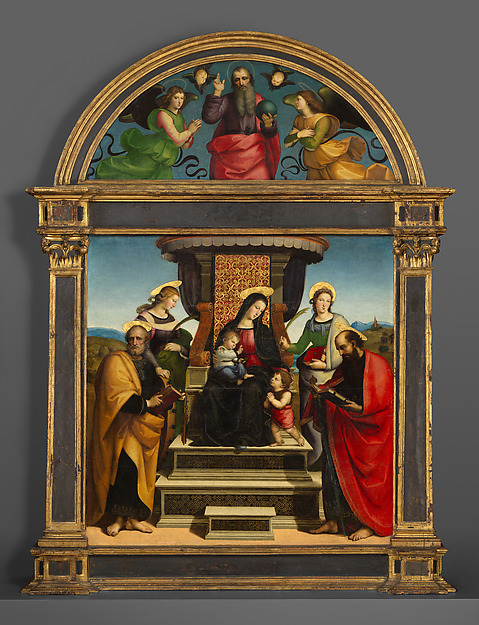
Madonna and Child Enthroned with Saints
The Madonna and Child Enthroned with Saints, painted around 1499 in tempera and oil on a poplar panel and now in the Metropolitan Museum of Art in New York, is one of the earliest documented works of the young Raphael — painted when he was about sixteen, almost certainly as part of an unidentified Umbrian altarpiece commission produced in the workshop of his teacher Pietro Perugino. The composition shows the Virgin enthroned with the Christ Child on her knee in the center of a Renaissance loggia, with two saints standing on either side and a small kneeling donor figure at the bottom. The chromatic palette and figural proportions are distinctly Peruginesque — the soft chalky color, the elongated tilted heads — and the panel is the principal surviving record of Raphael's apprenticeship before he developed his own distinctive High Renaissance manner. The painting entered the Metropolitan in 1916 from the bequest of Benjamin Altman.
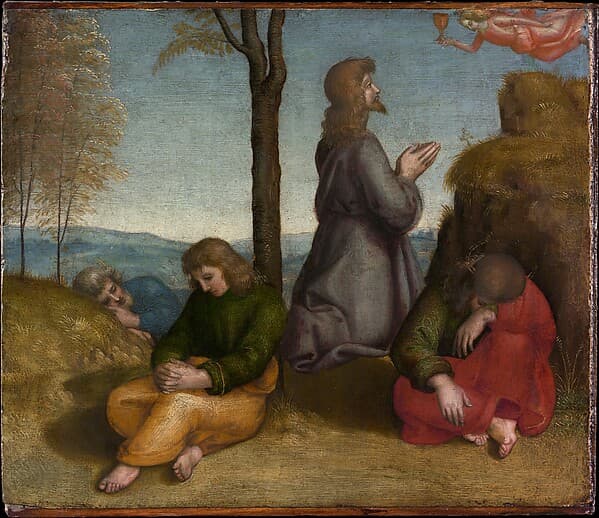
The Agony in the Garden, painted around 1503 in tempera and oil on a small wooden panel and now in the Metropolitan Museum of Art in New York, is one of a small group of predella panels Raphael produced as part of an early Umbrian altarpiece in the orbit of his teacher Pietro Perugino. The composition shows Christ kneeling in prayer before the angel bearing the cup of the Passion in a small hilltop garden, with the three sleeping disciples — Peter, James, and John — gathered in the lower left corner of the panel and Judas leading the soldiers toward the garden through the gate at the lower right. The pictorial surface is small — the panel is only about twenty-three centimeters tall — but the composition demonstrates the young Raphael's ability to organize multiple narrative moments inside a single tightly framed image. The panel entered the Metropolitan in 1932 from the J. Pierpont Morgan collection.
met-340577
The Madonna and Child with the Infant Saint John the Baptist, painted in pen and brown ink with brown wash on paper around 1501 and now in the Metropolitan Museum of Art in New York, is one of a number of early Raphael drawings in which the young painter — still in his late teens and working in the orbit of Pietro Perugino — was working out variations on the Madonna-and-Child compositional types that he would refine throughout his career. The drawing shows the Virgin seated holding the Christ Child on her lap, with the boy John the Baptist standing in profile beside them; the figures are sketched rapidly with confident outlines and minimal interior modeling. Drawings of this kind, scattered today across the Uffizi, the Louvre, the British Museum, and the Metropolitan, are the principal record of the young Raphael's compositional experiments in the years immediately before he moved to Florence around 1504.
met-340579
Studies of the Christ Child, drawn in red chalk on a sheet of paper around 1513 and now in the Metropolitan Museum of Art in New York, is a sheet of preparatory studies from the central Roman period of Raphael's career, the years of the Vatican Stanza decorations and the major commissioned altarpieces. The sheet shows multiple poses of the infant Christ — seated, half-reclining, gesturing with one arm raised — drawn rapidly with the soft red chalk that the High Renaissance Roman workshops had popularized for figure studies. Drawings of this kind were used as compositional source material for finished altarpiece commissions; specific motifs from sheets very like this one can be matched to figures in the Madonna della Sedia, the Madonna of the Chair, and several of the smaller late Roman Madonnas. The sheet entered the Metropolitan in the early twentieth century.

%20-%20WGA18609.jpg?width=800)


.jpg?width=800)
.jpg?width=800)
.jpg?width=800)
