Ezekiel 1
People in this chapter
The book of Ezekiel opens not in a temple or a palace but in a refugee camp. Now it came to pass… as I was among the captives by the river of Chebar, that the heavens were opened, and I saw visions of God (v. 1). Ezekiel is a priest in exile - carried off to Babylon with King Jehoiachin, far from the altar he was born to serve, in the land of a people who worshipped other gods.
It is the worst possible address for a vision of the living God, and that is precisely the point. The heavens open over the Chebar, not over Zion. Whatever this book is about to say about judgment and ruin, it begins by insisting that God is not confined to the holy land He is about to let fall. He comes to His prophet in the place of loss.1
Tap any highlighted phrase to jump to the commentary that unpacks it.
Ezekiel 1:1-3Among the Captives by Chebar
1Now it came to pass in the thirtieth year, in the fourth month, in the fifth day of the month, as I was among the captives by the river of Chebar, that the heavens were opened, and I saw visions of God. 2In the fifth day of the month, which was the fifth year of king Jehoiachin’s captivity, 3The word of the LORD came expressly unto Ezekiel the priest, the son of Buzi, in the land of the Chaldeans by the river Chebar; and the hand of the LORD was there upon him.
Every detail of the opening is meant to locate the vision precisely, and the location is the point. As I was among the captives by the river of Chebar… the word of the LORD came expressly unto Ezekiel the priest… in the land of the Chaldeans (vv. 1-3). Ezekiel is a priest, trained for the altar, now living hundreds of miles from it among deportees on a canal in Babylon. By every assumption of his world, this is exactly where God's presence is not: outside the land, away from the temple, in the country of the conqueror.
And yet here the heavens were opened. The prophet even dates it twice over - by an unexplained “thirtieth year” and by the fifth year of king Jehoiachin's captivity (v. 2) - anchoring the wonder in real, datable history rather than dream-time. The repeated note that the hand of the LORD was there upon him seals it: God lays hold of His prophet in exile. Before a single creature or wheel is described, the chapter has already made its first claim.
The God of Judah is not a local deity who can be left behind when His people are carried away. He goes to them.1
Ezekiel 1:4-6A Whirlwind Out of the North
4And I looked, and, behold, a whirlwind came out of the north, a great cloud, and a fire infolding itself, and a brightness was about it, and out of the midst thereof as the colour of amber, out of the midst of the fire. 5Also out of the midst thereof came the likeness of four living creatures. And this was their appearance; they had the likeness of a man. 6And every one had four faces, and every one had four wings.
The vision announces itself as a storm: a whirlwind came out of the north, a great cloud, and a fire infolding itself, and a brightness was about it, and out of the midst thereof as the colour of amber (v. 4). Each element carries weight. The whirlwind and the great cloud are the long-standing signs of God drawing near - the cloud that led Israel through the wilderness, the storm out of which the LORD answered Job.
The fire infolding itself is a fire that turns endlessly in on itself, flashing and self-feeding, never consumed; and at its heart gleams the colour of amber, a glowing metallic brightness the eye can barely hold. That it comes out of the north would have struck Ezekiel hard, for the north was the direction from which Babylon's armies had marched on Jerusalem. The very quarter of the sky that meant invasion and ruin is now the quarter from which the glory of God advances.
The storm of judgment and the storm of glory arrive on the same wind. From the first verse of the vision the reader is warned: what is coming is overwhelming, and it cannot be tamed into something small or comfortable.
Ezekiel 1:7-9Straight Forward, Never Turning
7And their feet were straight feet; and the sole of their feet was like the sole of a calf’s foot: and they sparkled like the colour of burnished brass. 8And they had the hands of a man under their wings on their four sides; and they four had their faces and their wings. 9Their wings were joined one to another; they turned not when they went; they went every one straight forward.
Out of the fire come the likeness of four living creatures (v. 5), and at once the prophet's language turns careful. He does not say he saw four creatures; he saw the likeness of them - and they had the likeness of a man. They are humanlike yet far more: every one had four faces, and every one had four wings (v. 6). Their feet are straight and gleam like the colour of burnished brass (v. 7); beneath their wings are the hands of a man (v. 8).
Two details govern how they move. First, their wings were joined one to another (v. 9) - they are bound together, a single coordinated whole. Second, they turned not when they went; they went every one straight forward (vv. 9, 12): with a face set toward every direction, they never need to turn around. Wherever the impulse to move arises, a face is already looking that way. And what governs them is not their own will: whither the spirit was to go, they went (v. 12).
These blazing, many-faced beings - like burning coals of fire… and out of the fire went forth lightning (v. 13), darting and returning as the appearance of a flash of lightning (v. 14) - do nothing of themselves. For all their power, they are servants, carried by a will higher than their own.
Ezekiel 1:10-12The Face of a Man, a Lion, an Ox, an Eagle
10As for the likeness of their faces, they four had the face of a man, and the face of a lion, on the right side: and they four had the face of an ox on the left side; they four also had the face of an eagle. 11Thus were their faces: and their wings were stretched upward; two wings of every one were joined one to another, and two covered their bodies. 12And they went every one straight forward: whither the spirit was to go, they went; and they turned not when they went.
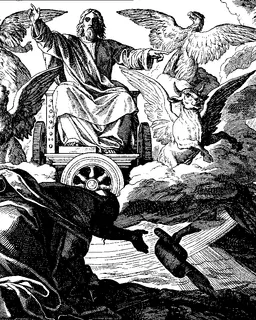
The four faces are the heart of the creatures' description, and Ezekiel names them deliberately: they four had the face of a man, and the face of a lion, on the right side: and they four had the face of an ox on the left side; they four also had the face of an eagle (v. 10). Four faces, fixed toward the four quarters, so that the creature beholds everything at once and is taken by surprise from no direction.
Readers have long seen in the four a kind of summary of creation's living orders - the man, crown of the visible world; the lion, mightiest among wild beasts; the ox, strongest of the domestic animals that serve; the eagle, swiftest and highest of the birds. Gathered around the throne, they suggest that all that lives is represented before God and bent to His service; nothing in His creation lies outside His rule or beyond His sight.
These same four faces reappear in the last book of the Bible, encircling the throne in heaven (Rev. 4:7), and from very early days Christian readers also linked the four to the four Gospels - the fourfold portrait of the one Lord. The vision does not pause to decode the symbols; it simply sets these living orders, full of eyes and fire, in ceaseless attendance on the One who is about to appear above them.2
Ezekiel 1:13-14Like a Flash of Lightning
13As for the likeness of the living creatures, their appearance was like burning coals of fire, and like the appearance of lamps: it went up and down among the living creatures; and the fire was bright, and out of the fire went forth lightning. 14And the living creatures ran and returned as the appearance of a flash of lightning.
Ezekiel 1:15-18A Wheel in the Middle of a Wheel · Full of Eyes
15Now as I beheld the living creatures, behold one wheel upon the earth by the living creatures, with his four faces. 16The appearance of the wheels and their work was like unto the colour of a beryl: and they four had one likeness: and their appearance and their work was as it were a wheel in the middle of a wheel. 17When they went, they went upon their four sides: and they turned not when they went. 18As for their rings, they were so high that they were dreadful; and their rings were full of eyes round about them four.
Now the prophet's eye drops to the ground beside the creatures: behold one wheel upon the earth by the living creatures, with his four faces (v. 15). The wheels gleam like unto the colour of a beryl - a pale, glassy green-gold stone - and their construction defies ordinary sense: their appearance and their work was as it were a wheel in the middle of a wheel (v. 16). Two wheels set at right angles through one another, so that the whole can roll in any of four directions without ever being turned: when they went, they went upon their four sides: and they turned not when they went (v. 17).
Like the four-faced creatures above them, the wheels need no pivot; every direction is already available to them. The picture is of total, instant mobility. There is no blind side, no slow turn, no direction this throne-bearing structure cannot move at once. Whatever else the wheels mean, they answer the deepest fear of an exile who has watched God's presence seemingly trapped in a fallen city: this throne is not fixed in one place.
It can go anywhere - even to Babylon, even to a canal called Chebar, even to the people who thought themselves abandoned.
Two further details press the picture toward awe. First, the sheer scale: As for their rings, they were so high that they were dreadful (v. 18). The rims tower up until the very sight of them strikes fear; this is not machinery a person could measure or master. Second, and stranger, those great rims were full of eyes round about them four. Eyes everywhere - a wheel that does not merely move in every direction but sees in every direction.
The same impression the four faces gave is now redoubled in the wheels: nothing escapes this. There is no angle from which one could approach unseen, no corner of the earth outside its gaze. The God whose throne this is misses nothing - not the sins of Jerusalem that the rest of the book will expose, and not the tears of the exiles by the river. And the eyes-everywhere is bound to the go-anywhere: a presence that both sees all and can move to all.
The wheels are a vision, rolled into beryl and fire, of a sovereignty that is at once everywhere-seeing and everywhere-reaching.1
Ezekiel 1:19-21Whither the Spirit Was to Go
19And when the living creatures went, the wheels went by them: and when the living creatures were lifted up from the earth, the wheels were lifted up. 20Whithersoever the spirit was to go, they went, thither was their spirit to go; and the wheels were lifted up over against them: for the spirit of the living creature was in the wheels. 21When those went, these went; and when those stood, these stood; and when those were lifted up from the earth, the wheels were lifted up over against them: for the spirit of the living creature was in the wheels.
What binds the wheels and the creatures into one is named four times in three verses, until the reader cannot miss it: the spirit. When the living creatures went, the wheels went by them… Whithersoever the spirit was to go, they went… and the wheels were lifted up over against them: for the spirit of the living creature was in the wheels (vv. 19-20). Creatures and wheels rise, halt, and advance in perfect unison - when those went, these went; and when those stood, these stood (v. 21) - because one spirit animates the whole, not a set of gears.
There is no separate engine, no independent will anywhere in the vision. Every blazing, eye-covered, many-faced part of it moves as one, driven by a single governing impulse. This is the quiet theological centre of the whole storm. For all its overwhelming complexity - faces, wings, wheels, fire, eyes - the vision is utterly unified and utterly directed. Nothing in it is random; nothing in it acts on its own. And the same will move the events the book is about to unfold.
The exile, the fall of the city, the long road to restoration - all of it, the vision insists, moves whither the spirit was to go.
Ezekiel 1:22-25The Firmament Like Terrible Crystal
22And the likeness of the firmament upon the heads of the living creature was as the colour of the terrible crystal, stretched forth over their heads above. 23And under the firmament were their wings straight, the one toward the other: every one had two, which covered on this side, and every one had two, which covered on that side, their bodies. 24And when they went, I heard the noise of their wings, like the noise of great waters, as the voice of the Almighty, the voice of speech, as the noise of an host: when they stood, they let down their wings. 25And there was a voice from the firmament that was over their heads, when they stood, and had let down their wings.
Above the creatures the prophet sees a vast expanse: the likeness of the firmament upon the heads of the living creature was as the colour of the terrible crystal, stretched forth over their heads above (v. 22). The word firmament is the same one used in Genesis for the great dome God set over the world on the second day - the sky spread out above. Here that expanse is rendered in dazzling, fearful brilliance: it gleams like terrible crystal, a clear shining surface so bright and so vast that it inspires dread.
The detail is doing careful work in the architecture of the vision. The blazing, many-faced creatures, for all their fire and power, are beneath this floor; whatever is about to be shown stands above it, on the far side of a shining barrier. The crystal expanse marks a threshold - the place where the realm of even the highest creatures ends and the realm of the One they serve begins. Ezekiel has not yet looked up past it.
The vision is deliberately ascending, level by level, and the firmament tells him - and us - that the greatest sight is still to come, set apart above the rest.
Now sound floods the vision. As the creatures move, I heard the noise of their wings, like the noise of great waters, as the voice of the Almighty, the voice of speech, as the noise of an host (v. 24). The prophet piles up comparisons because no single one will do: it is like the thunder of a great waterfall or a storming sea; it is like the roar of an army on the march; it is like the voice of the Almighty Himself.
Yet even this overwhelming sound is only the noise of the creatures' wings - the servants' movement, still below the Master's speech still to come. And then a hush falls and a far greater sound waits: when they stood, they let down their wings. And there was a voice from the firmament that was over their heads (vv. 24-25). The creatures fall silent and still, wings lowered, and only then comes the voice from above the crystal expanse.
The order is striking. When the One enthroned above the firmament is about to speak, the thunderous heavenly host goes quiet. Their tremendous noise yields at once to a higher voice. Even the mightiest worship is, in the end, a stilling of self to hear the word of God.
Ezekiel 1:26-28The Likeness of the Glory of the LORD
26And above the firmament that was over their heads was the likeness of a throne, as the appearance of a sapphire stone: and upon the likeness of the throne was the likeness as the appearance of a man above upon it. 27And I saw as the colour of amber, as the appearance of fire round about within it, from the appearance of his loins even upward, and from the appearance of his loins even downward, I saw as it were the appearance of fire, and it had brightness round about. 28As the appearance of the bow that is in the cloud in the day of rain, so was the appearance of the brightness round about. This was the appearance of the likeness of the glory of the LORD. And when I saw it, I fell upon my face, and I heard a voice of one that spake.
At last the prophet's eye rises above the crystal expanse, and at the summit of the whole vision there is a throne: above the firmament that was over their heads was the likeness of a throne, as the appearance of a sapphire stone (v. 26). The colour is deliberate - a deep, lucid blue, the colour of the heavens themselves; long before, Moses and the elders on Sinai had seen beneath the feet of the God of Israel as it were a paved work of a sapphire stone, and as it were the body of heaven in his clearness (Ex. 24:10).
Ezekiel is being shown the same throne, now carried over the waters of exile. And every word he chooses keeps its careful distance. It is not a throne but the likeness of a throne; not sapphire but as the appearance of a sapphire stone. The structure of the whole vision has been an ascent - creatures, then wheels, then the firmament, and now, above it all, the throne. The reader has been climbing toward this from the first verse.
Everything beneath it - the fire, the wheels, the four-faced living creatures - has been bearing this up. The whole elaborate vision was always about the One who sits enthroned above it.
Now comes the centre of the vision, and the prophet's language is at its most careful: upon the likeness of the throne was the likeness as the appearance of a man above upon it (v. 26). Notice the layered words - not “a man,” but the likeness as the appearance of a man. Ezekiel piles guard upon guard, telling us he is at the very edge of what may be seen and said. What is upon the throne has a form he can only describe in human terms, and he describes it exactly as it appeared, no more and no less.
The figure is wrapped in radiance from the waist up and down: the colour of amber, as the appearance of fire round about within it… and it had brightness round about (v. 27). And encircling the whole is a softer glory: as the appearance of the bow that is in the cloud in the day of rain (v. 28). The rainbow is no idle ornament; it is the sign God set in the cloud as the token of His mercy and His covenant after the flood (Gen. 9:13).
So the figure on the throne, blazing with fire, is ringed with the sign of peace. The prophet does not explain the form; he reports it. He has seen a glory that can only be told in the likeness of a man, fire, and the rainbow of mercy - and he leaves the sight standing exactly as it met his eyes.
Having reached the summit, Ezekiel finally names the whole vision - and he names it at the same careful remove he has kept all along: This was the appearance of the likeness of the glory of the LORD (v. 28). Not “this was the LORD,” but the appearance of the likeness of the glory of the LORD - three soft words of distance laid over the sight. The prophet will not claim more than he was given.
He saw the radiance, the visible weight of God's presence, and he tells us so without overreaching into what lies beyond it. And then the only fitting response: And when I saw it, I fell upon my face, and I heard a voice of one that spake. He does not analyse the throne or describe the figure further. He goes down. The man who has stared into fire and wheels and crystal and a throne can do nothing but fall flat on the ground - and it is in that posture, face to the earth, that he first hears the voice that will commission him.
This is where the whole vision has been driving. It humbles before it speaks. The book of Ezekiel begins not with a message but with a man on his face before the glory, ready, at last, to listen.
Research trail
Sources & further study
These references support the historical, linguistic, manuscript, and contextual notes in this chapter. Scripture remains the primary text; external sources are provided so readers can inspect the research directly.
- Ezekiel 1 - Translators' NotesThe NET Bible's detailed footnotes on Ezekiel 1 - the puzzle of the “thirtieth year” and the river Chebar (vv. 1-3), the burnished-brass feet and joined wings of the living creatures (vv. 7-11), the wheel within a wheel and the rings full of eyes (vv. 16-18), and the carefully hedged language of throne, fire, and rainbow in verses 26-28.
- Ezekiel 1 ↔ Revelation 4 · John 1 · Isaiah 6 · Daniel 7Traces the threads tying Ezekiel 1 to the rest of Scripture - the four living creatures with the faces of man, lion, ox, and eagle (v. 10) read alongside the four beasts around the throne in heaven (Rev. 4:6-8), and the throne with the likeness of a man upon it (v. 26) read beside the throne John saw standing open (Rev. 4:2) and the glory we beheld in the Word made flesh (John 1:14).
- Ezekiel 1 · Hebrew + classical Jewish commentaryThe Hebrew text of Ezekiel 1 with Rashi, Radak, and other classical commentators side by side - useful for chayyot (vv. 5, 13, 14, the “living creatures”), for kevod YHWH (v. 28, “the glory of the LORD”), and for the layered language of demuth (likeness) and mareh (appearance) the prophet returns to again and again.
Where this echoes in Scripture
Like a Flash of Lightning
- Revelation 4:6-8four beasts full of eyes before and behind... the first beast was like a lion, and the second beast like a calf, and the third beast had a face as a man, and the fourth beast was like a flying eagle.The same four faces as verse 10 - lion, ox (calf), man, eagle - encircling the throne John sees in heaven.
- Ezekiel 10:20This is the living creature that I saw under the God of Israel by the river of Chebar; and I knew that they were the cherubims.Ezekiel later names the living creatures of verses 5-14 - they are the cherubim of God's throne.
- Genesis 28:12he dreamed, and behold a ladder set up on the earth... and behold the angels of God ascending and descending on it.Another opened heaven and vision of God (v. 1) given to a man far from home and afraid.
- Matthew 3:16the heavens were opened unto him, and he saw the Spirit of God descending like a dove, and lighting upon him.The opened heaven of verse 1 echoed at the Jordan - Father, Son, and Spirit revealed together.
- Psalm 18:9-10He bowed the heavens also, and came down... And he rode upon a cherub, and did fly: yea, he did fly upon the wings of the wind.The storm-borne coming of God in verses 4-14 - the LORD riding upon the cherubim, swift as the wind.
Whither the Spirit Was to Go
- Ezekiel 10:9-13one wheel by one cherub... their appearance and their work was as it were a wheel in the middle of a wheel.The same wheels of verses 15-21 seen again - bearing the glory as it departs the temple in Jerusalem.
- 2 Chronicles 16:9the eyes of the LORD run to and fro throughout the whole earth, to shew himself strong in the behalf of them whose heart is perfect.The rings full of eyes (v. 18) - the all-seeing gaze of the LORD ranging over all the earth.
- Proverbs 15:3The eyes of the LORD are in every place, beholding the evil and the good.The eyes-everywhere of verse 18 stated plainly - no place and no deed outside His sight.
- Revelation 4:6and round about the throne, were four beasts full of eyes before and behind.The same eyes round about (v. 18) gather at the heavenly throne - the all-seeing creatures before God.
- Jeremiah 23:23-24Am I a God at hand, saith the LORD, and not a God afar off?... Do not I fill heaven and earth?The truth the wheels enact (vv. 19-21) - the LORD is not confined to one place but fills heaven and earth.
The Firmament Like Terrible Crystal
- Ezekiel 43:2the glory of the God of Israel came from the way of the east: and his voice was like a noise of many waters: and the earth shined with his glory.The same voice like many waters as verse 24 - the glory of God returning, its sound an ocean-roar.
- Revelation 1:15-17his voice as the sound of many waters... And when I saw him, I fell at his feet as dead.The flood-roar voice of verse 24 borne by the risen Christ - and the same falling-down response Ezekiel gives.
- Genesis 1:6-8And God said, Let there be a firmament in the midst of the waters... And God called the firmament Heaven.The same word firmament as verse 22 - the expanse God stretched over the world at creation.
- Psalm 29:3-4The voice of the LORD is upon the waters... The voice of the LORD is powerful; the voice of the LORD is full of majesty.The thunderous, water-like voice of verse 24 - the voice of the LORD in its power and majesty.
- Habakkuk 2:20But the LORD is in his holy temple: let all the earth keep silence before him.The stilling of the creatures in verses 24-25 - all creation falling silent before the voice of God.
The Likeness of the Glory of the LORD
- Revelation 4:2-3a throne was set in heaven, and one sat on the throne... and there was a rainbow round about the throne, in sight like unto an emerald.The throne and the rainbow of verses 26-28 seen again - the throne standing open in heaven, ringed with the bow of mercy.
- John 1:14And the Word was made flesh, and dwelt among us, (and we beheld his glory, the glory as of the only begotten of the Father,) full of grace and truth.The glory Ezekiel saw only in likeness (v. 28) - now beheld, full of grace and truth, dwelling among us.
- Exodus 24:10and there was under his feet as it were a paved work of a sapphire stone, and as it were the body of heaven in his clearness.The sapphire throne of verse 26 - the same sapphire brightness seen beneath the God of Israel on Sinai.
- Hebrews 1:3Who being the brightness of his glory, and the express image of his person, and upholding all things by the word of his power.The brightness round about the glory (vv. 27-28) named in person - the Son, the very radiance of God's glory.
- Genesis 9:13I do set my bow in the cloud, and it shall be for a token of a covenant between me and the earth.The rainbow round the throne (v. 28) - the sign of mercy and covenant, set round the glory of God.