Revelation 4
People in this chapter
The seven letters are finished, and the vision lifts. After this I looked, and, behold, a door was opened in heaven: and the first voice which I heard was as it were of a trumpet talking with me; which said, Come up hither, and I will shew thee things which must be hereafter (v. 1). The same trumpet-voice that first sent John to write now calls him upward, through an open door, to be shown what must come.
And the moment he answers, the scene changes utterly: immediately I was in the spirit: and, behold, a throne was set in heaven, and one sat on the throne (v. 2). Everything that follows in this chapter, and much that follows in the book, is arranged around that one fixed center. Before the future is unrolled, the throne is shown.1
Tap any highlighted phrase to jump to the commentary that unpacks it.
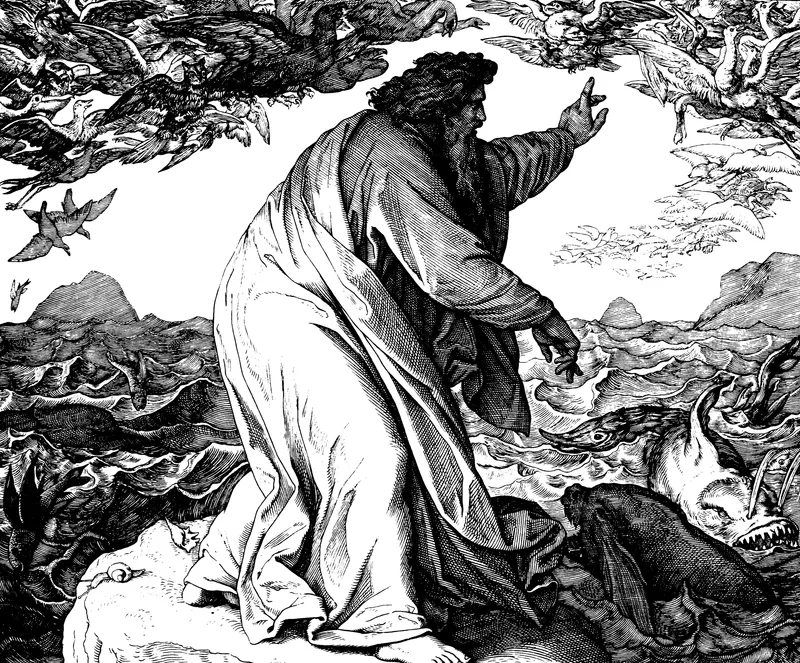
Revelation 4:1-3A Throne Was Set in Heaven
1After this I looked, and, behold, a door was opened in heaven: and the first voice which I heard was as it were of a trumpet talking with me; which said, Come up hither, and I will shew thee things which must be hereafter. 2And immediately I was in the spirit: and, behold, a throne was set in heaven, and one sat on the throne. 3And he that sat was to look upon like a jasper and a sardine stone: and there was a rainbow round about the throne, in sight like unto an emerald.
The chapter opens with a deliberate hinge: After this I looked. The letters to the seven churches are done, and John's gaze is lifted from the struggling congregations on earth to what stands over them. And, behold, a door was opened in heaven (v. 1). Heaven is not sealed shut; a door stands open, and through it John is summoned. The voice that calls him is the same trumpet-voice that first commissioned him to write (cf. Rev. 1:10) - a summons, not a whisper, the kind of sound that all through Scripture announces the presence and the call of God.
Come up hither, it says, and I will shew thee things which must be hereafter. What follows is given as a sight of things to come; but the very first thing shown is not a sequence of events. It is a throne. Before John is told what will happen, he is shown who reigns. The order matters: every event the book will go on to unveil is set, from the start, beneath the throne the chapter is about to reveal.1
John's response is immediate and total: And immediately I was in the spirit: and, behold, a throne was set in heaven, and one sat on the throne (v. 2). The verb set is quiet but firm - the throne is placed, established, standing. This is not a throne that can be toppled, contested, or moved. It was standing before the empires John's readers feared; it will stand when they are dust. And notice how little John argues.
He does not set out to prove that God exists or that God is powerful; he simply reports what he sees. One sat on the throne. The One seated is not yet named or described - that comes in the next verse, and even then only in light. But the bare fact is laid down first, plain and immovable, as the ground of everything else: at the center of all things there is a throne, and it is not empty.
Someone is seated there. For churches living under a power that claimed the last word over their lives, no truth could matter more than this one - the real throne is in heaven, and it is occupied.
When John finally describes the One on the throne, he reaches not for a face but for light: he that sat was to look upon like a jasper and a sardine stone: and there was a rainbow round about the throne, in sight like unto an emerald (v. 3). This is how Scripture speaks of the glory of God - not by drawing His features but by confessing that His brightness outruns description. Jasper here is a clear, brilliant stone, flashing with light; the sardine is a deep fiery red.
The One on the throne is seen as blazing radiance shot through with fire - pure light and burning glory together. And around the throne is a rainbow… like unto an emerald, a circle of living green. The bow set in the cloud was God's own sign of His covenant and His mercy after the flood (Gen. 9:13-16); now it rings the very throne. The point is not to decode each stone but to feel the whole: this is glory beyond telling, and around all that searing brightness there is a band of mercy.
The throne at the center of the universe is wrapped in the colors of holiness and of covenant kept.
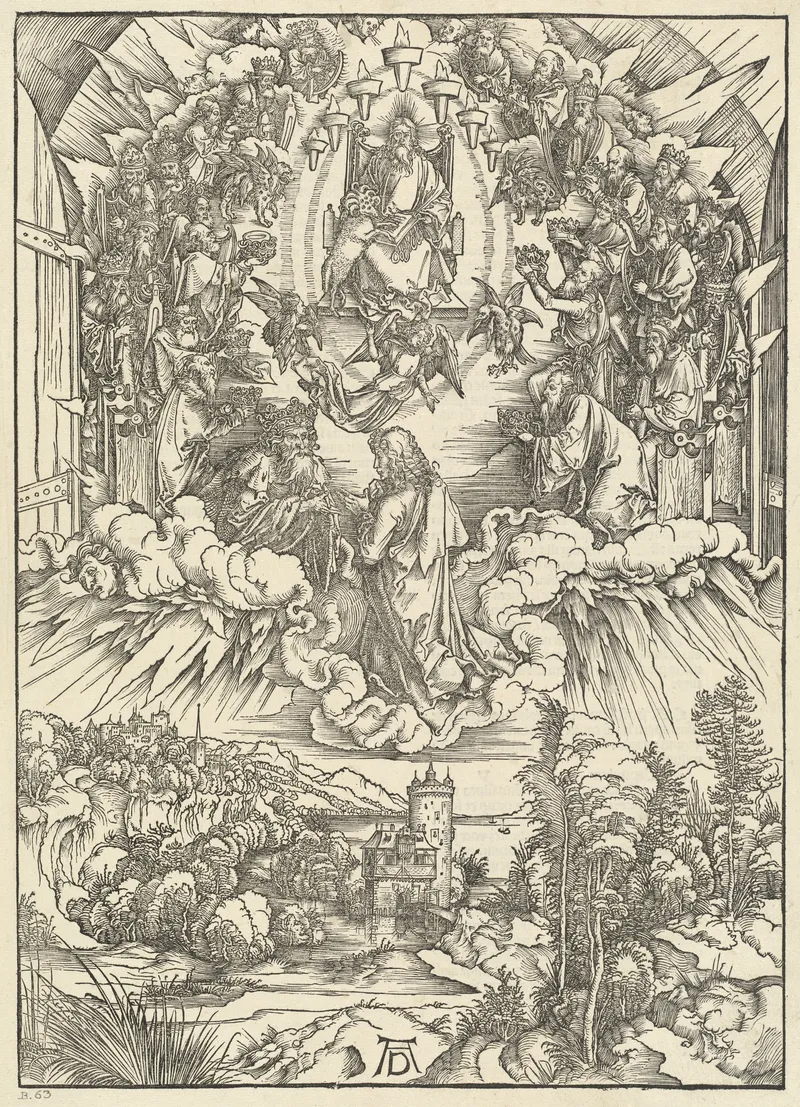
Revelation 4:4-8Holy, Holy, Holy, Lord God Almighty
4And round about the throne were four and twenty seats: and upon the seats I saw four and twenty elders sitting, clothed in white raiment; and they had on their heads crowns of gold. 5And out of the throne proceeded lightnings and thunderings and voices: and there were seven lamps of fire burning before the throne, which are the seven Spirits of God. 6And before the throne there was a sea of glass like unto crystal: and in the midst of the throne, and round about the throne, were four beasts full of eyes before and behind. 7And the first beast was like a lion, and the second beast like a calf, and the third beast had a face as a man, and the fourth beast was like a flying eagle. 8And the four beasts had each of them six wings about him; and they were full of eyes within: and they rest not day and night, saying, Holy, holy, holy, LORD God Almighty, which was, and is, and is to come.
The first ring around the throne is a circle of thrones: round about the throne were four and twenty seats: and upon the seats I saw four and twenty elders sitting, clothed in white raiment; and they had on their heads crowns of gold (v. 4). Three details tell the story. They are sitting - not standing at anxious attention but seated, at rest, near the throne; their place is secure. They are clothed in white raiment - the dress of purity and of triumph that runs all through this book, worn by those who have come through.
And they have crowns of gold - tokens of honor and of victory, granted them by the One on the throne. The text leaves their exact identity open, and we need not force it; what is unmistakable is that around God's throne sits a company of the honored and the at-rest, robed and crowned in His presence. They are the picture of what it is to be brought near and given a place - not servants kept at a distance, but elders seated in the very court of heaven.
And, as the chapter's close will show, every bit of the honor they have been given they are about to hand straight back.1
From the throne itself comes a display of sheer power and presence: out of the throne proceeded lightnings and thunderings and voices (v. 5). This is the language of Sinai, where the LORD came down on the mountain in thunders and lightnings and a thick cloud and a trumpet so loud the people trembled (Exod. 19:16). The same signs now break from the heavenly throne - but mark the direction: they proceed from it, flowing out, not striking against it.
Where God is enthroned, the very air bears witness to His majesty; creation answers His presence with thunder. These are not threats hurled at the throne but the radiance of the throne's own glory spilling outward. The One seated there is no tame or distant figure; He is the living God before whom Sinai shook, and the trembling grandeur of that mountain has its true home here, around the throne from which the world is ruled.
Before the throne burn seven lamps of fire… which are the seven Spirits of God (v. 5). The number seven runs all through this book as the figure of fullness and completeness; seven lamps blazing before the throne speak of a fullness of light and life that is wholly present, never failing. The phrase the seven Spirits of God is unusual to Revelation, and the book itself has already linked these seven Spirits to God's throne and to Christ (Rev. 1:4; 3:1).
However precisely the image is understood, its thrust is clear: the Spirit of God is not absent from the throne-room but burns there in perfect fullness, a living flame before the seat of God. The throne is not cold or static. It blazes with the fullness of the Spirit, and from it light and life pour out over all the earth. Heaven's center is alive with fire.
Two more features complete the throne's court. First, before the throne there was a sea of glass like unto crystal (v. 6) - a vast clear expanse, still and shining, like water turned to crystal. It recalls the moment when the elders of Israel saw God and beneath His feet was as it were a paved work of a sapphire stone, and as it were the body of heaven in his clearness (Exod. 24:10): a floor of pure transparency before the presence of God.
Then, at the very heart of the vision, in the midst of the throne, and round about the throne, were four beasts full of eyes before and behind. These living creatures are not opposed to the throne; they are nearest of all to it, in the midst and encircling it. They are full of eyes before and behind - an arresting image of vision that misses nothing, of beings wholly awake and aware, who see and know and are never caught unguarded.
Their whole existence is bent toward the One at the center. They are the throne's innermost worshippers, and the next verses tell us what they look like and what they say.
John describes the four living creatures by their faces and their wings: the first beast was like a lion, and the second beast like a calf, and the third beast had a face as a man, and the fourth beast was like a flying eagle (v. 7), and each had six wings about him and was full of eyes within (v. 8). The four faces gather up the heights of God's creatures - the lion, greatest among the wild beasts; the calf or ox, strongest among the tame; the eagle, swiftest and highest of the birds; and man, made in God's own image and set over them all.
It is as though the noblest of all living things are drawn up to the throne to render their worship. These same eyes-and-wings creatures stand behind the cherubim Ezekiel saw by the river Chebar, bearing up the glory of God (Ezek. 1:5-10; 10:14).2 And the six wings echo the seraphim of Isaiah, who with two covered their faces, with two their feet, and with two flew, crying out before the throne.
John is not inventing strange new beings; he is seeing the same heavenly worshippers the prophets saw, gathered around the same throne. Creation's noblest, fullest of eyes and wings, exist for one thing: to behold the One enthroned and to cry His praise.
Revelation 4:9-11Thou Art Worthy, O Lord
9And when those beasts give glory and honour and thanks to him that sat on the throne, who liveth for ever and ever, 10The four and twenty elders fall down before him that sat on the throne, and worship him that liveth for ever and ever, and cast their crowns before the throne, saying, 11Thou art worthy, O Lord, to receive glory and honour and power: for thou hast created all things, and for thy pleasure they are and were created.
The chapter's last movement shows worship answering worship: when those beasts give glory and honour and thanks to him that sat on the throne, who liveth for ever and ever, the four and twenty elders fall down before him that sat on the throne, and worship him that liveth for ever and ever (vv. 9-10). The living creatures lead, and the elders follow. There is a rhythm to heaven's praise: the cry of the innermost worshippers draws the wider circle down to its knees.
Twice over the One praised is named him that sat on the throne, who liveth for ever and ever - the living God, whose life has no beginning and no end, set against every power that John's readers feared, all of which would one day die. And the elders' response is not grudging duty but glad worship: they fall down, the whole-bodied posture of adoration, and bow before the throne. Heaven's honored ones, seated and crowned, do not guard their dignity in the presence of God.
The nearer they are to the throne, the lower they bow.
Then comes the gesture that crowns the whole chapter: the elders cast their crowns before the throne (v. 10). They had been given crowns of gold (v. 4) - real honor, granted them by the One on the throne. And the moment they worship, they take those crowns off and throw them down at His feet. It is an act of complete surrender, but not of loss; it is the most fitting thing they could possibly do.
Every honor they have been given, they give straight back to the One from whom it came. They do not say, I earned this; this is mine. They see the One on the throne and they cannot hold a crown in His presence. This is the deepest instinct of true worship: not to clutch what we have been given but to lay it down before the Giver. And the gesture looks ahead to the next chapter, where the same heavenly court will fall down again - this time before the Lamb that was slain - crying that He too is worthy. The crowns cast before the throne here are cast, in the end, before the One worthy of every honor heaven can offer.
The elders' song gives the reason for all of it in a single sentence: Thou art worthy, O Lord, to receive glory and honour and power: for thou hast created all things, and for thy pleasure they are and were created (v. 11). Here is the ground of worship laid bare. God is worthy because He created all things. Not merely set them spinning and stepped back; He created them, and they exist still because He wills it.
The little phrase for thy pleasure is the heart of the matter: all things are, and were made, because it pleased Him - because He delighted to make them and delights to hold them in being. Creation is not an accident or a machine that runs on its own; it is held, moment by moment, by the will and the joy of the One on the throne. And so He alone is worthy to receive glory and honour and power. The worship of heaven is not flattery offered to a needy king; it is the only honest response of everything that exists to the One who gave it existence.
He made it all, He sustains it all, and it is all His. To worship Him as Creator is simply to tell the truth about where everything came from and to whom it belongs.
Research trail
Sources & further study
These references support the historical, linguistic, manuscript, and contextual notes in this chapter. Scripture remains the primary text; external sources are provided so readers can inspect the research directly.
- Revelation 4 - Translators' NotesThe NET Bible's detailed footnotes on Revelation 4 - the open door and the summons come up hither in verse 1, the precious stones of verse 3, the identity of the four and twenty elders and the seven Spirits, and the grammar of the unceasing hymn in verse 8.
- Revelation 4 ↔ Isaiah 6 · Ezekiel 1 · Daniel 7Traces the older Scriptures woven through the throne-vision - the thrice-holy cry of verse 8 from the seraphim of Isaiah 6:3; the living creatures full of eyes (vv. 6-8) from the cherubim of Ezekiel 1 and 10; and the throne set and One seated (v. 2) from Daniel 7:9.
- Revelation 4 · Greek interlinearThe Greek text of Revelation 4 word by word, with parsing and Strong's links - useful for thronos (the “throne” that sounds through the whole chapter), for hagios (v. 8, the threefold “Holy, holy, holy”), and for axios (v. 11, “Thou art worthy”).
Where this echoes in Scripture
A Throne Was Set in Heaven
- Isaiah 6:1I saw also the Lord sitting upon a throne, high and lifted up, and his train filled the temple.The throne and the One seated of verses 2-3 - Isaiah's vision of the LORD enthroned in glory.
- Daniel 7:9the thrones were cast down, and the Ancient of days did sit, whose garment was white as snow.A throne set and One seated (v. 2) - Daniel's vision of the eternal God taking His seat to reign.
- Genesis 9:13-16I do set my bow in the cloud, and it shall be for a token of a covenant between me and the earth.The rainbow round about the throne (v. 3) - the ancient sign of God's covenant and mercy.
- Hebrews 12:2Jesus... who for the joy that was set before him endured the cross... and is set down at the right hand of the throne of God.The throne at the center (v. 2) - the throne to which the crucified and risen Christ is exalted.
- Psalm 47:8God reigneth over the heathen: God sitteth upon the throne of his holiness.The settled, occupied throne of verse 2 - God reigning from the seat of His holiness over all.
Holy, Holy, Holy, Lord God Almighty
- Isaiah 6:2-3each one had six wings... And one cried unto another, and said, Holy, holy, holy, is the LORD of hosts: the whole earth is full of his glory.The six wings and the thrice-holy cry of verses 8 - the seraphim's song before the throne, sung again here.
- Ezekiel 1:5-10they had the likeness of a man... the face of a lion... the face of an ox... the face of an eagle.The four faces of the living creatures (vv. 6-7) - the cherubim Ezekiel saw bearing the glory of God.
- Exodus 19:16there were thunders and lightnings, and a thick cloud upon the mount, and the voice of the trumpet exceeding loud.The lightnings and thunderings of verse 5 - the signs of God's presence at Sinai, now around the throne.
- Exodus 24:10under his feet as it were a paved work of a sapphire stone, and as it were the body of heaven in his clearness.The sea of glass like crystal of verse 6 - the shining clearness beneath the presence of God.
- John 12:41These things said Esaias, when he saw his glory, and spake of him.The thrice-holy of verse 8 - the Gospel naming whose glory Isaiah beheld upon the throne.
Thou Art Worthy, O Lord
- Revelation 5:11-12the voice of many angels round about the throne... Worthy is the Lamb that was slain to receive power, and riches, and wisdom.The cry Thou art worthy of verse 11 - sung again in the next scene over the Lamb who was slain.
- Colossians 1:16-17by him were all things created... all things were created by him, and for him: and he is before all things, and by him all things consist.The Creator worthy of worship (v. 11) - the Son named as the One by whom and for whom all things were made.
- John 1:3All things were made by him; and without him was not any thing made that was made.The making of all things the elders praise (v. 11) - the Word by whom everything came to be.
- Psalm 95:6O come, let us worship and bow down: let us kneel before the LORD our maker.The elders falling down before the throne (v. 10) - worship owed to the LORD precisely as our maker.
- 1 Chronicles 29:11Thine, O LORD, is the greatness, and the power, and the glory... thine is the kingdom, O LORD, and thou art exalted as head above all.The glory, honour, and power ascribed in verse 11 - David's confession that all of it belongs to God alone.