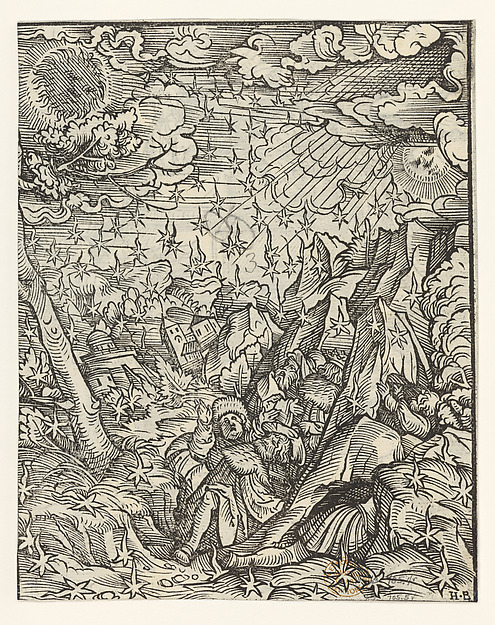
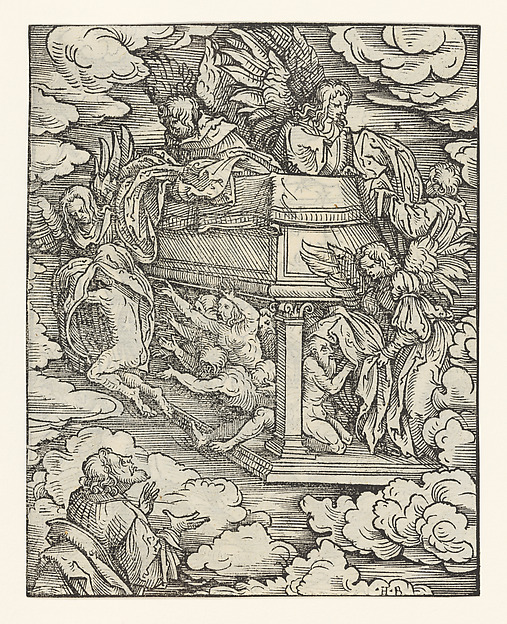
Painter of the Bible
Hans Burgkmair
Hans Burgkmair the Elder was, alongside Albrecht Dürer and Hans Holbein the Elder, one of the three principal artists of the Augsburg circle that brought the Italian Renaissance into German painting.

Their faith
Why Hans Burgkmair painted Christ
Hans Burgkmair the Elder was a devout Christian whose faith deeply influenced his artistic endeavors. Born in Augsburg in 1473, he was immersed in the rich Christian tradition from an early age, having trained under his father, a painter, and possibly with the renowned Martin Schongauer. His commitment to his faith is evident in his significant role as a court painter for prominent Christian patrons, including the merchant-banker Jakob Fugger and Emperor Maximilian I. Burgkmair's artistic output includes numerous altarpieces and devotional woodcuts that reflect his reverence for scripture and the Christian narrative, demonstrating his dedication to portraying sacred themes with sincerity and beauty.
Burgkmair's faith is beautifully illustrated in works such as the Saint John Altarpiece and the Crucifixion, which capture the essence of Christian devotion through their intricate detail and emotive expression. The tenderness of his style, characterized by smooth modeling and vibrant colors, allows viewers to experience the profound spiritual truths embedded within his art. His altarpieces served not only as visual representations of faith but also as sources of inspiration for the faithful, inviting contemplation and worship. Even today, Burgkmair's devotion resonates through his works, reminding us of the enduring power of faith to inspire and uplift the human spirit.
Life & work
Hans Burgkmair the Elder was, alongside Albrecht Dürer and Hans Holbein the Elder, one of the three principal artists of the Augsburg circle that brought the Italian Renaissance into German painting. Born in Augsburg in 1473 to the painter Thoman Burgkmair, trained in his father's workshop and possibly briefly with Martin Schongauer in Colmar, and active in Augsburg for almost his entire career, he died in Augsburg in 1531. He was the principal court painter of the city's leading patron, the merchant-banker Jakob Fugger, and one of the favored designers used by the Emperor Maximilian I.
His Christian religious work is concentrated in altarpieces and devotional woodcuts. The Saint John Altarpiece (Alte Pinakothek, Munich, 1518), the Crucifixion now in Augsburg, the Esther triptych for the Dominican church, and the Madonna and Saints of 1509 (Nuremberg) are the principal painted survivals. He produced the great series of Lebensgeschichte des Kaisers Maximilian (Life of the Emperor Maximilian, 1514–1518), the Triumphzug Maximilians (Triumphal Procession of Maximilian, 1516–1518), and the Genealogy of Maximilian for the imperial publishing project — secular cycles, but they educated his hand for the religious commissions that ran in parallel.
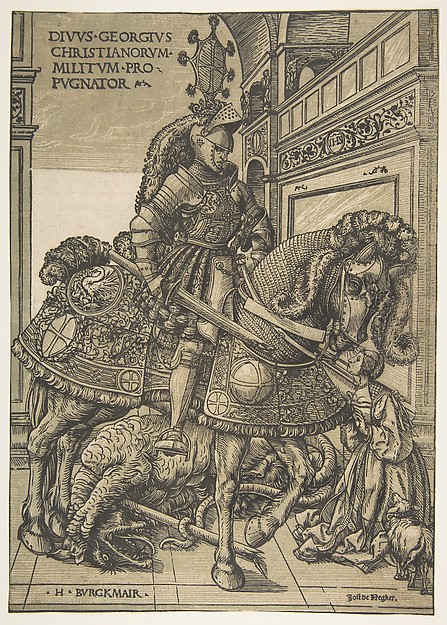
He was an early and skilled experimenter with the chiaroscuro woodcut: the addition of one or two tone-blocks printed in flat color over a black-line block, producing what we now call a tone-print. His Saint George on Horseback (1508), one of the first chiaroscuro woodcuts produced in Germany, remains a landmark of the technique. The chiaroscuro Lovers Surprised by Death (1510) and the religious chiaroscuros of the Madonna and Crucifixion that followed shaped the development of the technique for the next half-century.
His personal style — sweetly proportioned, smoothly modeled, jewel-colored, with the bright chromatic Italian Renaissance palette translated into Augsburg's wood-panel tradition — gives his religious paintings a tenderness that distinguishes them from Dürer's grand-manner austerity. Augsburg adopted the Reformation in 1534, three years after Burgkmair's death; his late altarpieces are the last great Augsburg pre-Reformation religious commissions.
Notable works in detail
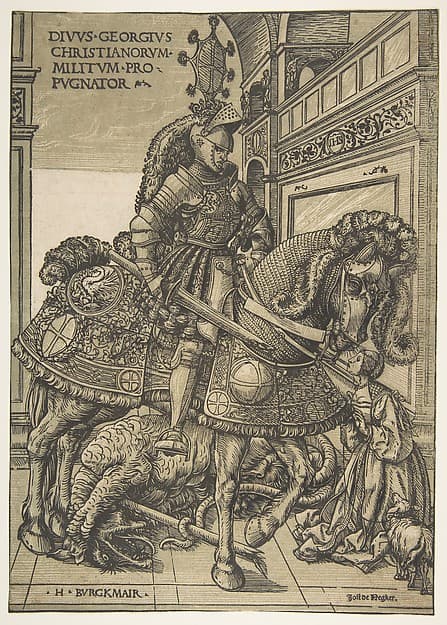
Saint George on Horseback, woodcut designed by Hans Burgkmair in 1508 in his Augsburg workshop, depicts the iconographic subject from the late-medieval Golden Legend tradition in which the Christian knight George rescues a princess from a dragon by piercing the creature with his lance. Burgkmair stages the scene as a vertical heraldic composition: the mounted George at the upper center in full armor, his lance thrust down through the dragon's open mouth, his horse rearing, the princess in the lower-left foreground in posture of grateful recognition. The print was one of the first chiaroscuro woodcuts produced in Germany — a printed image that combined a black line block with one or two flat tone blocks printed over it in flat color, producing what we now call a tone-print. Burgkmair's chiaroscuro Saint George is one of the foundational documents of the entire chiaroscuro woodcut tradition.
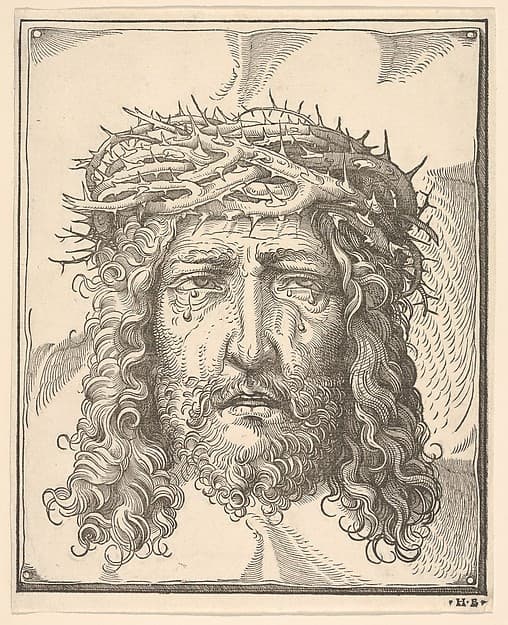
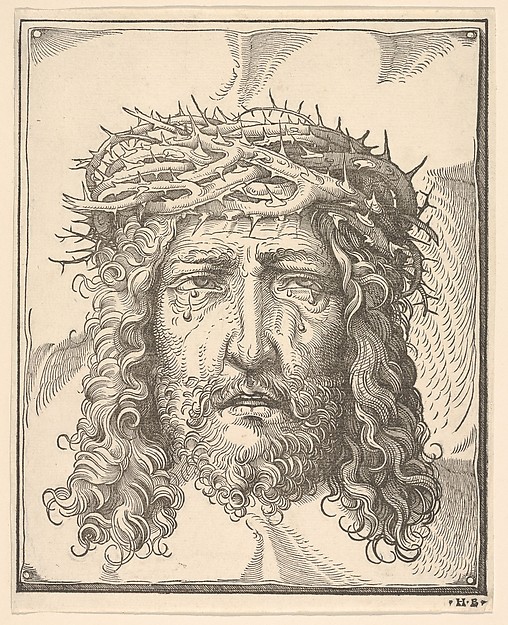
The Head of Christ Crowned with Thorns
The Head of Christ Crowned with Thorns, designed by Hans Burgkmair around 1498 in his early Augsburg workshop, depicts the iconographic subject of the Vir Dolorum (Man of Sorrows) — the close-cropped head of the suffering Christ presented as an autonomous devotional image for personal contemplation. Burgkmair shows the head in three-quarter view against a darkened ground, the crown of thorns pressed down on the brow, drops of blood running down the face from the puncture wounds, the eyes lowered in the attitude of inward suffering. The Vir Dolorum subject was one of the standard late-medieval and early-Renaissance Northern devotional types, intended for meditation on the Passion as a continuing personal encounter; Burgkmair's print circulated through the German-speaking Catholic devotional publishing market in editions for several decades after its first appearance.
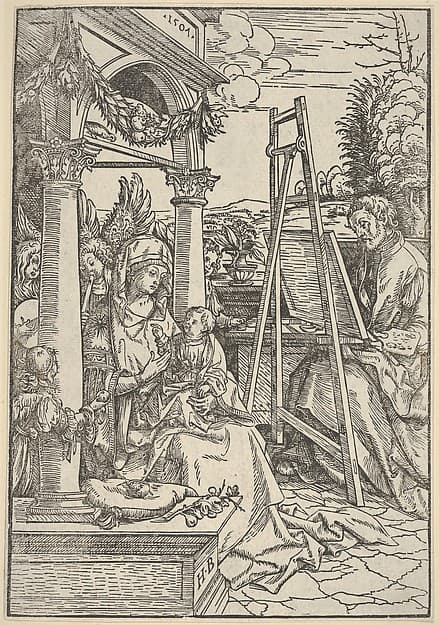
Saint Luke Painting the Virgin
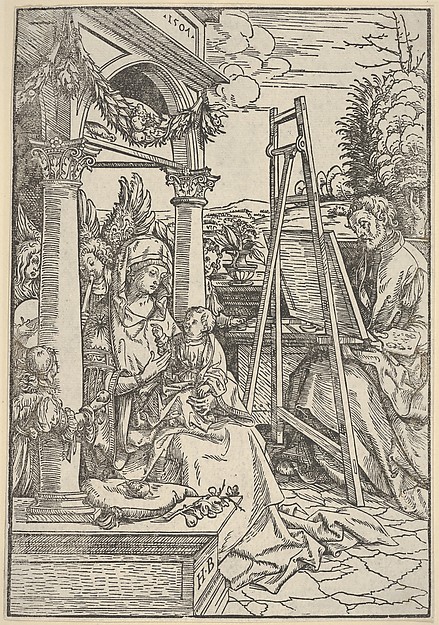
Saint Luke Painting the Virgin, woodcut designed by Hans Burgkmair around 1507 in his Augsburg workshop, depicts the iconographic subject from the medieval Golden Legend tradition in which the evangelist Luke — said to have been a painter as well as a Gospel writer — is shown painting a portrait of the Virgin Mary while she sits patiently with the Christ Child on her lap. Burgkmair stages the scene in a small Renaissance interior: the Virgin and Child seated at the right under a small architectural canopy, Luke seated in the center at his easel in the act of painting, with his attribute (the ox associated with him as the second of the four evangelists) at his feet. The composition was a particular favorite of late-medieval and Renaissance European painters' guilds, who took Luke as their patron saint.
Bible scenes Hans Burgkmair painted
John
Matthew
Luke
1 Kings
Revelation