
Matthew 4
People in this chapter
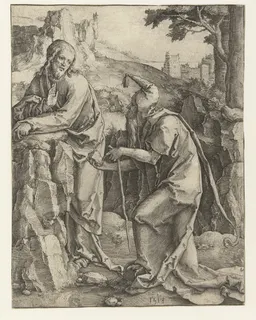
Matthew has just shown us the baptism - the heavens opened, the Spirit descending like a dove, the voice from heaven: This is my beloved Son, in whom I am well pleased (3:17). And the very next words turn that scene on its head: Then was Jesus led up of the Spirit into the wilderness to be tempted of the devil (v. 1). The same Spirit who anointed Him now leads Him out into the waste places to be tested.
The wilderness is loaded ground in the story of Israel. It is where the people wandered forty years, hungry and complaining, tested again and again to see whether they would trust God - and where, again and again, they failed. Now another Son goes into the wilderness, fasts forty days and forty nights, and is brought to the edge of His hunger. What broke Israel is about to come against Him.1
Tap any highlighted phrase to jump to the commentary that unpacks it.
Matthew 4:1-11It Is Written
1Then was Jesus led up of the Spirit into the wilderness to be tempted of the devil. 2And when he had fasted forty days and forty nights, he was afterward an hungred. 3And when the tempter came to him, he said, If thou be the Son of God, command that these stones be made bread. 4But he answered and said, It is written, Man shall not live by bread alone, but by every word that proceedeth out of the mouth of God. 5Then the devil taketh him up into the holy city, and setteth him on a pinnacle of the temple, 6And saith unto him, If thou be the Son of God, cast thyself down: for it is written, He shall give his angels charge concerning thee: and in their hands they shall bear thee up, lest at any time thou dash thy foot against a stone.
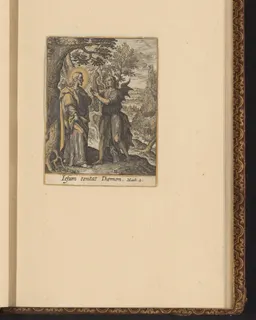
Mark where the testing begins. Jesus has just come up from the Jordan with the Father's voice still in the air - This is my beloved Son - and immediately He is led up of the Spirit into the wilderness to be tempted (v. 1). The same Spirit who anointed Him now leads Him to the testing. Forty days He fasts, and only then, afterward, when He is at the floor of His hunger, does the tempter come: If thou be the Son of God, command that these stones be made bread (v. 3).
It is a clever assault. There is nothing wrong with bread, and nothing wrong with the power Jesus truly has. The poison is in the if and in the shortcut - doubt the Father's word that just named you, and use your own power to meet your own need on your own terms, setting aside the Father's provision. Jesus will not. His answer goes back to the wilderness Israel knew: Man shall not live by bread alone, but by every word that proceedeth out of the mouth of God (v. 4).1
7Jesus said unto him, It is written again, Thou shalt not tempt the Lord thy God. 8Again, the devil taketh him up into an exceeding high mountain, and sheweth him all the kingdoms of the world, and the glory of them; 9And saith unto him, All these things will I give thee, if thou wilt fall down and worship me. 10Then saith Jesus unto him, Get thee hence, Satan: for it is written, Thou shalt worship the Lord thy God, and him only shalt thou serve. 11Then the devil leaveth him, and, behold, angels came and ministered unto him.
The first answer is worth lingering over, because it sets the pattern for all three. The tempter offered bread; Jesus replies, Man shall not live by bread alone, but by every word that proceedeth out of the mouth of God (v. 4). He is quoting Moses' explanation of the manna years - how God let Israel hunger and then fed them, that he might make thee know that man doth not live by bread only2.
Hunger is real and the body is good; and life runs deeper than appetite. A person who has everything to eat and no word from God is starving in the way that counts most. Israel, given bread from heaven, still grumbled and distrusted; this Son, given no bread at all, holds fast to the Father's word as the thing He truly lives on. He refuses to let even legitimate need become the lever that pries Him loose from trust.
The second temptation changes tactics entirely. The devil takes Jesus to a pinnacle of the temple and says, in effect, You trust the Scriptures? Here is one for you - and quotes Psalm 91: He shall give his angels charge concerning thee… lest at any time thou dash thy foot against a stone (v. 6). Cast yourself down; God has promised to catch you. It is a stunning move: the tempter wields the written word too.
But he wields it crookedly, snipping a promise of God's care for the faithful into a dare to force God's hand. Jesus answers with another word from Deuteronomy: It is written again, Thou shalt not tempt the Lord thy God (v. 7). To stage a crisis just to make God prove Himself is the opposite of faith. True trust does not need to manufacture rescues. The verse cuts cleanly through the misquotation - Scripture is a word for trusting God, held out by One who trusts it fully.3
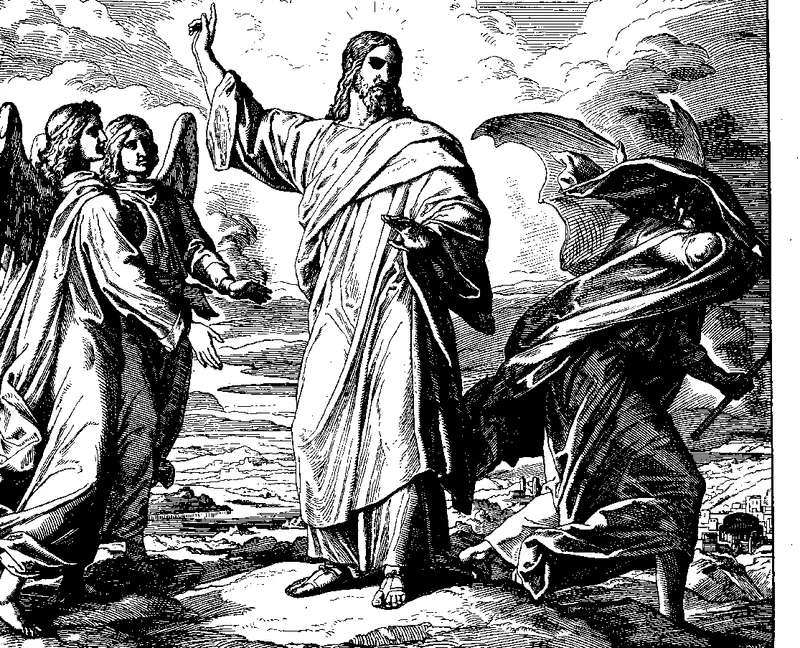
The third temptation drops all pretense. From an exceeding high mountain the devil shows Jesus all the kingdoms of the world, and the glory of them, and names his price: All these things will I give thee, if thou wilt fall down and worship me (vv. 8-9). This is the offer of the end without the means - the kingdoms that are rightly the Son's, handed over now, with no wilderness, no opposition, no cross.
All it costs is one act of worship aimed the wrong way. Jesus does not negotiate or linger; He drives it off: Get thee hence, Satan: for it is written, Thou shalt worship the Lord thy God, and him only shalt thou serve (v. 10). The word only is the hinge. Worship cannot be divided; the moment it is shared with another, it is no longer worship of God at all. The kingdom Jesus came for is not seized by bowing to the enemy of it.
And with that the assault breaks: Then the devil leaveth him, and, behold, angels came and ministered unto him (v. 11). The One who refused to demand angelic rescue is quietly given it, after the testing, in the Father's own time.
Matthew 4:12-17The People Which Sat in Darkness Saw Great Light
12Now when Jesus had heard that John was cast into prison, he departed into Galilee; 13And leaving Nazareth, he came and dwelt in Capernaum, which is upon the sea coast, in the borders of Zabulon and Nephthalim: 14That it might be fulfilled which was spoken by Esaias the prophet, saying, 15The land of Zabulon, and the land of Nephthalim, by the way of the sea, beyond Jordan, Galilee of the Gentiles; 16The people which sat in darkness saw great light; and to them which sat in the region and shadow of death light is sprung up. 17From that time Jesus began to preach, and to say, Repent: for the kingdom of heaven is at hand.
A hinge turns quietly in verse 12: Now when Jesus had heard that John was cast into prison, he departed into Galilee. John's voice is silenced, and at that very moment Jesus' own ministry steps forward - the forerunner gives way to the One he announced. And notice where Jesus goes: north to Galilee, and specifically to Capernaum, in the old tribal lands of Zabulon and Nephthalim (v. 13). This was the borderland - the first region overrun and carried off when Assyria came centuries before, the territory closest to the nations, mixed and looked down on, Galilee of the Gentiles (v. 15).
Of all the places to begin, Jesus begins here, among the people most likely to be written off. Matthew sees in it the hand of God: this is the very ground a prophet had marked out long before for the breaking of a great dawn. The light does not start at the center and trickle to the edges. It rises first over the margins.1
Matthew reaches back seven centuries to Isaiah, who had promised that the very region first swallowed in darkness would be the first to see the dawn: The people which sat in darkness saw great light; and to them which sat in the region and shadow of death light is sprung up (v. 16). The words are carefully chosen. The people do not merely walk in darkness; they sat in it - settled, resigned, at home in the dark, as if no other life were coming.
And it is not only darkness but the shadow of death, the gloom that hangs where death has the final say. Into exactly that, says Isaiah and now Matthew, light is sprung up. The light does not have to be searched out and earned; it dawns, the way morning comes to people who did nothing to summon it. This is Matthew's way of telling us who Jesus is before Jesus says a word: He is the daybreak the prophets promised, come to the people sitting in the dark.2
And then His ministry opens with one sentence: From that time Jesus began to preach, and to say, Repent: for the kingdom of heaven is at hand (v. 17). It is, word for word, the message John had been preaching (3:2) - but now the One the kingdom belongs to is the one announcing it. Two things hold together in the single line. The kingdom of heaven is at hand - God's reign has drawn near, a present and pressing reality, because the King Himself has stepped onto the stage.
And therefore: Repent. The order matters. The summons to repent is the only fitting response to good news that has already arrived. The reign of God is breaking in - so turn. Turn from the old direction, the old loyalties, the settled life in the dark, and turn toward the light that has sprung up. The call is urgent precisely because the kingdom is not far off but at hand.
Matthew 4:18-25Follow Me, and I Will Make You Fishers of Men
18And Jesus, walking by the sea of Galilee, saw two brethren, Simon called Peter, and Andrew his brother, casting a net into the sea: for they were fishers. 19And he saith unto them, Follow me, and I will make you fishers of men. 20And they straightway left their nets, and followed him. 21And going on from thence, he saw other two brethren, James the son of Zebedee, and John his brother, in a ship with Zebedee their father, mending their nets; and he called them. 22And they immediately left the ship and their father, and followed him.
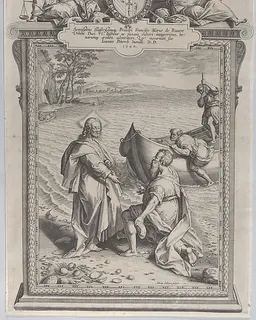
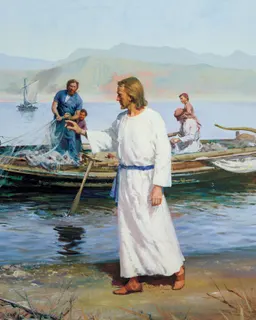
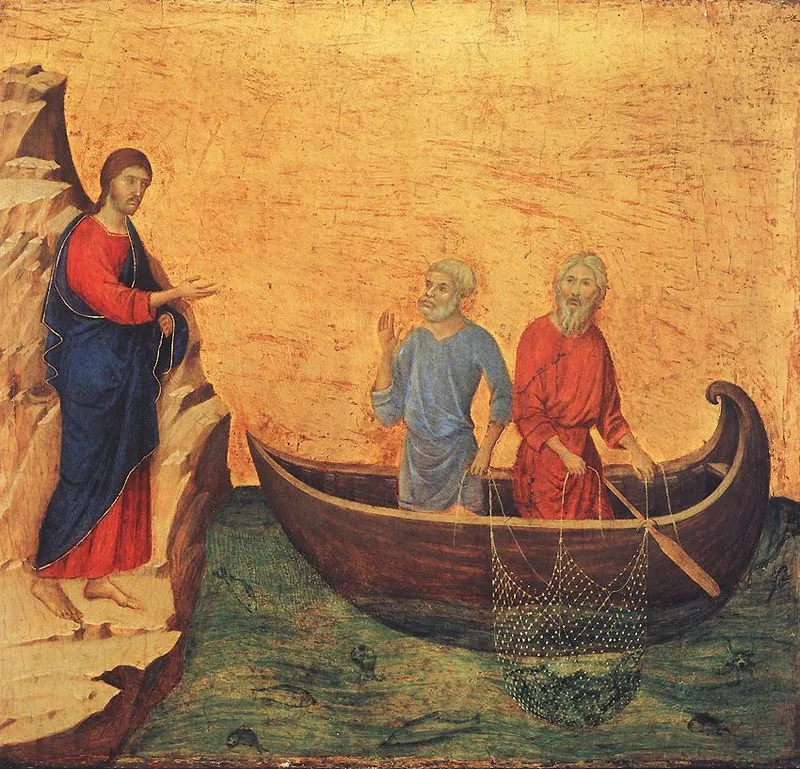
After the towering scenes of the wilderness and the prophecy of the dawn, the kingdom advances through something startlingly ordinary: a man walking by a lake, speaking to fishermen at work. And Jesus, walking by the sea of Galilee, saw two brethren, Simon called Peter, and Andrew his brother, casting a net into the sea (v. 18). There is no audition, no résumé, no test of their learning. Jesus simply calls: Follow me, and I will make you fishers of men (v. 19).
It is a remarkable promise folded into a command. He says I will make you - the forming is His work. And He meets these men exactly where they are, taking the one trade they know and bending it toward the kingdom: the skill of the net, the patience, the daily labour of the catch, all to be reborn as the gathering of people. The call takes their ordinary life up and gives it a vastly larger aim.1
What follows is told with almost no commentary, and the bareness is the point: And they straightway left their nets, and followed him (v. 20). Then again, with the second pair: James and John are in a ship with Zebedee their father, mending their nets, and at the call they immediately left the ship and their father, and followed him (vv. 21-22). Twice the same word - straightway, immediately. There is no hesitation recorded, no period of weighing the cost.
And see what is left: the nets are their livelihood, the ship their capital, and their father their family and their security - all of it set down at once to follow a man who offered them no wages and no guarantee, only Himself. This is what answering the call looks like in its purest form: the willingness to hold even good things loosely enough to leave them when He says follow. They went because they had recognized in Jesus something worth more than the nets in their hands.
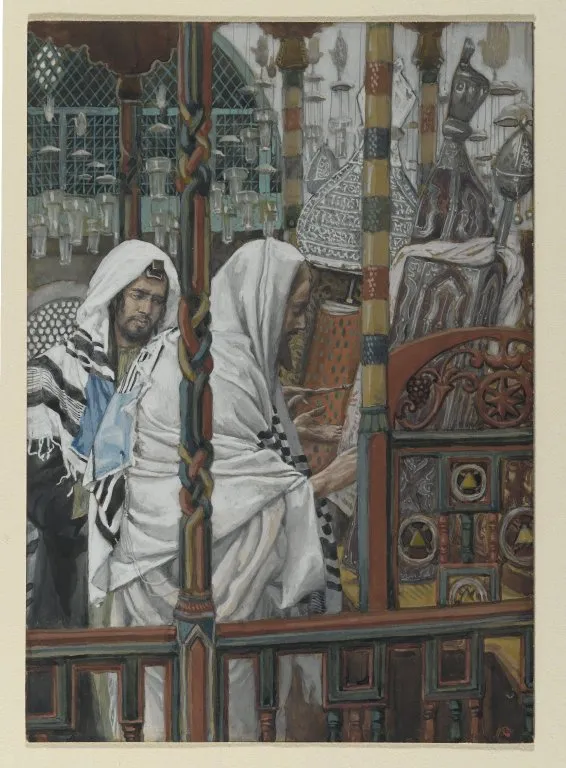
23And Jesus went about all Galilee, teaching in their synagogues, and preaching the gospel of the kingdom, and healing all manner of sickness and all manner of disease among the people. 24And his fame went throughout all Syria: and they brought unto him all sick people that were taken with divers diseases and torments, and those which were possessed with devils, and those which were lunatick, and those that had the palsy; and he healed them. 25And there followed him great multitudes of people from Galilee, and from Decapolis, and from Jerusalem, and from Judaea, and from beyond Jordan.
The chapter ends with the light spreading. Matthew sums up the whole of Jesus' early ministry in a threefold rhythm: teaching in their synagogues, and preaching the gospel of the kingdom, and healing all manner of sickness and all manner of disease (v. 23). Word and deed move together - the same kingdom that is preached is also enacted in bodies made whole; the announcement that God's reign has drawn near is confirmed in sickness, torment, and affliction giving way.
And the list of those brought to Him is deliberately sweeping - all manner of sickness, the demon-oppressed, the lunatick, those that had the palsy - as if to say there is no kind of brokenness outside the reach of this kingdom. So the crowds come, and from everywhere: from Galilee, and from Decapolis, and from Jerusalem, and from Judaea, and from beyond Jordan (v. 25) - from the Jewish heartland and the half-pagan east alike.
The dawn that rose over despised Galilee is already drawing people out of every direction toward the light. What began with one man calling four by a lakeside is becoming a multitude.
Research trail
Sources & further study
These references support the historical, linguistic, manuscript, and contextual notes in this chapter. Scripture remains the primary text; external sources are provided so readers can inspect the research directly.
- Matthew 4 - Translators' NotesThe NET Bible's detailed footnotes on Matthew 4 - the sense of the wilderness testing (vv. 1-2), the order of the temptations, the geography of Zebulun and Naphtali in the Isaiah citation (vv. 13-16), and the force of the call to the first disciples (vv. 18-22).
- Matthew 4 ↔ Deuteronomy 6-8 · Isaiah 9 · Psalm 91Traces the threads tying Matthew 4 to the rest of Scripture - each of Jesus' three answers drawn from Deuteronomy (8:3; 6:16; 6:13), the tempter's misuse of Psalm 91:11-12, and the light over Galilee quoted straight from Isaiah 9:1-2.
- Matthew 4 · Greek interlinear + lexiconThe Greek text of Matthew 4 word by word, with parsing and Strong's links - useful for peirazo (v. 1, “to be tempted,” the verb that means both to test and to entice), for gegraptai (vv. 4, 7, 10, the perfect “it stands written” behind “it is written”), and for metanoeite (v. 17, the command “repent”).
Where this echoes in Scripture
It Is Written
- Deuteronomy 8:2-3the LORD thy God led thee these forty years in the wilderness, to humble thee, and to prove thee... that he might make thee know that man doth not live by bread only.The verse Jesus quotes in v. 4 - Israel's forty years of testing answered by the Son's forty days.
- Hebrews 4:15we have not an high priest which cannot be touched with the feeling of our infirmities; but was in all points tempted like as we are, yet without sin.The wilderness testing of vv. 1-11 read as the ground of His sympathy - tempted as we are, yet without sin.
- Hebrews 2:18For in that he himself hath suffered being tempted, he is able to succour them that are tempted.Why the test in vv. 1-11 matters for us - the tempted Son becomes the help of the tempted.
- Psalm 91:11-12For he shall give his angels charge over thee... They shall bear thee up in their hands, lest thou dash thy foot against a stone.The promise the tempter twists in v. 6 - God's care turned into a dare to force His hand.
- 1 Corinthians 10:13There hath no temptation taken you but such as is common to man: but God is faithful, who will... with the temptation also make a way to escape.The pattern of vv. 1-11 promised to His people - tested, but never beyond a God-given way through.
The People Which Sat in Darkness Saw Great Light
- Isaiah 9:1-2The people that walked in darkness have seen a great light: they that dwell in the land of the shadow of death, upon them hath the light shined.The prophecy quoted in vv. 15-16 - the dawn promised to Zebulun and Naphtali, now risen in Jesus.
- John 8:12I am the light of the world: he that followeth me shall not walk in darkness, but shall have the light of life.The light of v. 16 named in person - the One in whom Isaiah's dawn comes.
- Luke 2:30-32For mine eyes have seen thy salvation... A light to lighten the Gentiles, and the glory of thy people Israel.Simeon's words fulfilled in vv. 15-16 - a light for the Gentiles, dawning first in Galilee of the Gentiles.
- Mark 1:14-15Jesus came into Galilee... saying... the kingdom of God is at hand: repent ye, and believe the gospel.The same opening proclamation as v. 17 - the nearness of the kingdom and the call to turn.
- Matthew 3:2And saying, Repent ye: for the kingdom of heaven is at hand.John's message taken up word for word in v. 17 - now spoken by the King the kingdom belongs to.
Follow Me, and I Will Make You Fishers of Men
- Mark 1:16-18Come ye after me, and I will make you to become fishers of men. And straightway they forsook their nets, and followed him.The same calling as vv. 18-20 - the immediate leaving of the nets at His word.
- Luke 5:10-11Fear not; from henceforth thou shalt catch men. And when they had brought their ships to land, they forsook all, and followed him.The catch of men promised in v. 19 - and the forsaking of all to follow.
- Matthew 16:24If any man will come after me, let him deny himself, and take up his cross, and follow me.The same call as v. 19 carried to its depth - following that costs the self.
- 1 Kings 19:19-21Elijah passed by him, and cast his mantle upon him... and he left the oxen, and ran after Elijah... and went after Elijah.An older picture of the call answered in vv. 20-22 - work and home left behind to follow.
- Matthew 9:35And Jesus went about all the cities and villages, teaching... and preaching the gospel of the kingdom, and healing every sickness.The same threefold ministry as v. 23 - teaching, preaching the kingdom, and healing.