

Mark 1
People in this chapter
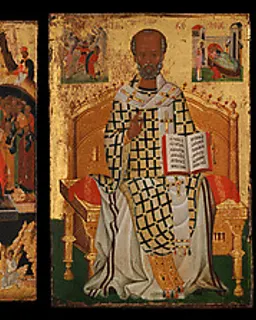
The Gospel according to Mark begins with a single line that does the work an entire genealogy does in Matthew and an entire birth narrative does in Luke: The beginning of the gospel of Jesus Christ, the Son of God (v. 1). Before anything happens, the reader is told the verdict the rest of the book will prove - this is good news, and it is about the Son of God. Then the curtain rises not in a palace or a temple but in the wilderness, where a prophet stands in the line of Isaiah's promise: The voice of one crying in the wilderness, Prepare ye the way of the Lord, make his paths straight (v. 3).
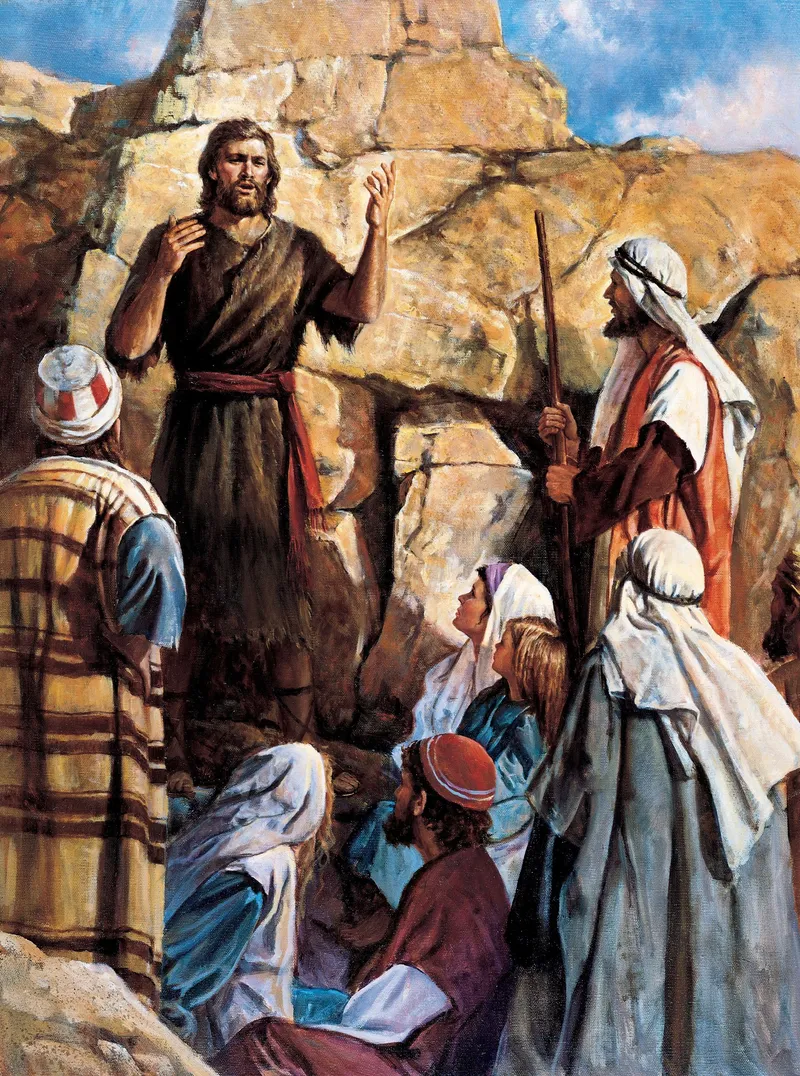
John baptizes the crowds streaming out from Judaea and Jerusalem, and yet he keeps pointing past himself: There cometh one mightier than I after me… he shall baptize you with the Holy Ghost (vv. 7-8).1
Tap any highlighted phrase to jump to the commentary that unpacks it.
Mark 1:1-13The Beginning of the Gospel of Jesus Christ
1The beginning of the gospel of Jesus Christ, the Son of God; 2As it is written in the prophets, Behold, I send my messenger before thy face, which shall prepare thy way before thee. 3The voice of one crying in the wilderness, Prepare ye the way of the Lord, make his paths straight. 4John did baptize in the wilderness, and preach the baptism of repentance for the remission of sins. 5And there went out unto him all the land of Judaea, and they of Jerusalem, and were all baptized of him in the river of Jordan, confessing their sins. 6And John was clothed with camel’s hair, and with a girdle of a skin about his loins; and he did eat locusts and wild honey; 7And preached, saying, There cometh one mightier than I after me, the latchet of whose shoes I am not worthy to stoop down and unloose. 8I indeed have baptized you with water: but he shall baptize you with the Holy Ghost.
Mark opens with a sentence that is really a banner unfurled over the whole book: The beginning of the gospel of Jesus Christ, the Son of God (v. 1). There is no genealogy here, no nativity, no shepherds or wise men - Mark gives the verdict first and lets the rest of the story prove it. Notice everything packed into this one line. The word gospel means good news, an announcement that something has happened. The name Jesus means the LORD saves. The title Christ is the Anointed One, the long-promised King.
And the Son of God names a relationship to the Father that the rest of the chapter will fill out at the Jordan. So before a single event unfolds, the reader already holds the conclusion in hand: this is good news, and it is about the anointed Son. Everything that follows - the wilderness preaching, the torn heaven, the calling, the casting out, the healing - is Mark showing his work, demonstrating in scene after scene the thing he stated in line one.1
Before Jesus appears, Mark reaches back into the prophets and stitches two voices together: Behold, I send my messenger before thy face… The voice of one crying in the wilderness, Prepare ye the way of the Lord, make his paths straight (vv. 2-3). The first phrase echoes Malachi's promise of a messenger sent ahead, and the second quotes Isaiah's herald who readies a highway through the desert for the coming of God Himself.
In the ancient world, when a king was about to travel, runners went ahead to clear the road, fill the low places, and level the path. John is exactly that runner. He appears in the wilderness, the very place Isaiah named, preaching a baptism of repentance, and the crowds pour out from Judaea and Jerusalem to confess their sins in the Jordan. The detail that he is clothed with camel's hair, and with a girdle of a skin about his loins (v. 6) is no accident either; it is the dress of Elijah, the prophet Israel expected to return before the great day of the LORD.
The whole picture says one thing: the road is being cleared because the King is almost here.2
John's entire ministry bends away from himself and toward another: There cometh one mightier than I after me, the latchet of whose shoes I am not worthy to stoop down and unloose (v. 7). Loosing a master's sandals was the lowest task a household servant could be given - and John says he is not fit even for that, in relation to the One coming after him. Here is a man at the height of his fame, with all the land streaming out to hear him, and he spends that influence pointing past himself.
Then he draws the decisive contrast: I indeed have baptized you with water: but he shall baptize you with the Holy Ghost (v. 8). John's baptism is real and good, but it is preparatory - an outward washing that readies the heart. What the mightier One brings is of a wholly different order: He pours out the Spirit of God. The forerunner can ready a people; only the One he announces can fill them. John knows the difference exactly, and he is content to be the voice, not the Word.
9And it came to pass in those days, that Jesus came from Nazareth of Galilee, and was baptized of John in Jordan. 10And straightway coming up out of the water, he saw the heavens opened, and the Spirit like a dove descending upon him: 11And there came a voice from heaven, saying, Thou art my beloved Son, in whom I am well pleased. 12And immediately the Spirit driveth him into the wilderness. 13And he was there in the wilderness forty days, tempted of Satan; and was with the wild beasts; and the angels ministered unto him.
Jesus comes from Nazareth of Galilee - an unremarkable town in an unremarkable region - and is baptized by John in the Jordan (v. 9). It is a quiet entrance for the One John has been heralding, and that quietness is part of the point: the King steps into the line of ordinary people coming to repent, identifying Himself fully with those He has come to save. Then the quiet breaks open. Straightway coming up out of the water, he saw the heavens opened, and the Spirit like a dove descending upon him (v. 10).
Mark's word for opened is stronger than it sounds in English - it means torn, ripped apart, the way cloth is rent; the same word will return at the very end of the Gospel when the temple veil is torn at the cross. Heaven does not politely part; it is torn open so that the Spirit may come down. And with the Spirit comes the voice: Thou art my beloved Son, in whom I am well pleased (v. 11).
The text sets three before us at once - the Son rising from the water, the Spirit descending upon Him, and the Father's voice from heaven naming Him - given together, exactly as Mark records them.
There is no pause to savour the moment. And immediately the Spirit driveth him into the wilderness (v. 12). The verb is forceful - the same Spirit that descended in blessing now thrusts Him out into the desert to be tested. Mark tells the whole forty days in a single compressed sentence where Matthew and Luke linger over each temptation: And he was there in the wilderness forty days, tempted of Satan; and was with the wild beasts; and the angels ministered unto him (v. 13).
Even in brevity the details carry weight. Forty days recalls Israel's forty years in the wilderness and Moses' and Elijah's forty-day fasts - Jesus is walking ground God's people have walked before, but walking it faithfully. The wild beasts evoke the danger and desolation of the wasteland, while the ministering angels show that He is not abandoned in it. The pattern is worth marking: the affirmation at the Jordan is followed immediately by the testing in the desert.
Heaven's approval did not exempt Him from the wilderness; it sent Him into it. The same Spirit who names a person beloved may also lead them straight into the place of proving.
Mark 1:14-20The Time Is Fulfilled · Fishers of Men
14Now after that John was put in prison, Jesus came into Galilee, preaching the gospel of the kingdom of God, 15And saying, The time is fulfilled, and the kingdom of God is at hand: repent ye, and believe the gospel. 16Now as he walked by the sea of Galilee, he saw Simon and Andrew his brother casting a net into the sea: for they were fishers. 17And Jesus said unto them, Come ye after me, and I will make you to become fishers of men. 18And straightway they forsook their nets, and followed him. 19And when he had gone a little farther thence, he saw James the son of Zebedee, and John his brother, who also were in the ship mending their nets. 20And straightway he called them: and they left their father Zebedee in the ship with the hired servants, and went after him.
With John now arrested, Jesus steps forward into Galilee and takes up the proclamation Himself: The time is fulfilled, and the kingdom of God is at hand: repent ye, and believe the gospel (vv. 14-15). Every word is loaded. The time is fulfilled - the appointed hour toward which all the prophets had been straining has at last arrived; the waiting is over. The kingdom of God is at hand - God's reign, His active rule, has drawn near, not as a distant future hope but as a present reality breaking into the world in the person of the King who is speaking.
And then the response He asks for comes in two words held together: repent and believe. To repent is to turn - a deliberate change of mind and direction, a turning away from the old course of life. To believe the gospel is to entrust oneself to the good news, to receive the announcement as true and stake one's life on it. Jesus does not open with a program of self-improvement or a list of moral techniques.
He announces that God has acted, and He calls for the only fitting response to news that large: turn, and trust.
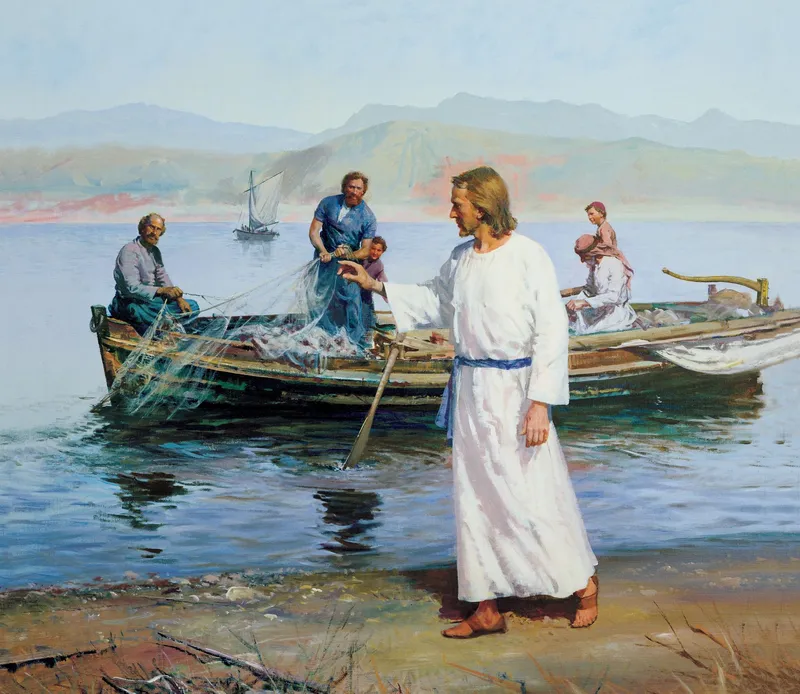
The first thing the King does after announcing the kingdom is gather people into it - and He does it by the most ordinary lakeside imaginable. As he walked by the sea of Galilee, he saw Simon and Andrew… for they were fishers (v. 16). These are working men in the middle of a working day, nets in their hands. To them Jesus speaks a summons and a promise in one breath: Come ye after me, and I will make you to become fishers of men (v. 17).
Notice that He does not despise their trade; He takes it up and transforms it. The skills of a fisherman - patience, timing, knowing the waters, the willingness to cast again after an empty night - will all carry over, only now the catch will be people drawn into the kingdom of God. And notice too the shape of the promise: I will make you to become. They do not arrive finished; He will form them over time into what He is calling them to be.
The initiative is entirely His - He sees them, He calls them, He promises to make them - and the call is at once an invitation to follow and a commission to a work far larger than the one they were doing.
The response is as abrupt as the call: And straightway they forsook their nets, and followed him (v. 18). There it is again, Mark's drumbeat word - straightway. No negotiation, no request for time to think it over, no settling of affairs first. They simply leave the nets where they fall and go. Then it happens a second time, a little further down the shore, with James and John: straightway he called them: and they left their father Zebedee in the ship with the hired servants, and went after him (vv. 19-20).
Mark adds a poignant detail the second time - they leave not only the nets but their father, and a family business solid enough to employ hired servants. This was no desperate flight from poverty; they walked away from a going concern and from their own father in the boat. The point of the doubled scene and the repeated straightway is not that following Jesus must always be instantaneous and uncalculated, but that the call of the King carries an authority that rightly claims everything.
When He says follow, the only response that fits the weight of who He is, is to go.
Mark 1:21-34What New Doctrine Is This? · Authority over Spirits and Disease
21And they went into Capernaum; and straightway on the sabbath day he entered into the synagogue, and taught. 22And they were astonished at his doctrine: for he taught them as one that had authority, and not as the scribes. 23And there was in their synagogue a man with an unclean spirit; and he cried out, 24Saying, Let us alone; what have we to do with thee, thou Jesus of Nazareth? art thou come to destroy us? I know thee who thou art, the Holy One of God. 25And Jesus rebuked him, saying, Hold thy peace, and come out of him. 26And when the unclean spirit had torn him, and cried with a loud voice, he came out of him. 27And they were all amazed, insomuch that they questioned among themselves, saying, What thing is this? what new doctrine is this? for with authority commandeth he even the unclean spirits, and they do obey him. 28And immediately his fame spread abroad throughout all the region round about Galilee.
Jesus speaks differently. His word stands on its own; it does not lean on anyone. There is a directness, a finality, a sense that the One speaking has the right to speak so - and the crowd feels it instantly, even before they can explain it. Mark does not record the content of the teaching here; he records its character. What stunned the synagogue was not a clever new argument but a new kind of authority in the very manner of the man - as though, for once, the truth were not being quoted but spoken at its source.
The teaching is interrupted by a cry. There was in their synagogue a man with an unclean spirit, and it shrieks out: Let us alone; what have we to do with thee, thou Jesus of Nazareth? art thou come to destroy us? I know thee who thou art, the Holy One of God (vv. 23-24). It is a startling moment - the first being in Mark's Gospel to name Jesus correctly is a demon.
The unclean spirit knows exactly who has walked into the room: the Holy One of God. Its words are full of dread; it senses that the arrival of the Holy One means its own undoing. Jesus does not engage it, debate it, or accept its testimony - He silences and expels it in a single stroke: Hold thy peace, and come out of him (v. 25). The command is curt and total. The spirit convulses the man and screams, but it must go: when the unclean spirit had torn him, and cried with a loud voice, he came out of him (v. 26).
The contrast is stark and deliberate. Here is the Holy One confronting the unclean spirit, and there is no struggle of equals - only a word, and obedience. The teaching with authority (v. 22) is now matched by power with authority: He speaks, and even the unseen powers must obey.
The synagogue erupts in astonishment, and Mark records the exact question on their lips: What thing is this? what new doctrine is this? for with authority commandeth he even the unclean spirits, and they do obey him (v. 27). It is the right question, even if they cannot yet answer it. They have just watched teaching and power come together in one person - a word that not only instructs but commands, and is obeyed by the very forces no rabbi could touch.
Their word new is telling: this is not more of the same religion, not another teacher in a long line, but something genuinely unprecedented breaking into their ordinary sabbath. And so, Mark notes, immediately his fame spread abroad throughout all the region round about Galilee (v. 28) - there is that immediately again, the news running ahead of Him from town to town. The crowd's question hangs in the air for the reader to answer: What thing is this? Mark has already told us in verse one.
The authority that silences demons belongs to the Son of God, and His coming is the inbreaking of a kingdom the old powers cannot withstand.
29And forthwith, when they were come out of the synagogue, they entered into the house of Simon and Andrew, with James and John. 30But Simon’s wife’s mother lay sick of a fever, and anon they tell him of her. 31And he came and took her by the hand, and lifted her up; and immediately the fever left her, and she ministered unto them. 32And at even, when the sun did set, they brought unto him all that were diseased, and them that were possessed with devils. 33And all the city was gathered together at the door. 34And he healed many that were sick of divers diseases, and cast out many devils; and suffered not the devils to speak, because they knew him.
From the synagogue the scene shifts at once to a home. Simon's wife's mother lay sick of a fever, and they tell Jesus of her without delay (vv. 29-30). What He does is quiet and personal where the exorcism was dramatic and public: he came and took her by the hand, and lifted her up; and immediately the fever left her (v. 31). There is great tenderness in the gesture - not a word shouted across the room but a hand taken, a person raised.
The same authority that hurled out a demon now stoops to lift a sick woman from her bed, and the fever flees as readily as the spirit did. And Mark adds the lovely sequel: she ministered unto them. Restored, she immediately turns to serve - her healing issues in service, the natural response of one made whole. It is a small picture of a large truth: those whom Jesus raises up, He raises up for something.
The hand that lifts is the same hand that calls into a life of ministering to others.
As word of the day's events spreads, the whole town converges on one doorway. At even, when the sun did set, they brought unto him all that were diseased, and them that were possessed with devils. And all the city was gathered together at the door (vv. 32-33). The timing matters: it was the sabbath, and the people waited until sundown, when the sabbath ended, before carrying their sick through the streets. And then they came - all of them, it seems, the whole city pressed up against Simon's door, bearing every kind of suffering.
He healed many that were sick of divers diseases, and cast out many devils (v. 34). The scope is staggering: disease after disease, demon after demon, person after person, late into the evening. Here is the kingdom of God spilling out of the synagogue and into the street, meeting the raw, mixed misery of an ordinary town. Mark adds one curious note - He suffered not the devils to speak, because they knew him. Even though their testimony was accurate, Jesus refuses it; the truth of who He is will be revealed on His terms and along the road to the cross, not broadcast by unclean spirits.
The Holy One commands even the timing of His own disclosure.
Mark 1:35-45A Great While Before Day · I Will; Be Thou Clean
35And in the morning, rising up a great while before day, he went out, and departed into a solitary place, and there prayed. 36And Simon and they that were with him followed after him. 37And when they had found him, they said unto him, All men seek for thee. 38And he said unto them, Let us go into the next towns, that I may preach there also: for therefore came I forth. 39And he preached in their synagogues throughout all Galilee, and cast out devils.
After a day of teaching and healing that ran late into the night, Mark gives us a glimpse of where Jesus draws His strength: in the morning, rising up a great while before day, he went out, and departed into a solitary place, and there prayed (v. 35). Every clause adds to the picture. It is still dark - a great while before day. He deliberately went out and departed, putting distance between Himself and the crowds.
He sought a solitary place, somewhere apart and quiet. And there, alone in the dark before anyone else was stirring, He prayed. This is striking precisely because of what came before it. The previous evening the whole city had been at the door; His fame was racing across Galilee; by every human measure He was at the peak of success. And the very next thing He does is rise before dawn to be alone with the Father.
The busiest, most fruitful day in the chapter is followed by withdrawal and prayer. Mark does not tell us the content of the prayer, but he tells us its priority: before the demands of the new day could reach Him, Jesus went first to the source. The Servant on mission is sustained not by the momentum of His own success but by communion with the One who called Him.
Simon and the others come hunting for Him - they that were with him followed after him - and when they find Him their words carry a hint of pressure: All men seek for thee (vv. 36-37). The crowds are waiting; the momentum is here; surely He should return and capitalize on it. But Jesus answers with a settled sense of purpose that overrides the pull of the crowd: Let us go into the next towns, that I may preach there also: for therefore came I forth (v. 38).
It would have been easy to stay where He was wanted, to become Capernaum's resident healer, hemmed in by a single town's demands. Jesus refuses. He has come for more than one place; the good news must be carried to the next towns and the ones beyond them. The phrase for therefore came I forth reveals a man governed by mission, not by acclaim. He measures the next step not by where the crowds are largest but by why He was sent.
And so, Mark reports, he preached in their synagogues throughout all Galilee, and cast out devils (v. 39) - the proclamation and the power moving on together, town after town, exactly as He said.
40And there came a leper to him, beseeching him, and kneeling down to him, and saying unto him, If thou wilt, thou canst make me clean. 41And Jesus, moved with compassion, put forth his hand, and touched him, and saith unto him, I will; be thou clean. 42And as soon as he had spoken, immediately the leprosy departed from him, and he was cleansed. 43And he straitly charged him, and forthwith sent him away; 44And saith unto him, See thou say nothing to any man: but go thy way, shew thyself to the priest, and offer for thy cleansing those things which Moses commanded, for a testimony unto them. 45But he went out, and began to publish it much, and to blaze abroad the matter, insomuch that Jesus could no more openly enter into the city, but was without in desert places: and they came to him from every quarter.
To grasp the final scene, one has to understand what leprosy meant. Under the law a leper was not merely ill; he was unclean, cut off from the camp, the worship, and the touch of the community. He was required to live apart, to wear torn clothes, and to warn others away by crying Unclean, unclean. No one could touch him without becoming unclean themselves. So when there came a leper to him, beseeching him, and kneeling down to him (v. 40), he is breaking every social rule simply by approaching.
His plea is a model of humble faith: If thou wilt, thou canst make me clean. He does not doubt the power - thou canst - he only wonders at the willingness - if thou wilt. And he asks not merely to be healed of a disease but to be made clean, restored to the people of God, allowed back into the community of the living. He wants more than a cure; he wants to come home.
Jesus' answer overturns everything the law of cleanness had built. He is moved with compassion - the feeling rises from His depths - and then He does the unthinkable: He put forth his hand, and touched him (v. 41). He could have healed with a word from across the road, as He will do elsewhere. Instead He reaches out and touches the untouchable man. By every rule of the law, that touch should have made Jesus unclean.
But the current runs the other way. Uncleanness does not flow from the leper into Jesus; cleanness flows from Jesus into the leper: I will; be thou clean. And as soon as he had spoken, immediately the leprosy departed from him, and he was cleansed (vv. 41-42). Here is something the law could only diagnose, never do. The law could declare a man unclean and shut him out; it could not make him clean and bring him back.
Jesus does what the law could not - and He does it by drawing near, not by keeping His distance. Then He sends the man to the priest to offer for thy cleansing those things which Moses commanded, for a testimony unto them (v. 44), honoring the law even as He transcends it - let the priests themselves certify that a leper has been made whole. The man, overflowing, cannot keep silent (v. 45); the news spreads until Jesus must stay outside in the desert places, and still they come to Him from every quarter.
Research trail
Sources & further study
These references support the historical, linguistic, manuscript, and contextual notes in this chapter. Scripture remains the primary text; external sources are provided so readers can inspect the research directly.
- Mark 1 - Translators' NotesThe NET Bible's detailed footnotes on Mark 1 - the composite citation from the prophets in verses 2-3, the force of the heavens being torn at the baptism (v. 10), the meaning of the kingdom drawn near (v. 15), and the textual question over whether verse 41 reads “moved with compassion” or “moved with anger.”
- Mark 1 ↔ Isaiah 40 · Malachi 3 · Exodus 23Traces the Old Testament threads Mark weaves into his opening - the messenger of Malachi 3:1 and Exodus 23:20 (v. 2) and the voice in the wilderness of Isaiah 40:3 (v. 3), read alongside the kingdom Jesus proclaims (v. 15) and the priestly cleansing of the leper that Moses commanded (v. 44; Lev. 13-14).
- Mark 1 · Greek interlinear + lexiconThe Greek text of Mark 1 word by word, each term linked to its lexicon entry - useful for euangelion (v. 1, the “gospel” or good news), for the relentless euthus (vv. 10, 12, 18, 20, 21…, “straightway / immediately”), for schizo (v. 10, the heavens “rent” open), and for splanchnizomai (v. 41, “moved with compassion”).
Where this echoes in Scripture
The Beginning of the Gospel of Jesus Christ
- Isaiah 40:3The voice of him that crieth in the wilderness, Prepare ye the way of the LORD, make straight in the desert a highway for our God.The herald Mark quotes in verse 3 - the road cleared in the wilderness for the coming of God Himself.
- Malachi 3:1Behold, I will send my messenger, and he shall prepare the way before me.The messenger promise woven into verse 2 - the forerunner sent ahead of the Lord.
- Isaiah 42:1Behold my servant, whom I uphold; mine elect, in whom my soul delighteth; I have put my spirit upon him.The servant in whom God delights, given the Spirit - the language behind the voice at the Jordan (vv. 10-11).
- Genesis 1:2And the Spirit of God moved upon the face of the waters.The Spirit hovering over the waters at the beginning - echoed by the Spirit descending over the Jordan (v. 10).
- John 1:32-33I saw the Spirit descending from heaven like a dove, and it abode upon him... the same is he which baptizeth with the Holy Ghost.The same descending Spirit and the same promise as verses 8 and 10 - the One who baptizes with the Holy Ghost.
The Time Is Fulfilled · Fishers of Men
- Daniel 2:44shall the God of heaven set up a kingdom, which shall never be destroyed... it shall stand for ever.The kingdom of God the prophets awaited - declared “at hand” in the person of Jesus (vv. 14-15).
- Matthew 4:17From that time Jesus began to preach, and to say, Repent: for the kingdom of heaven is at hand.The same opening proclamation as verse 15 - the kingdom near, the call to repent.
- Luke 5:10-11Fear not; from henceforth thou shalt catch men. And... they forsook all, and followed him.The calling of the fishermen of verses 16-20, with Luke's added detail that they forsook all.
- 1 Kings 19:19-21Elijah passed by him, and cast his mantle upon him... and he arose, and went after Elijah, and ministered unto him.The pattern of an immediate, costly call to follow - Elisha leaving his oxen as the four leave their nets (vv. 18-20).
- Philippians 3:7-8But what things were gain to me, those I counted loss for Christ.The reckoning behind forsaking the nets (v. 18) - counting all else loss for the sake of following Christ.
What New Doctrine Is This? · Authority over Spirits and Disease
- Matthew 7:28-29the people were astonished at his doctrine: for he taught them as one having authority, and not as the scribes.The same astonishment at His authority as verse 22 - a word unlike the borrowed authority of the scribes.
- Luke 4:33-36with authority and power he commandeth the unclean spirits, and they come out. And the fame of him went out.Luke's account of the same synagogue exorcism in verses 23-28.
- James 2:19Thou believest that there is one God; thou doest well: the devils also believe, and tremble.The demon's accurate confession in verse 24 - knowledge of who Jesus is, without saving faith.
- Colossians 2:15And having spoiled principalities and powers, he made a shew of them openly, triumphing over them.The authority over unclean spirits in verses 25-27 carried to its end - the powers disarmed and triumphed over.
- Psalm 107:19-20they cry unto the LORD in their trouble... He sent his word, and healed them.The healing word that meets the city's diseases in verses 32-34 - God sending His word to heal.
A Great While Before Day · I Will; Be Thou Clean
- Leviticus 13:45-46his clothes shall be rent... and shall cry, Unclean, unclean... he shall dwell alone; without the camp shall his habitation be.The law that exiled the leper of verse 40 - the uncleanness Jesus reverses with a touch in verse 41.
- Luke 5:15-16so much the more went there a fame abroad of him... And he withdrew himself into the wilderness, and prayed.The same rhythm as verses 35 and 45 - rising fame met by withdrawal and prayer.
- John 4:34My meat is to do the will of him that sent me, and to finish his work.The mission that drives Him past the crowds in verse 38 - sent forth to do the will of the One who sent Him.
- Hebrews 4:15-16we have not an high priest which cannot be touched with the feeling of our infirmities... Let us therefore come boldly.The compassion that reaches for the leper in verse 41 - the high priest moved by our weakness, to whom we may come boldly.
- Isaiah 53:4Surely he hath borne our griefs, and carried our sorrows.The Servant who takes our uncleanness upon Himself - the deeper meaning of the touch that cleanses in verses 41-42.