Matthew 7
People in this chapter
Jesus brings the Sermon on the Mount to its close, and the teaching turns outward - from the heart's hidden life to the way His disciples are to treat one another and the world. It opens with a warning against the harsh, fault-finding spirit: Judge not, that ye be not judged (v. 1). The picture that follows is unforgettable and a little absurd - a person fussing over the mote, the speck, in someone else's eye while a beam, a plank, juts out of his own (vv. 3-5).
The cure begins with oneself: first cast out the beam out of thine own eye; and then shalt thou see clearly to help your brother. He adds a hard, balancing word about not casting what is holy before those set against it (v. 6).1
Tap any highlighted phrase to jump to the commentary that unpacks it.
Matthew 7:1-12Ask, and It Shall Be Given You
1Judge not, that ye be not judged. 2For with what judgment ye judge, ye shall be judged: and with what measure ye mete, it shall be measured to you again. 3And why beholdest thou the mote that is in thy brother’s eye, but considerest not the beam that is in thine own eye? 4Or how wilt thou say to thy brother, Let me pull out the mote out of thine eye; and, behold, a beam is in thine own eye? 5Thou hypocrite, first cast out the beam out of thine own eye; and then shalt thou see clearly to cast out the mote out of thy brother’s eye. 6Give not that which is holy unto the dogs, neither cast ye your pearls before swine, lest they trample them under their feet, and turn again and rend you. 7Ask, and it shall be given you; seek, and ye shall find; knock, and it shall be opened unto you: 8For every one that asketh receiveth; and he that seeketh findeth; and to him that knocketh it shall be opened. 9Or what man is there of you, whom if his son ask bread, will he give him a stone? 10Or if he ask a fish, will he give him a serpent? 11If ye then, being evil, know how to give good gifts unto your children, how much more shall your Father which is in heaven give good things to them that ask him? 12Therefore all things whatsoever ye would that men should do to you, do ye even so to them: for this is the law and the prophets.
The Sermon's closing movement opens with a word so familiar it is often heard wrongly: Judge not, that ye be not judged (v. 1). It is worth being careful here, because the verse is not a blanket ban on all moral discernment - the same Sermon will go on to warn against false prophets and call its hearers to tell good trees from corrupt ones, which takes real judgment. What Jesus forbids is the censorious, fault-finding spirit that sets itself up as another's judge while excusing its own faults.
He names the principle plainly: with what judgment ye judge, ye shall be judged: and with what measure ye mete, it shall be measured to you again (v. 2). The standard you apply to others is the standard you invite upon yourself. A person harsh and quick to condemn is building the very scaffold by which he will be measured - if not by others, then by God. The warning is against the proud, unmerciful posture that loves to weigh everyone but itself.1
Jesus drives the point home with an image at once absurd and exact: why beholdest thou the mote that is in thy brother's eye, but considerest not the beam that is in thine own eye? (v. 3). A mote is a speck, a splinter, a fleck of sawdust; a beam is a plank, a load-bearing timber. The comedy is deliberate - a man with a whole length of lumber jutting from his own eye, peering in to tweeze a speck from someone else's.
And it lands as rebuke: how absurd to fuss over a small fault in another while blind to a glaring one in yourself. Notice, though, that Jesus does not say the speck does not matter or should be left alone. His command is about order: first cast out the beam out of thine own eye; and then shalt thou see clearly to cast out the mote out of thy brother's eye (v. 5). Self-examination is not an excuse to ignore a brother's need; it is what makes real help possible.
The one who has dealt honestly with his own sin sees clearly, and comes to remove the speck not as a judge above but as one who knows from the inside what it costs. He calls the man who reverses the order what he is: Thou hypocrite.
Verse 6 sits like a hard, balancing weight against the gentleness around it: Give not that which is holy unto the dogs, neither cast ye your pearls before swine, lest they trample them under their feet, and turn again and rend you. If the verses before guard against being too quick to condemn, this one guards against being undiscerning - against treating what is sacred as if it had no value, pressing it on those set against it.
In the ancient world the dog was a scavenger and the swine an unclean animal; the images are vivid, not contemptuous of persons but warning that holy things can be squandered. Pearls - precious, costly - thrown before swine are not received but trampled, and the giver may be turned on for his trouble. Read alongside judge not, the verse rounds out the picture: the disciple is to be neither harsh nor naive. Mercy is not the same as carelessness.
There is a wisdom that knows when to press the truth and when its time has not yet come - that holds what is holy as holy, and does not force it where it will only be trodden underfoot.
Now the tone opens into pure invitation: Ask, and it shall be given you; seek, and ye shall find; knock, and it shall be opened unto you (v. 7). The three verbs build on one another - asking, then seeking, then knocking - and Jesus repeats them with their answers so the promise cannot be missed: every one that asketh receiveth; and he that seeketh findeth; and to him that knocketh it shall be opened (v. 8).
This is prayer held out as a child's open access to a Father who delights to give. And that is exactly the ground Jesus stands it on. He turns to ordinary fatherhood: what man, if his son asks bread, hands him a stone? if he asks a fish, gives him a serpent? (vv. 9-10). No decent father plays such cruel tricks. Then the argument from the lesser to the greater: If ye then, being evil, know how to give good gifts unto your children, how much more shall your Father which is in heaven give good things to them that ask him? (v. 11).
The logic is breathtaking in its tenderness. If even flawed, sinful parents instinctively give good things to their children, the goodness of the Father in heaven must be greater beyond measure. The hesitation we so often feel in prayer - that God is reluctant, that we must wear Him down - is answered here at the root. He is not a grudging giver. He is a Father who waits to be asked.
Then, with a single therefore, Jesus gathers the whole moral teaching of Scripture into one line: all things whatsoever ye would that men should do to you, do ye even so to them: for this is the law and the prophets (v. 12). It is striking how the rule is framed. It begins with an active imagination of the good: picture what you would want done to you, and then go and do that for another.
It puts the burden of love on the one who acts, inviting generosity rather than waiting for need to announce itself. And Jesus weights it with extraordinary breadth: this is the law and the prophets. The entire revelation God had given - the commandments of Moses, the burden of the prophets - comes to a point in the call to treat your neighbour as you would long to be treated. The placement matters too. Coming right after the promise that the Father gives good things to those who ask, the rule reads as the overflow of received grace: those who know themselves freely given to by the Father are to become, in turn, free givers to everyone around them.
Matthew 7:13-23The Strait Gate · Known by Their Fruits
13Enter ye in at the strait gate: for wide is the gate, and broad is the way, that leadeth to destruction, and many there be which go in thereat: 14Because strait is the gate, and narrow is the way, which leadeth unto life, and few there be that find it. 15Beware of false prophets, which come to you in sheep’s clothing, but inwardly they are ravening wolves. 16Ye shall know them by their fruits. Do men gather grapes of thorns, or figs of thistles? 17Even so every good tree bringeth forth good fruit; but a corrupt tree bringeth forth evil fruit. 18A good tree cannot bring forth evil fruit, neither can a corrupt tree bring forth good fruit. 19Every tree that bringeth not forth good fruit is hewn down, and cast into the fire. 20Wherefore by their fruits ye shall know them. 21Not every one that saith unto me, Lord, Lord, shall enter into the kingdom of heaven; but he that doeth the will of my Father which is in heaven. 22Many will say to me in that day, Lord, Lord, have we not prophesied in thy name? and in thy name have cast out devils? and in thy name done many wonderful works? 23And then will I profess unto them, I never knew you: depart from me, ye that work iniquity.
After the open invitation, Jesus sets a fork in the road: Enter ye in at the strait gate: for wide is the gate, and broad is the way, that leadeth to destruction, and many there be which go in thereat: because strait is the gate, and narrow is the way, which leadeth unto life, and few there be that find it (vv. 13-14). The word strait here means narrow, confined - not “straight” in direction but tight in passage.
Two gates, two roads, two destinations, and the contrast is sharp at every point. The broad way is easy to enter and easy to walk; it requires no turning, no surrender, and so it is crowded - many there be which go in thereat. But its end is destruction. The narrow way is hard to find and demands much; it is entered by few. But it leadeth unto life. Jesus is setting before His hearers a genuine decision with everything at stake.
And notice He says the gate to life is not crowded and not obvious - few there be that find it. The way of self-surrender runs against the grain of what most people want. The call is not to drift with the crowd but to seek out, deliberately, the gate that opens onto life.
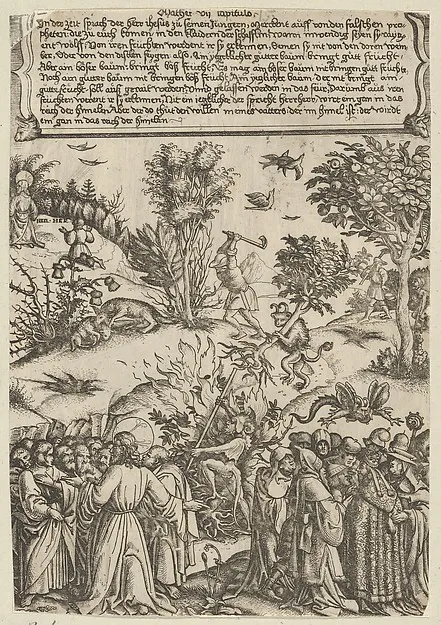
Then a warning, because the narrow way has its counterfeits: Beware of false prophets, which come to you in sheep's clothing, but inwardly they are ravening wolves (v. 15). The danger is precisely that they do not look dangerous. They come dressed as sheep - gentle, harmless, belonging - while inwardly they are predators. So how is anyone to tell? Jesus gives a test that cuts through appearances: Ye shall know them by their fruits (v. 16).
What their lives actually produce is the test. He draws it from the orchard, where the rule is plain: Do men gather grapes of thorns, or figs of thistles? A good tree bringeth forth good fruit; but a corrupt tree bringeth forth evil fruit (v. 17), and the deepest point is that a tree cannot do otherwise - a good tree cannot bring forth evil fruit, neither can a corrupt tree bring forth good fruit (v. 18).
The fruit reveals the root. What a life consistently produces - over time, under pressure, away from the audience - tells the truth about what it really is. Twice He presses the test home, framing the whole passage: by their fruits ye shall know them (v. 20). This is the very discernment that judge not never forbade - the clear-eyed wisdom to recognize what is genuine and what only wears the costume of it.2
The most sobering words of the Sermon now fall, and they are Jesus' own warning against a religion that is all profession and no substance: Not every one that saith unto me, Lord, Lord, shall enter into the kingdom of heaven; but he that doeth the will of my Father which is in heaven (v. 21). The dividing line falls between saying and doing - and the people in view sound utterly sincere. It is possible to call Jesus Lord, even fervently and twice over, and yet not be living as one who belongs to Him.
He presses it with a scene from the last day: Many will say to me in that day, Lord, Lord, have we not prophesied in thy name? and in thy name have cast out devils? and in thy name done many wonderful works? (v. 22). These are not nominal believers on the fringe; they claim a record of remarkable spiritual works. And yet the answer is the heaviest sentence in the chapter: And then will I profess unto them, I never knew you: depart from me, ye that work iniquity (v. 23).
What is missing is relationship - I never knew you - and a life that, beneath the works, was still given over to iniquity. The passage does not invite us to sort others into the saved and the lost; it turns the searchlight inward. It asks each hearer whether calling Jesus Lord has become the actual shape of a life lived in His will, or only a word said. The whole weight of it presses toward one thing: genuine, obedient discipleship, rooted in truly knowing and being known by Him.
Matthew 7:24-29The House Upon the Rock
24Therefore whosoever heareth these sayings of mine, and doeth them, I will liken him unto a wise man, which built his house upon a rock: 25And the rain descended, and the floods came, and the winds blew, and beat upon that house; and it fell not: for it was founded upon a rock. 26And every one that heareth these sayings of mine, and doeth them not, shall be likened unto a foolish man, which built his house upon the sand: 27And the rain descended, and the floods came, and the winds blew, and beat upon that house; and it fell: and great was the fall of it. 28And it came to pass, when Jesus had ended these sayings, the people were astonished at his doctrine: 29For he taught them as one having authority, and not as the scribes.
The whole Sermon now comes to rest on one final image, and it is a parable of two builders: whosoever heareth these sayings of mine, and doeth them, I will liken him unto a wise man, which built his house upon a rock… and every one that heareth these sayings of mine, and doeth them not, shall be likened unto a foolish man, which built his house upon the sand (vv. 24, 26). Two things are worth noticing at once.
First, both men build a house and both men hear the same words - the difference between them is obedience: one doeth them, the other doeth them not. Second, both houses face the identical storm: the rain descended, and the floods came, and the winds blew, and beat upon each one (vv. 25, 27). Jesus does not promise the wise builder calmer weather. The trials of life fall on the obedient and the disobedient alike. What differs is the foundation - laid out of sight, before the rain ever comes, in the unseen choice to do or not do what Jesus said.
When the flood rises, that hidden foundation is suddenly the only thing that matters. The house on the rock fell not. The house on the sand fell: and great was the fall of it. The phrase lands with deliberate weight. A life that heard the words of Jesus and only admired them, never built on them, does not merely wobble in the end - it comes down completely, and its collapse is total.
Matthew closes the Sermon by turning from the words to their effect on the crowd: when Jesus had ended these sayings, the people were astonished at his doctrine: for he taught them as one having authority, and not as the scribes (vv. 28-29). The reaction is not mere admiration but astonishment - they were struck, almost shaken, by what they had heard. And the cause is named precisely: it was the authority with which He spoke.
The scribes, the recognized teachers, taught by citation; their habit was to ground every ruling in the chain of earlier authorities - this rabbi said, and that one replied. Jesus had done nothing of the kind. All through the Sermon He had said, again and again, but I say unto you - setting His own bare word over against what had been said of old, speaking as though the final say were simply His to give. No teacher leaning on the authority of others speaks like that.
The crowds felt the difference instinctively, even if they could not yet name what it meant. Here was someone teaching as one whose word carried its own weight, the very note on which the whole Sermon had been pitched, and the note Matthew leaves ringing as it ends.
Research trail
Sources & further study
These references support the historical, linguistic, manuscript, and contextual notes in this chapter. Scripture remains the primary text; external sources are provided so readers can inspect the research directly.
- Matthew 7 - Translators' NotesThe NET Bible's detailed footnotes on Matthew 7 - the force of “judge not” in verse 1, the imagery of the speck and the beam (vv. 3-5), the “narrow” and “strait” gate (vv. 13-14), and the closing comparison of Jesus' teaching with that of the scribes (vv. 28-29).
- Matthew 7 ↔ Luke 6 & 11 · Proverbs · Psalm 6Traces the threads tying Matthew 7 to the rest of Scripture - the ask-seek-knock promise beside Luke 11:9-13 with the Father giving the Holy Spirit, the two ways echoing Deuteronomy 30 and Psalm 1, the tree known by its fruit (vv. 16-20), and depart from me, ye that work iniquity (v. 23) drawn from Psalm 6:8.
- Matthew 7 · Greek interlinear & word studyThe Greek text of Matthew 7 word by word, with parsing and lexical entries - useful for the present-tense imperatives behind ask… seek… knock in verse 7 (aiteo, zeteo, krouo, all durative: “keep on”), for poieo, the verb for “doeth” that runs through verses 21-26, and for exousia, the “authority” of verse 29.
Where this echoes in Scripture
Ask, and It Shall Be Given You
- Luke 6:37-38Judge not, and ye shall not be judged... For with the same measure that ye mete withal it shall be measured to you again.Luke's record of the same teaching as verses 1-2 - the measure we use returned to us.
- Luke 11:9-13how much more shall your heavenly Father give the Holy Spirit to them that ask him?The ask-seek-knock promise of verses 7-11, with the Father's gift named as the Holy Spirit.
- James 1:17Every good gift and every perfect gift is from above, and cometh down from the Father of lights.The Father who gives good things (v. 11) - the source of every good gift.
- Leviticus 19:18thou shalt love thy neighbour as thyself.The command the golden rule of verse 12 gathers up - the heart of the law and the prophets.
- John 16:23-24Whatsoever ye shall ask the Father in my name, he will give it you... ask, and ye shall receive, that your joy may be full.The same open promise as verses 7-8, repeated by Jesus on the night before the cross.
The Strait Gate · Known by Their Fruits
- Deuteronomy 30:19I have set before you life and death, blessing and cursing: therefore choose life.The two ways of verses 13-14 - the ancient setting of life and death before the hearer.
- Psalm 1:6For the LORD knoweth the way of the righteous: but the way of the ungodly shall perish.The two roads and two ends of verses 13-14 - one leading to life, one to ruin.
- John 10:9I am the door: by me if any man enter in, he shall be saved.The strait gate of verse 13 named in person - Christ Himself the door that opens onto life.
- Galatians 5:22-23But the fruit of the Spirit is love, joy, peace, longsuffering, gentleness, goodness, faith.The fruit by which a life is known (vv. 16-20) - what the Spirit produces in the good tree.
- Luke 6:46And why call ye me, Lord, Lord, and do not the things which I say?The same warning as verse 21 - calling Jesus Lord must become doing what He says.
The House Upon the Rock
- Luke 6:47-49he is like a man which built an house, and digged deep, and laid the foundation on a rock.Luke's telling of the two builders (vv. 24-27) - the one who dug deep to found his house on rock.
- 1 Corinthians 3:11For other foundation can no man lay than that is laid, which is Jesus Christ.The rock of verses 24-25 named - Christ Himself the only foundation that holds.
- 1 Corinthians 10:4they drank of that spiritual Rock that followed them: and that Rock was Christ.The Rock the wise builder builds on (v. 24) - identified by the apostle as Christ.
- James 1:22But be ye doers of the word, and not hearers only, deceiving your own selves.The lesson of the two builders (vv. 24-27) - hearing must become doing, or it deceives.
- Matthew 28:18All power is given unto me in heaven and in earth.The authority that astonished the crowd in verse 29 - later claimed by the risen Christ in full.