Luke 5
People in this chapter
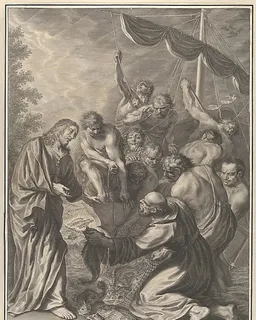
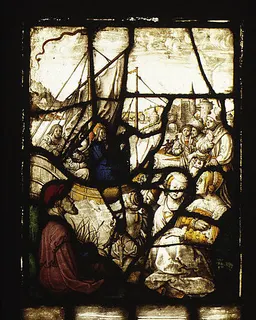
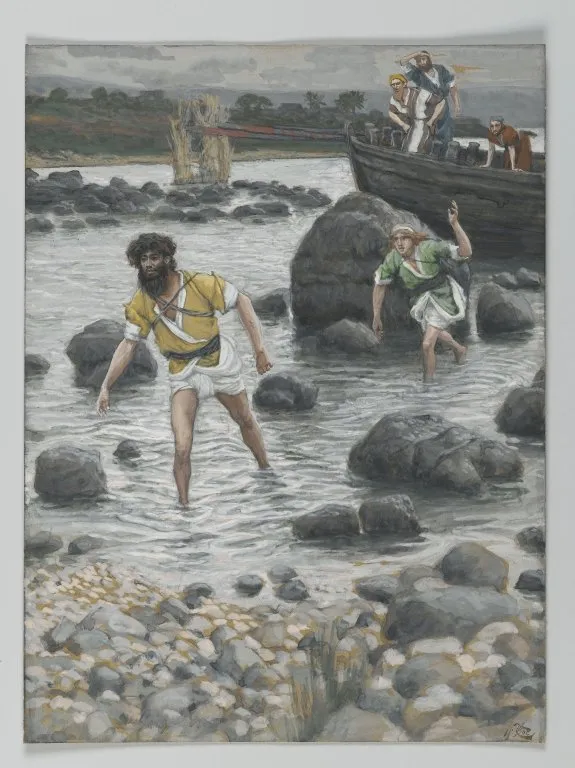
Luke 5 opens by the lake of Gennesaret, with the crowds pressing in to hear the word of God (v. 1). Jesus sees two empty boats and steps into one of them - Simon's - and teaches the multitude from the water. When He finishes He turns to the fisherman with a strange command: Launch out into the deep, and let down your nets for a draught (v. 4). Simon has worked the whole night for nothing and knows the futility of fishing by day, yet he answers, nevertheless at thy word I will let down the net (v. 5).
What follows breaks his nets: a great multitude of fishes, two boats filled to sinking. Overwhelmed, Simon falls at Jesus' knees: Depart from me; for I am a sinful man, O Lord (v. 8). And the answer comes - not rejection but calling: Fear not; from henceforth thou shalt catch men (v. 10). They bring their ships to land, and forsook all, and followed him (v. 11).1
Tap any highlighted phrase to jump to the commentary that unpacks it.
Luke 5:1-11Launch Out into the Deep · From Henceforth Thou Shalt Catch Men
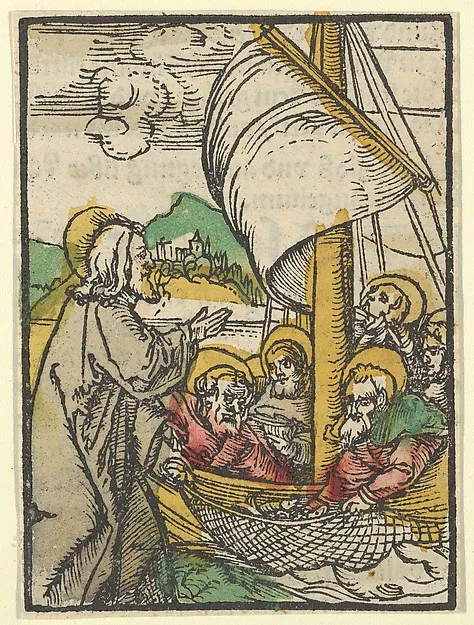
1And it came to pass, that, as the people pressed upon him to hear the word of God, he stood by the lake of Gennesaret, 2And saw two ships standing by the lake: but the fishermen were gone out of them, and were washing their nets. 3And he entered into one of the ships, which was Simon’s, and prayed him that he would thrust out a little from the land. And he sat down, and taught the people out of the ship. 4Now when he had left speaking, he said unto Simon, Launch out into the deep, and let down your nets for a draught. 5And Simon answering said unto him, Master, we have toiled all the night, and have taken nothing: nevertheless at thy word I will let down the net. 6And when they had this done, they inclosed a great multitude of fishes: and their net brake. 7And they beckoned unto their partners, which were in the other ship, that they should come and help them. And they came, and filled both the ships, so that they began to sink.
The scene begins with a crowd so eager for the word of God that they press in on Jesus at the water's edge, and with two empty boats whose owners stand nearby washing their nets after a fruitless night (vv. 1-2). Jesus does something quietly remarkable: He climbs into Simon's boat and asks him to push out a little from the shore, turning a fishing vessel into a pulpit and the slope of the beach into a natural amphitheater (v. 3).
When the teaching is done, He gives Simon a command that crosses straight into the fisherman's own expertise: Launch out into the deep, and let down your nets for a draught (v. 4). Every instinct Simon has trained over years says this is wrong. Galilean fishermen worked the shallows by night, when the fish could not see the nets; to row into deep water in broad daylight, after catching nothing all night, is to court a second failure in front of a crowd.
Notice that the carpenter from Nazareth is telling the professional how to fish. The command is an invitation to trust a word that runs against hard-won experience - and the whole miracle will turn on whether Simon will obey it.1
Simon's reply is one of the most honest sentences a follower of Jesus ever speaks: Master, we have toiled all the night, and have taken nothing: nevertheless at thy word I will let down the net (v. 5). He does not pretend the command makes sense to him. He lays his exhaustion and his expertise on the table - we have toiled all the night, and have taken nothing - and then pivots on a single word.
Nevertheless. Everything Simon knows points one way; the word of Jesus points the other; and Simon decides that the word of Jesus outweighs everything he knows. This is the shape of faith in its plainest form: not the absence of doubt or the feeling that obedience will work, but the choice to act at thy word even when one's own judgment objects. And the result outruns anything Simon could have imagined: they inclosed a great multitude of fishes: and their net brake (v. 6).
The catch is so vast it tears the nets and beckons the second boat, until both ships are so loaded they began to sink (v. 7). The deep that Simon expected to be empty was full all along - he had only to let the net down at the word of the One who made the sea and the fish in it.
8When Simon Peter saw it, he fell down at Jesus’ knees, saying, Depart from me; for I am a sinful man, O Lord. 9For he was astonished, and all that were with him, at the draught of the fishes which they had taken: 10And so was also James, and John, the sons of Zebedee, which were partners with Simon. And Jesus said unto Simon, Fear not; from henceforth thou shalt catch men. 11And when they had brought their ships to land, they forsook all, and followed him.
The miracle does not leave Simon elated; it leaves him undone. When Simon Peter saw it, he fell down at Jesus' knees, saying, Depart from me; for I am a sinful man, O Lord (v. 8). This is a startling reaction to a boatload of fish - until we see what Simon has seen. The catch has told him something about the man in his boat. A power that commands the deep and fills the nets is not the power of an ordinary teacher; Simon is suddenly aware that he is in the presence of holiness, and the nearness of holiness makes him acutely aware of his own sin.
His instinct is to put distance between them: depart from me. It is the oldest human response to the presence of God - the same cry the prophet Isaiah made when he saw the LORD high and lifted up and said, Woe is me! for I am undone; because I am a man of unclean lips (Isa. 6:5)2. Simon does not yet understand grace; he only understands that he is unworthy, and he assumes unworthiness must mean separation.
What he has not reckoned with is that the Holy One in his boat did not come to withdraw from sinful men, but to call them.
Jesus' answer overturns everything Simon feared. To the man begging Him to leave, He says, Fear not; from henceforth thou shalt catch men (v. 10). He does not deny that Simon is a sinful man; He simply refuses to let it be the last word. The proper terror before holiness is met not with departure but with a calling - and a calling that takes up the very skill Simon has just watched fail and succeed.
The fisherman who could catch nothing by his own reckoning, and everything at the word of Jesus, will now spend his life drawing people into the kingdom by that same word. And the response is total: when they had brought their ships to land, they forsook all, and followed him (v. 11). The detail is staggering when set beside the miracle. They walk away from the largest catch of their lives - the boats still heaped with fish, a fortune lying on the shore - precisely at the moment their trade had never looked more promising.
The grip of the old life is broken not by its failure but by the surpassing pull of the One calling them. They forsook all: not the nets only, but the boats, the business, the security, the catch itself. The call of Christ proved heavier than the heaviest haul they had ever taken.
Luke 5:12-16I Will: Be Thou Clean
12And it came to pass, when he was in a certain city, behold a man full of leprosy: who seeing Jesus fell on his face, and besought him, saying, Lord, if thou wilt, thou canst make me clean. 13And he put forth his hand, and touched him, saying, I will: be thou clean. And immediately the leprosy departed from him. 14And he charged him to tell no man: but go, and shew thyself to the priest, and offer for thy cleansing, according as Moses commanded, for a testimony unto them. 15But so much the more went there a fame abroad of him: and great multitudes came together to hear, and to be healed by him of their infirmities. 16And he withdrew himself into the wilderness, and prayed.
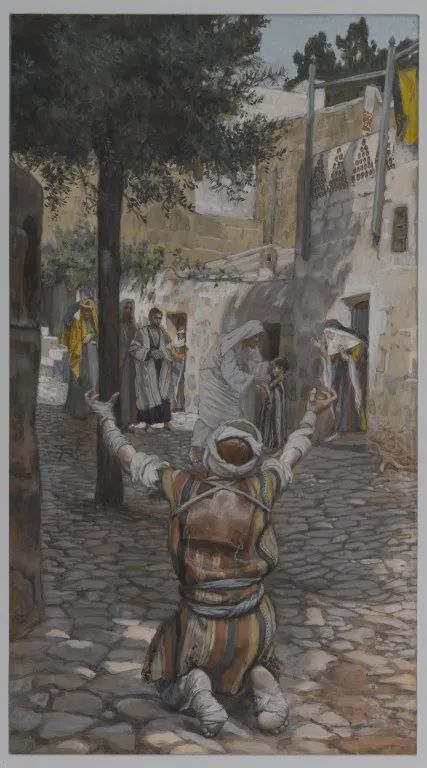
Luke introduces the man with stark medical precision - a man full of leprosy (v. 12) - the disease at its most advanced, his whole body consumed by it. To grasp the scene one must remember what leprosy meant in Israel. It was not only a physical affliction but a sentence of total exclusion: the law required the leper to live apart, to tear his clothes and cry Unclean, unclean as a warning to all who came near.
He was cut off from his family, from worship, from the touch of any clean person - a living death. This man comes and fell on his face, and his plea is a model of faith mixed with humility: Lord, if thou wilt, thou canst make me clean (v. 12). Notice what he does and does not doubt. He has no doubt about the power - thou canst make me clean. His only uncertainty is the willingness - if thou wilt. Years of being shunned have taught him to expect rejection; he cannot quite believe that this One would want to help a man like him.
It is the quiet question many carry to God: not can He, but would He, given who I am. And Jesus is about to answer that question in the plainest possible terms.
Before He speaks a word, Jesus does the unthinkable: he put forth his hand, and touched him (v. 13). No one touched a leper. By the law of Moses, contact with the unclean made the clean person unclean - uncleanness was contagious, and the whole system of separation existed to contain it. A healer might have spoken a word from a safe distance; everyone would have understood. But Jesus reaches across the boundary the law had drawn and lays His hand on a man who has likely not felt a human touch in years.
And then the law of contagion runs backward. Instead of the leper's uncleanness defiling Jesus, the cleanness of Jesus overwhelms the leprosy: I will: be thou clean. And immediately the leprosy departed from him. Two things arrive together - the willing word that answers the man's if thou wilt, and the touch that answers his isolation. The healing meets not only the disease but the exile; the man is made clean and, in the same gesture, made touchable again, welcomed back into the human family.
The Holy One drew near to the unclean and was not diminished; the unclean drew near to the Holy One and was made whole.
Jesus gives the cleansed man two instructions. First, tell no man; and second, go, and shew thyself to the priest, and offer for thy cleansing, according as Moses commanded, for a testimony unto them (v. 14). Both matter. The charge to silence guards against a fame built on spectacle - Jesus will not let Himself be reduced to a wonder-worker mobbed for cures. The charge to show himself to the priest honors the law of Moses, which appointed the priest to examine a healed leper and pronounce him clean, restoring him formally to the community (Lev. 14)2.
Even in an act that broke the boundary of touch, Jesus upholds the law's proper order; the cleansing is meant to be certified and the man fully reintegrated, and it stands as a testimony to the priests of what God has done. Yet the news cannot be contained: so much the more went there a fame abroad of him, and great multitudes gathered (v. 15). And here Luke records something he will note again and again about Jesus - that at the height of His popularity He sought solitude: he withdrew himself into the wilderness, and prayed (v. 16).
The pull of the crowd did not set His agenda; communion with the Father did. The One with power to cleanse lepers is also the One who steps away from the applause to pray.
Luke 5:17-26Man, Thy Sins Are Forgiven Thee
17And it came to pass on a certain day, as he was teaching, that there were Pharisees and doctors of the law sitting by, which were come out of every town of Galilee, and Judaea, and Jerusalem: and the power of the Lord was present to heal them. 18And, behold, men brought in a bed a man which was taken with a palsy: and they sought means to bring him in, and to lay him before him. 19And when they could not find by what way they might bring him in because of the multitude, they went upon the housetop, and let him down through the tiling with his couch into the midst before Jesus. 20And when he saw their faith, he said unto him, Man, thy sins are forgiven thee. 21And the scribes and the Pharisees began to reason, saying, Who is this which speaketh blasphemies? Who can forgive sins, but God alone?
The setting shifts to a packed house, and Luke notes the gathered audience carefully: Pharisees and doctors of the law sitting by, which were come out of every town of Galilee, and Judaea, and Jerusalem (v. 17). The religious establishment has come to take the measure of this teacher, and the stage is set for a confrontation. Into that crowded scene comes a paralyzed man carried by friends who cannot get near the door because of the multitude (vv. 18-19).
What they do next is one of the most vivid pictures of determined faith in the Gospels: they climb to the flat roof, open it up, and let him down through the tiling with his couch into the midst before Jesus. Picture the scene - debris falling, daylight breaking through the ceiling, a man on a pallet lowered by ropes into the very center of the room, right in front of Jesus. These friends will not be stopped by the crowd, the architecture, or the spectacle they are making.
And Luke tells us how Jesus reads it: when he saw their faith (v. 20). Faith here is not a private feeling but a visible, stubborn, costly action - tearing open a roof to get a friend to Jesus. The faith of the friends becomes the occasion of mercy for the man they carried.1
Then Jesus says the most unexpected thing in the scene. The man was lowered for healing; everyone in the room is braced for a word about his legs. Instead Jesus looks at him and says, Man, thy sins are forgiven thee (v. 20). It is a startling reordering of the man's need. Jesus goes past the obvious, visible affliction to a deeper one the paralysis only pictures - the paralysis of sin, the deeper helplessness that no friend can carry a man out of.
He addresses first what no one in the room had thought to ask for. And in doing so He throws down a claim that the watching scribes catch immediately: the scribes and the Pharisees began to reason, saying, Who is this which speaketh blasphemies? Who can forgive sins, but God alone? (v. 21). Their logic is not foolish; it is, in fact, correct. They know their Scriptures: the forgiveness of sins is God's own prerogative, His alone to grant.
Sins are offenses against God, and only the one offended can pardon them. For a man to stand in a house and declare another man's sins forgiven is, on its face, to usurp the place of God - unless that man holds the authority of God. The scribes have seen the size of the claim clearly. What they have not yet considered is the possibility that it might be true.
22But when Jesus perceived their thoughts, he answering said unto them, What reason ye in your hearts? 23Whether is easier, to say, Thy sins be forgiven thee; or to say, Rise up and walk? 24But that ye may know that the Son of man hath power upon earth to forgive sins, (he said unto the sick of the palsy,) I say unto thee, Arise, and take up thy couch, and go into thine house. 25And immediately he rose up before them, and took up that whereon he lay, and departed to his own house, glorifying God. 26And they were all amazed, and they glorified God, and were filled with fear, saying, We have seen strange things to day.
Jesus knows their thoughts before they speak them - itself a quiet sign of who He is - and meets the objection head-on: What reason ye in your hearts? Whether is easier, to say, Thy sins be forgiven thee; or to say, Rise up and walk? (vv. 22-23). The question is sharper than it first appears. In one sense, to say “thy sins are forgiven” is easier, because no one can see whether it has happened - pardon is invisible, unverifiable, beyond proof.
To say “rise up and walk” is harder, because everyone will instantly see whether it worked. So Jesus proposes to do the visible, testable thing in order to authenticate the invisible one. He stakes His claim to forgive on a miracle the whole room can check: that ye may know that the Son of man hath power upon earth to forgive sins… I say unto thee, Arise, and take up thy couch, and go into thine house (v. 24).
The healing is offered as proof of the pardon. If the man rises, then the One who declared his sins forgiven has the authority He claimed. Notice the title Jesus chooses for Himself: the Son of man. It is a phrase that reaches back to Daniel's vision of one to whom was given dominion, and glory, and a kingdom - a figure who comes with the very authority of God. Jesus does not retreat from the scribes' charge; He claims, in their hearing, to hold on earth the power they rightly said belongs to God alone.
The proof is immediate and total: immediately he rose up before them, and took up that whereon he lay, and departed to his own house, glorifying God (v. 25). The man who had to be lowered through a roof on a pallet now picks up that very pallet and walks out under his own power, praising God as he goes. The visible word has come true, which means the invisible word has come true with it: his sins are forgiven, and the authority of the One who forgave them is vindicated before every skeptic in the room.
And the crowd's reaction is exactly the right one: they were all amazed, and they glorified God, and were filled with fear, saying, We have seen strange things to day (v. 26). They glorify God - they recognize that God has acted - and they are filled with fear, the proper awe of people who have witnessed divine power up close. Strange things is almost an understatement; they have seen something genuinely unprecedented, a man on earth exercising what they knew to be the prerogative of heaven.
Luke leaves the conclusion hanging in the amazed silence of the room. The scribes asked, Who can forgive sins, but God alone? The healed man walking home is the answer Jesus gave them - and it is an answer that demands a verdict about who He is.
Luke 5:27-39I Came to Call Sinners · New Wine, New Bottles
27And after these things he went forth, and saw a publican, named Levi, sitting at the receipt of custom: and he said unto him, Follow me. 28And he left all, rose up, and followed him. 29And Levi made him a great feast in his own house: and there was a great company of publicans and of others that sat down with them. 30But their scribes and Pharisees murmured against his disciples, saying, Why do ye eat and drink with publicans and sinners? 31And Jesus answering said unto them, They that are whole need not a physician; but they that are sick. 32I came not to call the righteous, but sinners to repentance.
Jesus passes a tax-booth and calls the man sitting in it: he saw a publican, named Levi, sitting at the receipt of custom: and he said unto him, Follow me (v. 27). To feel the scandal, one must understand what a publican was. Tax-collectors worked for the occupying Roman power, gathering tolls from their own countrymen, and they were notorious for taking more than was owed and pocketing the difference. They were counted as traitors and thieves at once - collaborators with the oppressor, barred from the synagogue, lumped together with the worst sinners.
Levi is exactly the sort of man a respectable rabbi would cross the street to avoid. And to this man Jesus speaks the same two words He spoke to the fishermen: Follow me. The response is immediate and complete: he left all, rose up, and followed him (v. 28). The echo of verse 11 is deliberate - like Simon and his partners, Levi left all. But Levi's leaving has a particular finality: a fisherman could always return to his boats, but a tax-collector who walked away from his lucrative post would never get it back.
He burns the bridge entirely. The despised collaborator rises from the very seat of his sin and follows the One who called him - called him not because he was worthy, but precisely as he was.
Levi's first act as a follower is to throw a party. Levi made him a great feast in his own house: and there was a great company of publicans and of others that sat down with them (v. 29). Newly found by Jesus, he gathers all his old associates - fellow tax-collectors and the disreputable crowd that surrounded their world - and seats them at table with Jesus. To share a meal in that culture was to share fellowship, to declare these people acceptable company; and the religious leaders are scandalized: Why do ye eat and drink with publicans and sinners? (v. 30).
To them, holiness meant separation - a clean person kept away from the unclean. Jesus answers with an image that turns their whole framework inside out: They that are whole need not a physician; but they that are sick (v. 31). A doctor does not avoid the sick to keep himself well; he goes to the sick because they are sick - that is the entire point of being a physician. So Jesus is doing exactly what He came to do by sitting at Levi's table.
The objection assumes the sick should be quarantined; Jesus reveals Himself as the Physician who seeks them out. The only people He cannot help are those who, like the murmuring scribes, are convinced they are whole and have no need of Him.
33And they said unto him, Why do the disciples of John fast often, and make prayers, and likewise the disciples of the Pharisees; but thine eat and drink? 34And he said unto them, Can ye make the children of the bridechamber fast, while the bridegroom is with them? 35But the days will come, when the bridegroom shall be taken away from them, and then shall they fast in those days. 36And he spake also a parable unto them; No man putteth a piece of a new garment upon an old; if otherwise, then both the new maketh a rent, and the piece that was taken out of the new agreeth not with the old. 37And no man putteth new wine into old bottles; else the new wine will burst the bottles, and be spilled, and the bottles shall perish. 38But new wine must be put into new bottles; and both are preserved. 39No man also having drunk old wine straightway desireth new: for he saith, The old is better.
The questioners move from Jesus' company to His practices: Why do the disciples of John fast often, and make prayers… but thine eat and drink? (v. 33). Fasting was a mark of serious piety, a way of mourning and pleading before God. Why, then, do Jesus' followers feast? His answer reframes the whole question around His own presence: Can ye make the children of the bridechamber fast, while the bridegroom is with them? (v. 34).
A wedding is the one occasion when fasting would be unthinkable - it is a time of joy, and the friends of the bridegroom celebrate as long as he is there. Jesus quietly casts Himself as the bridegroom, and His presence among His disciples as a wedding feast. To mourn and fast while He is bodily with them would be to misread the moment entirely; the appropriate response to the arrival of the long-awaited One is joy.
Yet He does not abolish fasting; He gives it its proper season: the days will come, when the bridegroom shall be taken away from them, and then shall they fast in those days (v. 35). It is a first shadow of the cross falling across the feast - the bridegroom taken away. There is a time to feast because He is present, and a time to fast in longing for Him; the disciples are, for now, in the time of the wedding.
Jesus closes with two short parables that explain why the old patterns of piety cannot simply absorb what He is bringing. No man putteth a piece of a new garment upon an old - the new patch shrinks and tears the worn cloth, and ruins the new garment besides (v. 36). And no man putteth new wine into old bottles - the bottles were skins, and old skins had grown stiff and brittle, so that the gases of still-fermenting new wine would split them and spill everything (v. 37).
New wine must be put into new bottles (v. 38). The point is not that the old is worthless but that the new cannot be contained by forms that have lost their give. What Jesus brings is new wine - living, expanding, full of ferment: the inbreaking kingdom of God, grace that seeks out tax-collectors and touches lepers and forgives paralytics. The rigid framework of the religion of His critics - holiness as separation, righteousness as the careful avoidance of sinners - is an old skin that cannot stretch around it; pour the new wine in and the old form bursts.
And He ends with a knowing, almost wry observation about the human heart: No man also having drunk old wine straightway desireth new: for he saith, The old is better (v. 39). People grow comfortable with the familiar and instinctively prefer it; having tasted the old, they are slow to want the new. It names exactly the resistance Jesus is meeting - not a failure of evidence, but an attachment to the accustomed that makes the new wine of the kingdom feel like a threat rather than a gift.
Research trail
Sources & further study
These references support the historical, linguistic, manuscript, and contextual notes in this chapter. Scripture remains the primary text; external sources are provided so readers can inspect the research directly.
- Luke 5 - Translators' NotesThe NET Bible's detailed footnotes on Luke 5 - the setting at the lake of Gennesaret (v. 1), the force of Simon's nevertheless at thy word (v. 5), the meaning of letting the paralytic down through the tiling (v. 19), and the much-discussed title Son of man claiming authority to forgive (v. 24).
- Luke 5 ↔ Isaiah 6 · Leviticus 13-14 · Psalm 103Traces the Old Testament threads under Luke 5 - Simon's I am a sinful man (v. 8) read beside Isaiah's Woe is me… I am undone (Isa. 6:5); the leper's cleansing and the priestly offering Moses commanded (vv. 13-14; Lev. 13-14); and the pardon of sins (v. 20) read with who forgiveth all thine iniquities (Ps. 103:3).
- Luke 5 · Greek interlinear + lexiconThe Greek text of Luke 5 word by word, each term linked to its lexicon entry - useful for zogreo (v. 10, “catch men,” literally to take alive), for aphiemi (vv. 20-24, “forgive,” the prerogative Jesus exercises), for katharizo (vv. 12-13, “make clean”), and for metanoia (v. 32, “repentance”).
Where this echoes in Scripture
Launch Out into the Deep · From Henceforth Thou Shalt Catch Men
- Isaiah 6:5Then said I, Woe is me! for I am undone; because I am a man of unclean lips... for mine eyes have seen the King, the LORD of hosts.The prophet's cry before the holiness of God - the same undoing as Simon's I am a sinful man (v. 8).
- Mark 1:16-18Come ye after me, and I will make you to become fishers of men. And straightway they forsook their nets, and followed him.The parallel calling of the fishermen - the same summons and the same forsaking as verses 10-11.
- John 21:6Cast the net on the right side of the ship, and ye shall find. They cast therefore, and now they were not able to draw it for the multitude of fishes.A second miraculous catch after the resurrection - echoing the draught of fishes in verses 4-6.
- Philippians 3:7-8But what things were gain to me, those I counted loss for Christ... I count all things but loss.The reckoning behind they forsook all (v. 11) - counting every gain as loss for the sake of Christ.
- Luke 5:32I came not to call the righteous, but sinners to repentance.The answer, later in the same chapter, to Simon's fear in verse 8 - Christ came precisely to call sinners.
I Will: Be Thou Clean
- Leviticus 13:45-46his clothes shall be rent... and shall cry, Unclean, unclean... he shall dwell alone; without the camp shall his habitation be.The law that exiled the leper of verse 12 - the uncleanness Jesus reverses with a touch in verse 13.
- Leviticus 14:2-4This shall be the law of the leper in the day of his cleansing: He shall be brought unto the priest.The priestly rite Jesus directs the cleansed man to in verse 14 - according as Moses commanded.
- 2 Kings 5:14his flesh came again like unto the flesh of a little child, and he was clean.Naaman the leper cleansed - an Old Testament foreshadowing of the cleansing in verse 13.
- Hebrews 4:15-16we have not an high priest which cannot be touched with the feeling of our infirmities... Let us therefore come boldly.The compassion that reaches for the leper in verse 13 - the high priest moved by our weakness, to whom we may come boldly.
- Mark 1:35And in the morning, rising up a great while before day, he went out, and departed into a solitary place, and there prayed.The same rhythm as verse 16 - rising fame met by withdrawal into solitude and prayer.
Man, Thy Sins Are Forgiven Thee
- Psalm 103:2-3Bless the LORD, O my soul... Who forgiveth all thine iniquities; who healeth all thy diseases.Forgiveness and healing joined as God's own work - exactly what Jesus does together in verses 20-25.
- Isaiah 43:25I, even I, am he that blotteth out thy transgressions for mine own sake, and will not remember thy sins.The pardon of sins as God's own prerogative - the very point the scribes raise in verse 21.
- Daniel 7:13-14one like the Son of man came... and there was given him dominion, and glory, and a kingdom.The vision behind the title Jesus claims in verse 24 - the Son of man given the authority of God.
- Colossians 1:14In whom we have redemption through his blood, even the forgiveness of sins.The forgiveness Jesus pronounces in verse 20 named as redemption through Him - sins sent away in Christ.
- Mark 2:10-12the Son of man hath power on earth to forgive sins... he arose, took up the bed, and went forth before them all.The parallel account of the same healing - the visible miracle proving the authority to forgive (vv. 24-25).
I Came to Call Sinners · New Wine, New Bottles
- Luke 19:9-10This day is salvation come to this house... For the Son of man is come to seek and to save that which was lost.Another tax-collector found by Jesus - the mission named in verse 32 lived out with Zacchaeus.
- 1 Timothy 1:15Christ Jesus came into the world to save sinners; of whom I am chief.The apostle's summary of the truth Jesus states in verse 32 - He came to save sinners.
- John 3:29He that hath the bride is the bridegroom: but the friend of the bridegroom... rejoiceth greatly because of the bridegroom's voice.The bridegroom image Jesus uses in verse 34 - His presence as a wedding, a time for joy.
- 2 Corinthians 5:17if any man be in Christ, he is a new creature: old things are passed away; behold, all things are become new.The newness the parables of verses 36-38 picture - new wine that the old forms cannot contain.
- Hosea 6:6For I desired mercy, and not sacrifice; and the knowledge of God more than burnt offerings.The heart behind I came… to call… sinners (v. 32) - mercy sought above the rigor of the self-righteous.